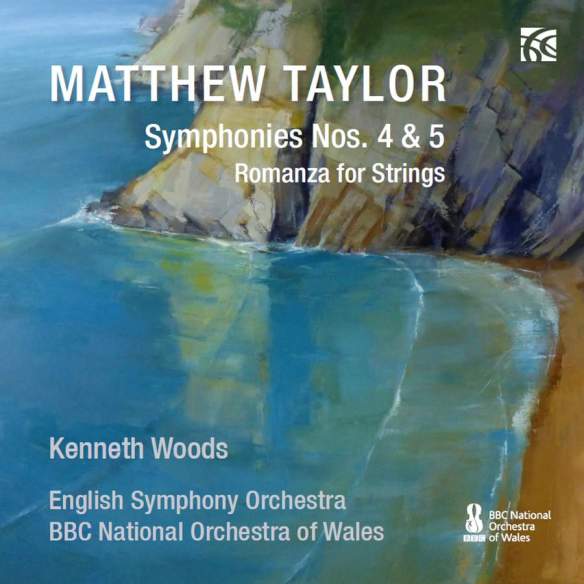
On record – Matthew Taylor: Symphonies nos.4 & 5 (BBC NOW / Woods) (Nimbus)

Matthew Taylor
Symphony no.4 Op.54 (2015-6)
Symphony no.5 Op.59 (2017-8)
Romanza for strings Op.36a (2006-7)

BBC National Orchestra of Wales (Symphonies), English Symphony Orchestra / Kenneth Woods

Nimbus Alliance NI6406 [63’56”]

Producer Simon Fox-Gál
Engineers Simon Smith, Mike Cox (Symphony no.4)

Recorded 8 June 2019 at St. Jude-on-the-Hill, London (Romanza); 14 January 2020 at Hoddinott Hall, Cardiff (Symphonies)

Written by Richard Whitehouse

What’s the story?

A new release of music by Matthew Taylor, including the Fourth and Fifth Symphonies, that means all of the composer’s works in this genre have now been commercially recorded (the First and Third on Dutton Epoch CDLX7178; the Second on Toccata Classics TOCC0175).

What’s the music like?

Symphonism goes back almost to the start of Taylor’s composing, his Sinfonia Brevis having been finished when he was 21, and symphonies have continued to appear at regular intervals across his output. Written respectively to mark the 50th anniversary of Kensington Symphony Orchestra, and as the third instalment within the English Symphony Orchestra’s 21st Century Symphony Project, these two pieces feel typical not least as regards their absolute contrasts of form and expression; while being equally unmistakable as the music of just one composer.

An in memoriam to composer John McCabe – dedicated to his widow Monica – the Fourth Symphony falls into three continuous movements. The first, marked Giubiloso, maintains its energy across distinct shifts of dynamics and activity (the evocative writing for woodwind and harp redolent of Tippett); subsiding from its impassioned climax into an Adagio where strings take the foreground in music of textural richness and emotional depth. Beginning at a decided remove from what has gone before, the Finale buffa exudes a nonchalant humour (reminiscent of Arnold), complemented by a deftly scored episode that cannily prepares for the denouement. This is purposefully controlled through to a climax that recalls the work’s opening theme before an ending as feels the more decisive for its literally coming to a halt.

Heard as an interlude between two imposing statements, the Romanza could hardly be better placed. An arrangement of the second movement of Taylor’s Sixth Quartet (Toccata Classics TOCC0144), it testifies to the suffused lyricism evident in this composer’s writing for strings.

The Fifth Symphony is only Taylor’s second such work in four movements, but its formal and expressive emphasis differs greatly. Indeed, the initial Allegro is unprecedented in his output for sheer volatility (not unlike that of Beethoven’s ‘Serioso’ Quartet), its driving impetus and explosive culmination creating a momentum which is pointedly left unfulfilled by the ensuing intermezzo-like Allegrettos. The first (a tribute to composer and teacher Cy Lloyd) is as terse and equivocal as the second (a tribute to Angela Simpson, wife of composer Robert Simpson) is poised and wistful. It thus remains for the final Adagio (a tribute to the composer’s mother Brigid) to secure that eloquent apotheosis towards which the whole work had been headed, as this moves with sustained power toward its plangent twin climaxes then on to a resigned coda.

Does it all work?

Indeed. In all three pieces, Kenneth Woods secures a dedicated response from the players so Taylor’s exacting yet practicable writing is heard to advantage, not least in acoustics whose immediacy emphasizes this music’s rapt inwardness as keenly as its untrammelled energy.

Is it recommended?

Yes, and not least for a booklet that features informative commentaries by both composer and conductor, and striking artwork by Andrea Kelland. An introductory portrait by James Francis Brown mentions Taylor as having written six symphonies: hopefully, no mere slip of the pen!

Listen & Buy

You can listen to clips from the recording and purchase, either in physical or digital form, at the Presto website

Read

You can discover more about Matthew Taylor by heading to his own website
On record – Philip Sawyers: Symphony no.4 & Hommage to Kandinsky (BBC NOW / Woods)

Philip Sawyers
Symphony no.4 (2018)
Hommage to Kandinsky (2014)

BBC National Orchestra of Wales / Kenneth Woods

Nimbus Alliance NI6405 [64’32”]

Producer Simon Fox-Gál
Engineers Simon Smith, Mike Cox

Recorded 15 & 16 January 2020 at Hoddinott Hall, Cardiff

Written by Richard Whitehouse

What’s the story?

Nimbus continues its coverage of Philip Sawyers (b1951) with this release of his most recent symphony, heard alongside a major symphonic poem written some years earlier, in what are impressively assured readings by the BBC National Orchestra of Wales and Kenneth Woods.

What’s the music like?

The emergence of Sawyers as a major symphonist of his generation has been among the more significant aspects of latter-day British music. From the overtly demonstrative First Symphony (2004), via the highly concentrated Second (2008) to the decidedly equivocal Third (2015), is to encounter a composer intent on expanding his idiom incrementally and without any fear of repeating himself. Hence the Fourth Symphony, whose three movements might be felt to take on the (unintentional) model of Bruckner’s Ninth from a distinctly contemporary perspective.

Such is immediately clear from the opening Moderato whose tonal ambivalence underpins an emotional restlessness set in motion by those granitic brass chords at the outset. Formally this is Sawyers’ most individual sonata design to date, its accrued tension duly carrying over into a scherzo with passing elements of intermezzo rather than an actual trio as ensures maximum continuity. There follows an extended Adagio of tangible weight and no little profundity, its focus ensured through a long-term transition from D minor to D accomplished as seamlessly as its incorporation of motifs from earlier in the score. Sawyers says that after this ‘‘there was nothing more to say’’, reinforced by a sustained apotheosis which resolves those chords from the outset with a finality only viable for a composer in command of his musical components.

Little that Sawyers writes is without symphonic potential, as is evident from his Hommage to Kandinsky. Scored for large forces and lasting almost 30 minutes, its subtitle A Symphonic Poem for Orchestra indicates this is no mere evoking of the Russian-born artist’s canvasses – though one aspect of his Composition IV has been transmuted into musical terms towards the start. Structurally the piece unfolds through alternating passages of relative stasis and motion, and if slower sections predominate as it progresses, there is never a risk of expressive inertia owing to the deftness with which existing motifs take on greater intensity while timbral and textural aspects are enriched accordingly. This latter aspect is crystallized at the close when an emphatic chordal cluster gradually dies down, to leave only the purest of C major tones.

Does it all work?

Yes, not least when this release judiciously combines two of Sawyers’ most distinctive and absorbing pieces. Never a composer who could be accused of favouring the easy option, his large-scale organization is, in both instances, as fascinating as it is resourceful. It helps when Kenneth Woods, who premiered Sawyers’ previous two symphonies (the Third as the initial commission of his 21st Century Symphony Project), is unstinting in his advocacy – securing playing of verve and finesse from the BBC NOW in the spacious ambience of Hoddinott Hall.

Is it recommended?

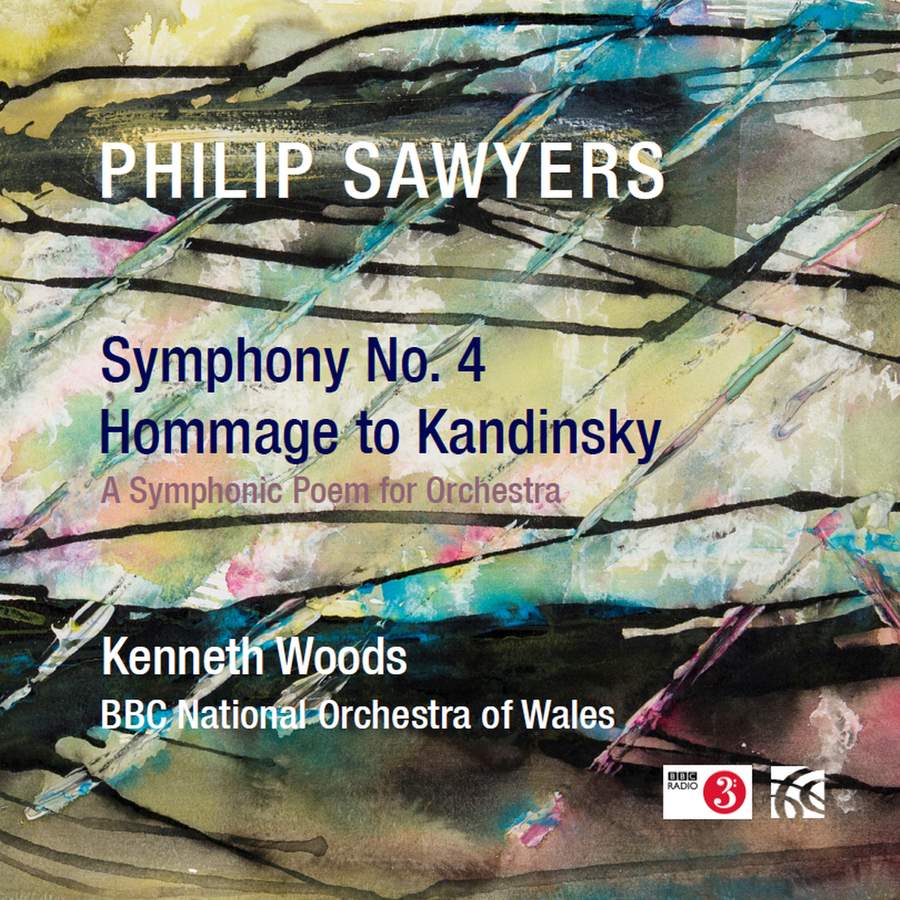
Indeed. The annotations deftly interlace Woods’ descriptive commentary with Sawyers’ own analytical observations, and the booklet cover is graced by artwork from Philip Groom. It will be fascinating to hear just where Sawyers goes from here on his eventful symphonic odyssey.

Listen

Buy

You can listen to clips from the recording and purchase, either in physical or digital form, at the Presto website

Read

You can discover more about this release at the Wyastone website, and more about Philip Sawyers by heading to his own website

On record: Peter Maxwell Davies – Music for Brass

maxwell-davies-brass

A new disc from The Wallace Collection on Nimbus Records, exploring Sir Peter Maxwell Davies’ rich and varied writing for brass instruments.

What’s the music like?

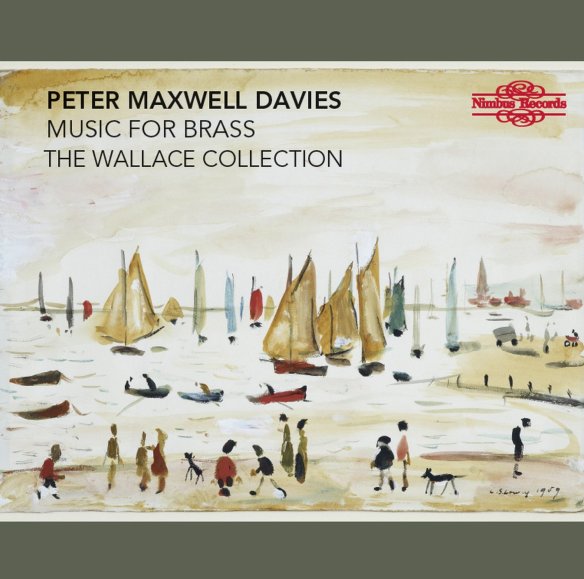
This collection brings with it some fascinating contrasts. On the one hand is the substantial Brass Quintet, a large-scale piece the composer wrote for the Empire Brass Quintet in 1981. It leaves a lasting impression, especially in the second of the three movements – an Adagio 16 minutes in length. It explores some desolate sound pictures, the composer achieving a strikingly dark and often subdued backdrop akin to the sky of the Lowry painting on the cover of the release.

Yet like that picture (Yachts, from 1959) there are pinpricks of light, too, as Maxwell Davies brings the instruments out in a solo capacity – especially the horn and two trumpets. It is a pointer towards the two complementary solo works on the disc. Litany for a Ruined Chapel between Sleep and Shore is for trumpet, and was written about the medieval ruins on the Orkney island of Sanday, where the composer moved in 1999. Sea Eagle, for solo horn, is a musical observation of a creature that captivated the composer from his first Orkney home in 1982.

Shorter works for brass complete the program, with a ceremonial fanfare written for the opening of The Lowry arts centre in Manchester, and arrangements of four short pieces by Tallis that reveal his influence on Maxwell Davies as a composer.

Does it all work?

Yes – but the music of Maxwell Davies, especially in the Brass Quintet, requires some work on the part of the listener to realise its full potential. It has taken me a long time to appreciate the composer’s music, as it can be difficult to connect with emotionally, and there are some complex harmonies. Yet familiarity brings great reward, and the bold writing for brass on such a large scale can be appreciated – especially when the music is quiet. The Wallace Collection are superb in the quintet, their feats of stamina and virtuosity complemented by genuine strength of feeling.

The works for solo instruments are more immediate in their impact, and helped by performances that could not be bettered. John Wallace plays as the composer would wish in the Litany, evoking an outdoor scene in the middle of the ruined Orkney church. Meanwhile Sea Eagle is still more effective, a vivid picture of the magnificent bird and the ultimate freedom it finds on the wing. With an especially reverberant recording in St Marylebone Church Paul Gardham delivers an outstanding performance.

The other pieces are well positioned on the disc and lighten the mood – the Four Voluntaries especially poignant in the simplicity of their arrangement.

Is it recommended?

Yes. This disc is a fine achievement documenting not just one of our greatest living composers but celebrating his habitat too.

Listen on Spotify

You can judge for yourself by hearing the album on Spotify here: