by Ben Hogwood, with text from the press release. Picture (c) Camilla Greenwell
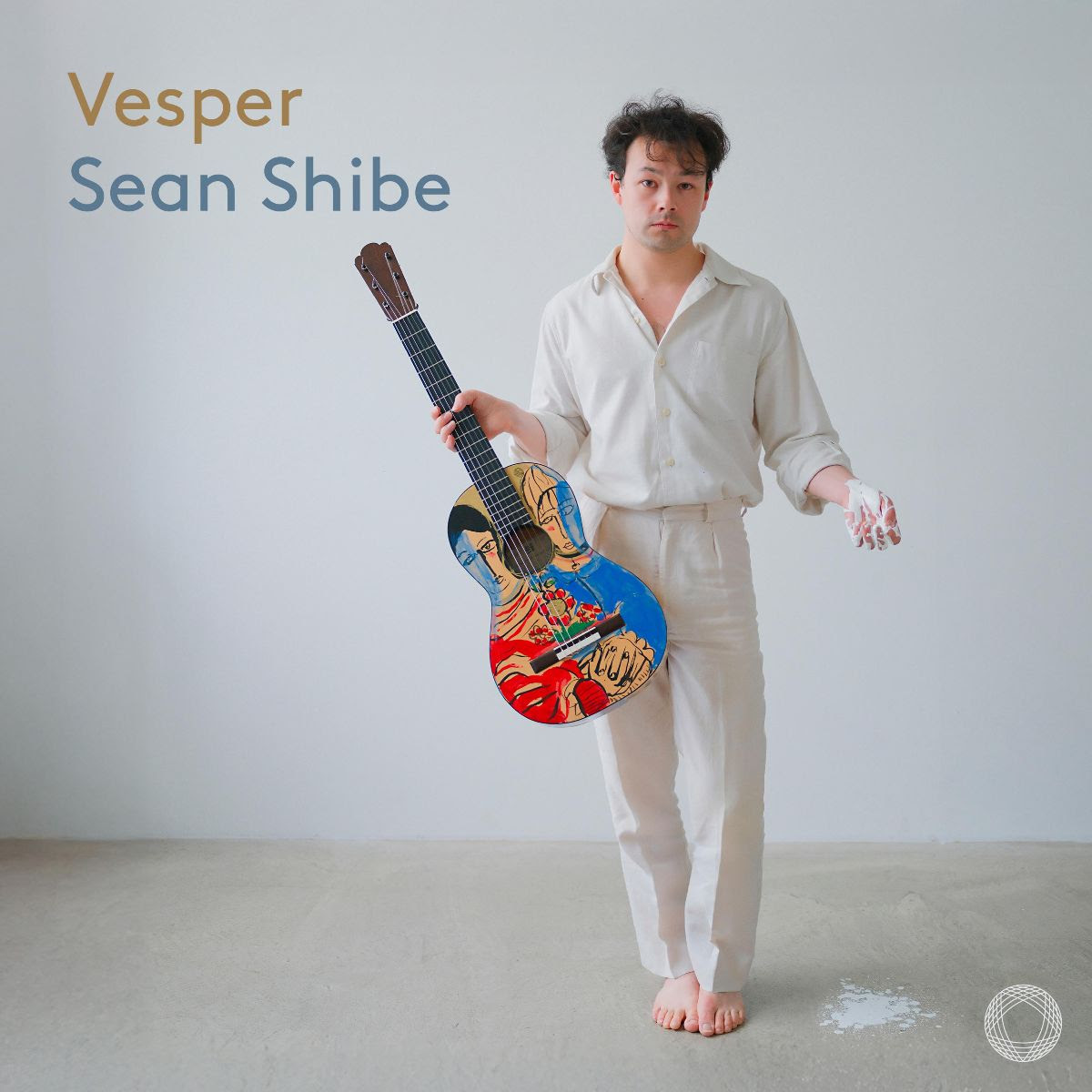
Sean Shibe’s fifth Pentatone album, Vesper, is due for release on 17 April 2026.
On it he presents a typically inventive collection of contemporary guitar works by the late Harrison Birtwistle, James Dillon, and Thomas Adès, “all composed by musicians who do not play the instrument themselves”, says the press release. “Recorded here for the first time, these recent miniatures explore the guitar’s expressive range in profoundly different ways: ritualistic and evocative in Birtwistle, elemental in Dillon, and allusive in Adès. Shibe’s interpretations reveal the instrument’s extraordinary colour, subtlety, and capacity for transformation, bringing each work to life with imagination and nuance.
For some of Birtwistle’s pieces, Shibe performs on Sylvette (2021), a guitar made by luthier Simon Ambridge in collaboration with French-British artist Lydia Corbett. A muse to Pablo Picasso – who was himself an important influence for several of Birtwistle’s works on this album – Corbett also inspired Picasso’s celebrated Sylvette series. Modelled on the small, responsive instruments of the Andalusian luthier Antonio de Torres, the guitar features Corbett’s artwork on its body, adding a visual and symbolic layer to the performance.
You can watch the launch video for Vespers here:
The tracklisting for Vesper is:
Thomas Adès (b. 1971) Forgotten Dances* 1 I. Overture, Queen of the Spiders 2 II. Berceuse, The Paradise of Thebes 3 III. Courante – Here was a swift (for Max Ernst) 4 IV. Barcarolle – The Maiden Voyage 5 V. Carillon de Ville (for Hector Berlioz) 6 VI. Vesper (for Henry Purcell)
Harrison Birtwistle (1934–2022) 7 Beyond the White Hand: Construction with Guitar Player** 8 Guitar and White Hand**
Thomas Adès 9 Habanera* from ‘The Exterminating Angel’
10 Oockooing Bird (arr. for guitar by Forbes Henderson) 11 Sleep Song 12 Berceuse de Jeanne (arr. for guitar by Forbes Henderson) 13 Sad Song (arr. for guitar by Forbes Henderson) 14 Je sui aussi
James Dillon (b. 1950) 12 Caprices* 15-26 1.-12.
You can explore purchase options for Vesper at the Pentatone website
Thomas de Hartmann is a composer whose profile has soared in recent years, thanks to well timed album releases from Wyastone and Pentatone, and a recent Proms debut where the Violin Concerto was performed by Joshua Bell, with the BBC Symphony Orchestra under Dalia Stasevka.
Today Pentatone make a small but meaningful addition to their discography. Cellist Matt Haimovitz has already recorded the composer’s Cello Concerto, but now he adds a meaningful extra in the solo work La Kobsa, composed by de Hartmann in exile in 1950.
The press release writes, “While the recording was made at Skywalker Sound in California, the emotional core of this project lies in Haimovitz’s four-city tour of Ukraine with the Odesa Philharmonic in May 2024, made possible by a grant from the U.S. State Department. During his journey, he performed impromptu sets in public squares and for wounded soldiers, accompanied by a documentary film crew, and brought de Hartmann’s music to his homeland for the very first time.”
What’s the music like?
Running in two short movements, La Kobsa begins with a deeply felt utterance, a profound piece from the cello:
The second part is more playful and optimistic, a dance with a rustic edge, which finds Haimovitz in exuberant but poignant form:
Listen / Buy
You can listen and explore download options from the Pentatone website
Kodály Budavári Te Deum (1936) Psalmus Hungaricus Op.13 (1923) Bartók Transylvanian Dances (Erdély táncok) Sz. 96 (1931) Cantata Profana Sz. 94 (1930)
Luiza Fatyol (soprano, Te Deum), Roxana Constantinescu (mezzo-soprano, Te Deum), Marius Vlad (tenor, Te Deum and Psalmus Hungaricus), Ioan Hotea (tenor, Cantata Profana), Bogdan Baciu (baritone, Te Deum and Cantata Profana), Junior VIP, Children’s Choir (Psalmus Hungaricus), Transylvanian State Philharmonic Choir & Orchestra / Lawrence Foster
Pentatone PTC 5187071 [64’14”] Texts and English translations included
Executive & Recording Producer Job Maarse Balance Engineer & Editing Erdo Groot Engineer Lauran Jurrius Recorded May 2022, Radio Studio of Radio Cluj, Romania
Written by Ben Hogwood
What’s the story?
Here is a chance to gain an insight into the choral music of two 20th century Hungarian composers known predominantly for their orchestral works. Bartók and Kodály were born just a year apart, and while their music is fiercely proud of their heritage their musical trajectories extend well beyond Hungary. Kodály stayed largely within Europe but brought back influences from Paris, while Bartók reluctantly emigrated to the US in late 1940.
Psalmus Hungaricus was Kodály’s first major post-war composition, in 1923. It is a landmark in his output, using for its text a Hungarian paraphrase of Psalm 55. Kodály uses a tenor soloist for the central dramatic role, the choir taking up their position as commentators. The Budavári Te Deum, completed 13 years later, marks the 250th anniversary of the liberation of Buda Castle from the Turks. While referencing Gregorian chant, Kodály incorporates references to Hungarian melodies and ornamentations in a dramatic setting.
In 1930 Bartók completed his first major work for chorus and orchestra. Cantata profana has Transylvanian roots, and Oana Andreica’s booklet note gives the context of its libretto, starting from two Romanian ‘colinde’ – ballads sung during the Christmas season but with a wide range of subjects well beyond the birth of Christ. Such is the case here, Bartók dramatising a myth of nine sons turned into stags. The cantata charts their fate and their father’s conflicting emotions, expressed by a baritone soloists. The Transylvanian Dances are a complementary addition, a short trio of works for small orchestra containing five traditional songs.
What’s the music like?
The Budavári Te Deum is a thrilling start to the album. This is red-blooded choral writing, Kodály diving in headlong to a high octane first section. He challenges choir’s higher sections, who respond admirably to the loud dynamic, retaining impressive clarity in the part writing. The work’s climactic points are notable for their power and passion.
This performance of the Psalmus Hungaricus has the authentic inflections to the melody, its bracing start turning to contemplation. Tenor soloist Marius Vlad inhabits the full tone and strong line demanded by Kodály, and sung so memorably by Ernst Haefliger in the legendary recording with Ferenc Fricsay. This makes for a fine digital alternative, with the choral response both full-bodied and unified. The meaningful counterpoint between Vlad and the Transylvanian woodwind in the middle section (Te azért lelkem) is especially memorable.
Bartók’s Cantata profana starts ominously, with an underlying menace that grows steadily as the hunt in the story progresses. Again the choral passages are well drilled, especially when in league with the percussion. The passionate tenor solo (Ioan Hotea) and fulsome bass (Bogdan Baciu) prove to be ideal foils, alighting on some spicy chords. There is little consolation at the end, in spite of the relative calm this performance leaves.
The Transylvanian Dances are over in a flash but leave a charming impression, with rustic themes. The recording is much closer, taking the action indoors to the tavern rather than outside in the wilds.
Does it all work?
Very much so. There is an adjustment to be made for the Transylvanian Dances, with the smaller ensemble and closer recording, but the performances justify the means. The choral works are a resounding success, brilliantly performed and with electric singing from the Transylvania State Philharmonic Choir, especially in the high passages. The orchestra match them under Lawrence Foster, who secures incisive rhythms and impressive clarity from such large forces.
Is it recommended?
It certainly is. This is an enterprising and very accessible coupling of three thrilling choral works, revealing fresh insights into the Hungarian composers.
Listen
Buy
For more information on this release and for purchase options, visit the Pentatone website




 Arcana.fm