
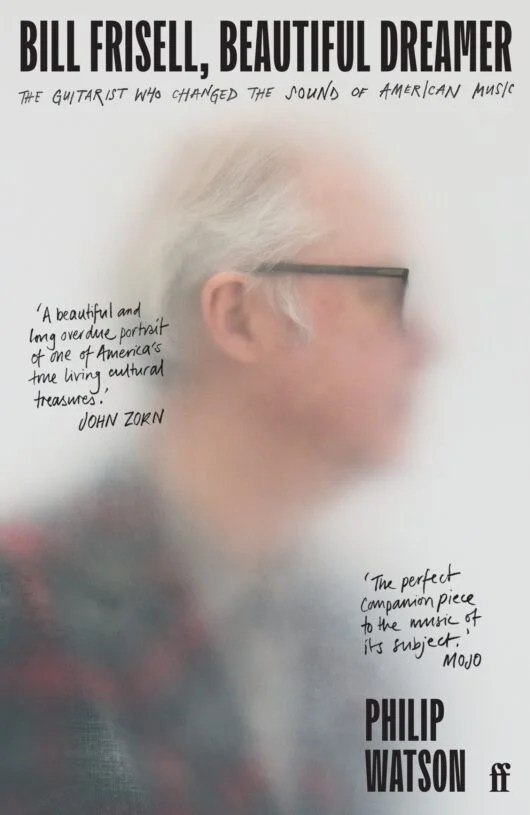
Bill Frisell, Beautiful Dreamer
by Philip Watson
Faber & Faber 2023 (paperback 544 Pages, ISBN: 978-0571361694)
Reviewed by John Earls
Philip Watson’s magnificent biography of Bill Frisell was first published in 2022 with the paperback edition released earlier this year. It is the first authorised biography of the American guitarist and composer – but it is no hagiography although Watson is a fan – and has already been described as definitive. It is also Watson’s first book. Not that you would know – it is both erudite and elegant. The author is of course a very experienced journalist (formerly deputy editor at GQ and editor-at-large at Esquire, he is currently jazz critic at the Irish Times).
An immediate issue to tackle in any work on Frisell is the description of him as a ‘jazz guitarist’ (not Watson’s phrase). Sure, he has played with many jazz greats including collaborations with Ron Carter, Dave Holland, Elvin Jones, Lee Konitz, Jim Hall, Paul Bley, Charlie Haden, Jan Garbarek and Billy Hart – to name but nine – as well as his thirty-year trio partnership with Paul Motian and Joe Lovano, and all are referenced in the book as are descriptions of Frisell’s jazz sensibility. However, the book is also excellent in illustrating the vast range of Frisell’s musical activity as listener, performer and influencer. This includes, in no particular order, folk, country, Americana, blues, world music, contemporary chamber, TV and film scores, 1950s and 60s pop, surf-rock, and the songs of John Lennon. This, as Watson acknowledges several times, can rub up against a certain type of jazz purist (more of which later).
On the ‘classical’ front, American composers Charles Ives and Aaron Copland are strong influences – excerpts from Ives’ Three Places in New England and an adaptation of Copland’s Billy the Kid feature in Frisell’s stunning and eclectic 1992 album Have a Little Faith. But early on in the book one of the young Frisell guitar tutors recalls making him aware of the music of Poulanc, Ravel, Debussy and Béla Bartók.
The book is diligent, but never dull, in tracking Frisell’s story and development from childhood, education, first musical steps (his original instrument was clarinet), the tough start to his career and later success and recognition. It’s quite a journey and there are interesting moments along the way despite Frisell’s protestations that “there haven’t been any fights or anything. And all I’ve done is stay married to the same woman for the past thirty-five years”.
A particularly innovative and insightful feature of the book are the ‘Counterpoint’ listening sessions dotted throughout whereby Watson (a long-time host of the Wire magazine’s ‘Invisible Jukebox’) plays pieces of Frisell’s music to a series of musicians and artists and probes for responses. The list includes Paul Simon, Justin Vernon of Bon Iver, Gus Van Sant, The Bad Plus, Gavin Bryars, Hal Willner, Martin Hayes and Dennis Cahill. It is the range and quality of the listeners that impresses. Many have been collaborators, but Rhiannon Giddens confesses “I don’t really know his music at all”. “Excellent” replies Norman, “This could be interesting!” Van Dyke Parks on Big Sur is a particularly fascinating exchange.
Amongst all the interviews throughout the book there are many references to Frisell’s modesty and shyness. But what also comes across is a powerful sense of his integrity. This can manifest itself in different ways. There’s the decision to honour a commitment to a tour with his long-term supporter and collaborator Paul Motion – “Paul was where my heart was” – at the expense of a more lucrative offer with Jan Garbarek and damage to the relationship with influential ECM boss Manfred Eicher.
But there’s also the night in a club in Rome in July 2004 when Frisell and Petra Haden are performing Stevie Wonder’s I Believe and are heckled by a guy shouting “This is not jazz. This is bullshit”. Frisell stops playing, goes to the microphone (a rarity in itself) and says “Fuck you”, or as Claudia Englehart, Frisell’s sound engineer and road manager, tells it ”Fuuuuuucccccck. Yooooou!” Yep, that would be the same modest and shy Frisell that seeps through the rest of the book.
If you are already familiar with Frisell’s work or even parts of it (it’s a huge catalogue) you will find this a fascinating and extremely valuable profile of this extraordinary musician. If you are not, but are a music lover, it will still be a good read.
John Earls is Director of Research at Unite the Union. He tweets / updates his ‘X’ content at @john_earls
For more information on the book and to explore purchase options, visit the Faber & Faber website
 Arcana.fm