
Listening to Beethoven #51 – Piano Trio in G major Op.1/2


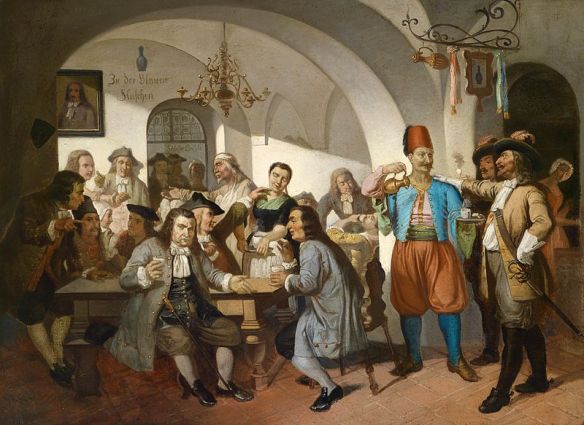
Vienna coffee house (18th century) (Anonymous painter)

written by Ben Hogwood

Piano Trio in G major Op.1 no.2 for piano, violin and cello (1792-94, Beethoven aged 23)

Dedication Prince Charles Lichnowsky
Duration 33′

Listen

Background and Critical Reception

The second of Beethoven’s three piano trios, Op.1, is a substantial work. As with the first it sets out a number of innovations in the form – structured in four movements rather than three, and giving the strings much more say in the melodic material so that they are on an even footing with the piano. This time Beethoven adds an expansive introduction to the first movement, taking it even closer to the profile of a Haydn symphony.

While the first piece in this triptych of piano trios had its origins in Bonn, this second instalment appears to wholly originate from Vienna, Beethoven working at it through 1793 and 1794. Its choice of key, G major, presents it as a complement to the oft-used E flat major of the first trio, meaning the set of three could be performed in a sequence if the performers had the stamina!

The extra demands on the performers are noted, however. Susan Tomes, talking to Arcana about this work, noted that “Op.1/2 is extremely difficult for the piano particularly, and it has to sound so effervescent, like a Mozart opera in piano trio form. It’s actually very difficult.”

Richard Wigmore, in his notes for the Florestan Trio’s recording on Hyperion, writes how the G major trio ‘immediately establishes its symphonic scale with an imposing slow introduction – something unheard of in a piano trio, and rare even in a string quartet’. Of the slow movement, he writes, ‘It is characteristic of the young Beethoven’s search for an increased profundity of expression that the second movement…combines a siciliano lilt with an unprecedented hymn-like solemnity.’ Meanwhile the finale ‘is another movement that infuses Haydn’s spirit with Beethoven’s own brand of boisterousness.’

Thoughts

The expansive first movement shows Beethoven completely at home in this medium. He allows plenty of time to set out the key and allow a few decorative but meaningful flourishes from the piano, harking back a little to the Baroque period. Soon however he becomes more impatient, and the music moves smoothly into the main body of the movement. A charming statement from the piano is picked up by the strings and the three instruments have fun developing its dance-like qualities.

There is often the sense that Beethoven is playing with his listener, and this comes through in the exchanges that close out the first movement. Elsewhere the music softens, nowhere more so than the second movement, marked Largo con espressione, where the composer opts for the more exotic key of E major to express his feelings. This is a beautiful and restful ten minutes of music, with both violin and cello given plenty of melodic material in their higher registers.

A pure sense of musical enjoyment comes through in the last two movements. The cello takes the lead in the third movement Scherzo, possibly for the first time in this form, while the trio section hints at a darker diversion but quickly returns to the light courtesy of trills on the piano. This is a slightly furtive movement, but gives way to a sparkling finale, emulating Haydn with some of its jokes. The running theme resembles Rossini’s William Tell overture (still 35 years away)

Beethoven’s second is the most substantial Piano Trio to date – but little would have prepared his listeners on what was to follow.

Recordings used

Castle Trio (Lambert Orkis (piano), Marilyn McDonald (violin), Kenneth Slowik (cello) (Warner Classics)
Florestan Trio (Susan Tomes (piano), Anthony Marwood (violin), Richard Lester (cello) (Hyperion)
Beaux Arts Trio (Menahem Pressler (piano), Daniel Guilet (violin), Bernard Greenhouse (cello) (Philips, 1964 recording)
Wilhelm Kempff (piano), Henryk Szeryng (violin), Pierre Fournier (cello) (Deutsche Grammophon)

The Castle Trio are again invaluable guides on how this music might of sounded in its first performance. Their sound can be brittle (to our ears at least) in the slow movement especially, no matter how affectionately it is played. Again the Florestan Trio are excellent in this music, with an affectionate ear for Beethoven’s inventions and in the finale a tempo which really does justice to the composer’s marking of Presto. Wilhelm Kempff, Henryk Szeryng, Pierre Fournier clock in at just over 35 minutes in a very expansive version, lovingly played if offering a lot more heart-on-sleeve. Again the Beaux Arts Trio are excellent guides in their long-established recording from 1964.

Spotify links

The playlist below compiles the recordings made by the Castle Trio, Beaux Arts Trio and the Szeryng-Fournier-Kempff trio:

You can chart the Arcana Beethoven playlist as it grows, with one recommended version of each piece we listen to. Catch up here!

Also written in 1794 Viotti Violin Concerto No.27 in C major

Next up Piano trio in C minor Op.1 no.3

Listening to Beethoven #50 – Piano Trio in E flat major Op.1/1


View of coffee house in Praterallee, Vienna (1810, thought to be by Joseph Koll)

written by Ben Hogwood

Piano Trio in E flat major Op.1 no.1 for piano, violin and cello (1792-94, Beethoven aged 23)

Dedication Prince Charles Lichnowsky
Duration 32′

Listen

Background and Critical Reception

Opus 1 was an extremely important milestone in the life of Beethoven. With it he was determined to make a statement, particularly as a newcomer to Vienna – and the pieces behind that statement were subject to a great deal of care and revision before publication. He chose the medium of the piano trio very deliberately, opting for a form that Haydn and Mozart had not dominated, and where there was room for development and innovation.

The second and third trios were begun in 1793, soon after arrival in Vienna, but the first in E flat major is thought to have been started in Bonn prior to that. All three were completed for Prince Lichnowksy, at whose home they were first heard in 1794. It is thought Haydn – now Beethoven’s teacher – heard each of the three pieces before he left for London. There were some reservations about the third work, of which more when that piece is the focus, but the first two were warmly received.

Beethoven’s innovations for Op.1 are set around a recalibration of the piano trio format, giving the three instruments – piano, cello and violin – greater equality. Until now Haydn had used the piano as a dominating instrument with stringed accompaniment, but in the slow movement of the first trio in E flat major Beethoven sides more with Mozart, giving the strings more prominence and greater freedom of expression.

He also changed the structure of the trio, expanding it from three to four movements, thinking along a more symphonic line. The ‘new’ movement would be a Minuet or Scherzo (a quicker movement laced with humour and energy), the structure similar also to string quartets of the time.

Praise for the first trio in the set is uniform. Richard Wigmore, writing in his notes for the Florestan Trio recording on Hyperion, enjoys the ‘luxuriant’ second movement, ‘with a first episode fashioned as a soulful love duet for violin and cello’. The third movement is ‘the first of Beethoven’s true scherzi’…which ‘ leaves its minuet model far in the background’. Meanwhile the finale ‘suggests Haydn in its verve and brilliance, and in the witty capital Beethoven makes of the initial leaping figure’.

Thoughts

Beethoven’s first ‘official’ published statement is in the key of E flat major, his ninth work to date to occupy that key. It is where he feels most at home, and, if the opening melody is anything to go by, it is a place where he can use the simplest of melodies as the basis for a whole movement. The second theme of the first movement is a nice, tender contrast, but both provide plenty of material for the composer to develop, which he does with a smile on his face. This is wonderfully open, airy music, which would have projected far beyond the small confines of the room in which it was first performed.

The slow movement has a songlike appearance (hence its Italian tempo marking Adagio cantabile) and provides a meaningful contrast, with music of real depth. The colours of piano with the stringed instruments’ greater involvement are beautifully shaded. The third movement has an appealing delicacy, again making much from what seems like very little material to construct an appealing dance form. There are some quite sudden interjections here, Beethoven’s ever changing musical moods beginning to surface on a regular basis.

The composer may use an unlikely melody from which to hang the finale, but Beethoven makes it work, taking the unconventional leap at the start of the melody and pushing the music forward with plenty of sparkle and wit. This is music to be enjoyed, though it comes at a price for the performers!

The sound has really filled out compared to Beethoven’s first unpublished essays in the form, with much more body to the strings but also greater technical demands on the pianist, no doubt to impress the Viennese audience and to ensure the pieces were not copied. In an enclosed, private space it would have made an extremely strong impression with its bright colours and heartfelt melodic statements.

Recordings used

Castle Trio (Lambert Orkis (piano), Marilyn McDonald (violin), Kenneth Slowik (cello) (Warner Classics)
Florestan Trio (Susan Tomes (piano), Anthony Marwood (violin), Richard Lester (cello) (Hyperion)
Beaux Arts Trio (Menahem Pressler (piano), Daniel Guilet (violin), Bernard Greenhouse (cello) (Philips, 1964 recording)
Wilhelm Kempff (piano), Henryk Szeryng (violin), Pierre Fournier (cello) (Deutsche Grammophon)

The fortepiano can be a bit too probing in its timbre but there is a really pleasing zip and enthusiasm in the Castle Trio’s performance, further energising the music. Occasionally the fortissimo playing can over-egg the pudding, but generally the balance is good.

The Florestan Trio present a beautifully weighted account, which works firstly because of the dexterity of Susan Tomes, under whom every note has meaning but always with the strings in mind. The Minuet has an appealing delicacy, while the finale really gets airborne at a terrific pace.

Spotify links

The playlist below compiles the recordings made by the Castle Trio, Beaux Arts Trio and the Szeryng-Fournier-Kempff trio:

You can chart the Arcana Beethoven playlist as it grows, with one recommended version of each piece we listen to. Catch up here!

Also written in 1794 Haydn Symphony no.100 in G major ‘Military’

Next up Piano trio in G major Op.1 no.2