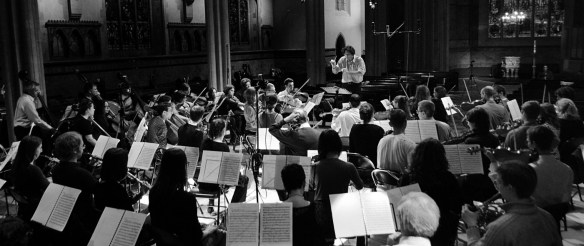
Beethoven: Symphony No.6 ‘Pastoral’; Dvořák: Cello Concerto in B minor (Rohan de Saram (cello), Oberon Symphony Orchestra / Samuel Draper)
Recorded live at St James’s Church, Sussex Gardens, London on 19th October, 2013
Grieg: Peer Gynt – Suites Nos. 1 & 2; Langgaard: Symphony No. 4 ‘Løvfald’ (UK premiere); Sibelius: Symphony No.5 (Oberon Symphony Orchestra/Samuel Draper)
Recorded live at St James’s Church, Sussex Gardens, London on 27th September, 2014
Now nearing the end of its fourth season, the Oberon Symphony has already established itself as an orchestra equally at home in the standard repertoire and relatively unfamiliar music; its conductor, Samuel Draper, as attentive to the letter of the score in question as to the spirit that informs it. These discs, comprising two out of its 13 concerts to date, typify the questing spirit of its performances: these are presented unedited, with no attempt to disguise passing flaws in ensemble or intonation – not that this lessens appreciation of some committed music-making.
What’s the music like?
The first disc juxtaposes two seminal pieces from either end of the 19th century. Beethoven’s ‘Pastoral’ Symphony has been described as the last of his works where beauty of sound and richness of texture predominate, and Draper acknowledges this in his unforced approach to the opening Allegro then his leisurely though never sluggish handling of its Andante. Some felicitous woodwind playing here (not least with the interplay of bird-calls towards its close) is further evident in the scherzo, even if the earnest characterization arguably pre-empts the ‘Storm’ movement which emerges as sombre rather than elemental. The highlight is a finale that rightly carries the expressive weight of the whole, its progress underpinned by an elusive if tangible onward motion which holds good through to a radiant climax and searching close.
The performance of Dvořák’s Cello Concerto features Rohan de Saram, for many years the cellist of the Arditti Quartet and a soloist whose perspective on arguably the finest work in its genre is distinctive and refreshing. Thus the initial Allegro is rendered with the necessary emotional breadth, its expansive though never unduly protracted formal design confidently unfolded despite passing technical fallibilities, while the central Adagio is even finer in its mingling of wistfulness with those passionate outbursts as open-out the music’s expression accordingly. De Saram’s inward eloquence comes into its own both here and in the extended coda to the finale, an inspired afterthought (prompted by the death of the composer’s sister-in-law) whose intense retrospection makes the concluding bars more affirmative in context.
The second disc has the Oberon SO venturing into more esoteric realms with the UK premiere of the Fourth Symphony by the Danish composer Rued Langgaard. Langgaard (1893-1952) is among the more prominent instances of a creative figure who snatched defeat from the jaws of victory, yet between his heady early success and the neglect prevalent from the mid-1920s onwards is a series of works that ought to have established him among the leading European composers of his generation. Not least the Fourth Symphony (1916): its subtitle, ‘Fall of the Leaf’, is often rendered as ‘Autumn’ though the seasonal process of change and decay surely has a metaphysical and even apocalyptic resonance. Its single movement, in eight continuous sections, is best heard as an expanded sonata-form design overlaid by continuous variation.
Certainly the plunging gesture with which it opens sets the tone for what follows and Draper amply brings out this fatalistic defiance, then ensures a seamless transition into the plaintive second main theme whose opulent expansion on strings at the end of the exposition is among the work’s highpoints. Nor does the central span risk diffusiveness, Draper as attentive to the geyser-like eruptions on strings and woodwind at its apex as to the mesmeric transition when oboe unfolds a plangent melodic line over a string cluster of inward intensity. Exposed string writing is for the most part securely managed, and while Draper cannot quite prevent the final stages from hanging fire, he secures the necessary momentum heading into the coda with its startling bell-like ostinatos, then a final build-up in which dread and decisiveness are as one.
This concert commences with three pieces from Grieg’s music for Peer Gynt. ‘Morning’ is rapturously expressive, while ‘The Death of Åse’ avoids undue vehemence, its inward final bars preparing for a ‘Solveig’s Song’ whose indelible main melody never becomes cloying.
Sibelius’ Fifth Symphony is given a sympathetic if not always ideally focussed reading. The first movement is finely launched, Draper ensuring the altered exposition repeat has the right cumulative intensity, with the majestic central climax moving convincingly into its ‘scherzo’ continuation where progress can be fitful, yet the coda lacks little in velocity. More debatable is a second movement which emerges as a slow intermezzo, its progress having insufficient lightness of touch as the music takes on a greater ambivalence prior to its winsome close. In the finale, Draper elides ideally between the surging impetus and airborne rapture of its main themes; if Sibelius’ ingenious design feels at times uncertain, neither the glowing affirmation of its coda nor the decisiveness of those six closing chords (taken ‘in tempo’) can be gainsaid.
Does it all work?
On both discs, the warm while occasionally diffuse sound is in keeping with the acoustic of St. James’s Sussex Gardens, with the booklets including full personnel for each concert and some excellent booklet notes (notably from Hannah Nepil on Dvořák and Andrew Mellor on Langgaard) – though Draper’s name might reasonably have featured on both the front covers.
Is it recommended?
Yes. The discs are obtainable either at the Oberon SO’s concerts (the next of these is on September 17th), or directly via the orchestra’s website


 Arcana.fm