published by Ben Hogwood, with text appropriated from the press release
Matthew Bourne has been a busy man of late. Hot on the heels of his Nightports collaboration Dulcitone 1804 he has returned to the piano on record for the first time since 2017’s Isotach.
As the press release says, “for such a restless and forward-thinking artist, perhaps we shouldn’t be surprised that Bourne can be a little reluctant to return to the instrument on which he made his name. At least in public. That would be too easy.”
It continues. “These days Bourne tends to find himself seated at his first instrument when working on collaborations or commissions for film and television projects. It’s often in these moments that inspiration strikes and the pieces are committed to tape. With outside deadlines, those sparks can often be left. Forgotten about. Recorded over.
This Is Not For You. was born from an off-hand comment by one of Matthew Bourne’s confidants. His instruction, “Do not delete,” provided Bourne with a commission of sorts, an ideal restriction to work within. Everything on the album was given a chance to shine in the studio, to be worked on amongst the freedom of that no deletion diktat – new inspirations now lie beside deep-mined remembrances. Cello and Dulcitone have been added sparingly for colour, but this is Bourne playing for his own enjoyment. Intimate. Reserved even. The real Matthew Bourne?”
The story behind this remarkable album is best read through quotes from the MINING Bandcamp site and press release, as it bears repeating.
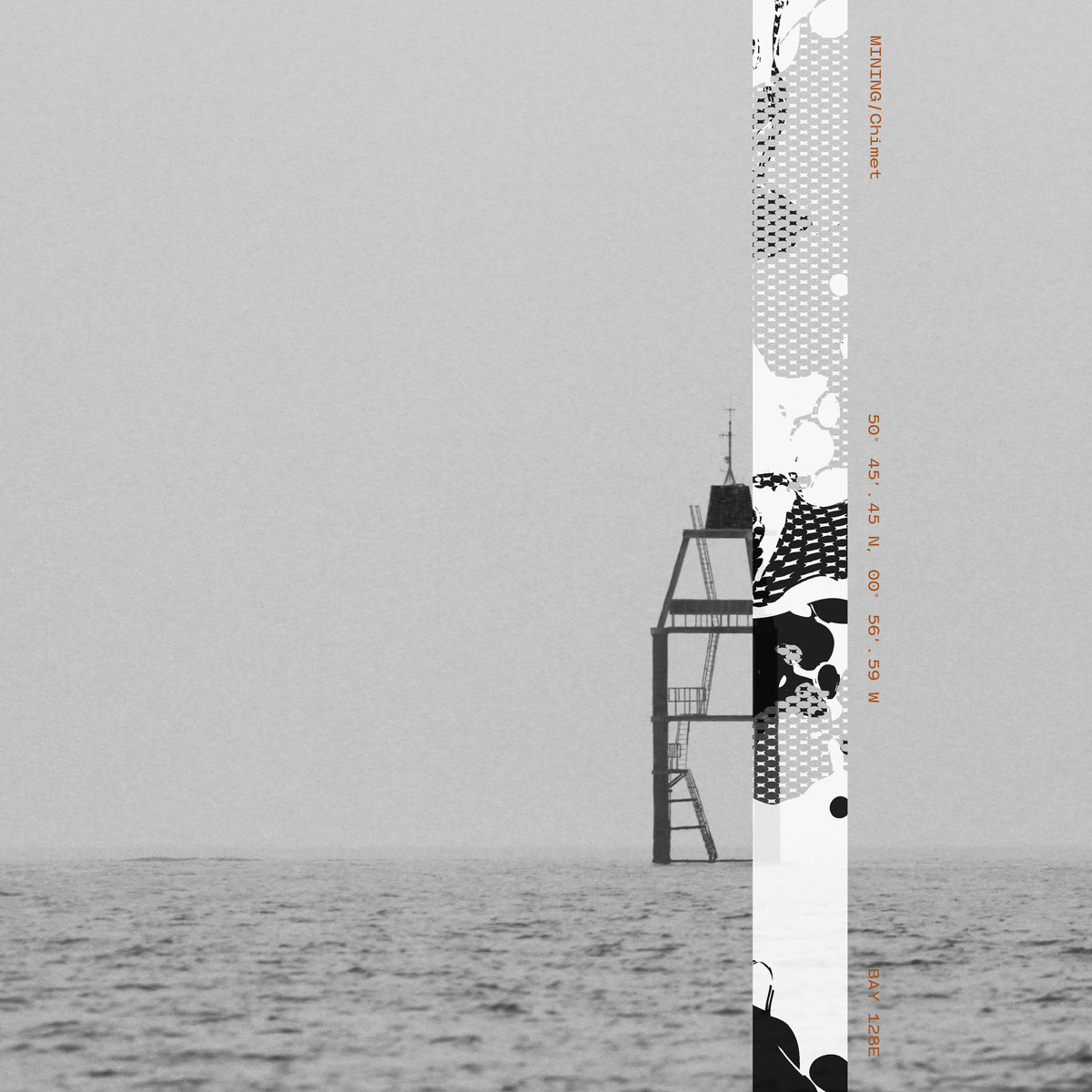
“Chichester West Pole Beacon, also known as Chimet, is a comprehensive weather information system recording conditions in Hayling Bay, West Sussex, both in real-time and historically. Located at 50° 45′.45 N, 00° 56′.59 W, approximately one mile from the entrance to Chichester Harbour, the instrumentation on Chimet records data including air and water temperature; barometric pressure; wind speed and direction; water depth; wave height, period and frequency; and time of day.
Over a period of seven days in October 2017, the devastating Atlantic Hurricane Ophelia fed straight into another weather event, known as Storm Brian in the UK. MINING mapped the data from this storm onto various musical values and parameters, including harmonic range, pitch, density and volume – resulting in a continuous piece of electronic sound design that directly traces the contours of the two storm systems. After several iterations, improvised instrumental performances were added on piano, cello and synthesiser.
The album was created using 2,016 sampled data streams, collected every five minutes between 0030 on October 16th 2017 and 0025 on the 23rd, translating seven days of information into 67 minutes and 12 seconds of detailed and evolving music. With mother nature orchestrating the piece, she is joined by intuitive and powerful improvisations on piano, cello and synthesiser. The recording captures the sense of building expectation and tension, the dropping air pressure, the rising winds, the interlocking storm systems and the serene aftermath. The shifts are seamless, monumental and open to the elements.”
MINING was conceived by Craig Kirkpatrick-Whitby, with sound design and programming from PJ Davy. The improvised contributions on piano, cello and Lintronics are all made by Matthew Bourne.
What’s the music like?
Intense, yet ambient at the same time. The circumstances of composition mean that Chimet is certainly best heard as an uninterrupted stream (pun intended), describing the weather activity in remarkable detail.
Yet the crowning achievement of this project is that in their work together, Craig, PJ and Matthew have made something that has deep emotional content. The sound ‘beds’ are effectively drones, slowly shifting in deep colours, over which Bourne is able to work some carefully thought improvisation.
Ophelia develops very slowly, over a quarter of an hour, but there is something immediately ominous about its approach. The synthesizers pile up, with the occasional intervention from the piano – with layers of notes in swirling harmony, before they gradually retreat. Petrichor poses more of an initial threat, the foreboding low synth sounds presenting a dark outlook, before the relative calm of Latent – a slow piano meditation – dispels the worry.
The central section starts with a piece depicting Chimet itself, the remoteness of the open water apparent in Bourne’s distant musings on the piano. Then, with Arise, a series of long cello notes provide a swell in the texture, moving seamlessly into the elongated Force 10 Pts. 1 & 2. Here the held notes feel bleaker, until the inexorable build that piles them up towards the sky, a regular ticking holding everything in place. There is a strong sense of the ravaged seas, of craft blown this way and that, but also Chimet standing tall throughout.
The epilogue, Debris, has a synthesizer motif depicting the aftermath, with matter falling back to earth and settling, the long note underneath held until it passes from audible range.
Does it all work?
It does. For such incredibly slow music to maintain this level of intensity is remarkable indeed, something few artists can achieve. The melodies may be minimal, but getting caught up in the sweep of the extended piece is inevitable.
Is it recommended?
It is – a proper musical experience that should be played from start to finish, so the listener can get the whole awe-inspiring weather events recreated in their own environment.
There are two new beginnings at work with this release, the first one on the new Odda Recordings label. Odda, founded by Leaf’s label manager and press officer, Thea Hudson-Davies, describes itself as being ‘informed by the musical contours of a long-running NTS Radio show, taking the lesser-walked paths across the fringe terrains of experimental music, percussive electronics and film soundtracks’.
To that end, the choice of Flaer – aka Realf Heygate – is an obvious one. Heygate is an artist, pianist and cellist based in Leicestershire, and this mini album has strong classical connotations in its title. For inspiration the net is cast further afield, however, drawing on environments and field recordings that would fit into 1970s folk horror films,
Heygate started the album during lockdown, restricting himself to four track tape and three acoustic instruments – cello, piano and acoustic guitar.
What’sthemusiclike?
Preludes captures the rarefied atmosphere of early lockdown in the UK, where an eerie quiet fell over the land and familiar sounds such as birdsong and church bells took on heightened significance and intensity.
Hew reflects this in its churchyard recording that quickly segues into gently oscillating piano and guitar, rippling out beautifully to a rocking cello motif. The cello takes the lead for a plaintive but searching melody on The Hill, while the guitar comes forward for Pasture, closely mixed to capture fret movements under the watchful eye of a blackbird.
Forever Never is the first truly heartstopping moment, an eddying piano line dropping away into stillness:
Landlock pits broad cello phrases against complementary guitar, but a low piano note on Magnolia introduces caution, the pastoral scene compromised by swarming treble lines, though these soften appreciably as the track proceeds. The closing Follow sees dense acoustic guitar lines accompanied by the distinctive chirp of house sparrows, before the cello adds richness.
Does it all work?
It does. Close-up listening is recommended, to catch the detail of the field recordings and the softened timbres Heygate often applies to the instruments. The only regret is that the recordings do not exist in longer versions, as there is still plenty of room for musical development in each.
Is it recommended?
It is. An auspicious start for the new label, which looks well set for the long haul. Preludes will put you under a spell for 20 minutes, and though on occasions it might get eerie, Flaer’s environment is a musically nourishing place to be.
This is a big year for the elusive minds behind Craven Faults. On the horizon is a debut live show in September, where their modular synthesisers, cables and organs will be extracted from the old textile mill where they work, and presented to the public.
Part of that presentation will surely include Standers, the outfit’s second album. A large scale piece, it moves towards a large scale approach that sees four of the six tracks clocking in at more than ten minutes each. Their approach is self-described as ‘a self-contained analogue electronic journey across northern Britain, viewed through the lens of a century in popular music.’ This time around the perspective around the landscapes they create in music is shifting, looking at how their outlines have been shaped by the elements and by human settlers. The interaction between the two provides plenty of raw material for composition.
What’sthemusiclike?
Rather like the artwork. Craven Faults make music of the exquisitely shaded black and white variety, with a combination of panoramic drones and detailed foreground work that makes a lasting impression and keeps the listener coming back for more.
The longer form of composition definitely suits Craven Faults’ music, as it allows each scene to be set, subtly shaded and crafted.
First track Hurrocstanes – which appears to be a historical name for Haddock Stones, in North Yorkshire – makes a striking start. Over the course of a quarter of an hour it emits a regular, tolling chime that is equal parts foreboding and comforting, as the musical landscape beneath pulses with activity, subtly shifting from the root note and back again.
Even more impressive is Sun Vein Strings, a blast of light from its massed banks of keyboards but also with plenty going on elsewhere. The 18-minute epic becomes a series of twisted electronic moves, the lines expanding and contracting with hypnotic regularity, and with the syncopation throwing the listener off the beat.
The shorter tracks are equally concentrated. Severals rises impressively from the depths, its synthesizer lines gaining in stature, while Odda Delf gains a probing piano line.
Descriptive writing is at the heart of Craven Faults work, and the outdoors certainly beckons on a track like Meers & Hushes, describing nature’s efforts to cover the trails of human industry. Its regular pulse suggests past activity, while the drones are highly descriptive. The music rises to a higher pitch, slow riffs playing off each other.
Does it all work?
Yes. Craven Faults have the ability to make music indoors that very clearly portrays the landscapes around them, and the blend of natural and mechanical elements feels just right.
Is it recommended?
Yes. On this evidence the live material will be fascinating to chart – but taken as a standalone work, Standers represents a very fine achievement and a cornerstone of this year’s British electronica.
Earth Patterns is the third album from the creative spirits of Szun Waves – saxophonist Jack Wyllie, keyboard maestro Luke Abbott and percussionist Laurence Pike.
The sessions took place in late 2019, where a succession of ideas germinated through improvisation – and after honing the tracks with James Holden and producer David Pye they have emerged with what is described as ‘the most fully-formed Szun Waves record to date’.
New Hymn To Freedom, their second album, looked up towards the stars – but Earth Patterns is very much of this planet, an organic affair where the music grows from small cells.
What’s the music like?
There is undoubtedly a special chemistry at work in Szun Waves. Each of the protagonists has their own special contribution to make, and there are so many notes produced in Earth Patterns, but somehow the trio and their studio team make room for all of them, crafting an album where each track goes on its own meaningful journey.
The album gets off to quite a chaotic but thrilling start, Exploding Upwards establishing the myriad of colours on offer from the trio, with surges of analogue synthesizers and saxophone alike. New Universe evolves at a gradual pace but ends up in an even more exalted and euphoric state, the saxophone flying high.
As the album progresses so the range of colours broadens, and In The Moon House features shimmering metallic instruments above a drone, with deeply soulful thoughts from the saxophone. Be A Pattern For The World builds its intensity through long notes, the saxophone starting to strain in its upper register.
Final track Atomkerne is poised, the saxophone like a massive, overarching presence, as figures flit back and forwards in the middle ground with a low drone buzzing away underneath. What unites all of these ideas is the sheer strength of feeling behind them. Jack Wyllie plays his saxophone like his life depends on it, with a dizzying range of pitches from soft, low thoughts to soaring high phrases. Luke Abbott marshals the electronics beautifully, ensuring we hear the colours of the analogue synths but that they bubble respectfully when other instruments play, surging to the front when their moment is called. Laurence Pike gives us the icing on the cake with intricate, detailed percussion that can focus on metallic treble-based material one minute, then fulsome lower range instruments the next.
Does it all work?
It does – and hangs together emotionally too, for Earth Patterns is certainly Szun Waves’ most deeply felt album to date.
Is it recommended?
Yes, without hesitation. Anyone following the musical progression of any of these three artists will want to snap this one up without delay – and anyone enjoying the intersection of jazz and electronica should also do the same. A Mercury nomination would not seem to be out of the question for next year, even at this stage!.




 Arcana.fm