Anyone interested in the history of electronic music will know that being asked to score a TRON film is a rare badge of honour.
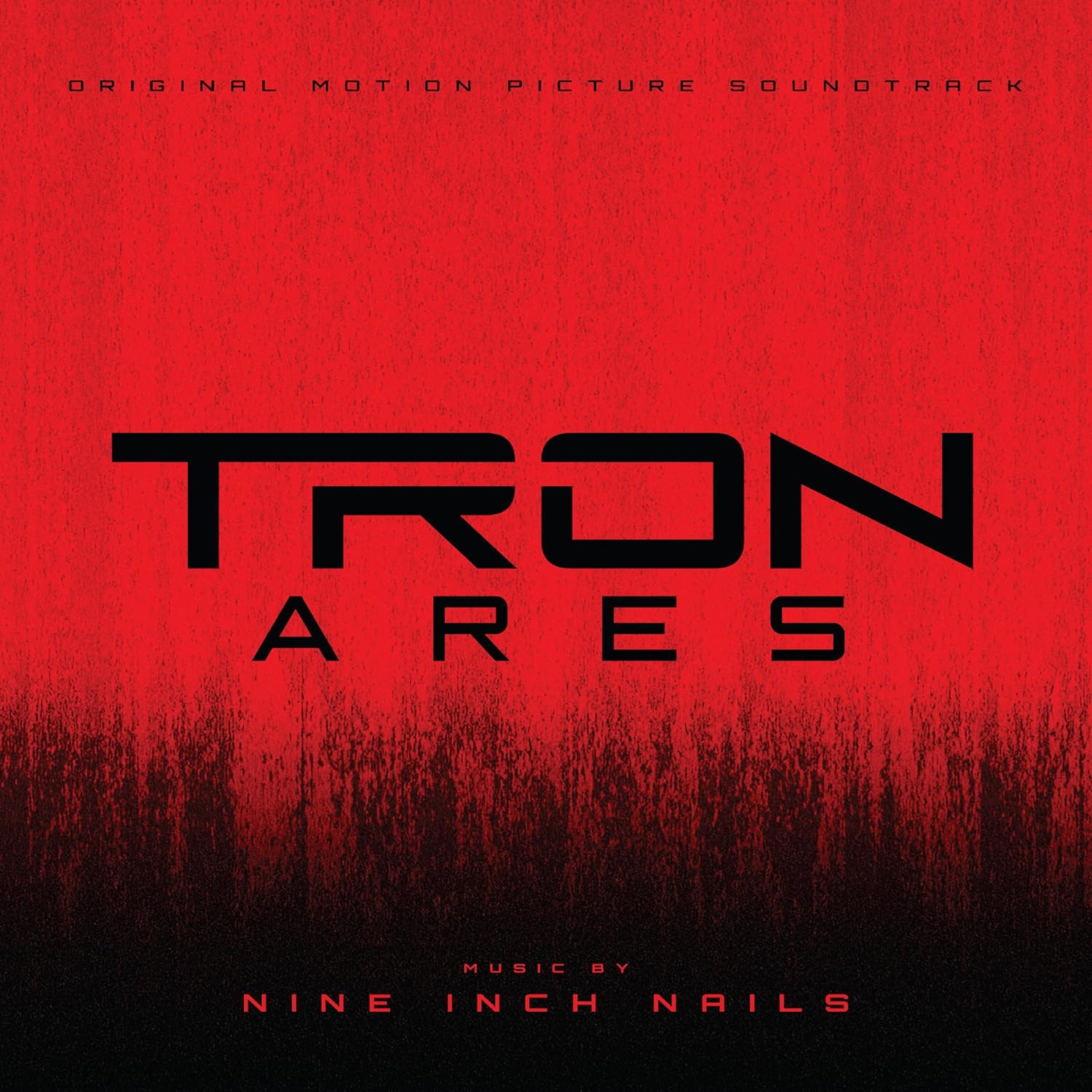
The previous two iterations in the series have been blessed with distinctive and influential series, from the Wendy Carlos original in 1982 or the Daft Punk soundtrack for 2010’s TRON: Legacy. The importance of the commission is shown in the fact that Trent Reznor and Atticus Ross have switched from their own ‘proper name’ branding to assume the familiar mantle of Nine Inch Nails, meaning TRON: Ares takes on extra significance.
As well as involving Reznor and Ross, Boys Noize and Hudson Mohawke add support as part of a high calibre production cast.
What’s the music like?
Both dated and futuristic, the TRON: Ares score is respectful to the past films in the series as well as being appropriately forward in its aims. The brooding synths throb and pulse in claustrophobic fashion, setting scenes of futuristic dread or an uneasy, present day calm.
At times it feels as though Nine Inch Nails are bringing forward the late 1990s’ penchant for dance-rock, with songs that Crystal Method or even Moby in his brief metal phase might have considered.
And yet the work through this substantial album tends to be more subtle, moving from ambient reflections of near emptiness (Echoes) to juggernauts with rousing choruses (As Alive As You Need Me To Be). On the way we get nods to the graceful synthesizers of Carlos in the original; also the dramatic, pumped-up orchestrations that Daft Punk used to such good effect in Legacy.
Does it all work?
Largely. On occasion the vocal gestures are too obvious yet surely fit the characterisation in the film. Otherwise the score reaches all the parts on headphones.
Is it recommended?
Yes, with conviction. Trent Reznor and Atticus Ross are seasoned film scorers, but don’t fall into the trap of recycling their ideas. TRON: Ares sounds every bit as futuristic as you would like, and its often-euphoric workings carry conviction in their full-bodied beats and bass. Even if you don’t see the film, make sure you hear the soundtrack.
Nonesuch Records releases the soundtrack to Luca Guadagnino’s film After the Huntdigitally on October 10; it will be available on CD from October 17. After the Hunt stars Julia Roberts, Ayo Edebiri, Andrew Garfield, Michael Stuhlbarg and Chloë Sevigny, and opens in cinemas from October 17, following its world premiere at the 2025 Venice International Film Festival. The album features the score by Trent Reznor & Atticus Ross, a selection of works by the composer John Adams, as well as additional music from the film by Ambitious Lovers, Julius Eastman, Ryuichi Sakamoto and Everything But The Girl among others. Find the full track list below.
From visionary filmmaker Luca Guadagnino, After the Hunt is a gripping psychological drama about a college professor (Julia Roberts) who finds herself at a personal and professional crossroads when a star student (Ayo Edebiri) levels an accusation against one of her colleagues (Andrew Garfield), and a dark secret from her own past threatens to come into the light. After the Hunt is written by Nora Garrett.
“I was excited to make a movie about now,” Guadagnino says. “After the Hunt is a thriller that asks not what is the truth of this event but how many truths are there? And who should decide which is right? And, as a filmmaker, it was also a way of exploring how to tell a story showing all the possibilities of truth without saying one point-of-view is most valuable.”
The film’s suspense, feeling, and questioning is heightened by the texturally inventive score from the two-time Oscar-winning team of Trent Reznor and Atticus Ross. This marks the fourth film Reznor and Ross have scored for Guadagnino. “I always show Trent and Atticus the full movie without any music first. Then we start talking about principles and ideas,” Guadagnino explains. “In this case it was all about creating doubt. They brought me these extraordinary piano notes that underline the question of do we believe this person or not. This theme of doubt starts up in the first scene and keeps expanding. And then, around the structure they created, we brought in pop music as well as contemporary composers like John Adams.”
Adams’ music has featured in almost all of Guadagnino’s work, beginning with I Am Love (2009). Inspired by and scored entirely to Adams’ pre-existing music, this was the first time Adams had allowed his work to be used in this way. Guadagnino subsequently featured pieces by Adams in his films A Bigger Splash (2015), Call My Be Your Name (2017), throughout the eight episodes of his miniseries We Are Who We Are (2020), as well as the documentaries Inconscio Italiano (2011) and Salvatore: Shoemaker of Dreams (2020).
“Adams’ music comes to me constantly. Discovering it was transformative and changed my life as a director forever,” admits Guadagnino. “It comes with a capacity of interpreting reality, interpreting the history of the reality, interpreting the history of the United States, and understanding even the boundaries of music to become a cunning exploration of the identity of human nature and the politic relationship that ties all us in.”
Filmmaker Luca Guadagnino is an Academy Award, BAFTA, and GRAMMY nominee. Over the last three decades, his career as a director, writer, producer, and designer has been defined by rigorous dedication to artistic craft and creative experimentation. Celebrated for his bold and emotionally resonant work, his films include The Protagonists (1999), I Am Love (2009), A Bigger Splash (2015), Call Me by Your Name (2017), Suspiria (2018), Bones and All (2022), Challengers (2024), and Queer (2024).
Trent Reznor and Atticus Ross are accomplished musicians, composers and producers who have achieved significant popular and critical success in both film and rock music. Most recently, the duo composed the scores for Luca Guadagnino’s Challengers and Queer. Both scores received wide acclaim, with Challengers winning Golden Globe and Critics Choice awards, as well as a GRAMMY nomination. Over the years, the pair has composed music for a diverse array of film and television projects, beginning with David Fincher’s The Social Network (2010), which earned them an Academy Award and a Golden Globe. Their next collaboration with Fincher, The Girl With The Dragon Tattoo (2013), earned them a GRAMMY Award. Beyond their work in film, Reznor founded the iconic band Nine Inch Nails in 1988. Ross joined Reznor and the band in 2016.
John Adams occupies a unique position in the world of music. His works are among the most performed of all contemporary classical music, long embraced by the world’s leading orchestras and conductors, instrumental soloists and singers, choreographers, and opera directors. Nonesuch Records made its first record with Adams in 1985. He was signed exclusively to the label that year, and since then the company has released more than 40 first recordings and over 30 all-Adams albums, including the soundtrack to Luca Guadagnino’s I Am Love, as well as 2022’s 40-disc Collected Works box set.
After the Hunt track list:
Disc 1
Clock, One
A Child Is Born – Tony Bennett, Bill Evans
Let’s Walk – Mark Harelik, Victoria Clark, Adam Guettel
After the Hunt, One – Trent Reznor & Atticus Ross
It’s Gonna Rain – Ambitious Lovers
György Ligeti: Piano Concerto: II. Lento e deserto – Pierre-Laurent Aimard, Asko Ensemble, Reinbert de Leeuw
Terrible Love – The National
John Adams: Gnarly Buttons: II. Hoe-down (Mad Cow) – John Adams, London Sinfonietta
John Adams: Gnarly Buttons: III. Put Your Loving Arms Around Me – John Adams, London Sinfonietta
After the Hunt, Two – Trent Reznor & Atticus Ross
Break With – Ryuichi Sakamoto
Disc 2
Clock, Two
Julius Eastman: Evil Ni**er – Julius Eastman, Frank Ferko, Janet Kattas, Patricia Martin
L’incontro – Piero Ciampi
John Adams: The Death of Klinghoffer, Act II: “It is as if our earthly life were spent miserably” – Kent Nagano, Orchestra of the Opéra de Lyon, The London Opera Chorus
John Adams: The Death of Klinghoffer, Act II: Desert Chorus – Kent Nagano, Orchestra of the Opéra de Lyon, The London Opera Chorus
After the Hunt, Three
John Adams: City Noir: III. Boulevard Night – David Robertson, St. Louis Symphony
É Preciso Perdoar – Ambitious Lovers
Nothing Left To Lose – Everything But The Girl
Soundtrack compiled by Luca Guadagnino & Matthew Rankin
The Vietnam War – A Soundtrack by Trent Reznor and Atticus Ross
Reviewed by Ben Hogwood
Summary
You may have seen The Vietnam War, an ambitious 10-part series directed by Ken Burns and Lynn Novick that has aired on the BBC through Autumn and Winter. This is the first of two companion soundtracks, featuring over 90 minutes of original material composed by Trent Reznor and Atticus Ross.
Its companion is also a double album, with 38 songs including heavyweights of the era from The Beatles, Bob Dylan, Nina Simone, Simon & Garfunkel and Procol Harum.
What’s the music like?
Atmospheric and moody – but with considerable depth. Reznor and Ross write in a deceptively simple style, setting scenes through unhurried motifs and brushes of instrumental colour. Much of this colour is dark and foreboding, suggesting an underlying threat. The Forever Rain does this most vividly, suggesting the approach of an enemy vehicle.
There is an exquisite tension at play in the music, helped by the subtle use of quarter tones that can distort and pull a suggested moment of consonance in the harmony towards something more weird. Other Ways To Get To The Same Place uses these subtle variations in pitch to introduce disquiet.
There are more comforting moments – the opening Less Likely, for instance, then A World Away, where mottled piano and harp combine in an affecting loop, but by the time Justified Response arrives the tension built up throughout is released with great power. We hear cold electronic drums for the first time, then a full-on, four to the floor bluster.
Does it all work?
Yes. As background music it is extremely effective if rather disquieting, demanding more input on the part of the listener. Ross and Reznor suggest mood, emotion and peril with a surprising combination of subtlety and intensity.
Is it recommended?
Definitely. This is a cut above the average soundtrack music, and an ideal accompaniment to the visuals. The score complements the pop heavyweights elsewhere, which could hardly be bigger hitters – A Whiter Shade Of Pale, The Sound Of Silence and A Hard Rain’s A-Gonna Fall to name just three. Get both for a full picture of the climate.



 Arcana.fm