2020 Beethoven: The Story So Far

As you may well know, Arcana is undertaking a Beethoven listening project this year, in celebration of the 250th year since his birth.

We are approaching Beethoven by way of composers and teachers that had an influence on his output – J.S. Bach, son C.P.E., Handel and teachers Albrechtsberger and Salieri. We have also had a quick look at the Mannheim school of composers who helped the forms of the symphony and sonata to spread their wings.

We will shortly hear from Haydn and Mozart, then a quick look at Clementi – who Beethoven held in very high regard – before a guide to the music of 1770, the year of Beethoven’s birth. Then – finally – we will start on the music of Beethoven himself.

Arcana have several exciting interviews in the bag to help us with our discovery of Beethoven. Pianist Angela Hewitt has given some pearls of wisdom on the Piano Sonatas, while this morning Cyprien Katsaris held court as he talked of his upcoming Beethoven Odyssey. Many discoveries were made! We will also hear from cellist Steven Isserlis, who has offered his thoughts on the Cello Sonatas.

It has been a relatively slow start – but expect the tempo to rise considerably over the coming months! Meanwhile here are clips from one of Hewitt’s discs for Hyperion on the Piano Sonatas, including the wonderful opening pages of the Pastoral:

Routes to Beethoven – The Mannheim School

by Ben Hogwood
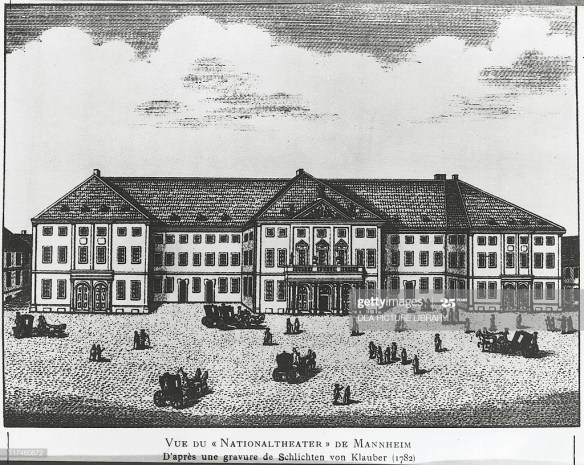
Picture: Mannheim National Theatre, 18th century (Schlichten & Klauber)

As we move towards the music of Beethoven we have so far encountered the music of three great masters – J.S.Bach, C.P.E. Bach and Handel. While all three exerted some sort of influence on Beethoven’s music, it is arguably the music of C.P.E. that was to prove the most far-reaching and original.

C.P.E.’s music went in hand with the Sturm und Drang approach, composers encouraged to bare their souls more explicitly in their music rather than (or as well as) sticking to more conventional rules.

The court orchestra of Mannheim was a hotbed for composers employing the Sturm und Drang in the mid-18th century. Its high level of musicianship was noted by Leopold Mozart and son Wolfgang, who made a prominent visit to Mannheim in 1777.

In his fantastically readable and comprehensive history Music In European Capitals – The Galant Style 1720-1780, Daniel Heartz takes up the story. He tells of how the city was incredibly well-placed for musical entertainment. Much of this took place in the palace, built from 1720 and containing the Knights’ Hall or Rittersaal, which became “the site of the orchestral academies for which Mannheim’s court music was to become most famous”. From 1742 the palace (below, depicted in 1725 by J.C. Froimon) was equipped with an opera house installed in its eastern wing, and a huge number of musicians in its employment.

One of those musicians was Johann Stamitz, described by English music historian Charles Burney as ‘the late celebrated Stamitz, from whose fire and genius the present style of Sinfonia, so full of great effects, of light and shade, was in considerable degree derived’. The ‘light and shade’ of which Burney speaks corresponds with the Sturm und Drang.

Stamitz worked at the court in Mannheim from 1743, but his fame soon spread, and Heartz writes of ‘the performance of a symphony by him with horns, trumpets, and timpani to open the Concert Spirituel in Paris in 1751’. This led to a prolonged period of work in the French capital, though soon Johann returned to Mannheim where he died in 1757, succeeded by his pupil Christian Cannabich.

The playlist below includes a number of Mannheim composers, headed by Johann Stamitz and his son Carl. Johann’s Sinfonia pastorale in D major begins the selection, quoting extensively from a Bohemian Christmas carol. Heartz writes of how ‘Stamitz’s fame rests principally on the handful of symphonies…attributed to his last four years…without equal in the 1750s’.

From there son Carl takes up the baton with the well-loved Clarinet Concerto no.3. Listening to this bright piece, brilliantly played by Sabine Meyer, gives an illustration of the positive energy Stamitz used throughout his music. The Cello Concerto in G major, later in the selection, is even more substantial, an assured piece that has a deeply soulful slow movement.

Cannabich himself wrote a large number of symphonies. Heartz writes of how his Symphony no.22, included here, contains crescendos – the idea of music changing in volume now a completely accepted one by scholars and audiences. It also includes oboes and horns in the scoring, signs that the orchestra was beginning to expand.

Mozart, however, was not impressed for a good while – until a later Cannabich symphony passed his ears in Munich in 1780. Now the story was different. ‘I assure you, if you had heard it yourself it would have pleased and moved you as much as it did me, and if you had not known ahead of time, you would not have believed that it was by Cannabich. Come soon then and hear the orchestra and admire it!’

Other prominent composers in the Mannheim court were Franz Xaver Richter, whose Symphony in B flat major appears on the playlist, as well as Franz Ignaz Beck and Ignaz Fränzl.

Did they influence Beethoven’s way of thinking in any way? We shall find out in due course. In the meantime, listen below:

Next up

Routes to Beethoven moves on to a quick look at the music of two of his teachers, Anton Albrechtsberger and Antonio Salieri.

Playlist – Sound of Mind 6: Celebrating mothers

Today is a celebration of mothers.

My own mother Coralie passed on five years ago, but this is a chance to celebrate her musical influence (which I did in written form here)

Here is a selection of her own favourite music, from Mozart‘s Clarinet Quintet – which she studied at college – through to Sibelius, Spanish guitar music, which she had a real fondness for, and Sir Peter Maxwell Davies‘ Farewell to Stromness.

I’m sure you’ll agree there is music here to match the blue skies today brings here in the UK – and it offers a chance to celebrate our mothers, too. Happy listening.

Ben Hogwood

Live review – CBSO Chorus and Orchestra / Mirga Gražinytė-Tyla: Brahms’ German Requiem & Mozart Serenade for wind

Camilla Tilling (soprano), Florian Boesch (baritone), CBSO Chorus, City of Birmingham Symphony Orchestra / Mirga Gražinytė-Tyla

Symphony Hall, Birmingham
Wednesday 4 March 2020

Mozart Serenade for wind in C minor K388 (1782-3)
Brahms Ein Deutsches Requiem Op.45 (1865-9)

Written by Richard Whitehouse

The City of Birmingham Symphony Orchestra’s current season features several major choral works that have long been central to this orchestra’s repertoire. While it has received numerous readings (most recently with Andrew Manze), Brahms‘s A German Requiem is not among these – so it was fascinating to hear what Mirga Gražinytė-Tyla might make of a piece that, though it has never fallen from favour since its premiere 152 years ago, remains a stern interpretive test in terms of projecting formal integration and an expressive essence more elusive for its restraint.

In the event the performance was a fine one – not least because this conductor found the right balance between flexibility of motion, without which the textures all too easily risk stolidity, and that seriousness of manner without which the music soon loses any sense of purpose. A balance as evident in the lengthy second movement, the inexorable tread of its outer sections framing an interlude of wistful grace then with the ensuing fugue building animatedly to its serene close, as in the brief fourth movement whose blithe exterior conceals music of artful dexterity. Camilla Tilling (above) summoned a winsome response in the fifth movement, a late but necessary addition in its opening-out the work’s emotional range, while Florian Boesch (below) was suitably if not unduly vehement in his initial contributions to the third and sixth; the former crowned by a fugue of visceral and unflagging energy, though that in the latter movement marginally lost focus as its grandly rhetorical gestures ran their (too?) predictable course.

It is in the first and seventh movements that Brahms’s highly personal concept of redemption through love is at its most explicit, MG-T duly having the measure of their calmly insistent searching towards eventual catharsis – even if the finale’s gradual winding-down resulted in less than the ideal repose. The CBSO Chorus was on fine form throughout – a tribute to the expertise of associate chorus director Julian Wilkins, who also made a pertinent contribution in an organ part no less crucial for its understatement; underpinning and often motivating an orchestration which adds in no small measure to the work’s humane and compassionate spirit.

A relatively short first half gave welcome opportunity for the CBSO’s woodwind to take the stage for an un-conducted reading of Mozart’s Serenade in C minor, last in his trilogy of such pieces which transcended an ostensibly lightweight genre and, in doing so, made possible the emotional substance of the symphonies that followed. Ensemble seemed a shade insecure in the opening Allegro, but its underlying intensity carried over to an Andante whose ineffable rapture was itself contrasted with the textural severity of the Menuetto. Best, though, was the final Allegro – a set of variation on an unassuming theme with the formal outline of a sonata-rondo made explicit with its major-key ending. Overall, a winning account of a piece whose scoring for wind octet has gained it less exposure than Mozart’s comparable orchestral works.

It also made for an unlikely while successful coupling and a similarly thought-provoking one is scheduled for next Tuesday, MG-T making her first foray into Bruckner with the erstwhile elusive Sixth Symphony alongside the deceptive simplicity of Bartók‘s Third Piano Concerto.

Further listening

Here is a Spotify playlist of music from the concert. The CBSO have not recorded either of these works before but these are fine alternatives:

For further information on the current season of CBSO concerts, visit the orchestra’s website

In concert – Orchestra of the Age of Enlightenment / Iván Fischer: Mozart’s Final Flourish

Orchestra of the Age of Enlightenment / Iván Fischer

Royal Festival Hall, Southbank Centre, London
Friday 7 February 2020

Mozart
Symphonies: no.39 in E flat major K543; no.40 in G minor K550; no.41 in C major K551 ‘Jupiter’ (all composed in 1788)

This concert was recorded for broadcast on BBC Radio 3 on Wednesday 12 February. You can listen to it here

Reviewed by Ben Hogwood

Few orchestras inspire their audience as consistently as the Orchestra of the Age of Enlightenment. Tonight was no exception, presenting ‘Mozart’s Final Flourish’ – his three final symphonies, nos. 39-41, written unusually in a short space of time, without commission, in 1788. The three works represent Mozart’s mastery of the symphonic form, and as conductor Iván Fischer explained to us before the performances began, there is an argument for the three works being viewed as one.

Fischer structured the concert to support his point, the trinity performed in order but with the interval positioned between the second and third movements of the Symphony no.40. This did not prove as much of a hindrance as expected, for the ‘one giant stucture’ – seen as such by no less than Nikolaus Harnoncourt, Fischer’s teacher – was merely paused half way through. Fischer encouraged applause between movements, a tactic which fragmented the performance a little but added to the relaxed atmosphere and will have encouraged first-time attendees.

The performances were very fine indeed. Symphony no.39 in E flat major, no.543 in Köchel’s catalogue of Mozart compositions, does not always get the appreciation it deserves. This is a shame as it is a wonderfully affirmative work, packed full of good tunes that responded well to the orchestra’s lean sound and fresh phrasing. The slow movement Andante was really nicely characterised, its middle section appropriately stern, while the busy finale chattered excitedly, Fischer leading the conversation.

The Symphony no.40 in G minor came as something of a shock to audiences with its ‘Sturm und drang’ approach, in keeping with Haydn and other artistic movements of the day but clearly plumbing emotional depths for the composer. The first movement was tautly argued, relenting a little for the Andante which was perhaps too relaxed in tone. When we returned after the interval the Menuetto disappeared rather quickly, with Fischer’s brisk tempo and an absence of repeats, while the fourth movement brought more abstract qualities to the fore before its final flourish.

And so to the Symphony no.41 in C major, nicknamed the ‘Jupiter’ 40 years or so after its publication. What a remarkable achievement this is, its surface simplicity masking complex inner workings with the serenity of a swan. Fischer, who smiled throughout, revelled in another fine performance, typified by the extra spring given to the exuberant second theme of the first movement. The tender heart of the Andante cantabile was aided by a lovely muted string sound, while the floated delivery from the violins helped the deceptively straightforward themes in the Menuetto. All this was headed for the finale, however, and its masterful fugue. This conversation between parts is the closest thing to perfection in Mozart’s symphonic writing, and the OAE relished both their individual parts and the ensemble workings resulting from them, building enough kinetic energy to sweep us home.

This was a thought provoking and ultimately uplifting evening, and the ideal setting of the scene for anyone moving on to Beethoven next!

Further listening and viewing

A reminder that this concert was recorded for broadcast on BBC Radio 3 on Wednesday 12 February. You can listen here

You can find out more about the Orchestra of the Age of Enlightenment on their website, and you can get an introduction to them in a minute through the video below:

The orchestra appear not to have recorded Mozart’s last three symphonies, but their one-time guest conductor Frans Brüggen made these excellent live recordings with the Orchestra of the 18th Century. They sit relatively closely to the sound heard at this concert: