Vaughan Williams – Symphonies nos. 4 & 8

Featured recording: Vaughan Williams – Symphonies nos. 4 & 8 (London Philharmonic Orchestra)
vaughan-williams-4-8

Two very different Vaughan Williams symphonies presented in live recordings by the London Philharmonic Orchestra, with the angry, resentful Fourth conducted by Ryan Wigglesworth and the seraphic Eighth under the direction of the orchestra’s chief conductor Vladimir Jurowski

What’s the music like?

Of all his nine symphonies, the Fourth, completed in 1935, is the one that sounds least like Vaughan Williams’ work. If you didn’t know the composer, you could be forgiven for thinking it was a wartime Russian work. Such is the explosion of anger at the start, the ongoing the desolation in the slow movement, the very notion of VW being a ‘green and pleasant land’ composer is thrown right out of the water.

The Eighth Symphony of 1955 is much more amiable in mood. It is not well known among the composer’s output but there are some lovely sonorities here, such as the beautiful textures at the start, where Vaughan Williams harnesses a number of percussion instruments. Celesta and vibraphone blend beautifully to make music that sounds as if it originated a lot further east than the North Sea! The large percussion section also includes three tuned gongs. The middle two movements dispense with these instruments – the third becoming a gorgeous romance for strings – while the closing minutes are full of joyous music.

Does it all work?

This is a disc of two halves. The Symphony no.4 is given a strong performance but feels rushed at times, especially in the fourth movement, where Ryan Wigglesworth zips through a lot of the arguments so fast that they sound just a bit perfunctory.

That said, the fall-out at the end of the first movement makes quite an impact, the coda sounding truly desolate, while the second movement Scherzo is spot on, thanks to a superb bassoon contribution.

In contrast the Eighth Symphony receives an affectionate performance under the direction of Vladimir Jurowski, enjoying the use of the percussion at the start, mysterious yet rather exotic too. The Cavatina is the emotional centre of this piece, ending with a lovely cello solo that rises through the layers at the end. From this point the last movement Toccata is a joyous celebration, sounding English in its folksy tunes but again enjoying the shimmering sounds the tuned percussion have to offer.

Is it recommended?

Jurowski’s performance of the Eighth is recommended without reservation, a beautifully constructed performance that enjoys the unusual orchestral colours but which is keenly emotive too. The recording from London’s Royal Festival Hall is excellent.

Wigglesworth’s Fourth – though well played – is good but not so fine that it displaces the formidable competition among its rivals. Recordings conducted by Sir Adrian Boult, Vernon Handley and Bernard Haitink are all preferable in this respect.

Listen on Spotify

You can judge for yourself by hearing the album on Spotify here:

Rattle conducts Sibelius – Symphony no.7

Rattle conducts Sibelius – Symphony no.7, in the last of a three-concert residency from the Berlin Philharmonic Orchestra, performing all the composer’s symphonies

sibelius-symphony-7

Berlin Philharmonic Orchestra / Sir Simon Rattle – Barbican Hall, live on BBC Radio 3, 12 February 2015.

Listening link (opens in a new window):

http://www.bbc.co.uk/programmes/b051czxp

on the iPlayer until 13 March

Spotify

For those unable to hear the broadcast, here is a Spotify link. Sir Simon has not recorded this piece with the Berlin Philharmonic, but this is a recording he made with the City of Birmingham Symphony Orchestra for EMI (track 6):


What’s the music?

sibelius-7-dad
(c) Brian Hogwood

Sibelius – Symphony no.7 in C major, Op.105 (1924) (22 minutes)

What about the music?

This symphony is a remarkable piece of work that reveals more and more with each subsequent listen. Initially it can seem too simple in its melodic material or too dense in the sheer amount of ideas, but in fact it is an amazingly self-contained unit, like a single long melody lasting for just over twenty minutes.

Sibelius worked on it at the same time as his Sixth Symphony, hence the reason for Rattle performing the two together without a break – but the recommendation (from here at least!) is to make the most of each piece on separate terms.

In my mind’s eye I often feel as though this piece is a seascape, with the spray almost tangible to the touch. The music is brooding at times, and its complex harmonies can twist the human response, but it is an overwhelmingly positive way in which to finish a symphonic cycle. And how better to finish than with a C major chord, regarded as the purest in all music?

Performance verdict

Rattle’s interpretation of the Seventh would appear to be spot-on tempo-wise, and as is the conductor’s wont it picks apart the structure to highlight all the different themes the composer uses – yet is always moving forward to the next musical ‘signpost’.

In each of the three occurrences of the trombone theme he stresses its heroic quality, and the overall impression of the symphony is a positive, resilient one.

What should I listen out for?

The symphony is in a single section, and though it is possible to break it in to constituent parts, it is so compressed and tightly bound together that is it best to listen to it as a single whole.

1:31:24 – a single timpani roll ushers in an ascending scale on the lower strings. Already the music is noticeably broader than the Sixth Symphony.

1:32:13 – the wind play a relatively distant figure that assumes great importance as the symphony progresses.

1:36:43 – the strings swell to a rousing theme on the trombones, just about rising above the whole orchestra.

1:41:00 – now the music is speeding up, with the strings adopting a similar figure to that found in faster moments of the Sixth Symphony.

1:41:52 – the swirl of the violins gets gradually slower, until 1:42:11, where the trombones return with their tune, now more isolated.

1:43:43 – the quicker theme returns on the woodwind.

1:48:21 – the ascending scale from the opening of the work simmers, but there is a tension between two different speeds before the trombone theme returns at 1:48:40.

1:51:43 – the final section, which ends with what seems the simplest resolution at 1:53:02.

Want to hear more?

After the Symphony no.7 – if you’re on Spotify – keep listening and you will hear another of Sibelius’s orchestral ‘tone poems’ – that is, an orchestral piece that describes a particular story or event. This one, Nightride and Sunrise, is not so well known, but is a descriptive work that draws on an unknown sequence of events for the composer.

For more concerts click here

Rattle conducts Sibelius – Symphony no.6

Rattle conducts Sibelius – Symphony no.6, in the last of a three-concert residency from the Berlin Philharmonic Orchestra, performing all the composer’s symphonies

sibelius-symphony-6

Berlin Philharmonic Orchestra / Sir Simon Rattle – Barbican Hall, live on BBC Radio 3, 12 February 2015.

Listening link (opens in a new window):

http://www.bbc.co.uk/programmes/b051czxp

on the iPlayer until 13 March

Spotify

For those unable to hear the broadcast, here is a Spotify link. Although Sir Simon has recorded the first symphony, with the City of Birmingham Symphony Orchestra, I could not find this for listening. I have therefore inserted a ‘replacement’ version with the Lahti Symphony Orchestra conducted by Osmo Vänskä on BIS.


What’s the music?

sibelius-6-dad

Sibelius – Symphonyno.6 in D minor, Op.104 (1923) (30 minutes)

What about the music?

The Sixth is often glossed over in the course of the Sibelius symphony cycle, coming as it does between the very popular Fifth and Seventh – but repeated study reveals that musically it is the ideal complement to them both.

The composer himself said it reminded him of ‘the scent of the first snow’, or even, in a wonderful quote, ‘Whereas most other modern composers are engaged in manufacturing cocktails of every hue and description, I offer the public pure cold water’.

That crisp air is evident right from the beginning of the music, and indeed it is more a succession of feelings rather than obvious tunes that shape the impact of the work. The compact scale of the orchestra recalls the Symphony no.3, but if anything Sibelius goes further in his economical use of the forces available.

In an interview on the radio prior to this performance Sir Simon Rattle draws attention to the panning of the composer’s symphonies by such lofty figures as Theodor Adorno, who regarded him as ‘the worst composer ever’. Each to their own, I suppose, but one listen even to this lesser known symphony shows this is absolutely not the case!’

Rattle chooses to perform the Sixth and Seventh together, without a break, so if you want to hear them individually (which I personally prefer!) you will have to stop listening quickly at 1:31:20.

Performance verdict

This is a brilliantly played and ideally paced account of the Sixth, to my ears, one that captures the outdoors, the listener feeling as though they are stood at an open door catching the air.

The third movement Scherzo is particularly thrilling, but it is the nuances and detail that Rattle captures within the score that ensure each phrase and unit is brought to life.

What should I listen out for?

First movement (marked Allegro molto moderato) (fast but very moderately so)

1:01:45 – immediately there is a serene air to the strings, a cool but bright and refreshing sound. Because the instruments are high the music is weightless, the depth of the orchestra only really heard just over two minutes in.

1:06:25 – a wispy figure winds its way up from the lower strings, the energy levels slightly raised. This leads to a bright, chirpy sequence from the woodwind with more incisive rhythms.

1:09:38 – what feels like a cold wind blows in from the strings and timpani, darkening the music. The end arrives quickly just over a minute later.

Second movement (marked Allegro moderato) (moderately fast)

1:11:01 – a clear beginning to this movement from the woodwind. Flutes and clarinets are prominent in this movement and indeed the whole symphony.

1:12:48 – at this point the music does not have an obvious base, moving around quite quickly with small fragments of melody that are related but seem not to settle, like birds staying on the wing.

1:16:51 – the music labours a bit before the end before quickly breaking up. It is remarkable that Sibelius signs off a piece of music in this abrupt way, effectively adding to his music a firm full stop and a line underneath.

Third movement (marked Poco vivace) (a little lively)

1:17:10 – with Sibelius’s picture of the first snow in mind, this is perhaps the brisk wind on which the snow arrives. Strings swirl around before more detached rhythms assert themselves, and then the brass and timpani add extra depth with sweeping brush strokes.

One of the shortest sections of a Sibelius symphony, this is over in a flash, using a rhythm that rather recalls Beethoven’s Seventh Symphony.

Fourth movement (marked Allegro molto) (very brisk)

1:20:53 – Once again we have an open orchestral sound, with beautifully phrased woodwind figures.

1:22:45 – the strings bring a more vigorous episode into play, harking back to the mood of the previous movement. Despite its positive mood the music still feels restless and unable to settle for long – until 1:23:52, where it takes a stronger root and now has quite a punch through the weight of the string section. There are now some more obvious motifs from the violins in particular.

1:28:16 – a slightly slower and more thoughtful passage from the strings, who come into play much more in this movement.

1:30:55 – the music slows to a pensive close.

Want to hear more?

A good companion piece to the Symphony no.6 is Tapiola, one of Sibelius’s last works – a descriptive piece based on a forest spirit that has an uncannily vivid description of what feels like a passing snow storm.

You can hear it on Spotify here (track 6):

For more concerts click here

Connecting Bach with Mozart – Giuliano Carmignola and Kristian Bezuidenhout

Connecting Bach with Mozart – Giuliano Carmignola and Kristian Bezuidenhout link J.S. Bach with Mozart by way of three violin sonatas

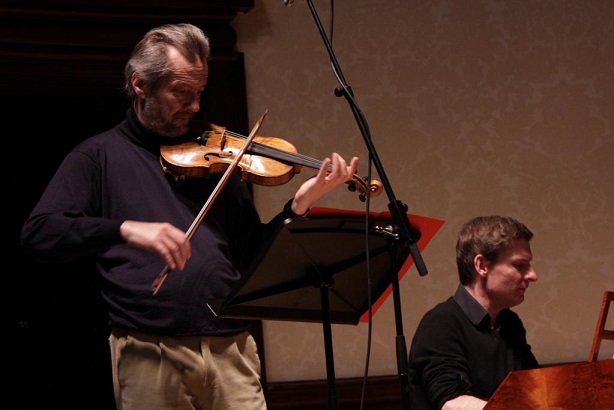
carmignola-bezuidenhoutGiuliano Carmignola and Kristian Bezuidenhout – Wigmore Hall, live on BBC Radio 3, 16 February 2015. Photo © Ben Collingwood

Listening link (opens in a new window):

http://www.bbc.co.uk/programmes/b051chkl

on the iPlayer until 17 March

For non-UK listeners, this Spotify playlist is available:

For those unable to hear the broadcast I have put together a Spotify playlist, including Giuliano’s recordings of the Bach with harpsichordist Andrea Marcon, and the Mozart – which he has not yet recorded – with Mark Steinberg and pianist Mitsuko Uchida on Decca:

What’s the music?

J.S. BachSonata no.2 in A major for violin and keyboard BWV1015 (thought to be between 1717-1723) (13 minutes) (the ‘BWV’ number gives an indication of the work’s position in the Bach-Werke-Verzeichnis (Bach Works Catalogue)

J.S. BachSonata no.3 in E major for violin and keyboard BWV1016 (thought to be between 1717-1723) (15 minutes)

MozartViolin Sonata in A major K526 (1787) (21 minutes) (the ‘K’ number gives an indication of the work’s position in Mozart’s catalogue. This is no.526 of a total of 626 numbered published works)

What about the music?

This is a ‘period instrument performance’ – that is, played on instruments from or designed to sound like those in Bach and Mozart’s time. The BBC Radio 3 announcer Sara Mohr-Pietsch confirmed Carmignola’s violin is an Italian model dating from 1739, while Bezuidenhout used an early piano developed from an original of 1805.

Mozart wrote dozens of sonatas for violin and keyboard, but the later ones are generally regarded as his finest. This particular example was written around the same time as the opera Don Giovanni, and is dedicated to the memory of Mozart’s friend and fellow-composer Carl Friedrich Abel.

The two Bach works are not as often performed as his works for solo violin, but demonstrate his ease and flair with writing for the instrument. Violin and piano are very closely linked in this music.

The Bach connection comes through the friendship between Bach’s son Johann Christian – whose music is still frequently performed to this day – and Carl Abel. Both met the eight-year old Mozart and stayed in touch with him.

Performance verdict

Carmignola’s bright tone is ideal for the Bach, which could be dry in lesser hands. Here he brings out all the vocal elements in the writing, and is helped by strong support by Bezuidenhout, whose springy rhythms and nicely shaped phrases are a constant pleasure.

The Mozart is an exceptional performance, bringing deep emotion and uncertainty to the slow movement in particular. The grace with which both performers play is unusual in period-instrument playing, and the softness of tone from the fortepiano is beautiful.

The Bach works are a little less obviously expressive, but are extremely well played. What was abundantly clear – an often underestimated point – is just how much the players were listening to each other during performance, not to mention a clear enjoyment of the music!

What should I listen out for?

Bach Sonata no.2

4:49 – at first I actually wondered if the two instruments were tuning up, as they were playing a unison ‘A’! However it turned out to be the easy going start of a graceful slow movement, the first of four.

7:49 – quite a punchy beginning to the first fast music of the sonata, the instruments dovetailing their melodic lines and with several cleverly worked sequences. The music ends quite suddenly.

10:54 – marked ‘Andante’ (at a walking pace), this has purposeful movement despite the slower tempo, and a slightly sorrowful air. Carmignola gives some tasteful ornamentation to the melody.

13:49 – an energetic fourth and final movement. The movement between the violin and piano parts (‘counterpoint’) drives the music forwards.

Bach Sonata no.3

18:47 – a spacious but very expressive slow movement, marked ‘Adagio’. The profile of the violin melody is as if written for a singer, with a common five-note accompaniment for the fortepiano.

22:29 – a lively second movement, with a constant stream of dialogue (‘counterpoint’) between the two instruments, beautifully dovetailed in this performance.

25:29 – this may be a slow movement but there is a soft dance element. Eventually it peters away into almost nothing.

29:44 – a vigorous fourth movement, simply marked Allegro, where both violin and fortepiano work hard together and apart.

Mozart

35:43 – a colourful fast movement to begin with, with both instruments equally involved in the dialogue and sharing the themes. The piano has some particularly tricky runs in the right hand which Bezuidenhout appears to manage easily.

42:19 – a deeply profound piece of contemplation, where Mozart appears to be remembering his friend in music that alternates between hope and deep thought. The passages of ‘hope’) (from the start, for example) tend to be in the ‘major’ key, while the passages of darker introspection (45:28 for example) are rooted in the minor.

49:15 – to start with the violin and piano seem out of sync, with some elaborate rhythms from Mozart. The piano in particular is incredibly busy, with the left hand shadowing the right in melodic profile. The violin becomes more showy in the central section.

Encore

57:49 – A short and nippy encore, the last movement of J.S. Bach‘s Violin Sonata in B minor, BWV1014. This work was published as the first of a group of six – the works above being the second and third in the group.

Want to hear more?

As the link between this music is Johann Christian Bach, here is a link to a disc of ‘Six Favourite Overtures’, played by the Academy of Ancient Music under Christopher Hogwood:

For more concerts click here

Rattle conducts Sibelius – Symphony no.5

Rattle conducts Sibelius – Symphony no.5, in the last of a three-concert residency from the Berlin Philharmonic Orchestra, performing all the composer’s symphonies

sibelius-5

Berlin Philharmonic Orchestra / Sir Simon Rattle – Barbican Hall, live on BBC Radio 3, 12 February 2015.

Listening link (opens in a new window):

http://www.bbc.co.uk/programmes/b051czxp

on the iPlayer until 13 March

Spotify

For those unable to hear the broadcast, here is a Spotify link. Although Sir Simon has recorded the first symphony, with the City of Birmingham Symphony Orchestra, I could not find this for listening. I have therefore inserted a ‘replacement’ version with the City of Birmingham Symphony Orchestra for EMI (from track 4):


What’s the music?

sibelius-5-swan

Sibelius – Symphony no.5 in E flat major, Op.82 (original version 1915, revised by 1919) (31 minutes)

What about the music?

This – quite simply – is one of the greatest symphonies of the 20th or any century. It is also one of Sibelius’ best known and loved works, being in a sense the sunrise to the Fourth Symphony’s darkness.

The construction of the first movement has occupied musical commentators for nearly a century now, debating its structure, and how Sibelius joins the music seamlessly from one section to another. All we need to know for now is that this wonderfully positive music.
Sir Simon Rattle speaks of this piece as offering a ‘revolution of rhythm and movement’, and saying how its ability to grow at a steady period of intensity is ‘not from any Western culture’. He likens it to Indonesian or Balinese music, though it is unlikely Sibelius would have heard much if any of these cultures.

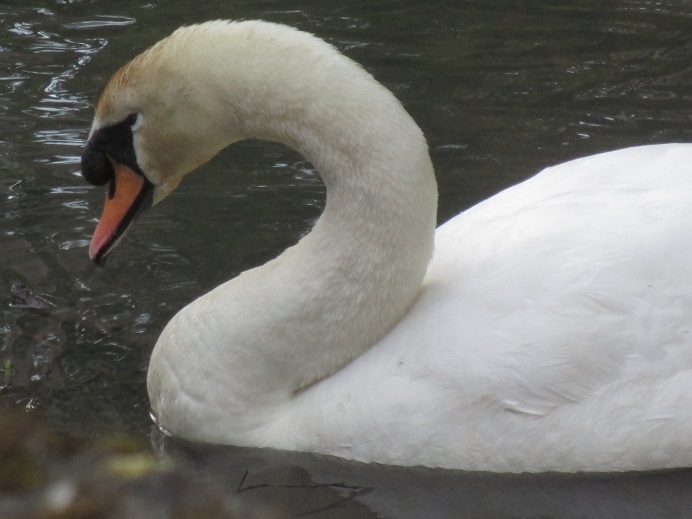
The density of the music is striking, but this is not difficult music to listen to – rather it is wide open, a celebration of nature and the outdoors. In the third movement Sibelius specifically celebrates the swans, recalling an instance where he saw a flock of them take flight at once, but also reproducing their calls in music.

Performance verdict

The playing of the Berlin Philharmonic is beyond criticism in this Fifth, but now and again questions are raised as to how much the music is actually instinctive for them, for this is music they do not often play (putting my snobby hat on, I would say I prefer this piece given by a Finnish orchestra!)

Rattle gives everything to his interpretation, of that there is no doubt, but there are some moments where the speed drags and the momentum of the music is harmed.

This issue comes up most prominently right near the end, as the tempo slows – but at no point do the orchestra lose the conviction of Rattle’s thoughts, and the ending itself is thoroughly convincing.

What should I listen out for?

First movement (which has a whole host of tempo markings)

4:25 – the wide open textures of the music are immediately obvious in themes from horn and woodwind. A serene, outdoor atmosphere is set.

5:50 – the violins interject with a note that raises the possibility of the music accelerating. There are almost dual speeds at this point, with some fast moving music and some slow. This creates a wide impression of space.

6:44 – a syncopated theme on the violins. All the time the music is building and pressing forward. Still the music builds, the violins coming to the fore – like birds taking off.

11:25 – a big, hugely affirmative statement on unison strings

12:29 – the wonderful climax to this movement, where we hear the theme from the opening on the brass. At this point Sibelius exacts a wondrous transition into a faster section, seemingly without breaking stride.

13:29 – a tangible shift here, back to the ‘home key’* – and a terrific gathering of momentum.

16:45 – the timpani hit E flat and start a whirlwind of phrases all around this note, the music gathering tremendous excitement before rushing headlong over the edge of the cliff at 17:20.

Second movement (again a whole host of tempo markings)

17:48 – the woodwind begin an attractive movement that once again sounds as if from outdoors. The sonorities of the Berlin Philharmonic woodwind in this section are especially beautiful. The flute theme at the beginning forms the basis of the whole movement, which is a theme and variations*

20:42 – a lush and affectionate reference to the woodwind’s theme from the strings. The orchestral texture remains wide open, and the music increases in energy. The same five-note rhythmic figure dominates this movement (from 21:43)

The music speeds up considerable before Rattle puts the brakes on at 23:18. Gradually we arrive at a slow and peaceful close.

Third movement (once more a whole host of tempo markings)

26:14 – a drum roll takes us immediately back to the mood of the first movement, with rushing strings giving the impression of trees flying past on a fast journey.

27:28 – the horns ring out in a theme closely related to the first one of the first movement. Here the mood is more regal.

30:43 – now the music is much quieter and more mysterious. The shimmering violins make reference to the horn theme described previously, like ripples on a lake. Then the music slows rather.

Rattle now slows the music considerably, and the theme sounds again, this time on trumpets at 32:35. The full power of the orchestra gathers again to the ‘home key’:

34:50 – a series of six massive chords end the symphony

Want to hear more?

After the Symphony no.5, the best next port of call is the next in the symphonic cycle, the Sixth – coming up in this series.

Glossary

*Home key – the base of the music – that is, the note on which the whole of a piece is based. The music may journey a considerable distance from this note, but if a piece is said to be ‘in E flat’, then it would normally be expected to start and finish with music based on those notes.

*Theme and variations – a common tactic in classical music, to introduce a theme and then construct a set of different themes that derive from it.

For more concerts click here