
Get behind the Classic BRITs

On Wednesday night the Classic BRITs returned for the first time in five years, back in the Royal Albert Hall.

While they have been away, several things have changed in classical music – and the most striking of those, on this evidence, is an increased diversity. The award winners were led by cellist Sheku Kanneh-Mason, a remarkable talent – and also a remarkable young man. His debut album Inspiration meets the expectations of a major label without compromising his own ideas, such as arranging Bob Marley’s No Woman, No Cry for solo cello. It works much better than you’d expect!

The inclusion of Marley, just a couple of tracks after Shostakovich’s Cello Concerto no.1, shows the influence playlists on streaming services have had on album planning, but also demonstrates a refreshing approach to bringing music of all forms together.

Tokio Myers also blends different styles, giving an intense live performance at the ceremony that included a barrage of drums, a soft Debussy reverie and some powerful electronically based music with its roots towards grime. Myers used to play in Mr Hudson & The Library among other groups, and he uses his experiences to bring a really satisfying urban grit to go with the purity of the piano.

Elsewhere it was gratifying to see winners young and old credit their teachers and musical education, and stress the importance of music in schools. Jess Gillam, deserved recipient of the Sound Of Classical award, did this – and so did Nile Rodgers. The guest presenter who was originally a classical guitarist playing the works of Fernando Sor – but who felt out of place in that sphere and went on to be a great guitarist elsewhere.

Sir Andrew Lloyd Webber went further, taking the government to task, but both Sheku and Myers were more subtle, thanking their teachers by name. Amanda Holden, who presented Myers with his award, recounted a visit he made to her daughter’s school, which has doubtless stayed with them.

Musical education is so important. I would not have been able to afford cello lessons at the age of eleven if the school hadn’t paid for them, and even towards the end of my grades my funding was dwindling and my parents were really having to dig deep to support me. I will be forever grateful for that, as I would not have been put on a musical path without it! It goes to show how it is not just the frontline performers who benefit from a musical education, but those much further down behind the scenes too.

Back to the BRITs, which also featured a wonderful performance of the theme and first of Bach‘s Goldberg Variations from Beatrice Rana – a shame we couldn’t hear more than we did! My only big criticism would be directed at the album of the year shortlist. While it is fine to include musicals, shows, film and middle of the road albums none of the shortlist had an obvious classical music connection. It is a thought for the future, where it might also work to have a ‘Best electronic’ category, recognising the likes of Nils Frahm, Bonobo and other classically influenced music that 6Music serve so well.

These are minor gripes though. We should get behind the Classic BRITs and support it, because it gives people a way in to classical music, pointing them forward towards the joys of the genre should they wish to look around further. There really should be room for everyone, and at the very least when I watch on Sunday night I shall be grateful for my musical education!
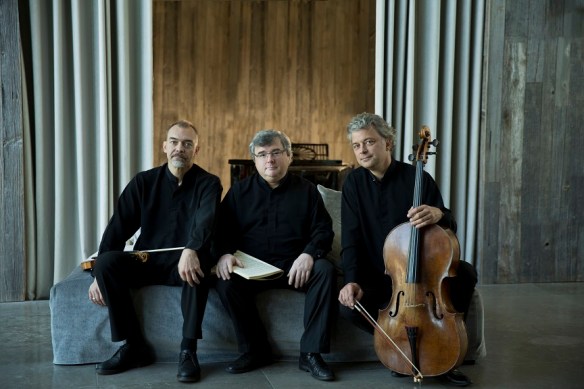
Wigmore Mondays: Trio Wanderer & Christophe Gaugué play Fauré & Haydn

Trio Wanderer (above – Jean-Marc Phillips-Varjabédian (violin), Raphaël Pidoux (cello), Vincent Coq (piano); Christophe Gaugué (viola)

Haydn Piano Trio in A flat major HXV:14 (1790) (1:47-20:05)
Fauré Piano Quartet no.2 in G minor Op.45 (1886) (23:34-54:44)

Wigmore Hall, London; Monday 11 June 2018

You can listen to the BBC Radio 3 broadcast by clicking here

Written by Ben Hogwood

The piano trio is a common means of expression in chamber music, but in the last few years its live profile has taken a hit, with the retirement of the legendary Beaux Arts and Florestan Trios.

Having achieved 25 years together as an ensemble, Trio Wanderer have a very important role to play in keeping this music visible (and audible!) to concertgoers, and at the Wigmore Hall they demonstrated why they are such a highly regarded act.

It is gratifying to note their most recent recording goes back to Haydn, and a choice selection of his Piano Trios. The composer – acknowledged godfather of the symphony and the string quartet – played a similarly important role in raising the profile of the Piano Trio. Initially his works viewed the violin and cello as accompanying forces rather than dominant melodic instruments, but by the end of his forty or so works in the genre he was showing signs of bucking that trend.

The Piano Trio in A flat major is numbered relatively early in the catalogue and dates from the composer’s second visit to London, where the pianist in its 1792 premiere was the fledgling composer Johann Nepomiuk Hummel. It is a highly appealing work, and here enjoyed a performance of sunny disposition from Trio Wanderer.

They were however alive to some of the work’s unexpected diversions, noting the surprise of the two-bar silence in the first movement (from 1:47 on the broadcast), and the uncertainty of its central section as the main theme underwent some quirky development.

The slow movement (9:40) took the form of an aria, with a sweet tone from violinist Jean-Marc Phillips-Varjabédian, and this led straight to an exuberant finale (14:44), with nimble passage work and cross rhythms from pianist Vincent Coq. This was one of Haydn’s forays into a ‘rare’ key – A flat major being difficult for strings to play in – but the Wanderer made it a highly enjoyable one.

The Fauré Piano Quartet no.2 in G minor was a tour de force. This is a wonderful piece, bursting with energy and passion but also taking time in its slower movements for deep, romantic thought. The stormy outer movements were contrasted by a slow movement that here vividly recalled the sleepy church bells of the village of Cadirac, on which Fauré’s writing is based.

The surging opening theme (from 23:34) set the tone, perfectly phrased, with the balance – often tricky to weight with such an active piano part – ideally set. Christophe Gaugué’s viola delivered a beautiful second theme (24:27), while the ensemble in unison found a rare moment of tenderness in this movement for the third (26:21). When the main tune returned (29:36) there was even more intent and power behind it, brilliantly conveyed.

The scherzo (33:50) was dazzling, Vincent Coq somehow phrasing a really tricky theme to perfection, with precise rhythmic accompaniment from the three strings. The slow movement (37:34) undulated softly, bringing visions of hazy fields in hot weather, before the reverie was abruptly shattered by the finale (46:57), back into the passionate groove, delivered with impressive intent by the ensemble. Tempo choices were assertive – just the right side of aggressive – and the final sweep towards the finish carried all before it!

Further listening

You can hear recordings of these works made by the Trio Wanderer for Harmonia Mundi. The Haydn has only just been released as part of a double album of some of the composer’s finest Piano Trios; the Fauré is recorded with Antoine Tamestit and dates from 2010.

Fauré has more wonderful chamber music up his sleeve, and if you enjoyed this performance of the Piano Quartet no.2 then the Piano Quintet no.1 is highly recommended as a next step:

Yuki Ito & Sofia Gulyak play Rachmaninov at the Wigmore Hall

Yuki Ito (cello, above), Sofia Gulyak (piano, below)

Rachmaninov
2 Pieces for cello and piano Op.2 (1891/2)
from the Morçeaux de fantaisie Op.3: Élégie; Mélodie; Sérénade (arr. Ito, Mélodie arr. Vlasov (1892)
Prelude in G flat major Op.23/10 (arr. Brandukov) (1903)
Lied for cello and piano (1890)
5 Songs: Morning Op.4/2 (1892), I the silence of the secret night Op.4/1 (1892), Lilacs Op.21/5 (1902), How fair this spot Op.21/7 (1902), Spring Waters Op.14/11 (1896) (arr. Ito)
Cello Sonata in G minor Op.19

Wigmore Hall, London; Saturday 2 June 2018

Written by Ben Hogwood

Rachmaninov’s music for cello and piano dates from the early part of his life, starting in teenage student years and working through to the mature sonata of his late twenties. With the addition of some judicious arrangements, Yuki Ito and Sofia Gulyak built a most attractive program for this concert, the last in the AVEX Recital Series at the Wigmore Hall for 2017-18.

They began near the start, with Two Pieces published as Op.2 in 1892. Rachmaninov’s gift as a melodist was already clear, as was his affinity with the piano, which already had a few demands placed on it here. Gulyak, as she did throughout the concert, proved an ideal partner, reining in the big textures where appropriate in the second piece, an attractive Danse orientale, so that Ito’s probing melodic line could still be heard.

A series of arrangements – maybe a couple too many in context – followed, several of them made by Ito himself. Rachmaninov’s songs have a register that fits the cello perfectly, as do the early piano pieces – and the Elegie and Sérénade, both Ito arrangements from the Morçeaux de fantaisie published as Op.3, worked well alongside a Mélodie arranged by Alexander Vlasov.

Of the following pieces the rich lower register of the Lied, an original cello piece, was beautifully brought to the fore by the Japanese cellist, while in the song arrangements the ardour surrounding In the silence of the secret night was nicely complemented by the higher arrangement of How fair this spot, and the onrush of the Spring Waters, where Gulyak’s control was exemplary.

And so to the Sonata, by far Rachmaninov’s biggest chamber work. It represents the culmination of his friendship with cellist Anatoly Brandukov in 1901, and is packed full of big tunes and tempestuous fast music. Once again the control and phrasing of Sofia Gulyak was key, and she was extremely attentive to Yuki Ito’s sensitive phrasing in the big-boned statements of the first and fourth movement in particular. The second movement scherzo, fleet of foot, had a tense drama about it, while the slow movement’s romantic tunes were lovingly delivered by Ito. The players returned for an encore, which was naturally more Rachmaninov – the Vocalise Op.34/14.

This was a fine chamber music concert, full of good things, with both players receptive to Rachmaninov’s style, phrasing and emotion. Yuki Ito is a fine young cellist, and has great things ahead of him – and as long as he continues to surround himself with musicians of the calibre of Sofia Gulyak, he will surely do extremely well.

For more information on Yuki Ito and Sofia Gulyak’s new disc of Rachmaninov, head to the Champs Hill website or listen on Spotify below: