Listening to Beethoven #77 – Canon in G major

Plaster casts of Ludwig van Beethoven’s seals, probably made in the Beethoven House in Bonn © Beethoven-Haus Bonn

Canon in G major Hess 247 for three voices (1795, Beethoven aged 24)

Dedication not known
Duration 1’10”

Listen

Background and Critical Reception

The canons are a fascinating but very little-known part of Beethoven’s output – and they reveal plenty about him as a composer. Many of them are short pieces but often with a particular friend or person in mind, and often shot through with humour and witty musical play.

The first example we hear is for three ‘voices’ – as in, three distinct instrumental voices.

Thoughts

This short piece has an attractive lilt in triple time, rather like a Minuet – and . Beethoven repeats his idea several times, and it is catchy enough to have worked its way into your head by the end of its 70-second stay.

Recording used and Spotify link

Benjamin Lichtenegger, Lara Kusztrich, Luka Kusztrich (violins) (Naxos)

An attractively performed version.

You can chart the Arcana Beethoven playlist as it grows, with one recommended version of each piece we listen to. Catch up here!

Also written in 1795 Salieri Il mondo alla rovescia

Next up 6 Minuets WoO 10 (orchestral version)

Let’s Dance – Róisín Murphy: Róisín Machine (Skint / BMG)

Róisín MurphyRóisín Machine (Skint / BMG)

reviewed by Ben Hogwood

What’s the story?

A new Róisín Murphy album is always a cause for celebration – whether it has been with her band Moloko or, in more recent times, a solo record in collaboration with a number of electronic music luminaries. This time around Róisín Machine, her first long player in four years, sees her working once again with Crooked Man aka Richard Barratt.

As if the new album was not enough Murphy has been busy making visual complements to the music under lockdown.

What’s the music like?

It is difficult to imagine a more stylish artist than Róisín Murphy. Even with Moloko it felt like her expressiveness matched the music in an effortless way, which made the finished result even more stylish and cool. Little has changed under her own name, though if anything the music is more dance based and the vocals even more meaningful.

Róisín Machine tells a story, threaded beautifully from start to finish, and as a result it works best when heard in a complete span. There are many telling lyrics, but the opening gambit, “I feel my story’s still untold, but I make my own happy ending”, sets the scene perfectly, after which Murphy and Barratt concoct a persuasive, loping groove.

Questions are asked as the album progresses. Kingdom Of Ends finds the singer “waking up every morning, thinking what the hell am I doing?”, while even during the cool chic of Shellfish Madamoiselle, with its bumpy beats and warm synthesizers, she feels that “I shouldn’t be dancing at a time like this”.

Difficult, though, when the music is so persuasive. The groove and vocal of Something More are a perfect match, the stylish slow disco-house brilliantly done. The same, too, goes for the effortless groove of Incapable. For the last two tracks, Narcissus and Jealousy, the tempo quickens and the pulse rate too, Róisín more obviously on the dancefloor.

The most compelling stories are told in Murphy’s Law, however, where she sings of how “I’d rather be alone than making do and mending”, but finds her instincts are pulling her in different directions.

Does it all work?

Yes – either as a single whole or as individual tracks, Róisín Machine is brilliantly worked through. The singer sounds completely at home, but at the same time there are thought provoking lyrics and feet-provoking grooves.

Is it recommended?

Wholeheartedly. This is an album that embodies the saying ‘Style never goes out of fashion’. Róisín Murphy remains one of our finest vocalists, and like a fine wine is just continuing to improve with age. Richard Barratt proves the ideal match in the production department, and together the two have made one of the best pop albums of the year.

Stream

Buy

Listening to Beethoven #76 – 6 Minuets for piano


line art drawing of Minuet dance from the Archives of Pearson Scott Foresman, donated to the Wikimedia Foundation 

6 Minuets, WoO 10 for piano (1795, Beethoven aged 24)

no.1 in C major
no.2 in G major
no.3 in E flat major
no.4 in B flat major
no.5 in C major
no.6 in D major

Dedication not known
Duration 11′

Listen

Background and Critical Reception

As he grew accustomed to Vienna, Beethoven was increasingly aware of the potential for composers to make a name for themselves by writing music for dancing in the ballroom.

This was to bear fruition through sets of German Dances and Minuets for orchestra, but first we witness Beethoven trying out his skills on the piano. There is the possibility these six works were written for instruments but if they were that version is no longer available.

Instead we have a set of piano pieces that have caught on among amateurs and musicians in their infancy, the Minuet in G – no.2 in the set – becoming especially popular for Associated Board exams in the UK. Each of the Minuets has a contrasting ‘trio’ section in the middle, traditional among these dance forms – and Beethoven generally uses that to make more flowing melodies to complement the light-footed main material.

Thoughts

This is genial music for carefree music making. Beethoven writes the six pieces in a clearly defined sequence, the keys of each linking together nicely.

The first minuet is lively and slightly cheeky with its main theme. The second, the well-known Minuet in G, has more of a march-like quality, with a catchy tune, while its trio feels like a variation on the theme. We move to E flat major for a bold third tune, with a few chromatic leanings in the trio, then an amiable fourth minuet with a syncopated trio. The fifth minuet has a nagging and rather catchy motif, before Beethoven signs off back in C major with a bold and uplifting dance.

These pieces may be polite but fulfil their function comfortably, raising more than a few smiles in the process.

Recordings used and Spotify links

Mikhail Pletnev (Deutsche Grammophon)

Jenő Jandó (Naxos)

Pletnev applies a few idiosyncrasies to his reading but is otherwise very enjoyable. Jandó’s version links all six minuets together as one track, performing them as the one linked piece Beethoven possibly intended.

You can chart the Arcana Beethoven playlist as it grows, with one recommended version of each piece we listen to. Catch up here!

Also written in 1795 Gyrowetz Three Flute Quartets Op.11

Next up 3-Voice fugues Hess 237

Online music recommendations – Oxford Lieder Festival

Over the last few years the Oxford Lieder Festival has established itself as one of the most attractive prospects in the autumn events calendar for classical music. Given the challenges faced by the sector in this most trying of years, it gives great pleasure to report that the team, led by artistic director Sholto Kynoch, have gone above and beyond the call of duty to present this year’s model.

An online extravaganza lasting ten days, the festival continues its penchant for the use of attractive venues in the city, presenting them in an online format with Tall Wall Media which is both easy to navigate and admire.

The artistic standard remains as high as ever, as does the programming. Viewers on Saturday were treated to James Gilchrist immersing himself in ancient lute songs, with the florid tones of Elizabeth Kenny alongside, from where we switched to the Hollywell Music Room. Here we found the redoubtable Dame Sarah Connolly (above) and Eugene Asti in a program including Schumann’s Frauenliebe und -leben and a rapt account of Mahler’s Rückert-Lieder, time standing still during the final two songs, a darkly atmospheric Um Mitternacht and an expansive Liebst su um Schönheit.

Many of the Oxford Lieder concerts include a slot for emerging artists, a healthy recognition of the outstanding young talent coming through in the world of song. On this occasion it was bass William Thomas who lent his fulsome tones to a quintet of Schubert songs. We also heard a nicely linked quintet songs from Finzi, Quilter, Haydn and Geoffrey Bush.

The festival has a very healthy instinct for presenting songs in context and giving them the right level of background through guest musicological experts. Natasha Loges illuminated Brahms’ Lieder contributions with music from baritone James Atkinson and pianist Ana Manastireanu while on Saturday 17 October, the festival’s final day, we will get a fascinating chance to explore the song prior to Beethoven in the company of baritone Stephan Loges and Eugene Asti.

On Tuesday 13 October, the lunchtime concert found tenor Robin Tritschler (above) giving a superb hour of music with pianist Graham Johnson from the Hollywell Music Room, journeying round the Zodiac with all the spirit of first-time voyagers. Travelling through works from Barber, Schubert, Ives, Rebecca Clarke and Argento, their ultimate destination was the Songs of the Zodiac of Geoffrey Bush. This inventive cycle provides a setting for each sign, helpfully introduced by Johnson before the two offered vivid characterisation. Here there was plenty of wit but tenderness too.

The following lunchtime tenor James Gilchrist and pianist Anna Tilbrook included a substantial world premiere of a work by Michael Zev Gordon, a composer Gilchrist studied with at King’s College Cambridge in the 1980s. There was a rather nice irony about a work with its genesis in Cambridge receiving its first performance in Oxford, and Gordon’s Baruch – Ten Propositions of Baruch Spinoza showed itself to be an impressive piece indeed.

Fusing elements of chant and more modern, English song – Holst’s great Betelgeuse came to mind in the final Ex hoc tertio cognitionis… – it was a dramatic performance that definitely warrants a further viewing. The cycle started with Gilchrist using a harsher tone but as it unfolded the voice blossomed to fill the space around, helped by the sensitive balance provided by Tilbrook. In the words of Gordon, these were ‘aphorisms meant to be heard and pondered; here sung and pondered’. Gilchrist complemented this with an affectionate and yearning account of a work he has known since childhood, Beethoven’s An die ferne Geliebte – the first clearly defined song cycle.

Today’s lunchtime concert was rather special with Ian Bostridge (above) joined by pianist Saskia Giogini at Merton College Chapel in a characteristically intense account of Britten’s Canticle I: My Beloved Is Mine. The camera work should be mentioned here, as it captured the glorious chapel in an ideal complement to Britten’s arrangements of Five Spiritual Songs, where Bostridge was masterly, and in the beautiful Bach, the arias Ich habe genug, from the cantata of the same name, and Der Ewigkeit saphirnes Haus (from Laß, Fürstin, laß noch einen Strahl). Taken on their own, these two – with the Oxford Bach Soloists – reminded us of the true value of live performance, even when given online in these restricted times.

The Oxford Lieder Festival continues until Saturday 17 October, where it will include a performance of Schubert’s Schwanengesang from tenor Christoph Prégardien and pianist Michael Gees. Before then you can enjoy concerts from baritone Benjamin Appl and Sholto Kynoch, mezzo-soprano Kitty Whately and Simon Lepper and a keenly anticipated collaboration between soprano Lotte Betts-Dean and guitarist Sean Shibe. All concerts are available online until 1 November, or 15 November with the event’s Pioneer Pass – which is much appreciated if you want to catch up with recommended concerts from Carolyn Sampson and Joseph Middleton, not to mention the Hermes Experiment!

For further details visit the festival website

Listening to Beethoven #75 – Variations on ‘Là ci darem la mano’ from Mozart’s ‘Don Giovanni’

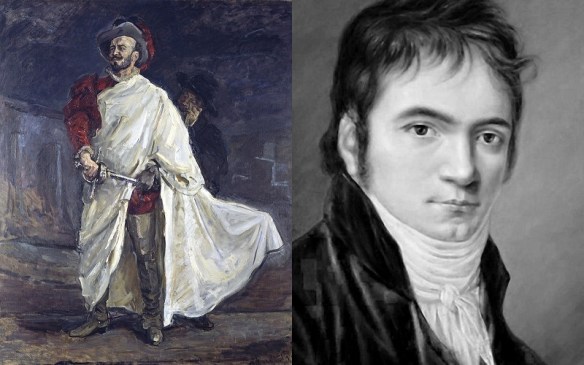
Portrait of Francisco D’Andrade in the title role of Don Giovanni by Max Slevogt (1912) / Young Beethoven

Variations on ‘Là ci darem la mano’ from Mozart’s ‘Don Giovanni’ WoO 28 for 2 oboes and cor anglais (c1795, Beethoven aged 24)

Dedication Not known
Duration 9′

Listen

Background and Critical Reception

This set of variations is closely related to the Trio in C major for the same instrumental combination, published later in Beethoven’s life as Op.87. The unusual trio of two oboes and cor anglais appears to have been inspired by Johann Wenth, a contemporary oboist and composer.

It is possible these variations were intended as a finale to the bigger work, sharing as they do the overall key of C major. There are eight variations and a coda.

Thoughts

Beethoven has an ability of making this trio sound like a much bigger ensemble right from the off. The theme gets a relatively polite outing, but soon Beethoven rolls his sleeves up to have some fun. Variation 2 gives the cor anglais a thorough workout with a very busy part in triplets, then a gentle Andante and spikier fourth variation work the players’ control.

The oboe has a flurry of notes marked ‘leggiero’ (‘lightly’) for the fifth variation, a real exercise in breath control, before the doleful tones of the cor anglais come to the fore in a straight faced minor-key variation.

To offset this, Beethoven writes a spiky and witty seventh variation, before the rich colours of the flowing eighth variation. A substantial coda follows, with a perky fugue that shows Beethoven putting into practice his recent teaching from Albrechtsberger. The three instruments then move in stepwise fashion before the piece fades to a graceful and more thoughtful close.

It is easy to see the link between this work and the Trio in C Op.87 for the same instrumental combination and mood, and these variations could effectively form an encore for that piece. They show Beethoven can write attractively and very skilfully for domestic music making, which like the best chamber music proves equally effective in concert as it does in private.

Recordings used and Spotify links

Heinz Holliger, Hans Elhorst (oboes), Maurice Bourgue (oboe) (Deutsche Grammophon)

Consortium Classicum (Christian Hartmann and Gernot Schmalfuß (oboes), Matthias Grünewald (cor anglais)

Les Vents FrançaisFrançois Leleux (oboe), Paul Meyer (clarinet), Gilbert Audin (bassoon) (Warner Classics) – tracks 8 to 16

The recording led by Heinz Holliger has aged a little but is still a lot of fun. Les Vents Français substitute the second oboe and cor anglais parts for a clarinet and bassoon, which gives a more rounded texture. The Consortium Classicum version, like their account of the Trio Op.87, is very well played too.

You can chart the Arcana Beethoven playlist as it grows, with one recommended version of each piece we listen to. Catch up here!

Also written in 1795 Haydn Berenice, che fai Hob.XXIVa:10

Next up 6 Minuets WoO 10