Listening to Beethoven #117 – Quintet for piano and wind in E flat major Op.16


The Freyung in Vienna, from the North-West by Bernardo Bellotto (1758)

Quintet for piano and wind in E flat major Op.16 for piano, clarinet, oboe, horn and bassoon (1796-7, Beethoven aged 26)

1. Grave – Allegro ma non troppo
2. Andante cantabile
3. Rondo (Allegro ma non troppo)

Dedication unknown
Duration 28′

Listen

Background and Critical Reception

On his return to Vienna after the successful Berlin trip, Beethoven ‘settled down to a relatively calm life’, writes Daniel Heartz, ‘where he had many well-paying piano pupils, especially young ladies of noble rank. His health was good, and he was composing some of his most charming chamber music at the time.’

Examples of that charm can be found in the Quintet for piano and wind, where we find Beethoven returning to E flat major – his ‘go to’ key for wind. The work is modelled on Mozart’s Quintet in E flat major K452, completed in 1784 for the same instrumental combination of piano, clarinet, oboe, horn and bassoon. One of Beethoven’s closest friends, Hungarian cellist Nikolaus Zmeskall von Domanovecz, had the autograph score of the Mozart, from where Beethoven took his acquaintance.

Each work is similar in form, cast in three movements. There is a slow introduction to the first movement, a slow movement in B flat major, and a carefree Rondo to finish. Yet the writing itself remains individual, and Richard Wigmore observes how ‘Beethoven…characteristically sets the piano and wind quartet in opposition, so that the outer movements at times resemble a chamber concerto for piano and wind’.

Lewis Lockwood is more critical, lamenting a lack of drama and passion in the first movement when comparing it with the Sonata for piano and cello in G minor Op.5/2. ‘The quality improves in the beautiful opening theme of its slow movement’, he says, but the finale is found ‘lacking Mozart’s perfect blend of imagination and restraint’.

The quintet was premiered on 6 April 1797, at a concert in Ignaz Jahn’s restaurant in Vienna.

Thoughts

It is true, the Quintet is less dramatic than the Cello Sonata – but the two are surely written for very different audiences. This piece would have been for more domestic, intimate music making among friends rather than trying to impress royalty – and its warm textures and collaboration between the quintet confirms that.

As with all the works for wind we have encountered so far, the sonorities are lovely – right from the stately and serious introduction, given in unison by all five instruments. Soon this cuts to a jovial Allegro with winsome melodies. The second movement is a lovely contemplation, introduced by the piano before the lovely sonority of the wind instruments appears once more. There is a lovely horn solo halfway through that steals the show.

The third movement has the catchiest theme, and as it is a Rondo we hear it often, dancing with an attractive turn of foot. It is one of Beethoven’s best earworms so far.

The Beethoven and Mozart quintets fit together hand in glove, which is why they appear on disc together so often. Yet Beethoven’s is a complement rather than a copy, a charming work both to play and to listen to.

Recordings and Spotify link

Pascal Rogé (piano), London Winds [Michael Collins (clarinet), Gareth Hulse (oboe), Richard Watkins (horn), Robin O’Neill (bassoon)]

Gaudier Ensemble [(Susan Tomes (piano), Richard Hosford (clarinet), Douglas Boyd (oboe), Jonathan Williams (horn), Robin O’Neill (bassoon)

Robert Levin (fortepiano), Academy of Ancient Music Chamber Ensemble [Antony Pay (clarinet), Frank de Bruine (oboe), Anthony Halstead (horn), Danny Bond (bassoon)

There is a lovely warm glow to the Gaudier Ensemble slow movement, with flowing piano and a Rondo that dances lightly. The colours are a little sharper in the period instrument version from Robert Levin and the Academy of Ancient Music Chamber Ensemble, but this adds more primary colours to the music, with an appealing rasp to the horn and a crisp clarity to the clarinet, oboe and bassoon

Minute-long clips from the Gaudier Ensemble recording can be heard on the Hyperion website here

You can chart the Arcana Beethoven playlist as it grows, with one recommended version of each piece we listen to. Catch up here!

Also written in 1797 Haydn 6 String Quartets, Op.76 (The Erdödy Quartets)

Next up Piano Quartet in E flat major Op.16
Listening to Beethoven #116 – 2 Rondos Op.51


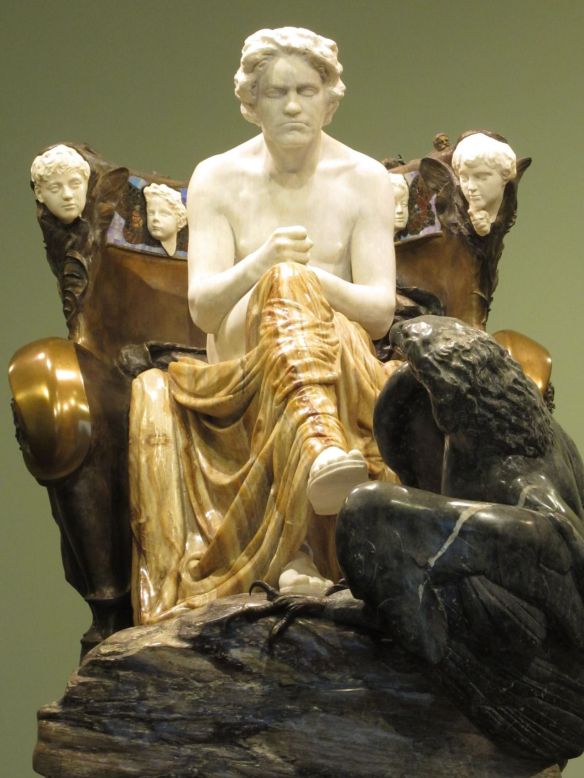
Max Klinger´s Beethoven monument in Leipzig (1902)

2 Rondos Op.51 for piano (thought to be from 1796-7, Beethoven aged 26)

no.1 in C major
no.2 in G major

Dedication Countess Henriette von Lichnowsky (no.2)
Duration 15′

Listen

Background and Critical Reception

In the 1790s Beethoven only assigned an opus number to new works in a ‘sonata’ form, while compositions such as these two Rondos had to wait until later for publication. Very little is written about them in Beethoven tomes, other than the second piece carrying a dedication to Countess Henriette von Lichnowsky.

The two pieces were seemingly written apart, but dates are inconclusive. Keith Anderson, writing in the booklet notes for Jenő Jandó’s Naxos recording, looks at the musical content. On no.1, ‘marked Moderato e grazioso, it offers a principal theme in characteristic singing style, contrasted in particular with a more dramatic C minor episode, after which the main theme returns in various guises.’

On the second, ‘with the opening direction Andante cantabile e grazioso, the rondo contains an E major episode of greater brilliance and further contrast before the final varied return of the main theme.’

Thoughts

Keith Anderson’s observation on the singing style of the first Rondo rings true. It has grace and poise, occasionally feels like it’s going to break out into more of a dance piece but otherwise is elegant…until the second section, where an unexpectedly fierce C minor asserts itself. There is a Mozartian simplicity at play in the way Beethoven makes a little go a long way.

The second rondo, a substantial piece lasting nearly ten minutes, is also quite graceful in its main theme but has these intriguing, flickering scales that travel up through the parts. The section ‘B’, in the relatively distant key of E major, feels like an exploration towards the unknown. There is a bit of an outburst, before eventually returning to the relative safety of the main material.

Both pieces are an assertion of Beethoven’s confidence in writing graceful but substantial material, showing he can comfortably hold the listener’s interest through an economy of works. They already feel like subtle pointers towards his later style.

Recordings used and Spotify links

Radu Lupu (Decca)
Alfred Brendel (Decca, no.1)
Ronald Brautigam (BIS)
Jenő Jandó (Naxos)
Rudolf Buchbinder (Teldec)
Olli Mustonen (BMG)

Some excellent versions here…but time and again I found myself returning to Radu Lupu for his compelling playing.

You can chart the Arcana Beethoven playlist as it grows, with one recommended version of each piece we listen to. Catch up here!

Also written in 1797 Dussek Duet for harp and piano Op.38

Next up Quintet for piano and wind in E flat major Op.16

On Record: Minotaur Shock: Qi (Bytes)

reviewed by Ben Hogwood

What’s the story?

David Edwards returns under his Minotaur Shock pseudonym with Qi, a six-part suite recorded on an Electron Digitone synthesizer. The idea of recording an extended set of pieces on a single piece of equipment seems to be catching on during lockdown, providing inspiration for a number of bedroom-based musicians, yours truly included!

What’s the music like?

Enjoyably instinctive. Edwards was very reluctant to go back to the tracks once recorded, delivering each in one or at most two takes. It means that the music-making is very much ‘in the moment’, and ensures the cells of melody that Minotaur Shock works with are kept fresh in their development.

As Qi unfolds it becomes clear that Edwards actually has an embarrassment of ideas, many of them flavoured with late 1980s and early 1990s techno and all of them linking together beautifully. The mood is friendly but on occasion heavier grooves punch in, so that tracks like Qat and QCD impress with their inventive breakbeats. The latter floats in on the wind like a set of chimes before some nice crossrhythms set up an unexpected but rather stately chorale.

Qui, the first track, shows how substantial these structures can become, leading to a swirling snowstorm of a loop where the keyboard carries all before it. Qis, the glittering closing section, and Qua are largely without percussion, but still have a natural rhythmic momentum.

Does it all work?

Yes. Edwards keeps things moving, nothing outstays its welcome, and the rich well of melodic inspiration continually pushes out new ideas.

Is it recommended?

Heartily. Minotaur Shock is very much on form here, with a warm-hearted half hour of electronic invention to enjoy.

Stream

Buy

In concert – Berliner Philharmoniker / Kirill Petrenko: The Golden Twenties – Weill & Stravinsky

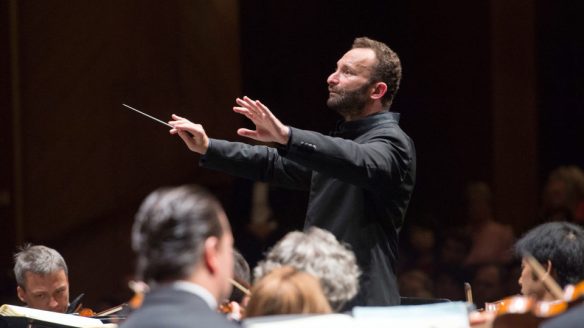
Michael Spyres (Oedipus), Ekaterina Semenchuk (Jocasta), Andrea Mastroni (Tiresias), Krystian Adam (Shepherd), Derek Welton (Creon, Messenger), Bibiana Beglau (speaker), Men of the Rundfunkchor Berlin, Berliner Philharmoniker / Kirill Petrenko (above)

Weill Symphony no.1 in one movement (1921)
Stravinsky Oedipus Rex (1927)

Philharmonie, Berlin
Saturday 13 February (review of the online broadcast)

Written by Ben Hogwood

“This is no little hicktown. This is one helluva city!”

The words of Bertolt Brecht, writing about his home city in the song Berlin im Licht, set to music by Kurt Weill. It is a sentiment brought to the front of The Golden Twenties, an online festival from the Berliner Philharmoniker running through February, examining ‘a metropolis of contrasts…the epicentre of artistic modernism’.

The festival’s first concert, streamed from the Philharmonie via the orchestra’s Digital Concert Hall, featured the Berliner Philharmoniker’s first ever performance of Weill’s single-movement Symphony no.1 from 1921. This seems like a remarkable historical oversight, even for a work as little-known, but the performance gave this student piece the best possible platform to reach a new audience.

After a thoughtful and revealing introduction from the orchestra’s concertmaster Noah Bendix-Balgley, the Symphony’s distinctive main motive rang out like an extended peal of bells. With this arresting opening Weill laid out the ambition of his work, writing as a student of Busoni looking to impress. This bold statement was complemented by intricate and intimate solo episodes through the inner workings of the orchestra.

Kirill Petrenko conducted a cohesive and convincing account, making sense of the more congested writing and bringing out the parallels with Hindemith and Schoenberg, which he spoke about in the interval. The work’s fulsome harmonies had plenty of deep colour, and it was revealing to hear the counterpoint in such detail. The double basses made an eerie contribution through a fugal episode which wound its way up through the orchestra at several points in the work, before an impressive climax and a darkly shaded postscript. Petrenko nailed the scope of the piece but ensured there was plenty of room for the phrases to breathe individually.

Stravinsky’s Oedipus Rex could hardly have been a more appropriate counterpart for a concert filmed behind closed doors. With its chilling opening statement, ‘The plague is destroying us!’, sung by a socially distanced male chorus from the choirstalls, it was a stark reminder of our current, locked down predicament – and struck an inevitable parallel with the state of the performing arts currently.

This 50-minute opera / oratorio is one of the most notable achievements in Stravinsky’s so-called ‘neo-classical’ period, a dramatic response to Sophoclese‘s tragedy that is not the easiest to digest but which packs an expressive punch.

Petrenko’s incisive conducting brought its message home with a lasting power, and in the performance he was aided by a strong cast of soloists. Michael Spyres’s tenor dominated in the title role, his ringing tones promising deliverance but ultimately winding up in great anguish before the end. He was given ample support by Creon (bass-baritone Derek Welton) and mezzo-soprano Ekaterina Semenchuk, whose fulsome contribution was made in a bright red dress bringing her into dramatic contrast with the funereal black of chorus and orchestra.

Petrenko kept things moving throughout, with virtuoso contributions from woodwind and percussion in particular. In spite of their social distancing the chorus lost none of their power, playing out the tragic story with detail but an ominous inevitability. Holding the threads together was narrator Bibiana Beglau (above), an excellent choice and with strong proejction in the empty hall.
Highlights could be found in the assertive delivery of Welton in the ‘Avenge Laius’ section, while Spyres gave an impassioned promise that he would solve the riddle of the Sphinx. The chorus alternated between a horror at the plague, a sorrowful realisation of the plight of Oedipus, which was particularly moving, and the cold, regretful end.

This was an auspicious start to what promises to be a revealing celebration of Berlin and particularly Weill in the 1920s. The next concert on 16 February will look at the composer’s better-known Second Symphony, while this and future instalments will include the music of HindemithRichard Strauss and Eisler. If the performances are as good as these then online attendance is highly recommended.

The next concert in The Golden Twenties season can be seen and heard at the Berliner Philharmoniker website


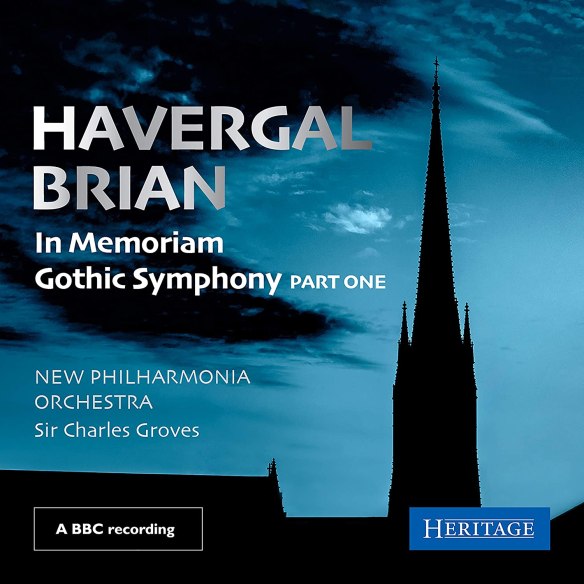
On record: New Philharmonia Orchestra / Sir Charles Groves – Havergal Brian: In Memoriam & Gothic Symphony Part 1 (Heritage Records)

New Philharmonia Orchestra / Sir Charles Groves

Brian
In Memoriam (1910)
Symphony no.1 in D minor, The Gothic (1919-27) – Part One

Heritage Records HTGCD172 [59’31”]
Producer Robert Simpson

Recorded 10 October 1976 in live performances at Royal Albert Hall, London, UK. Released by arrangement with BBC Studios, with funding from the Havergal Brian Society

Reviewed by Richard Whitehouse

What’s the story?

The Heritage label renews its archival coverage of Havergal Brian with this disc of works given at the last concert of those centenary events in 1976, including what is still the only professional account of Part One from the Gothic Symphony heard separately, as sanctioned by the composer.

What’s the music like?

Following three concerts at Alexandra Palace, this final one took place at the Royal Albert Hall. even if a planned performance of the Gothic had to be shelved through financial considerations, a second half featuring Berlioz’s arrangement of La Marseillaise and his Symphonie funèbre et triomphale was no easy option. At the helm was Charles Groves who, having recently given the Ninth Symphony at the Proms, proves a Brian interpreter of real perception. Such is evident in his account of the tone poem In Memoriam, among the best of its composer’s earlier works and unheard for almost 55 years. Whether prompted by thoughts as to the end of an era, or by more personal considerations (its initial title having been ‘Homage to an Artist’), the trajectory of its three continuous ‘scenes’ from impulsive vehemence, via searching contemplation, to sustained affirmation is a striking one made more so through the finesse of Brian’s tonal thinking and his resourceful scoring. These are qualities to the fore with Groves’s interpretation, as convincingly shaped as it is eloquently rendered, and most likely the finest that this work has so far received.

If the performance of Part One of the Gothic Symphony is not quite as good, it more than makes the case for this to be heard as an autonomous entity. Tempi are slightly more measured overall than those of Sir Adrian Boult (Testament) or Martyn Brabbins (Hyperion) in their live readings at the same venue, but this enables Groves to wrest unity from the three movements – not least by bringing those extremes of motion and mood of the Allegro into closest accord, while ensuring a cumulative momentum across the whole. The Lento has all the necessary ‘expressiveness and solemnity’, and at a speed flexible enough to contain its volatile progress towards a powerfully rhetorical climax then a lingering postlude. The Vivace more than fulfils its function as a finale: Groves is mindful to integrate the increasingly disjunct scherzo-and-trio episodes, then keeps a firm hold on its explosive central outburst and surreally imagined ‘night flight’, on the way to a peroration of a grandeur intensified by its tonal audacity and afforded pathos in its limpid coda. That the rather bemused applause has not been retained is maybe of no consequence in context.

Does it all work?

Yes, given Brian always did things his way so that his music often pivots between the visionary and the reckless, yet one where he is almost always justified. Certainly, Groves’s In Memoriam is preferable to the well-paced if technically limited account by Geoffrey Heald-Smith with the City of Hull Youth Symphony Orchestra (Cameo Classics), as also the capably played if most often stop-go approach of Adrian Leaper and the National Symphony of Ireland (Naxos). There is no other version of the Gothic’s Part One, in which Groves’s trenchant advocacy vindicates the decision.

Is it recommended?

Very much so. The (unnamed) remastering engineer has done an admirable job of enhancing the BBC sound, not least in minimizing the bronchial audience contribution on that autumn evening now almost 45 years ago, and John Pickard’s booklet notes are a model of reasoned enthusiasm.

For further information on this release, and to purchase, visit the Heritage Records website. Heritage also offer a recording of Brian’s first opera The Tigers here, and the first commercial recordings of the composer’s music here