Switched on – Celebrating Daft Punk

As of yesterday, it’s ‘au revoir’ to one of the best and most influential outfits in dance music.

Daft Punk, the duo behind massive hits Around The World, Digital Love, Get Lucky and more – not to mention three huge albums in Homework, Human After All and Random Access Memories – have decided to call it a day. The chances are this decision was made some time ago, for it is a long time since we have heard from them in a collaborative sense, their last released work being two brief cameos on The Weeknd’s Starboy album in 2016.

With Thomas Bangalter and Guy-Manuel de Homem-Christo going their separate ways, it’s a good time to consider their impact on music and culture from the 1990s until now.

I can well remember when Da Funk came out, sneaking through the underground and on to an unexpected initial home, Glasgow label Soma Recordings. It was unusually slow for the techno label, and more guitar-laden than their roster at the time – but label heads Slam – aka Stuart McMillan and Orde Meikle – spotted its potential. The instantly recognisable riff found a home in Chemical Brothers live and DJ sets, like a distorted version of Kraftwerk in the way it strutted across the dancefloor – and in the way it translated effortlessly to radio.

Daft Punk built on this with imaginative samples and utterly brilliant videos – both combining to mesmerising effect on their second UK top 10 hit, Around The World:


Homework, their first long player, appeared in many a ‘best of 1997’ list – by which time the pair had moved onto Virgin, their logo uncannily matching that of their new label. Four years later the second album, Discovery, raised them to another level, propelled by their first no.1 single, One More Time:

The breathy vocals from Romanthony (another unexpected Glasgow link) were initially divisive as they sounded exaggerated…but the longer the single loitered on the radio the bigger it became. The lead track on Discovery, it began an album of true dancefloor happiness, which reached giddy heights with Aerodynamic and Digital Love.

These were sleek, funky club cuts with a healthy slab of disco attached, and went perfectly with the robotic image Daft Punk had now created. Harder, Better, Faster, Stronger – the next cut from the album – fared even better, its vocal calling card and riff picked up by Kanye West years later.

Live, Daft Punk were securing a devoted following, with winning sets at Coachella in 2006 and Hyde Park’s Wireless festival the following year. By that time album number three was on the streets. Human After All – good though it was – did not quite hit the heights of Discovery, in spite of Robot Rock and the title track.

By this time French dance music was enjoying a charmed life through the likes of Cassius and Etienne de Crécy, who worked close to Daft Punk and shared mutual influences in their work. Thomas and Guy-Manuel were enjoying success with their own collaborations, too – and we would soon see the fruit of their influence through the likes of Calvin Harris and David Guetta.

The pair’s next direction was unexpected but made total sense, realised in the Tron:Legacy film soundtrack of 2010. Again a little patience was needed on the part of the reviewers and record buying public, and sure enough after a few weeks it was confirmed to be one of the century’s leading soundtracks to date. The plethora of car adverts that still feature Tron:Legacy’s music are a testament to that, and the merging of electronica and orchestra is seamlessly achieved.

An unexpected treat was to follow in 2013, when Get Lucky surfaced – a superstar collaboration that delivered even more than it promised, with the effortless funk of Nile Rodgers’ guitar and the cool-as-California vocals from Pharrell Williams. The chart topping album Random Access Memories also delivered in this respect, though – Lose Yourself To Dance aside – it did not reach the heights of its lead single and even had an underlying melancholy towards the end.

We hardly ever saw their faces, but that was one of Daft Punk’s enduring qualities. They were friendly, robotic types, unable to make music without injecting a huge dose of funk into proceedings. Yet their soundtrack to Tron: Legacy showed there was so much more to their craft – and who knows, we may hear their work for Dario Argento‘s Occhiali Neri which was due to appear in 2020.

Even if we don’t, there is plenty with which we can treasure this duo and their lovable dance music, which makes the dancefloor a brilliant place to be when it’s on. C’est magnifique!

On Record: Django Django: Glowing In The Dark (Because)

reviewed by Ben Hogwood

What’s the story?

Over the course of three albums, Django Django have shown themselves to be a remarkably fluid musical group. Staying clear of genre labels and pigeon holes, they simply make the music that feels right to them in the moment – and Glowing In The Dark, their fourth long player, is no exception.

What’s the music like?

With lean textures, danceable beats and quickly moving basslines, Django Django have made an album of urgency and craft, but with a few surprises along the way too, which befits the way they work.

It is easy to get swept up in the rush of Spirals, a heady opening track with a fluid bassline. It establishes the positive mood with dazzling keyboards, jangly guitars and a catchy chorus – all elements that are kept up with Right The Wrongs.

Charlotte Gainsbourg’s guest appearance on Waking Up will raise a good many eyebrows, but for good reason as the combination works perfectly. Here and elsewhere it is the drums and bass that provide a really strong basis for the music, while the vocals reach back through the 1970s and 1960s for their source material.

There is a slight dip in form towards the end, but Hold Fast and Asking For More ensure the album ends on a high.

Does it all work?

Glowing In The Dark may lose a bit of its brightness towards the end, where the melodies are not quite so strong as they were at the beginning, but other than that it is a very strong album, with regular bursts of inspiration and some really catchy choruses and hooklines.

Is it recommended?

Yes. If you enjoyed the last album Marble Skies then you’ll warm to the winding paths of this one, added to the instinctive feel it has throughout. A record made by friends with a common love of instinctive pop music that pays homage to their record collections but keeps their own identity strong too.

Stream

Buy

You can purchase Glowing In The Dark at the Piccadilly Records website here


Switched On: Grasscut: Overwinter (Lo Recordings)

reviewed by Ben Hogwood

What’s the story?

Overwinter, the fourth album from Brighton duo Grasscut, was conceived in 2018 and 2019 – but its message carries from there to where we find ourselves today, locked down and in need of solace. Andrew Phillips, the principal songwriter, drew inspiration from wintertime walks around their home city, talking with homeless people on the seafront, while also attending marches of protest against the Grenfell tragedy.

At that time he was writing the music for a feature documentary on the disaster, and that writing spilled into Overwinter, conveying the keen desire to move from darkness to light. The same applies today, in the first album the duo have completed since their Lo Recordings debut in 2015, Everyone Was A Bird.

What’s the music like?

Very descriptive, and with an extremely strong sense of time and place. Phillips did much of his walking at either end of the day, and the music reflects the unusual light just before or after darkness. The enchanting first song Return Of The Sun has the wonder of a new start, captured through Marcus O’Dair‘s dappled piano and Phillips’ hushed vocals, which immediately transport the listener to his world. Edges Of Night reaches similar parts, and so does The Branches Of The Tree, by which time the album has taken an upward turn.

The songs are lovingly crafted, with very little percussion – in complete contrast to the duo’s earlier work but leading on naturally from Everyone Was A Bird. The natural world takes pride of place, realised in analogue arrangements with electronic trimming. The gentle bass clarinet undulations of Root & Branch suggest the beginnings of new life, thanks to the playing of Nick Moss, while the strings of the Moscow Bow Tie Orchestra are beautifully managed by conductor Vladimir Podgoretsky.

Does it all work?

Overwinter, heard by this listener for the first time in the ideal conditions of a snowstorm, is a vivid portrait of the UK’s coldest season. It works as well as it does because the nine tracks are arranged to form a single suite whose mood and climate align to the situation in which we find ourselves now. Andrew Phillips’ vocals are just right, a mixture of subtle emotion and clarity, and the arrangements complement them perfectly.

Is it recommended?

Heartily – but with the caveat that listening to this piece of work is even more effective if you have heard the previous three Grasscut albums. That may sound like a promotional sentence, but it’s true – the duo’s musical voyage together is creating music of ever greater substance. Overwinter is their most meaningful statement yet.

Stream

Buy

Talking Heads: Grasscut

Interview with Alec Snook

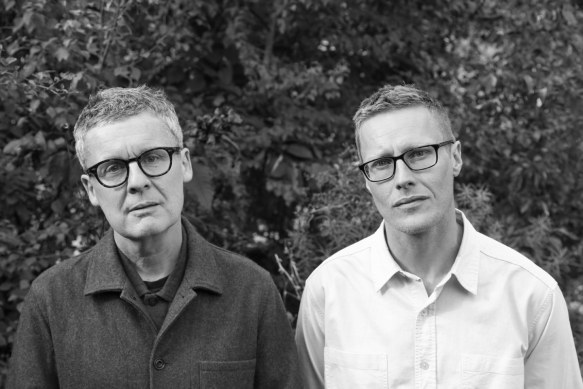
Andrew Phillips and Marcus O’Dair, known to us as Grasscut (above), make a welcome return with their fourth album Overwinter. It is an atmospheric, weather-beaten score with imaginative use of the acoustic instrumentation, blending nicely with the pair’s electronic know-how. In this interview the duo talk about their music-making to date, the writing dynamic between the two, and what they would change about the music industry if they could…

This is the first new Grasscut material for nearly 6 years; tell us what you’ve been up to…

Andrew Phillips I’ve been working on a lot of film and tv scores, won an Emmy and got nominated for a BAFTA, but have also been working on Grasscut material the whole time! (hangs head in shame) It’s just taken a long time to get the balance right! A few times I went back and started again because we wanted to develop and change as we have with every album.
Marcus O’Dair I’ve been working on writing projects, including spending a summer as writer in residence in the North Downs Area of Outstanding Natural Beauty. I’m currently doing something for the European Jazz Network. I’ve also been doing academic projects, including a stint as researcher in residence at Digital Catapult in London, during which I wrote a book, and a project with British Council Mexico.

How did you guys meet and start making music together?

AP We met through a mutual friend in another band in the 00s. Marcus was a music broadcaster and journalist as well as a musician, and was full of interesting thoughts and takes on lots of contemporary music. While we were touring, I started making what turned out to be early Grasscut tracks on my laptop on the tour bus and he was really into it. I think I probably would have poked something out on a very small scale, but Marcus got Ninja Tune to hear it, brought a lot of ambition to the project, and here we are.

Do you employ largely the same techniques used while composing/scoring for TV/film when writing for Grasscut, or do you deliberately change up the process?

AP It’s similar musically really, but for the fact that Grasscut songs often start in my head as lyrics or a phrase. But like a film score, the songs I write for Grasscut are always serving a bigger idea than just themselves: these albums are not just a collection of songs over a period. Also, and I shouldn’t admit this, but sometimes I’ll be writing something for a score and save it for Grasscut, because of its tone, or because it won’t leave me alone.

What does a Grasscut writing session look like, between the two of you?

AP Our collaboration is unusual in the sense that we’ve never written music together – the music lyrics and production are my job. Overwinter is a classic example of how Marcus and I work together: I’d started Return of the Sun and a couple of other tunes in 2017; then Marcus brought Grasscut an arts commission to respond to the Wessex Film and sound Archive in Winchester, and we both worked with a film director colleague of mine there. The resulting film had a profound effect on what then became Overwinter – and there is a track called The Archive on the album as a result. So different elements feed back into the writing process. I think it takes a very special kind of creative trust to work like this, and I really appreciate it.

How has the COVID situation affected this process? Have there been any positives, musically, to come out of the enforced restrictions?

AP I’ve worked remotely with a lot of musicians during Covid on film and TV scores, but like a lot of composers I’ve been doing this for years – the recording session with the string orchestra for Overwinter in Moscow in 2019 was a remote session. You’re communicating with the conductor and orchestra via video link and hearing the sound in real time, and it can work really well. But also this year, lockdowns permitting, Marcus and I started playing together again in my studio and it was like a breath of fresh air. I just hope we get to play live more next year.

Is Grasscut a welcome distraction from the film work and writing?

AP For me they’ve come closer together in the last few years, particularly on this record. It is lovely to write without an obvious deadline, and sometimes in a freer style. But I think my work as a composer has been more affected by being known for Grasscut, so the two feed into each other now.
MO It might seem as though they’ve moved further apart for me. In 2015, when the last album came out, I was working in the music department of a university. I still work in a university now, but more in the context of art and design. But actually, I think the things I do in Grasscut – not just management and playing keyboards and double bass, but helping dream up madcap projects – are still pretty aligned with what I do beyond. The bit that *is* a welcome change is actually making music.

How has the Grasscut ‘sound’ changed over the years? Has the progression been a conscious decision or has it occurred organically?

AP I think it’s progressed organically, and been affected both by our obsessions, poetry, Robert Wyatt, Kathleen Ferrier, and what’s going on around us. When we started Grasscut some of the music was more explosive, we were having fun, the mix of samples, strings, synths and poetry felt really exciting. But though it’s always been about human experience in landscape, now the landscape has changed. Overwinter is more orchestral, darker and hymn-like I think. And also more political: I find myself writing about homelessness, a crisis of identity in this country, and our relationship with our past. After the last 5 years in the UK, what else would I write about?
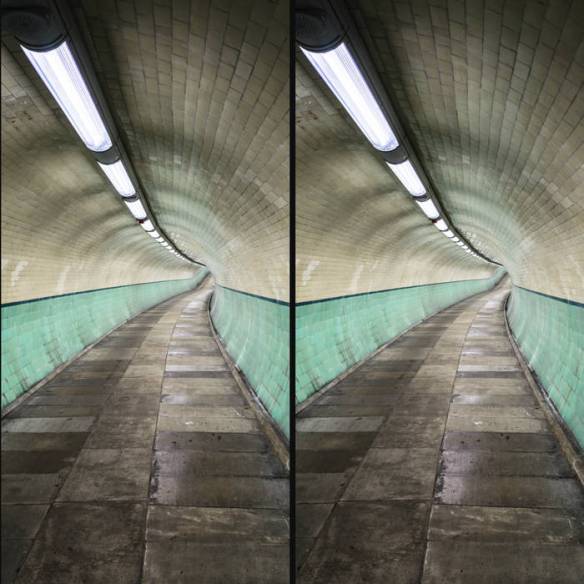
Previous LPs have seen you embellishing the music with really unique conceptual extras (See: the treasure map-esque aspect included as part of 2010’s 1 inch: 1/2 Mile LP package, which led fans to a totally unique musical artefact, hidden in a deserted hamlet in East Sussex). Does the new LP have a conceptual element? Tell us the idea behind the album.

AP Our ‘3rd member’ is designer and photographer Pedr Browne, who has been an integral part of presenting all the albums. For Overwinter he has produced a 10 image sequence of stereoscopic photographs. Stereoscopy is Victorian 3D, so the images, like the songs, explore the idea of looking at ourselves and our environment through the lens of the past, to understand how we’ve got to where we are. The limited edition album bundle includes those images and a pair of stereo specs.

If you had to choose one musician/writer/artist without whom the Grasscut sound would not exist, who would it be?

AP For me it would be Gavin Bryars‘ piece Jesus Blood Never Failed Me Yet – a string orchestra accompanying a tape loop of a homeless man singing from 1971. I heard this when I was a teenager in the early 80s. It doesn’t immediately sound like Grasscut, but the collision of unlikely elements that heighten the intensity of the listening experience, is something that’s stayed with me, and I don’t think Hilaire Belloc would have been on In Her Pride, Kathleen Ferrier on We Fold Ourselves or Siegfried Sassoon on Red Kite otherwise.

2012’s Unearth saw you collaborating with Robert Wyatt; is there one artist you would dearly love to work with in the future?

AP Right now, composer and turntablist Shiva Feshereki would be amazing.
MO We knew Robert because I’d written a book about him, and it was humbling to have him contribute to Richardson Road. But we’ve worked with some other great people too, including jazz musicians like Seb Rochford and John Surman. Also Robert Macfarlane, who wrote liner notes for Everyone Was A Bird. Right now, I seem to be mainly listening to jazz records from the 1950s and 60s, and dub records from the 1970s, which don’t throw up a lot of potential collaborators. But I’d love to do something with David Coulter playing singing saw.

What part does the live element play on completion of a new project? Is it integral to conveying the ideas/concepts, or is it simply a necessary evil?

AP For us I think the live show is always an exciting reinvention of the record, and it brings different things out of the songs and arrangements. I really hope we get to play it live later in 2021.
MO Yeah, bring on the gigs. Obviously, one thing 2020 has shown us is how much we need live music. I realise I’m not alone in this but I really miss it, both as a performer and an audience member.

If you could change one thing about the music industry, what would it be?

AP Genre. I find the obsession with it exhausting, misleading, and conservative. And it can end in so many playlists that feel like a padded cell lined with oatmeal wallpaper.

MO I would change the way in which streaming works, which relates in part to Andrew’s answer. But I also mean I would change the money side. I should declare an interest in this, as I’m a Director of the Featured Artists Coalition. There is great work happening with the Broken Record and Fix Streaming campaigns, led by people like Tom Gray, and now the Digital Culture, Media and Sport Select Committee are having an enquiry. But they are up against some big beasts. We’ll see.

Overwinter is out now on Lo Recordings – and a full review will follow on Arcana soon. The album can be purchased through clicking on the Bandcamp link above.

Listening to Beethoven #118 – Piano Quartet in E flat major Op.16 (arrangement of Quintet for piano and wind)


View of Vienna from the Belvedere by Bernardo Bellotto (1758-61)

Piano Quartet in E flat major Op.16 (arrangement of Quintet for piano and wind), for piano, violin, viola and cello (1796-7, Beethoven aged 26)

1. Grave – Allegro ma non troppo
2. Andante cantabile
3. Rondo (Allegro ma non troppo)

Dedication unknown
Duration 28′

Listen

Background and Critical Reception

This work is a near-direct copy of the Quintet for piano and wind, arranged for piano quartet forces – piano, violin, viola and cello. Beethoven was very familiar with this combination, having completed the three student quartets in 1785 – and no doubt this arrangement was made with a specific group of players or performing circumstances in mind, not to mention the possibility of increased sales of the music.

This is Richard Wigmore‘s focus in his booklet note for the Nash Ensemble‘s recording of the Piano Quartet on Hyperion. He notes that ‘the piano part is unaltered, though the strings sometimes play where the wind were silent’.

Both versions were published together as Beethoven’s Op.16 in 1801, the quintet having been first performed in 1797.

Thoughts

Though lacking in the warmth of the woodwind colours, this is still an attractive piece. With very little rewritten to accommodate the strings, the moods of the music are largely similar – but I did miss the sonorities of the woodwind, especially in the slower music.

The first movement, after the slow introduction, feels like it has a great deal of purpose with the extra attack offered by the strings, while the second movement brings the role of the piano further forward. Halfway through, when the mood turns darker in the minor key, the viola has a chance to shine taking the solo previously assigned to horn – and it is very well suited to the role. The dance of the third movement Rondo is every bit as attractive as it was before.

Recordings and Spotify link

Mozart Piano Quartet: (Paul Rivinius (piano); Mark Gothoni (violin); Hartmut Rohde (viola); Peter Hörr (cello)] (MDG)
Nash Ensemble: Ian Brown
(piano), Marianne Thorsen (violin), Lawrence Power (viola), Paul Watkins (cello) (Hyperion)

Paul Rivinius and the Mozart Piano Quartet give a strong performance, pushing forward with great purpose when the first movement Allegro reveals itself. However the Nash Ensemble, with more relaxed choice of tempi, get much closer to the emotional core of the music, especially in the slow movement, where the string tone is particularly beautiful and well matched with the piano.

Minute-long clips from the Nash Ensemble recording can be heard on the Hyperion website here

You can chart the Arcana Beethoven playlist as it grows, with one recommended version of each piece we listen to. Catch up here!

Also written in 1797 Haydn 6 String Quartets, Op.76 (The Erdödy Quartets)

Next up Piano Quartet in E flat major Op.16