On record – Joly Braga Santos: Chamber Music Volume Two (Toccata Classics)

Joly Braga Santos
Piano Quartet Op.28 (1957)
Suite de Danças Op.63 (1984)
Piano Trio Op.64 (1985)
Adagio e Scherzino (1956)
Suite para intrumentos de metal (1985)

Piano Quartet, Piano Trio: Jill Lawson (piano), Eliot Lawson (violin), Natalia Tchitch (viola), Catherine Strynckx (cello)
Suite of Dances: Jill Lawson (piano), Ricardo Lobes (oboe), Natalia Tchitch (viola), Adriano Aguiar (double bass)
Adagio e scherzino: Nuno Ivo Cruz (flute), Ricardo Lopes (oboe), António Saiote (clarinet), Paulo Guerreiro (horn), Carolino Carreira (bassoon)
Suite for brass: Jorge Almeida, António Quítalo, Pedro Monteiro (trumpets), Paulo Guerreiro (horn), Jarrett Butler, Vitor Faria (trombones), Ilídio Massacote (tuba)

Toccata Classics TOCC0428 [71’20”]

Producers Brian MacKay, Romain Zémiri
Engineer Romain Zémiri

Recorded 5-8 December 2017, 6-8 June 2018 at Centro Cultural de Belém, Lisbon, Portugal

Written by Richard Whitehouse

What’s the story?

Toccata Classics issues the second instalment devoted to the chamber output of Joly Braga Santos (1924-88), one which ranges widely in terms of its instrumental media and features one of the undoubted high points from over the Portuguese composer’s extensive catalogue.

What’s the music like?

To describe three of these pieces as ‘occasional’ is not to deny their musical attraction. The Suite of Dances makes the most of its unlikely combination of oboe, viola, double bass and piano – the astringent harmonies of its Prelũdio commuted into more plaintive expression by the Sarabanda, before the Tarantella rounds off the sequence with heady insouciance. In its follow-through of wistful song then whimsical dance, the Adagio and Scherzino is an unassuming gift to the repertoire for woodwind quintet that all such ensembles should seize upon. Although a combination of horn, three trumpets, two trombones and tuba might prove awkward, the Suite for Brass is no less diverting – whether in the soulful pathos of its initial Moderato, incisive fanfares of its central Allegro or insinuating resolve of its final Andante.

Highly appealing as these all are, the remaining works more completely affirm Braga Santos as a composer of substance. Cast in a single movement lasting almost 15 minutes, the Piano Quartet unfolds as the interplay between tensile and rhapsodic main themes such that neither mode of expression ever quite gets the upper hand. Moreover, the writing for the four players is of an integrated ensemble with any solo expression secondary to that of the collective; not least in the final pages as the music regains its initial impetus on the way to a forthright close.

Undoubtedly the main achievement here, the Piano Trio can rank alongside the Third String Quartet (included on the previous volume) among Braga Santos’s finest achievements. The opening Largo elides between distanced and ominous expression, its unforced synthesis of modal and non-tonal facets accorded greater resolve by the ensuing Allegro with its tensely intertwined strings and repeated-note piano writing that, between them, reach an impetuous climax. More than twice the length of its predecessors, the closing Lento is also one of this composer’s most potent inspirations – the sheer remoteness of its initial gestures underlying the speculative discourse which follows, and while the later stages afford greater emotional variety, the destination of this music towards its ethereal final repose can never be doubted.

Does it all work?

It does, allowing for the fact that some of the pieces here are modest in scope but written most felicitously as to the ensemble required. The performances of the main two pieces –    by violinist Eliot Lawson, cellist Catherine Strynckx, pianist Jill Lawson and (in the Piano Quartet) violist Natalia Tchitch – make a strong case for these works to form part of their respective repertoire. The other items mainly feature woodwind and brass players from the leading Portuguese orchestras and bring similar combinations of insight and commitment.

Is it recommended?

Indeed. The sound avoids that slightly out-of-focus perspective of the first volume, even if breaks between works could have been lengthier. The booklet has an affectionate memoir by Santos’s pupil Alexandre Delgado, with detailed notes on each work by Bernardo Mariano.

Listen

Buy

You can discover more about this release at the Toccata Classics website, where you can also purchase the recording. For our review of volume one in this series, click here

On record: Michael Brown – Noctuelles: Ravel & Medtner (First Hand Records)

Michael Brown (piano)

Ravel  Miroirs (1904-5)
Medtner Second improvisation (in variation form) Op.47 (1925)

First Hand Records FHR78 [61’49”]
Producers Adam Golka, Roman Rabinovich
Engineers Monte Nickles, Jim Ruberto

Recorded 2-10 January 2019 at Olivier Music Barn, Tippet Rise Arts Centre, Fishtail MT

Reviewed by Richard Whitehouse

What’s the story?

Michael Brown follows his earlier disc for First Hand Records (Beethoven and Mendelssohn on FHR67) with this coupling of Ravel’s most extensive solo piano work and Medtner’s most extended such piece outside of his sonatas; here featuring two recently discovered variations.

What’s the music like?

While the term ‘post-impressionism’ had not then been applied in a musical context, Ravel’s Miroirs effectively inaugurates this through five pieces that evoke the essence of the image in question rather than merely attempting its depiction. Other pianists may have rendered these evocations more acutely, but few have approached so highly contrasted a sequence with such evident concern for formal and expressive unity.

Hence the overall seamlessness with which the fugitive activity of Noctuelles is followed by the wistful poise of Oiseaux tristes; itself proceeded by those glistening textures and kaleidoscopic timbral interplay of Une barque sur l’océan, then the stark juxtaposition (vividly delineated here) between high-jinx and eruptive unease of Alborada del gracioso. Nor is La vallée des cloches the slight anti-climax it can often seem, Brown judiciously setting the scene for that stately modal theme as is among the composer’s most potent inspirations. An interpretation leaving one more than usually aware that the audacity of Ravel’s musical thinking is made more so by its pointed understatement.

One cannot imagine that Medtner had much regard for this music – but, fortunately, he almost always proved more flexible in his accommodation with past and present as composer than as writer. Never more so than with his Second Improvisation, written after he had left the Soviet Union for uncertain exile in Paris then London – its subtitle ‘in variation form’ indicating the fusing of precision and fluidity that gives this work its substance and its fascination. Brown’s perceptive reading is made more so by his inclusion of two previously unpublished variations which he tracked down to the National Library of Canada: thus, the elaborate passagework of La Cadenza (placed between variations four and five) and the coursing rhetoric of Pesante (placed between variations 11 and 12) which, between them, open out the emotional scope of what is already a design as unpredictable as it is engrossing. Certainly, the trajectory between the initial Theme and eventual Conclusion exudes a freedom from inhibition that Medtner here achieves almost despite himself and which Brown is demonstrably intent on conveying.

Does it all work?

Yes, given Brown teases out those musical connections between composers whose aesthetic outlook differed greatly (Medtner forthright in condemning most of his contemporaries). The account of Miroirs can certainly hold its own in what is now a crowded field (one featuring such as Beatrice Rana on Warner and Steven Osborne on Hyperion), whereas in the Second Improvisation the main competition comes from Hamish Milne (CRD) and Geoffrey Tozer (Chandos), neither of who include the additional two variations that Brown interpolates here.

Is it recommended?

Indeed. The acoustic of the Olivier Music Barn is ideal for piano music of this intricacy and subtlety, while Brown’s booklet notes are succinctly informative. A welcome release by one of the Tippet Rise triumvirate who have become notable contributors to First Hand Records.

Listen and Buy

For further information on this release, and to purchase, visit the First Hand Records website. Meanwhile you can listen to Noctuelles on Spotify:

Listening to Beethoven #121 – Kriegslied der Österreicher WoO 122


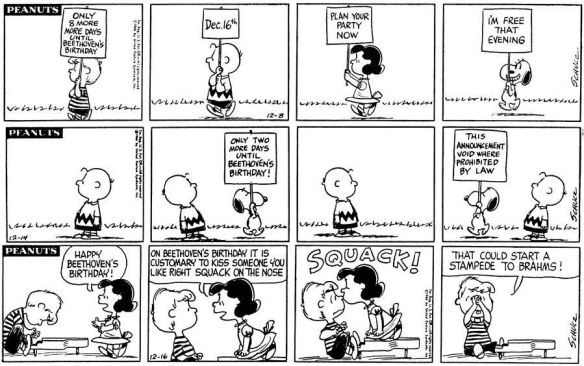
Peanuts comic strip, drawn by Charles M. Schulz (c)PNTS

Kriegslied der Österreicher WoO 122 for voice and piano (1797, Beethoven aged 26)

Dedication not known
Text Josef Friedelberg

Duration 3’15”

Listen

Background and Critical Reception

There is no official translation of Friedelberg’s text – at least none that I could find – but a loose interpretation via Google reveals something of a hymn to Germany, while inspiring his newish home countrymen too. ‘Man, woman and child in Austria. feel deeply your own worth’, runs the last verse.

The song draws out the point made by the unknown writer of the booklet notes for Capriccio’s set of the complete songs, who notes that ‘Beethoven’s songs are not music for the concert hall, but, for the large part, house music for the sophisticated entertainment or the edification of the educated classes.’

Thoughts

As with his previous setting of Friedelberg’s poetry, Beethoven offers a full bodied setting of a celebratory text. As noted in that setting, the piano functions to double the melody and provide a bit of punctuation between verses. It is the sort of song you can imagine being sung after a few drinks!

Recording used and Spotify link

Hermann Prey (baritone), Leonard Hokanson (piano), Berlin Heinrich Schütz Choir / Wolfgang Matkowitz

Hermann Prey is brilliant here, a wonderful tone complemented by the Heinrich Schütz Kreis, Berlin, in the refrains.

You can chart the Arcana Beethoven playlist as it grows, with one recommended version of each piece we listen to. Catch up here!

Also written in 1797 Dussek La Consolation Op.62

Next up Piano Sonata no.4 in E flat major Op.7

Listening to Beethoven #120 – Sonata for piano duet in D major Op.6


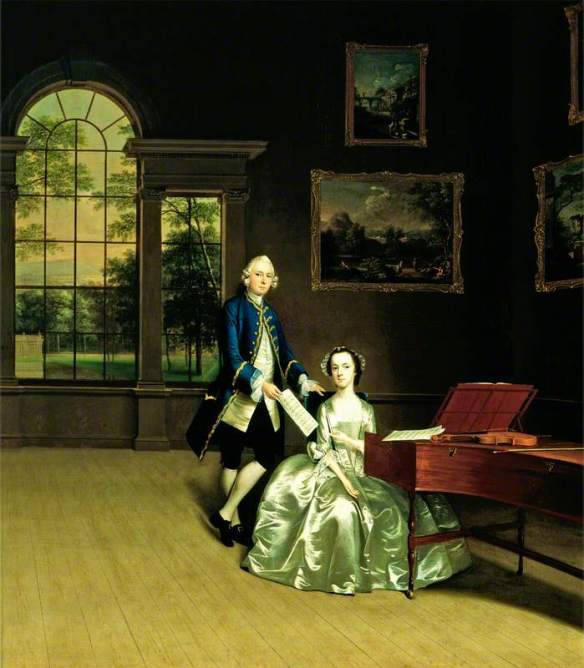
The duet by Arthur Devis. Photo credit: Victoria and Albert Museum, London

Sonata for piano (four hands) in D major Op.6 (1796-97, Beethoven aged 26)

Dedication not known
Duration 6′

1. Allegro molto
2. Rondo: Moderato

Listen

Background and Critical Reception

If it’s not too confusing a statement, Beethoven’s output for piano duet could be counted on the fingers of one of those four hands. We have already seen how imaginatively he writes for this combination in the Variations on a theme of Count von Waldstein, but here he returns for a short, two-movement sonata.

It is thought this brief piece, at little more than five minutes, was used for teaching. Peter Hill, who recorded the piece with Benjamin Frith for Delphian Records in 2019, writes that ‘the duet Sonata’s opening Allegro molto could be used as a textbook examples of how to write a classical first movement.’ He also writes affectionately of ‘the exchanges between the pianists that culminate (at the ends of the exposition and recapitulation) in arpeggios that ripple between and across the four hands.’ He also notes the ‘operatic feel’ of the second movement Rondo.

Thoughts

There is an impish quality about this piece, as though Beethoven wanted to have some fun with whoever was chosen to be by his side at the piano. A simple theme, a call to arms, leads to some fun between the parts in the first movement, with a few mischievous asides.

The Rondo has an elegant main subject, while its second theme is suddenly loud, as though it wants to grab your attention and talk over your conversation. It proceeds very naturally.

Recordings used and Spotify playlist

Peter Hill & Benjamin Frith (Delphian)
Amy and Sara Hamann (Grand Piano)
Louis Lortie & Hélène Mercier (Chandos)
Lang Lang & Christoph Eschenbach (Deutsche Grammophon)

A stylish and fun interpretation from Hill and Frith. Even if you hadn’t seen the cover of their recording you would guess how much fun they had putting it together! The Hamann sisters are very good too, if a bit jarring with their dynamic contrasts in the second movement. Their second version, on a fortepiano after J.A. Stein from 1784, is almost comical as the ear adjusts – but ultimately good fun.

Also written in 1797 Eberl 2 Sonatas for piano four hands Op.7

Next up Kriegslied der Österreicher WoO 122

Listening to Beethoven #119 – Serenade in D major Op.8

Ignaz Schuppanzigh, Austrian violinist, teacher and friend of Beethoven

Serenade in D major Op.8 for string trio (violin, viola and cello) (1796-7, Beethoven aged 26)

Dedication unknown
Duration 30′

1. Marcia: Allegro
2. Adagio
3. Menuetto: Allegretto
4. Adagio – Scherzo: Allegro molto – Adagio – Allegro molto – Adagio
5. Allegretto alla Polacca
6. Andante quasi allegretto – Variations 1-4 – Allegro – Tempo I
7. Marcia: Allegro

Listen

Background and Critical Reception

Beethoven returned to the string trio for a love letter to Vienna – possibly echoing his feelings after returning to the city. He chose the form of a serenade, and followed many of its conventions, including a March which ushers the players in and takes them out after a series of dance movements.

Choosing a string trio to perform the Serenade was quite unusual. In Mozart’s case the string ensemble would have been more substantial, with wind instruments possibly included.

Beethoven biographer Lewis Lockwood is quite dismissive of this work, implying it is lightweight when compared with the ‘higher level’ of the three string trios that follow as Op.9. Daniel Heartz notes this, but makes a strong claim for the Serenade’s endearing humour. ‘For three solo string instruments to produce such a big, pompous sounds as this Marcia in common time is already funny and portends a good show to come’. He notes how each of the three instruments gets a good solo in the theme and variations movement, placed fourth of six.

He also reveals that the work was advertised alongside another E flat major composition, the Piano Sonata no.4 Op.7, in the Wiener Zeitung on 7 October 1797. Stephen Daw, in his notes for the Leopold Trio recording on Hyperion, observes how ‘the Serenade was challenging material to play by the apparent standards of the time, but it looks as though Beethoven was already acquainted with the great violinist Schuppanzigh (above) at this time.

The use of a Polacca for the fifth movement is unusual, for Daw ‘one of the few real polonaises to survive from the period between those of W. F. Bach and Chopin.

Thoughts

The Serenade is a bright and breezy work, but an ambitious one too, far from the lightweight piece of fluff suggested by Lewis Lockwood.

The Marcia theme that forms the outer casing of the sandwich is hefty, and deceptive with it – Beethoven could easily have four or five instruments on stage rather than three. The contrast with the tender Adagio is rather affecting, and this movement takes its time, looking back longingly when it moves into the minor key.

A brisk Menuetto takes us back for a whirlwind stint on the dancefloor, and fades out rather cleverly with pizzicato. The fourth movement is one of extremes, with a slow section that threatens to spoil the mood, but ends up being a po-faced foil for a capricious Scherzo, taken at a breakneck speed.

The Polacca is next, tripping along with an enjoyment of the dance, and with a catchy tune. Then the theme and variations, which Beethoven turns over beautifully, showcasing each of the trio’s instruments in significant solo episodes – with a special place for the viola in the middle and the cello at the end. After this the reappearance of the Marcia theme ensures the Serenade signs off with a flourish – and everyone can go home!

The Serenade is a thoroughly enjoyable piece, not to be taken too seriously – but with plenty of emotion under its often frivolous surface. It is definitely not a Beethoven work to be thrown away.

Recordings used and Spotify links

L’Archibudelli (Vera Beths (violin), Juergen Kussmaul (viola), Anner Bylsma (cello)
The Grumiaux Trio (Arthur Grumiaux (violin), Georges Janzer (viola), Eva Czako (cello) (Philips)
Anne-Sophie Mutter, Bruno Giuranna and Mstislav Rostropovich (Deutsche Grammophon)
Leopold String Trio Isabelle Van Keulen (violin), Lawrence Power (viola), Kate Gould (cello) (Hyperion)
Trio Zimmermann (Christian Tetzlaff (violin), Antoine Tamestit (viola), Christian Poltéra (cello) (BIS)

You can listen to the versions from L’Archibudelli, the Grumiaux Trio and the Mutter-Giuranna-Rostropovich trio on this playlist:

There are some very fine recordings of the Serenade, with three standing out as excellent – the Grumiaux Trio, who are quite luxurious in their thick sound, the Leopold Trio for a strongly characterised account, and Trio Zimmermann for an equally musical recording. All of them capture Beethoven straining at the leash, offering a Serenade but much more besides.

You can chart the Arcana Beethoven playlist as it grows, with one recommended version of each piece we listen to. Catch up here!

Also written in 1797 Wranitzky Symphony in C minor, Op. 31 “La paix”

Next up Sonata for piano (four hands) Op.6