On Record: Floating Points, Pharoah Sanders & the London Symphony Orchestra: Promises

floating-points-pharoah-sanders-lso

reviewed by Ben Hogwood

What’s the story?

Promises may have only just been released, but it is a high-level collaboration five years in the making. Floating Points, the electronic alias for Sam Shepherd, teamed up with senior jazz royalty Pharoah Sanders to record their parts for the album in Los Angeles in 2019, while the orchestral parts, arranged by Shepherd, were set down by the London Symphony Orchestra at Air Studios in the summer of 2020.

What’s the music like?

The album is essentially one span of music lasting three-quarters of an hour, divided into nine sections. Everything germinates from a deceptively simple seven-note motif given out by the keyboards at the start, and from this minimal and seemingly unremarkable start a gradual climb of intensity begins.

Sanders is used sparingly, which makes his saxophone contributions all the more meaningful. The statement in Movement 1 has a spiritual air. Shepherd, too, operates well within himself as far as density of musical notes is concerned, supplying dappled colours in response to the saxophonist’s chant-like figures. This is notable because anyone who is familiar with the rich, luminous colours of Floating Points’ previous album Crush will know the energy and rapid movement his music can generate.

The influence of Ravel remains as part of the orchestral style, especially at the start of Movement 2, where everything is written in thrall to the saxophone, giving Sanders the room he needs to work his magic. Promises develops as a meditation, the seven-note motif underpinning almost everything. Movements 3 and 4 develop a vocalise, the addition of a glockenspiel giving a sound that glitters at the edges. Sanders returns with greater urgency, then pulls back to a magical and breathy Movement 6, where the long lines of a solo cello shine. This ushers in the strings’ big moment, and with a swell of intensity the musical waves crash on to the shore.

From here the tide pulls back, giving room for more thoughts from Sanders. This time the build is towards a more dissonant but similarly exultant climax, reaching for the skies in a musical murmuration of upper strings and electronics. From here everything subsides to a peaceful close, the seven-note motif murmuring for one last time.

Does it all work?

In every way. Many collaborations between electronics, jazz and / or symphony orchestra miss the mark because of balance issues, with everything turned up too loud or with too many notes given to too many instruments, or because one or more of the musical parties are not on the same wavelength. This makes Promises all the more remarkable, for even the LSO strings, adding their contribution a year hence, are fully in the moment.

The ‘less is more’ approach of this collaboration pays off in every way. Sure, the music is slow moving, but that is an essential part of its appeal, a meditation for large forces securing the most intimate of responses.

Is it recommended?

Without question. Promises is an enchanting album, spanning its magic across the 45 minutes – after which the listener will simply wish to repeat the experience. It crosses genres effortlessly, appealing to fans of jazz, classical and electronica without becoming rooted in any of those areas. It is simply wonderful music for meditative thought.

Intriguingly we are told to ‘stay tuned for the next chapter of Promises, which will be announced soon’. If that proves capable of following up what is already one of the best albums of the year, we will be well and truly spoilt!

Stream

Buy
 

Listening to Beethoven #131 – String Trio in D major Op.9/2

string-trio-op92

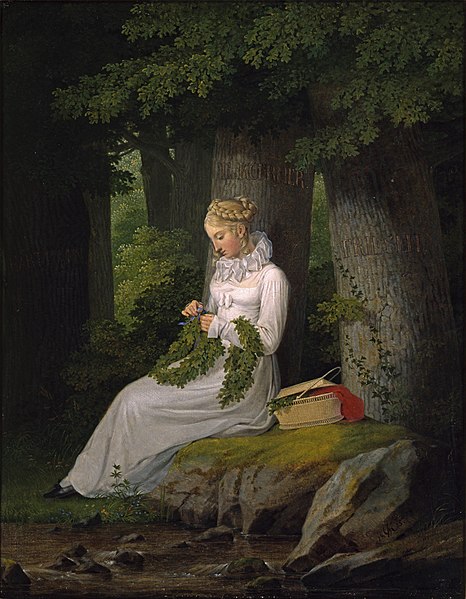
The wreath maker, by Georg Friedrich Kersting (1815)

String Trio in D major Op.9/2 (1798, Beethoven aged 27)

Dedication Count Johann Georg von Browne
Duration 22′

1. Allegretto
2. Andante quasi allegretto
3. Menuetto: Allegro
4. Rondo: Allegro

Listen

Background and Critical Reception

This second trio of Beethoven’s Op.9 set is in D major – the same key as the Piano Sonata Op.10/3, on which the composer was working at the same time. Stephen Daw, in his booklet notes for the Leopold String Trio’s recording on Hyperion, notes similarities between the two works – not least the scale of their technical challenges. ‘The solo part is in fact frighteningly difficult’, he writes of Beethoven’s violin writing. ‘We are led to contemplate whether the composer (who was certainly, in Op.10, still composing music to play himself) was aware of all the problems he was presenting to his violinist’.

Daniel Heartz spots a couple of pointers towards the Symphony no.2 of four years later – also to be in D major – and is relatively critical of the fourth movement Rondo, highlighting the ‘none-too-promising’ melody begun by the cello…too sectionalized into little segments to be of much interest’.

Thoughts

The start of this piece has an appealing warmth and is deceptively laid back – soon, Beethoven is bringing more energy to the table. The scoring for string trio is once again effortless, a form where the composer feels happy.

For the slow movement we move to the minor key, but the mood remains quite upbeat, the music still quite lively at a walking pace. The Minuet is bright and breezy, given in a quick triple time, the first violin with some technically tricky melodies to play. The final movement is quite stop start, led off quickly by the cello with a melody that becomes its relatively catchy calling card.

This trio is an attractive piece, if not quite as memorable as the first in the set, and with fewer contrasts between the movements. Beethoven’s mastery of writing for stringed instruments, however, gains an even firmer foothold.

Recordings used and Spotify links

L’Archibudelli (Vera Beths (violin), Juergen Kussmaul (viola), Anner Bylsma (cello)
The Grumiaux Trio (Arthur Grumiaux (violin), Georges Janzer (viola), Eva Czako (cello) (Philips)
Anne-Sophie Mutter, Bruno Giuranna and Mstislav Rostropovich (Deutsche Grammophon)
Leopold String Trio Isabelle Van Keulen (violin), Lawrence Power (viola), Kate Gould (cello) (Hyperion)
Trio Zimmermann (Christian Tetzlaff (violin), Antoine Tamestit (viola), Christian Poltéra (cello) (BIS)

The Leopold and Zimmermann trios offer very strong digital versions, while L’Archibudelli bring an attractively grainy tone to their version. Arthur Grumiaux leads his trio with a singing tone, especially in the second movement.

You can listen to the versions from L’Archibudelli, the Grumiaux Trio, the Mutter-Giuranna-Rostropovich trio and Trio Zimmermann on this playlist:

You can chart the Arcana Beethoven playlist as it grows, with one recommended version of each piece we listen to. Catch up here!

Also written in 1798 Eybler Clarinet Concerto in B flat major

Next up String Trio in C minor Op.9/3

Playlist – Audio Obscura: Adventures In The Anthropocene

It is our great pleasure to welcome Audio Obscura to the Arcana playlist section, with a 28-minute ‘Live’ performance from Adventures In The Anthropocene, originally broadcast on YouTube in January 2021.

This is part of the follow-up to the Love In The Time Of The Anthropocene album from October 2020, the culmination of nearly three years’ work about the family unit, parenthood and climate change.

Audio Obscura: Live from Adventures

Our thanks to Audio Obscura for a rather special piece of music. Adventures In The Anthropocene can be streamed and purchased on the Bandcamp link below:

Listening to Beethoven #130 – String Trio in G major Op.9/1

string-trio-op91

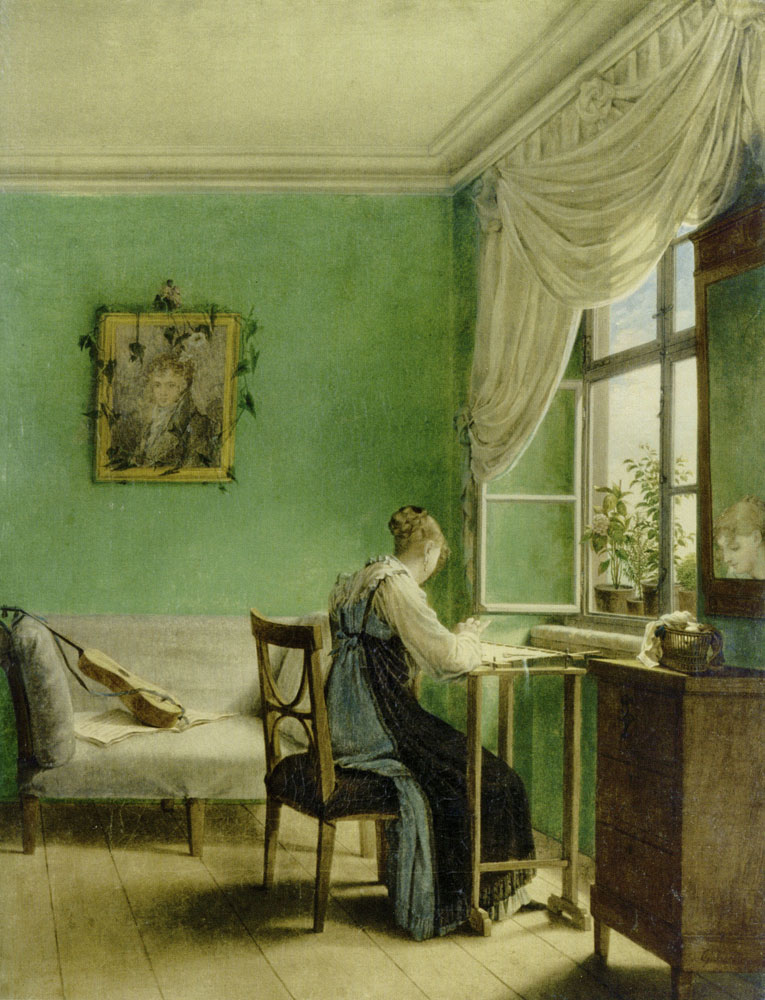
Woman embroidering, by Georg Friedrich Kersting

String Trio in G major Op.9/1 (1798, Beethoven aged 27)

Dedication Count Johann Georg von Browne
Duration 25′

1. Adagio – Allegro con brio
2. Adagio, ma non tanto e cantabile
3. Scherzo: Allegro
4. Presto

Listen

Background and Critical Reception

Seemingly preoccupied with units of three, Beethoven returned to the string trio around the same time that he was working on the three Op.10 piano sonatas – just before writing the three sonatas for violin and piano Op.12. The trios are dedicated to Count von Browne, husband of the dedicatee for Op.10 – and there are several parallels between the two sets. D major and C minor are used for a work in each – while G major, seldom used until now, is used for this first piece.

Robert Simpson, writing in The Beethoven Companion, argues persuasively that the trios are overlooked. ‘His three Op.9 trios are rightly quoted as the locus classicus for astonishing weight and richness of sound in this medium’. He notes how Beethoven’s writing for the three instruments is so inclusive that the ‘missing’ second violin that would make up a string quartet is not evident.

Thoughts

Beethoven has already shown an impressive mastery of the string trio in the Op.3 and Op.8 works, but with the first work of Op.9 he goes up another level. The grand introduction for the first movement is imposing, almost orchestral in its conception given that there are only three instruments in play. It leads to a main theme where Beethoven is really pushing the ranges of the three instruments, the cello down low and the violin up high. It gives a strong sense of pushing boundaries – but there is a lot of fun to be had in the process.

The second movement is a beauty, a tender reflection in E major, a stream of consciousness. The third movement is bright, a quick dance that is much more scherzo than minuet, while the fourth movement rushes forward impatiently, each of the instruments bristling with energy.

Beethoven’s ambition here is clear, taking the string trio to a new level of technical prowess while expanding the form.

Recordings used and Spotify links

L’Archibudelli (Vera Beths (violin), Juergen Kussmaul (viola), Anner Bylsma (cello)
The Grumiaux Trio (Arthur Grumiaux (violin), Georges Janzer (viola), Eva Czako (cello) (Philips)
Anne-Sophie Mutter, Bruno Giuranna and Mstislav Rostropovich (Deutsche Grammophon)
Leopold String Trio Isabelle Van Keulen (violin), Lawrence Power (viola), Kate Gould (cello) (Hyperion)
Trio Zimmermann (Christian Tetzlaff (violin), Antoine Tamestit (viola), Christian Poltéra (cello) (BIS)

You can listen to the versions from L’Archibudelli, the Grumiaux Trio, the Mutter-Giuranna-Rostropovich trio and Trio Zimmermann on this playlist:

Heifetz and co are expansive in the slower music but enjoy tripping along in the third movement, relishing the music’s positive energy. The Grumiaux Trio are satin-smooth, Arthur’s violin taking the lead in an affectionate account. The Leopold String Trio give an elegant first movement but keep the freshness of the new discoveries as the work progresses.

You can chart the Arcana Beethoven playlist as it grows, with one recommended version of each piece we listen to. Catch up here!

Also written in 1798 Kozeluch Sinfonia Concertante in E-flat major

Next up String Trio in G major Op.9/2

Live review – Raphael Wallfisch, English Symphony Orchestra / Kenneth Woods: Elgar Reimagined Part 1

raphael-wallfisch

Raphael Wallfisch (cello), English Symphony Orchestra / Kenneth Woods

Elgar, arr. Fraser Miniatures for cello and strings
Chanson de Matin, Op.15 No.2 (1899)
Chanson de Nuit, Op.15 No.1 (1899)
The Wild Bears, Op, 1b No. 6 (1908)
Nimrod, Op.36 No. 9 (1899)
Romance in D minor, Op.62 (1910)
Sospiri, Op.70 (1914)
Mazurka, Op.10 No.1 (1899)
Pleading, Op.48 (1908)
In Moonlight (1904)
Salut d’Amour, Op.12 (1888)
Adieu (1933)

Wyastone Concert Hall, Monmouth
Recorded October 9 2020 for online broadcast from Wednesday 19 March 2021

Written by Richard Whitehouse

This latest in the English Symphony Orchestra’s online concerts focussed on Elgar – namely a series of miniatures for cello and strings arranged by Donald Fraser and played by Raphael Wallfisch, whose commitment to and conviction in this music hardly needs reiterating here.

Chanson de Matin launched proceedings in mellifluous fashion, and if the cello’s assuming of the melodic line was slightly to the detriment of the original scoring, that could hardly be said of Chanson de Nuit whose more sombre contours and ruminative character were ideally realized. Nor did The Wild Bears lose out on vivacity, and if this arrangement brought it into the orbit of Saint-Saëns, that served to underline the significance of ‘Second Empire’ French music on Elgar’s own thinking. In Nimrod, the cello’s dominance rather detracted from the subtlety of the original instrumentation; conversely, Fraser’s take on the Romance brought soloist and strings into even closer accord than the composer’s own version with orchestra.

Nevertheless, the undoubted highlight here was Sospiri – the cello’s subsuming of the harp’s crucial contribution just one aspect of an arrangement which presented one of Elgar’s finest inspirations (miniature or otherwise) in a striking new light. Lighter fare next with the robust tread of the Mazurka, proceeded by a rendering of the song Pleading of unforced eloquence. The evergreen In Moonlight (adapted from the overture In the South) responded well to this suitably limpid treatment, as did Salut d’Amour to one that underlined its wholly un-cloying essence. A wistful take on the piano piece Adieu saw this programme to an affecting close.

Throughout, the idiomatic feel of Wallfisch’s playing was complemented by that of the ESO under Kenneth Woods, as discreet or understated as the music requited. Forty minutes came and went effortlessly – the ‘Part 1’ designation happily meaning there will be more to come.

You can watch the concert on the English Symphony Orchestra website here

For more information on the English Symphony Orchestra you can visit their website here