Switched On – Jimi Tenor: Deep Sound Learning (1993 – 2000) (Bureau B)

jimi-tenor-deep

reviewed by Ben Hogwood

What’s the story?

Bureau B have already had an extended look at Jimi Tenor’s legacy from the 1990s in last year’s NY, Hel, Barca – a fruitful foray into his impressively consistent archive. Deep Sound Learning visits a similar era, casting its eye over unreleased tracks from DATs sent by the Finnish artist to Warp Records, his label at the time. Warp preserved the tracks they didn’t use on his albums of that era, so this is a set of previously unheard music from the Tenor vaults.

What’s the music like?

Once again the music of Jimi Tenor is notable for its bold exploration and freedom, and the 19 tracks here cover all sorts of stylistic terrain. The saxophone often features, pulling some of the tracks towards deeper jazz, while many of these pieces of work venture into house and funk.

Colour is an important ingredient of the music, which is never dull, and never coasts. Exotic House Of The Beloved starts off by showing its age in a good way, with a chunky profile and funky beats. Dub de Pablo by contrast is a low slower, with a nocturnal air. Another Space Travel indulges Tenor’s love of a wobbly synth line, while Travellers Cape has an appealing bounce to its rhythm.

The Tenor saxophone blesses a few tracks with its presence, not least the evocative Sambakontu, or setting the scene on Downtown.

Does it all work?

More often than not. Sometimes the music is easily dated, which can be a good thing, but the standard is high. Only a track like O-Sex, with some familiar clichés, sounds like an offcut from the 1990s.

Is it recommended?

Yes. Deep Sound Learning is an ideal companion to last year’s exploration of Jimi Tenor’s early works, and shows just how consistent he could be – and how much fun he had while doing so. There will be something for everyone in this set, that’s for sure.

Stream

Buy


On Record: STR4TA: Aspects (Brownswood)

str4ta

reviewed by Ben Hogwood

What’s the story?

In all honesty it is surprising that more has not been heard of this new project, the first alliance in ten years between Gilles Peterson and the driving force of Incognito, Jean-Paul ‘Bluey’ Maunick. The two point their music squarely towards the 1980s, bearing in mind Light of the World and Freeez, bands Maunick used to be in. They channel funk as Britain heard it then, but with a strong emphasis on improvisation. That is where STR4TA has its roots, but listeners will hear the tracks incorporate songwriting hooks too.

What’s the music like?

Summery! This is real good-time music, and it takes less than a minute to make that point. There is some seriously funky attitude on tracks like Aspects, We Like It and Steppers Crusade, with the sort of elastic bass lines that power the very best Incognito tracks. Each has a subtle but well-executed vocal and rich, ever-changing harmonies.

Rhythm In Your Mind is breezy like Sunday morning, hitting exactly the right spot, while the dappled textures of After The Rain have a rather neat parallel with emerging from lockdown in our current situation.

Dance Desire and Kinshasa FC are good instrumentals, painting a nocturnal party scene, while Give In To What Is Real is a vocal winner, dressed with bright, brassy offcuts.

Does it all work?

It does. With a relaxed approach, the music of STR4TA comfortably equals that of its 1980s peers, bringing instinctive good vibes and large, much-needed, doses of sunshine through funk. A few jazzy flavours round the edges are the icing on the cake.

Is it recommended?

Wholeheartedly. Two friends sharing a mutual love of funk bring their own take on it to the world, with no pretence – simply the need to make good music and get it out there. Good vibes prevail the whole way through!

Stream

Buy


Listening to Beethoven #140 – 7 Variations on ‘Kind, willst du ruhig schlafen’ WoO 75

beethoven-von-winter

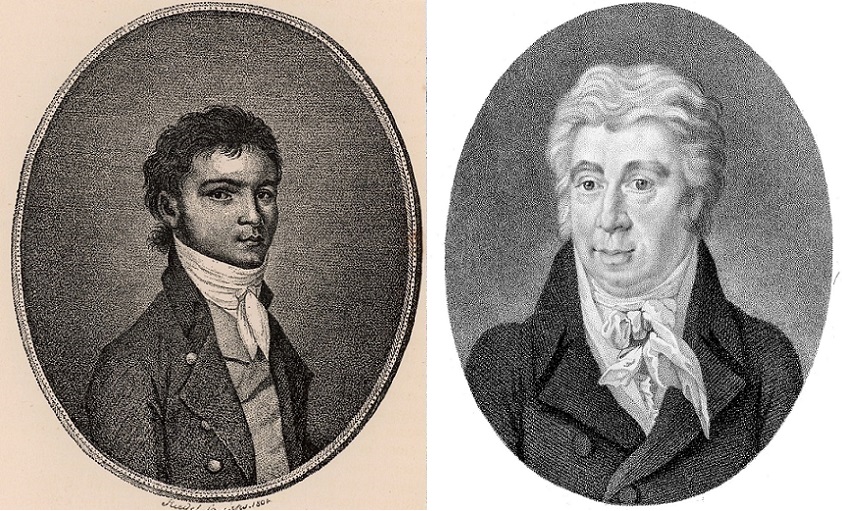
Ludwig van Beethoven and Peter von Winter (right)

7 Variations on ‘Kind, willst du ruhig schlafen’ WoO 75 for piano (1792-99, Beethoven aged 28)

Dedication unknown
Duration 11′

written by Ben Hogwood

Listen

What’s the theme like?

The theme, written by German contemporary Peter von Winter, is a compact tune, with quite a clipped melody – simple but ripe for development.

Background and Critical Reception

This set of seven variations on a quartet, Kind, willst du ruhig schlafen, from Peter von Winter’s opera Das unterbrochene Opferfest (The interrupted festival of sacrifice) appears to use all the four parts of the quartet as its inspiration.

Very little is written about this set, coming as it does in the middle of a rich vein of variation ‘form’ for Beethoven in the late 1790s. The general consensus is that he was enjoying himself and taking a feelw risks with harmony and form. This set would seem to confirm those notions.

Thoughts

Beethoven takes on the challenge with relish – so far very few of his variations have sounded routine. Having showcased the tune and a first variation, we get a glimpse in the second of a composer literally rolling up his sleeves as the piano surges up the scale. The next variation suggests a recent study of Handel, with pinpoint figuration and fluent movement.

A serious minor key diversion (variation no.6) is followed by an extended final variation and coda. Here Beethoven goes for a wander off the beaten track, moving unexpectedly into D major but with a surety and fluency that suggest this ‘surprise’ was well-planned all along. Sure enough the return ‘home’, with trills in the right hand, presents the theme in a subtly triumphant manner.

Recordings used and Spotify links

John Ogdon (piano) (EMI)
Cécile Ousset (piano) (Eloquence)
Ronald Brautigam (fortepiano) (BIS)

Cécile Ousset gives a typically characterful performance of these variations, with particularly enviable phrasing in the right hand of the chromatic fourth variation. John Ogdon is sparkling throughout, slightly drier in wit perhaps. Ronald Brautigam offers a vivid contrast on the fortepiano, played with plenty of fire and brimstone in the quicker music at the end of the coda.

Also written in 1799 Benjamin Carr Dead March and Monody

Next up Plaisir drainer WoO 128

Listening to Beethoven #139 – Romance no.2 in F major Op.50

Violin from Beethonven’s possession, one of four instruments Beethoven received as a gift from Prince Karl von Lichnowsky around 1800 (image from the Beethoven-Haus Bonn)

Romance no.2 in F major Op.50 for violin and orchestra (1798, Beethoven aged 27)

Dedication unknown
Duration 7’30”

Listen

Background and Critical Reception

After his early attempt at a concerto for violin and orchestra in 1792, Beethoven revisits the combination with two Romances – published in 1803 and 1805 as Op.40 and Op.50 respectively. The second is thought to predate the first, completed in 1798. Both Romances are thought to have been candidates for the slow movement of the early concerto, written as they are in suitable keys – but they stand alone as popular pieces.

Wolfram Steinbeck, writing for Universal’s Complete Beethoven Edition, observes that ‘Beethoven created a new genre with these two works, the violin romance, which found a number of successors in the 19th century (famous ones were composed by Berlioz, Dvořák and Bruch).’

Commentators observe that the focus is the singing tone of the violin, rather than athletic virtuosity. ‘These works by Beethoven were also to have been a stepping stone to his great Violin Concerto’, writes Steinbeck. ‘What appears there in broad strokes is tried out here on a much smaller canvas.’

Given the popularity of both Romances, there is a surprising dearth of writing from scholars of the composer.

Thoughts

The Romance no.2 is a sublime piece, and Beethoven fulfils his aims by really making the violin sing, The orchestral accompaniment is kept very much in the background but with the lovely ‘Viennese’ sound of a small orchestra.

As the piece progresses there is the opportunity for the violinist to show off, but lyricism is always the prime aim – and the tune itself is a keeper. Beethoven’s softer side is not always acknowledged, but it is to the fore throughout in this piece.

Recordings used and Spotify links

Anne-Sophie Mutter (violin), New York Philharmonic Orchestra / Kurt Masur (Deutsche Grammophon)

Thomas Zehetmair (violin), Orchestra of the Eighteenth Century / Frans Brüggen

Itzhak Perlman (violin), Berliner Philharmoniker / Daniel Barenboim

Arthur Grumiaux (violin), Royal Concertgebouw Orchestra / Sir Colin Davis

The creamy tone of Anne-Sophie Mutter may be a bit calorie-rich for some tastes, but it is an undeniably beautiful way to experience the Romance, nicely accompanied by the New York Philharmonic Orchestra and Kurt Masur. By contrast Thomas Zehetmair uses much less vibrato, playing with the Orchestra of the Eighteenth Century under Frans Brüggen in an account where less is most definitely more where emotion is concerned. Itzhak Perlman gives a special account with Daniel Barenboim and the Berliner Philharmoniker, while Arthur Grumiaux’s famous singing tone is ideal for these purposes.

You can chart the Arcana Beethoven playlist as it grows, with one recommended version of each piece we listen to. Catch up here!

Also written in 1798 Eybler Clarinet Concerto in B-flat major

Next up 7 Variations on ‘Kind, willst du ruhig schlafen’ WoO 75

Listening to Beethoven #138 – March in B flat major WoO 29 ‘Grenadiermarsch’ (piano version)

Austrian Infantry 1798 – 1805 (artist unknown)

March in B flat major WoO 29 ‘Grenadiermarsch’ for piano (1797-98, Beethoven aged 27)

Dedication unknown
Duration 1’30”

Listen

Background and Critical Reception

A piano reduction of the Grenadiermarsch, originally scored for wind sextet.

Beethoven was to write a good many marches, and this one must have meant something to him for it to be used in dual instrumentation.

Thoughts

After the wind sextet version, with its gritty sound and allusions to an accordion squeezebox, the piano sounds dry and rather foresquare as the march proceeds.

There are two versions – an original and a revision – but in all honesty there is very little to choose between the two!

Recordings used and Spotify links

Carl Petersson (Naxos)

Revised version

You can chart the Arcana Beethoven playlist as it grows, with one recommended version of each piece we listen to. Catch up here!

Also written in 1798 Wranitzky Grande Sinfonie caracteristique in C minor Op.31

Next up Romance no.2 in F major Op.50