Listening to Beethoven #134 – Sonata for piano and violin no.2 in A major Op.12/2

santa_maria_maggiore_in_rom
Santa Maria Maggiore, Rome (c1808) by Joseph Anton Koch

Sonata no.2 for piano and violin in A major Op.12/2 (1798, Beethoven aged 27)

1. Allegro vivace
2. Andante, più tosto allegretto
3. Allegro piacevole

Dedication Antonio Salieri
Duration 18′

Listen

by Ben Hogwood

Background and Critical Reception

‘Learned, learned, always learned, no naturalness, no melody!’ So wrote a reviewer on hearing Beethoven’s Op.12 sonatas for piano and violin in 1799. Nigel Fortune, writing in The Beethoven Companion, speculates the ‘tumbling succession of fresh material’ in the first movements would have been responsible for this verdict.

William Drabkin, writing liner notes for Chandos and the Tasmin Little / Martin Roscoe recording, notes the extended phrases on the ‘E’ string, and how they add ‘to that work’s brilliant sound-world’, and that ‘arpeggios and scale passages are also well placed’.

Thoughts

There is a cheeky grin on Beethoven’s face from the outset as his main tune appears to have a lot of ‘wrong’ notes in it. He deliberately leans on those notes to create an amusing and fresh dialogue between piano and violin, who stick closely together as they do on the previous work.

After these frivolities the second movement is more thoughtful and reserved, set in the minor key. A solemn introduction from the piano is followed by a plaintive violin melody. This feels the more ‘Mozartean’ of the three movements, A minor being a favoured key of Mozart.

From here Beethoven returns to the light-hearted mood of the first movement, with a triple-time lilt offering the spirit of the dance. It is attractive with the outright cheekiness of the melody we heard before.

This second sonata is an attractive piece, bright as a spring day thanks to the writing for violin. It is easy to imagine Beethoven hamming up the cheeky tune in the first movement, perhaps craving the mildly outraged review he got. There would be many more!

Recordings used and Spotify playlist

Midori Seiler (violin), Jos van Immerseel (fortepiano) (Zig Zag Classics)
Yehudi Menuhin (violin), Wilhelm Kempff (Deutsche Grammophon)
Josef Suk (violin), Jan Panenka (piano) (Supraphon)
Alina Ibragimova (violin), Cédric Tiberghien (Wigmore Hall Live)
Tasmin Little (violin), Martin Roscoe (piano) (Chandos)
Frank Peter Zimmermann (violin), Martin Helmchen (BIS)
Paul Barritt (violin), James Lisney (piano) (Woodhouse Editions)

Zimmermann and Helmchen deliver a sparkling performance of this work, enjoying the humour of the first movement. Seiler and van Immerseel, too, give a winsome account, with effective lack of vibrato from the violinist in the second movement. Josef Suk and Jan Panenka enjoy the bright sound Beethoven assigns to his instrumentalists.

The Spotify playlist below does not contain the Barritt / Lisney version, but does include a highly powered account by Gidon Kremer and Martha Argerich, recorded for Deutsche Grammophon:

You can chart the Arcana Beethoven playlist as it grows, with one recommended version of each piece we listen to. Catch up here!

Also written in 1798 Haydn – Solo e pensoso, Hob.XXIVb:20

Next up Sonata for piano and violin no.2 in A major Op.12/2
Listening to Beethoven #133 – Sonata for piano and violin no.1 in D major Op.12/1

joseph-anton-koch-wasserfall-im-berner-oberland-1796
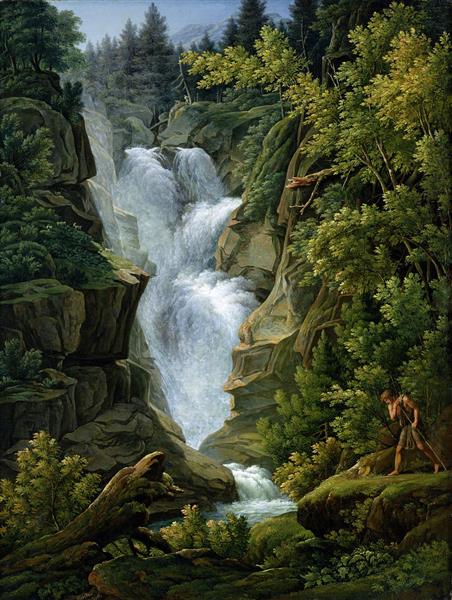
Waterfall in the Bern Highlands (1796) by Joseph Anton Koch

Sonata no.1 for piano and violin in D major Op.12/1 (1798, Beethoven aged 27)

1. Allegro con brio
2. Tema con variazioni. Andante con moto
3. Rondo. Allegro

Dedication Antonio Salieri
Duration 20′

Listen

by Ben Hogwood

Background and Critical Reception

Beethoven’s first venture into the world of the violin sonata needs a few qualifiers. Firstly, the three works collected together as Op.12 were published in 1798 as Three Sonatas for keyboard with a violin, dedicated to his teacher Salieri. They were following Mozart’s convention where the keyboard is still given primary billing – but as the music shows, the tables were definitely beginning to turn in favour of the stringed instrument, just as they were in the two sonatas for keyboard and cello published as Op.5.

The verdict among musicologists is generally that Beethoven is sticking closely to Mozart’s style of writing in these pieces – and indeed that they might be playing it too safe. Daniel Heartz certainly thinks so, and given the detail he invests in Beethoven’s works it is surprising to see them dismissed with a relatively curt verdict. For him the Op.12 sonatas are ‘comparatively tame’. They are said to be indebted to Mozart’s works in the genre. Nevertheless they lack gripping ideas’.

Elsewhere praise is more forthcoming. Richard Bratby, writing for the recording on Signum Classics from Tasmin Waley-Cohen and Huw Watkins, declares that ‘far from being constrained by Mozart’s model, Beethoven had given it Romantic wings’. He enjoys the ‘winsome theme’ given to the second movement, on which the composer writes four variations, and the ‘jig-like finale’ with its ‘subversive rhythmic games worthy (though Beethoven would never have conceded it) of Haydn himself.

Thoughts

A new form for Beethoven – and one that he approaches with characteristic vigour. The first of what would be twelve published sonatas for the combination of piano and violin is enjoyably upbeat and full of melodies – and concise, too, as the composer keeps his musical arguments to the point.

That said, the first movement is quite a sizable structure, beginning with a flourish from both instruments that sets a sunny mood and the close musical relationship between the two instruments. Beethoven, who played the piano with violinist Ignaz Schuppanzigh (quartet leader for Prince Lichnowsky) in the early performances, is immediately at home

The theme and variations of the second movement are a familiar tactic but freshly employed, especially when the third of the four variations moves into an explosive section in the minor key. Beethoven, an acknowledged master of the variation form, is still finding new ways of pushing himself.

The third movement has the best tune, and it’s a surprisingly angular one, with big melodic leaps – but it stays in the head, helped by the repetitions demanded by the Rondo form. Beethoven is off and running in the violin sonata form, and though Mozart is undoubtedly an influence, the overall voice is unique.

Recordings used and Spotify playlist

Midori Seiler (violin), Jos van Immerseel (fortepiano) (Zig Zag Classics)
Yehudi Menuhin (violin), Wilhelm Kempff (Deutsche Grammophon)
Josef Suk (violin), Jan Panenka (piano) (Supraphon)
Alina Ibragimova (violin), Cédric Tiberghien (Wigmore Hall Live)
Tasmin Little (violin), Martin Roscoe (piano) (Chandos)
Frank Peter Zimmermann (violin), Martin Helmchen (BIS)
Paul Barritt (violin), James Lisney (piano) (Woodhouse Editions)

The above is only a snapshot of a remarkably high-level discography for these sonatas, with a wide variety of approaches. Yehudi Menuhin and Wilhelm Kempff have a wonderfully close rapport and obvious enjoyment of the music. Josef Suk and Jan Panenka are brightly lit on an older Supraphon recording, which is brilliantly played if a little too ‘full-on’ at times.

The newest recording, from Frank Peter Zimmermann and Martin Helmchen, has a youthful vigour while the only period instrument example here, from Midori Seiler and Jos van Immerseel, has an exciting cut and thrust.

The Spotify playlist below does not contain the Barritt / Lisney version, but does include a highly powered account by Gidon Kremer and Martha Argerich, recorded for Deutsche Grammophon:

You can chart the Arcana Beethoven playlist as it grows, with one recommended version of each piece we listen to. Catch up here!

Also written in 1798 Haydn – Solo e pensoso, Hob.XXIVb:20

Next up Sonata for piano and violin no.2 in A major Op.12/2

Igor Stravinsky – three personal favourites on the 50th anniversary of his death

by Ben Hogwood

Today marks the 50th anniversary of the death of Russian composer Igor Stravinsky.

Stravinsky was a true revolutionary, and at Arcana we are looking forward to exploring the music behind that revolutionary voice later on in his anniversary year.

For now, here are three personal favourites of mine. The first is the ballet Petrushka, written in 1911 when Stravinsky was emerging from the influence of his teacher, Rimsky-Korsakov. This was the piece that switched me on to the composer’s colourful and descriptive sound world, highlighting his thoroughly original harmonic thinking:

The second is a much later ballet, Agon, written in America in 1957. By this time Stravinsky had explored a number of different styles, and was beginning to push the boundaries of tonality along with a new, more austere form of orchestration. In spite of that, there is an appealing warmth to the sparse textures of this, his final ballet:

Finally, a true favourite – the Symphony of Psalms. I was fortunate enough to play the cello in a performance of this and I can honestly say it was one of the most enjoyable 25 minutes of my musical life. The first chord is quite unlike anything I had heard before, but as the piece progresses Stravinsky’s use of the choir and orchestra is highly unusual for anything written in 1930, culminating in a wonderful, meditative Laudate Dominum that could easily go on for eternity. This performance conducted by Pierre Boulez is one of the best:

Stay with Arcana for some exciting explorations of Stravinsky later in 2021, but for now raise a toast to a wholly original voice.

Listening to Beethoven #132 – String Trio in C minor Op.9/3

string-trio-op93

Man reading at lamplight, by Georg Friedrich Kersting (1814)

String Trio in C minor Op.9/3 (1798, Beethoven aged 27)

Dedication Count Johann Georg von Browne
Duration 24′

1. Allegro con spirito
2. Adagio con espressione
3. Scherzo: Allegro molto e vivace
4. Finale: Presto

Listen

All of Beethoven’s mature writing for string trio can be seen in this wonderful set of live performances from the Wigmore Hall, given by Daniel Sepec (violin), Tabea Zimmermann (viola) and Jean-Guihen Queyras (cello).

Background and Critical Reception

Whenever publishing a trio of works, Beethoven looks to include one in a minor key. The Op.1 piano trios, the Op.2 piano sonatas, the Op.10 piano sonatas and now the Op.9 string trios – each includes a work in the minor, in this case another outing in C minor. It is, as you might expect, a very different piece to the other two, but reception is decidedly mixed.

Stephen Daw, writing for the Leopold String Trio recordings on Hyperion, is surprisingly dismissive, declaring ‘there is little of the drama of either Haydn’s Sturm und Drang symphonies, or even the opening of Mozart’s Die Zauberflöte about this music, and much of its character seems to spring from its short-phrased gruffiness – a characteristic far more essential to this work, and later almost unique to Beethoven’s music’.

Daniel Heartz notes that the music can still sound positive when in the minor, and shows how the density of Beethoven’s writing for strings could easily fool the ear into thinking four instruments are playing. ‘Like the end of the Piano Trio in C minor Op.1/3’, he writes, ‘the final moments are in hushed C major, a pianissimo with the violin climbing up to the heavens (Jacob’s Ladder?)’. This would be Beethoven’s last contribution to the string trio – his aim was squarely at the string quartet.

Thoughts

Whereas the first two works in this trilogy are sunny, optimistic works, the third has a different air from the outset. There is a pensive anxiety to the tune and the way it is developed, and as Daniel Heartz notes the lack of a rest for either instrument means the sound is congested. The edginess runs throughout the first movement, its arguments tense and unrelenting.

The second movement relents, introducing some light to the shade by moving to the major key. There is still an element of tension in the pauses between the phrases, but its reflections are generally more positive. The development challenges this – the ‘gruff’ exterior spoken of above – before the relative serenity returns.

The third movement is equal parts minuet and scherzo. It would be pretty quick to dance to but its springy rhythms generate a good deal of momentum. Again the mood is nervy, and there is no let up in the trio sections, despite a move towards sunnier climbs. The fourth movement continues in this air, with the violin’s unnerving twists and turns an ever-present doubt. Beethoven has searching questions here, but just when it seems they will not be answered he finds peace in a rather beautiful resolution, the major key arriving just in time – as it does at the end of the Piano Trio no.1, in the same key.

There is a restless air about this piece, suggesting Beethoven is on a quest and has not found answers to the darker thoughts currently circulating. Perhaps we will get more clues to his thinking when the string trios of Op.9 become the string quartets of Op.18.

Recordings used and Spotify links

L’Archibudelli (Vera Beths (violin), Juergen Kussmaul (viola), Anner Bylsma (cello)
The Grumiaux Trio (Arthur Grumiaux (violin), Georges Janzer (viola), Eva Czako (cello) (Philips)
Anne-Sophie Mutter, Bruno Giuranna and Mstislav Rostropovich (Deutsche Grammophon)
Leopold String Trio Isabelle Van Keulen (violin), Lawrence Power (viola), Kate Gould (cello) (Hyperion)
Trio Zimmermann (Christian Tetzlaff (violin), Antoine Tamestit (viola), Christian Poltéra (cello) (BIS)

Anybody looking for a version of the Op.9 trios has a wealth of treasures from which to choose. The C minor trio brings out the dramatists in the superpower trio of Mutter, Giuranna and Rostropovich, while Arthur Grumiaux’s tone in the second movement is magical, the trio interwoven beautifully throughout the piece. The Leopold, Zimmermann and L’Archibudelli versions are all excellent, the latter benefiting from the leaner sound of instruments of the period.

You can chart the Arcana Beethoven playlist as it grows, with one recommended version of each piece we listen to. Catch up here!

Also written in 1798 Haydn The Creation

Next up Sonata for piano and violin in D major Op.12/1

Switched On – Dntel – The Seas Trees See (Morr Music)

dntel

reviewed by Ben Hogwood

What’s the story?

Dntel returns with his first new music in three years, with not one but two albums to offer for release on Morr Music in 2021. Dntel – the modus operandi of Los Angeles producer Jimmy Tamborello – has made intriguing music for 20 years now, enjoying leftfield pop on his early works for Plug Research, and mixing in ambience with subtle doses of hip hop and funk. He is an artist who has never stayed still musically, and this latest burst of creativity sees him taking on the challenge of working with less equipment.

What’s the music like?

As appealing as ever from this source. Tamborello springs a surprise or two, as well, with first track The Lilac And The Apple an interpretation of a folk song recorded by Kate Wolf in 1977. It is an oddly moving experience, especially with the minimal Dntel treatment, which feeds it through a vocoder but still gives it plenty of room.

With the scene set, The Sea Trees See – its title an indication of the subtle Dntel humour and a reluctance to take things too seriously – proceeds at an easy pace with some attractive music. Easy, attractive loops with foreground detail lift the likes of Back Home and Yoga App well above repetitive poolside fodder to music that handsomely repays closer listening. Around the edge of the textures sit woozy sound effects, gentle white noise and snatches of musical phrases that drift in and out of focus, lending a muffled heat haze to tracks like Whimsy. There is some nice storytelling, too, lifting The Man On The Mountain.

Does it all work?

Largely. The lack of rules and encouragement of explorations in sound, alongside the poppier moments, are a good combination. Sitting behind everything is a broad brush of ambience, ensuring the album works particularly well on headphones.

Is it recommended?

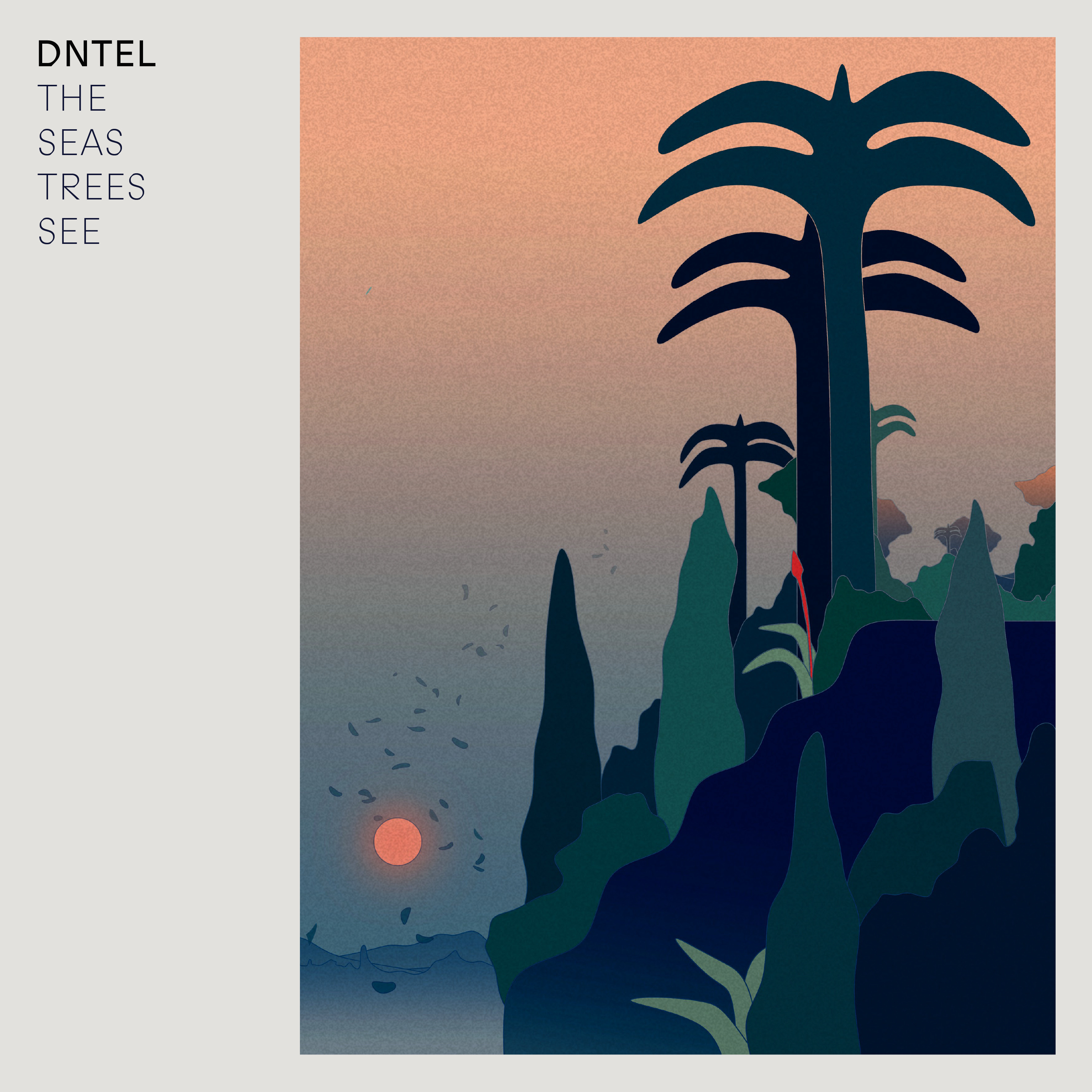
It is. Dntel delivers again with the winning mixture of comforting sounds and original exploration, meaning the ease of the familiar rubs up against newer thoughts and tendencies. This is an outdoor album, with an attractive and lasting warmth – as the cover art implies. Dntel’s second opus of this year is destined to be more pop-based, which bodes well for a complementary pair.

Stream

Buy