This is the first in an occasional series of posts where I would like to draw attention to writers on music, classical or pop, whose work I love and respect.
Yesterday Arcana’s Listening to Beethoven series reached the Second Symphony– the last work discussed by Daniel Heartz in the third volume of an epic series looking at music of the 18th century.
I wanted to draw attention to Daniel’s writing because this series of books is quite simply invaluable. When I first considered purchasing it I baulked at the price per instalment (roughly £45, even at second hand) but I can honestly say it has provided me with incredible value for money.
Heartz’s strengths are many, but his ability to talk through technical aspects of music without losing the reader in jargon is unusually strong. However even that quality is second to his knack of placing the music in historical context, which he does so throughout the books. I warmed to this quality in the third volume (Haydn, Mozart and early Beethoven 1781-1802) just as much in the second (Haydn, Mozart and the Viennese School: 1740-1780). Going back further, the equally sizable volume of Music In European Capitals: The Galant Style, 1720-1780 ensures lesser-known and appreciated composers such as Boccherini, J.C. Bach and Stamitz get the detail and respect they fully deserve.
Heartz is great at telling a story, applying the same detailed and pictorial approach to each composer or historical figure, and at every turn it is clear that a remarkable depth of research has been applied to his work. There is very little speculation needed, but where it is made he is never fanciful or exaggerated.
Very sadly Professor Heartz died in 2019. I must admit, rather selfishly, that I was hoping his exploration of Beethoven would continue beyond the year 1802, but on learning the sad news I can only say I am very grateful to him for illuminating the classical period of music history with such high quality, informed writing. His books will give pleasure and more information, no doubt, for many years to come.
A tribute to Daniel can be found here on the University of California website. The three books referred to above are published by W.W. Norton.
The Longing for Happiness. Left wall, detail from the Beethoven-Frieze (1902) by Gustav Klimt
Symphony no.2 in D major Op.36 for orchestra (1800-1802, Beethoven aged 31)
Dedication Karl Alois, Prince Lichnowsky Duration 30′
1. Adagio molto – Allegro con brio 2. Larghetto 3. Scherzo: Allegro 4. Allegro molto
Listen
Background and Critical Reception
Beethoven’s time in Heiligenstadt may have been difficult, but it yielded music of remarkable positivity in such testing situations. George Hall, writing booklet notes for Simax, sums up the situation neatly: ”What has proved remarkable to Beethoven’s biographers is that the (second) symphony, whose sketches date back to 1800 and whose finishing touches were probably added in 1803, was composed largely in the year that he wrote the famous Heiligenstadt testament. The fact that this document – in which Beethoven in his post-suicidal mood railed against his deafness and isolation in a letter – was conceived in the year of this predominantly happy and straightforward piece is considered paradoxical.’
‘Symphony no.2 is the main fruit of Beethoven’s labors in 1801-2 and is considered to be the culminating success of his early period’, writes Daniel Heartz. He gives an account of the premiere on 5 April 1803, which took place at the new Theater an der Wien, and included the hastily composed short oratorio Christus am Ölberge and also a new piano concerto, the third.
In a fascinating and detailed analysis, Heartz goes on to draw close links with Mozart‘s Symphony no.38, the Prague, which Beethoven greatly admired. Written in the same key, the two works share a broad Adagio introduction to the first movement, and a nearly identical instrumentation. The crucial difference here is that Beethoven adds clarinets in A, a distinctive part of the woodwind sound which makes such a difference to this symphony.
The second symphony would probably have been, to date, the longest symphony yet published – a quality acknowledged by Allegmeine Musikalische Zeitung of Leipzig, in their 1804 appraisal. ‘It is’, their critic wrote, ‘a noteworthy, colossal work (the biggest so far), whose profundity, strength and artistic understanding are very rare, and presents difficulties from the point of view of execution…that certainly no previous symphony has offered.’
Heartz identifies it as ‘a watershed for its composer, the last of his big works in which he looked to Haydn and Mozart for inspiration.’ Later, he notes that when ‘the London Philharmonic Society invited Beethoven to compose a symphony in the style of the first and second symphonies’, it was ‘an offer that deeply offended the composer, who indignantly refused. There can scarcely be more striking confirmation than this that a corner was turned after 1802.’
Thoughts
If you approached this piece cold, there is no way you would know it was written by a man whose grip on life itself was tenuous. In the midst of all the strife he was experiencing, Beethoven pulled out this sunny piece of beautifully joined-up thinking, giving the best possible response to his illnesses and impending deafness. If he was to be hindered, the music would see him through.
There is much to love about the Second Symphony. Its dimensions look front-loaded, with a substantial first and second movement and a shorter Scherzo and Finale placed third and fourth. These two, however, act as a combined pair – and so the feeling is of a trio of movements, as perfected by Mozart in the Prague symphony discussd above. The spirit of Mozart is present for sure, but so is the drive and energy of the younger composer, along with his ability to develop incredibly small melodic cells into material for whole movements.
His expertise in this is evident in those third and fourth movements. The scherzo’s seemingly throwaway phrase at the start is the block on which the whole movement rests, played by the orchestra but with the strings keeping busy in between. The finale follows on naturally, moving closer to ‘home’ with another clipped phrase from the full orchestra.
Before these two symphonic gems we have had the pleasure of an energy-filled first movement and a balletic second, a ‘slow’ movement with a good deal of poise. Here the clarinets make themselves known the most, and Beethoven’s writing for wind is a joy in which to indulge. The movement flows with a happy stream of invention, anticipating perhaps the outdoor vistas of the later Pastoral symphony.
Working backwards, the first movement has a good deal of drama in its introduction and a tautly argued Allegro section which frequently breaks into an unfiltered smile. Perhaps Mozart and a little of Haydn are most obvious in the music here, but again the material could not be from anyone else.
Many commentators declare the Second Symphony as the culmination of Beethoven’s first period. With music of such rich invention, such clever but instinctive development and such bright textures, it is to be savoured – and bodes extremely well for what is to come.
Spotify playlist and Recordings used
NBC Symphony Orchestra / Arturo Toscanini (RCA) Cleveland Orchestra / George Szell (Sony Classical) Orchestra of the Eighteenth Century / Frans Brüggen (Philips) Berliner Philharmoniker / Herbert von Karajan (Deutsche Grammophon) Vienna Philharmonic Orchestra / Claudio Abbado (Deutsche Grammophon) Danish Chamber Orchestra / Ádám Fischer (Naxos) Minnesota Orchestra / Osmo Vänskä (BIS) Royal Concertgebouw Orchestra / Rafael Kubelik (Deutsche Grammophon) Anime Eterna Brugge / Jos Van Immerseel(ZigZag Territories)
Performances on ‘period’ instruments or modern interpretations are both to be lauded in this piece. The former camp contains really fine versions from Anime Eterna Brugge and Jos van Immerseel, or the Orchestra of the Eighteenth Century and Frans Brüggen, to name just two thoroughly enjoyable accounts. The latter gives great enjoyment thanks to the batons of Harnoncourt, Kubelik and Szell, not to mention many, many others!
To listen to clips from the recording from the Scottih Chamber Orchestra conducted by Sir Charles Mackerras on Hyperion, head to their website
You can chart the Arcana Beethoven playlist as it grows, with one recommended version of each piece we listen to. Catch up here!
Also written in 1802 HaydnMass in B flat major Hob. XXII:14 ‘Harmoniemesse’
Pre-Concert Event: Ma Xiao-Qing Back to the Beginning (2021) Skempton Heinen Skizzen (2021) [BCMG Commission: World premiere] Colette Overdijk (violin), Ulrich Heinen (cello)
Concert: Turnage This Silence (1992) Alberga On a Bat’s Back I do Fly (2000) Saunders Stirrings (2011) Turnage Concertino for Clarinet and Ensemble (2020) [BCMG commission: World premiere]
Jon Carnac (clarinet), Birmingham Contemporary Music Group / Thomas Kemp
CBSO Centre, Birmingham Sunday 12 September 2021
Written by Richard Whitehouse
Birmingham Contemporary Music Group began its new season with a concert centred around music from Mark-Anthony Turnage, and what should have been a premiere to mark his 60th birthday last year but which still left a favourable impression however belated its emergence.
First came an earlier Turnage piece, This Silence drawing clarinet, bassoon, horn and string quintet into an intensive dialogue whose opening Dance built up a fair momentum that the ensuing Dirge channelled towards an eloquent if by no means unruffled set of variations as found just tentative closure. Three decades (and a brief Uli fanfare) later, Concertino exudes a far more relaxed aura, doubtless occasioned by its being a tribute to clarinettist (and fellow sexagenarian) Jon Carnac – his artistry to the fore in the playful Study in Fifths and incisive Carnac with its ingenious workout on the soloist’s name. In between, a soulful Romanza afforded contrast but if this and the final Sad Soliloquy found Turnage’s cool-jazz leanings at their smoothest, the alluring interplay of clarinet and ensemble was no less appealing for it.
In between these works came, firstly, a timely revival for Eleanor Alberga. On a Bat’s Back I do Fly takes its cue from Ariel’s final song in Shakespeare’s The Tempest for music whose fluid contrasts of motion and expressive force, ably drawn into a cohesive whole, brought an agile response from BCMG – not least percussionist Julian Warburton. Appreciably different was Stirrings, the third in a sequence of ‘‘quiet and fragile collage compositions’’ by Berlin-based composer Rebecca Saunders, which took extracts from Samuel Beckett as the starting-point for an evocative soundscape whose simple yet effective spatial disposition – woodwind being situated around the gallery, with strings and piano spread across the platform – audibly enhanced the succession of echoes and resonances informing this frequently intangible score.
The pre-concert event (essentially the first half, given the interval which followed) brought a welcome further hearing of Ma Xiao-Qing’s Back to the Beginning, arguably the most striking of the ‘Soliloquys and Dialogues’ series written for BCMG musicians during the pandemic – violinist Colette Overdijk eliding between some vividly rhetorical passagework and spoken interpolations with a confidence borne of familiarity. Ulrich Heinen then gave the premiere of Heinen Skizzen, a miniature wholly typical of Howard Skempton in its deceptive simplicity.
This latter piece ably served its purpose of honouring Heinen’s retirement from BCMG after 35 years of commitment to the ensemble and its music-making. Not a few listeners (including the present writer) fondly recall his cycle of Bach’s Cello Suites given at St. Paul’s, Hockley in the late 1980s, with his subsequent recordings of the initial five of these – placed within a stimulating contemporary context – well worth investigating on the Métier Sound and Vision label. Hopefully his retirement will not preclude the occasional reappearance with BCMG.
Back to the present, this evening’s main concert is being repeated at West Malling in Kent on September 26th, with BCMG’s subsequent recitals in Birmingham and Bristol on November 12th and 13th. A full programme of activities for the 2021/22 season hopefully (!) lies ahead.
You can find information on further BCMG activities here, while further information on Ulrich Heinen’s Bach can be found at the Divine Arts website
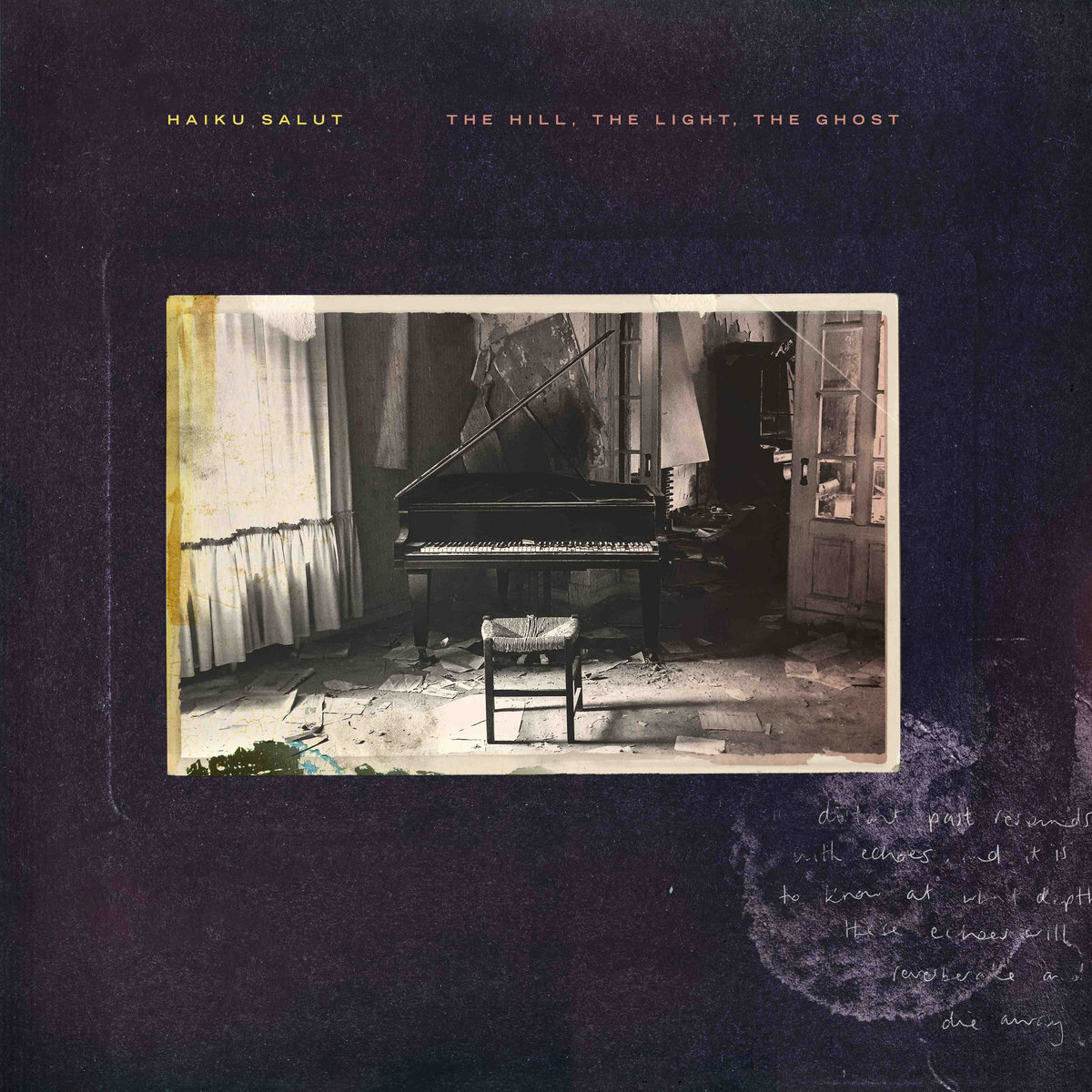
Derbyshire trio Haiku Salut relocate outdoors for this, their fifth album, which is in their words ‘an exploration of sound in relation to memory’. To fuel the latter they blend electronics and field recordings taken from a variety of sources, at all times seeking a personal touch or a story behind. The notes in the CD booklet document their findings, which range from natural sources to the strains of a ghostly piano in a large abandoned house, somewhere near Frankfurt.
What’s the music like?
Strange and captivating. Beginning with birdsong, Wide Awake is the ideal piece of music with which to start your day, soft strings and distant piano stretching the eardrums pleasantly. The mood changes with Entering, where a cold shiver runs through the arpeggios on the upper register of the ghostly piano. Gradually a mournful air descends on the instrument as it tolls slowly, beautifully played by band member Sophie Barkerwood.
A simpler, calmer piano informs the restful Trespass, while the tones are softer but the musical key remains the same for We Need These Beams, where a gently oscillating loop is gradually taken over by eerie displacement from the electronics. The sounds become increasingly wooden as the track dissolves.
I Dreamed I Was Awake For A Very Long Time is a lovely piece, a combination of a clipped piano phrase and stately chords over a steady, chugging beat. It really is a wonder, and is complemented by the wide open vista of How The Day Starts.
There are less field recordings evident for the friendly chatter of All Watched Over By Machines Of Loving Grace, an older track, but they come to the fore in the reassuring balm of Try Again And Again And Again, full of subtle positivity, and the closing All Clear, which brings back birdsong and strings akin to the start of the album.
Does it all work?
Yes, especially on headphones. Closer listening reveals the different layers and perspectives of the field recording, which is matched by the trio’s distinctive and carefully monitored musical complements. These are always pleasant to listen to at the very least but often take the breath subtly with moments of consonant beauty. There is, however, a dark undertone running through some of the memories, a shadow that once applied is hard to remove.
Is it recommended?
Yes. Another excellent set from one of our electronic musical treasures, who continue to fly just under the radar – when really they deserve to be held in much higher regard.
reviewed by Ben HogwoodWhat’s the story?
For the eighth in the Cue Dot Series, Paul Scott turns to Wales and the Snowdonia-based Robin Edwards, aka R. Seiliog. Ash Dome is his first full length release since 2018, taking both its title and structure from a living sculpture by David Nash (below)
Seiliog writes ambient music and dresses his work on this album with field recordings made in Coed Camlyn between March and May 2021.
What’s the music like?
Beautifully restful. The field recordings are a lovely complement to Edwards’ textures, which are light in the extreme and often glint at the edges, as though catching the early morning sun. Rotunda is a good example of this, a sonic portrayal of how beaten metal might reflect bright sunlight. Mind Garden brings birdsong into the equation, a robin making itself known quite early on.
There is a natural ebb and flow in the music, the wind in the branches portrayed through subtle, dappled electronic movements, with pockets of melody that take time establishing themselves, but make a subtle mark. 22 Onnen pulses softly with warm textures, while a steadier beat emerges during In The Direction Of Sunlight.
Ultimately though this is music that works at its best without a beat marking time, and the treble-rich sounds give a lasting brightness.
Does it all work?Yes. The musical representation of the sculpture is strong, but like the structure it also has an endearing vulnerability, reflecting the plight of treasured green spaces. The fact that the location of Nash’s sculpture had to be withheld shows how precious and endangered these things are, and that reflects in the slightly rarefied nature of Edwards’ music.Is it recommended?It is – an album that again with Cue Dot works on several levels, as a background balm or as thought provoking statement on the environment. Both are valid approaches from which to enjoy a rather lovely album.Stream and Buy



 reviewed by Ben Hogwood
What’s the story?
For the eighth in the Cue Dot Series, Paul Scott turns to Wales and the Snowdonia-based Robin Edwards, aka R. Seiliog. Ash Dome is his first full length release since 2018, taking both its title and structure from a
reviewed by Ben Hogwood
What’s the story?
For the eighth in the Cue Dot Series, Paul Scott turns to Wales and the Snowdonia-based Robin Edwards, aka R. Seiliog. Ash Dome is his first full length release since 2018, taking both its title and structure from a 
 Arcana.fm