
BBC Proms 2023 – María Dueñas, BBC Symphony Orchestra / Josep Pons – Falla, Lalo, Debussy & Ravel

Prom 8 – María Dueñas (violin), BBC Symphony Orchestra / Josep Pons

De Falla La vida breve (1904-05) – Interlude and Dance
Lalo Symphonie espagnole, Op. 21 (1874)
Debussy Ibéria (1905-08)
Ravel Boléro (1928)

Royal Albert Hall, London
Thursday 20 July 2023

by Richard Whitehouse photos by Chris Christodoulou / BBC

The Proms went to town on Spanish music just over two decades ago, and if tonight’s concert featured only one piece by a Spanish composer, an aura of ‘Spanish-ness’ fairly pervaded this programme which likewise found the BBC Symphony Orchestra in excellent form throughout.

The piece in question was Interlude and Dance from de Falla’s opera La vida breve, once a regular fixture at these concerts and one which makes for an ideal encore or (as here) curtain-raiser according to context. Josep Pons duly brought out the drama of its initial pages, before heading into a rendition of the main section such as (rightly) predicated suavity over rhetoric, while not lacking for impetus as this music reached its effervescent close. Lasting little more than an hour, the opera ought to enjoy more frequent revival as part of a judicious double-bill.

Édouard Lalo is himself a composer worth revival, his Symphonie espagnole having regained something of its familiarity from half a century ago. Her tonal warmth and incisiveness made María Dueñas an ideal exponent, while her rapport with the orchestra accordingly underlined its concertante-like ingenuity. There was no lack of energy or pathos in the opening Allegro, the capering elegance of the Scherzando duly complementing the forcefulness of the ensuing Intermezzo before the Andante brought a finespun eloquence, itself offset by the final Rondo with its indelible main theme and never wanton virtuosity. Evidently a first-rate accompanist, Pons drew as subtle a response from the BBCSO here as in a rapt arrangement for violin and strings of Fauré’s song Après un Rêve which Dueñas offered as the entirely apposite encore.

Debussy allegedly spent just one day over the Spanish border, but his feel for that country’s musical essence in Ibéria could not be gainsaid. The unwieldly trilogy that is the orchestral Images often makes performance of this in itself a stand-alone triptych preferable, and Pons had its measure from the outset of Along the Streets and Pathways, with its characteristic alternation of decisiveness and hesitancy. Nor was there any lack of ecstatic languor in The Perfumes of the Night whose soulfulness only gradually became apparent – Pons making a rhythmically seamless transition into The Morning of a Festive Day with its vivid evoking of castanets and guitars, along with a folk-inflected élan as carried through to the headlong closing bars. Highlighting of detail never risked cohesiveness in this scintillating account.

Ravel’s Rhapsodie espagnole would have been an ideal work to conclude this concert, though few in the audience would surely have begrudged hearing Boléro in its place and Pons did not disappoint. At just over 15 minutes it was appreciably faster than the inexorable unfolding its composer most likely envisaged, but the combination of textural definition and astute placing of detail ensured this traversal enticed over the short term as keenly as it compelled across the whole. In what is a ‘concerto for orchestra’ without equal, it would seem invidious to single out individual contributions, but Alex Neal was unerring in his articulation of the side-drum ostinato, while Antoine Bedewi’s timpani steered those climactic stages through to a forceful but not overbearing denouement. If not the ultimate Boléro, this was certainly one to savour.

For more on the 2023 BBC Proms, visit the festival’s website at the BBC. Click on the names for more information on the BBC Symphony Orchestra, Josep Pons and María Dueñas

BBC Proms 2023 – Elena Urioste, BBC NoW / Tadaaki Otaka – Rachmaninoff / Respighi, Coleridge-Taylor & Beethoven

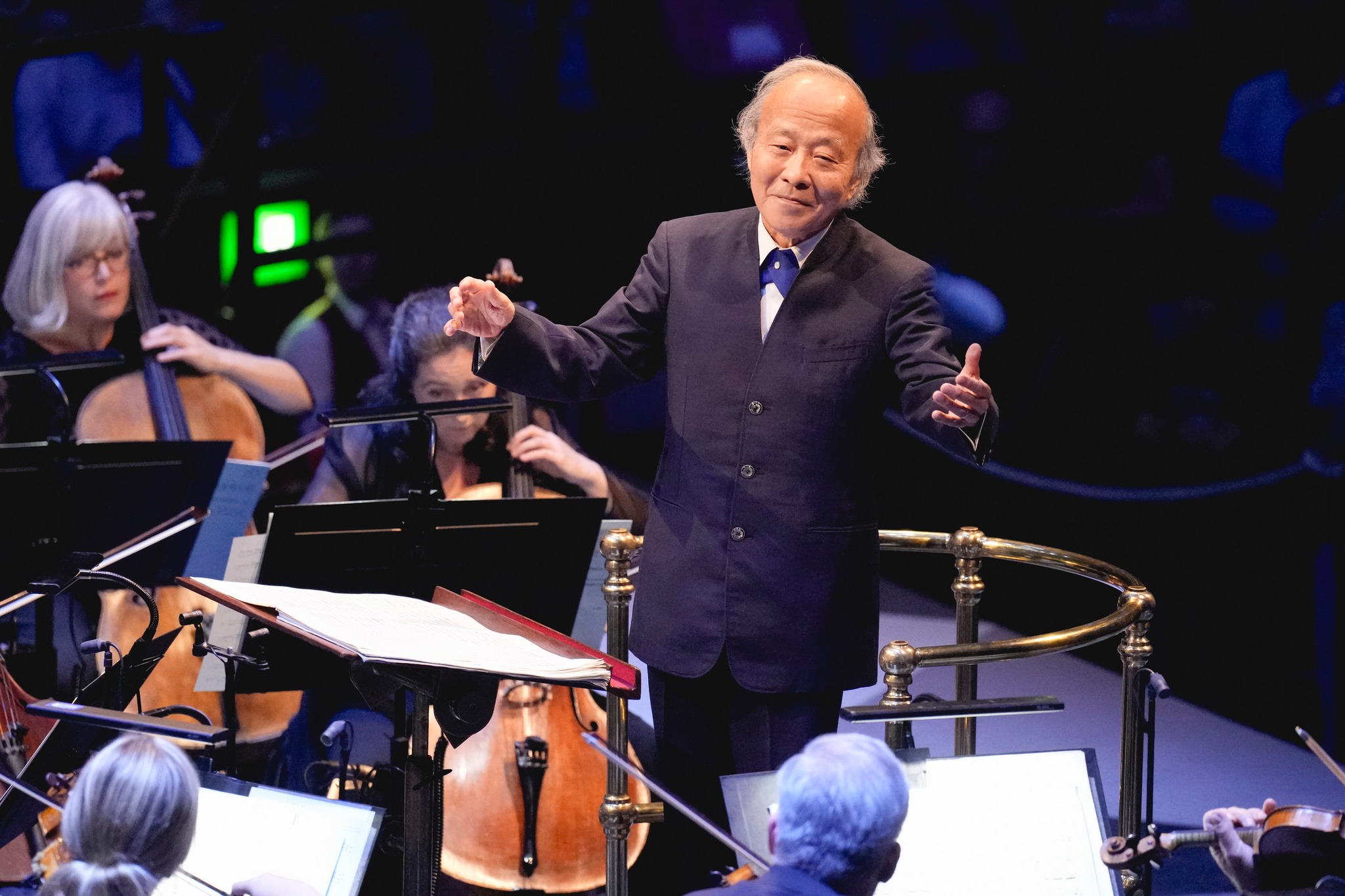
Prom 7 – Elena Urioste (violin), BBC National Orchestra of Wales / Tadaaki Otaka

Rachmaninoff (orch. Respighi) Five Études-tableaux (1911-17, orch 1930) [Proms premiere]
Coleridge-Taylor Violin Concerto in G minor Op.80 (1911-12)
Beethoven Symphony no.5 in C minor Op.67 (1807-08)

Royal Albert Hall, London
Wednesday 19th July 2023 [7pm]

by Richard Whitehouse photos by Andy Paradise / BBC

Tadaaki Otaka’s years at the helm of the BBC National Orchestra of Wales (1987-95) were a highpoint of the latter’s history, and it was good to see and hear the rapport between them now that he is Conductor Laureate being maintained throughout this evening’s programme.

Surprising that Respighi’s orchestration of five from Rachmaninoff’s sets of Études-tableaux had not been given at the Proms, but the respective 150th and 80th anniversaries of his birth and death provided an ideal opportunity. Otaka brought out the listless calm of The Sea and the Seagulls with its death-haunted aura, then conveyed the scintillating energy of The Fair. With its evocations of Orthodox chant and heady pealing of bells towards the close, Funeral March is the most imposing and Otaka gave it its due – not least by pointing up the deadpan humour of Little Red Riding Hood and the Wolf which provides greatest possible contrast. The sheer effervescence of March made a fitting conclusion to a sequence that, while other orderings are possible (not least 2-1-4-3-5), is a viable and a cohesive entity in its own right.

The resurgence of interest in Samuel Coleridge-Taylor continued apace with a revival of his Violin Concerto, 111 years after its UK public premiere at these concerts. Its composer’s last major work, this is a work audibly in the Romantic tradition and while the initial Allegro gets off to a less than promising start with its blousy and over-emphatic first theme, the resource with which the soloist elaborates both this and the insouciant idea that follows is as engaging as the cadenza underpinned by drum-roll is arresting. The central Andante is the undoubted highlight, its warmly confiding main melody capable of unexpected plangency as it unfolds, then the final Allegro draws on the Afro-American inflections of Coleridge-Taylor’s heritage in a spirited discourse whose climax sees an opulent restatement of the work’s opening theme.

A testing assignment such as Elena Urioste (after last year’s Proms debut with Ethel Smyth’s Double Concerto) gave with no little panache, her vivid while modest tone heard to advantage in Tom Poster’s eloquent take on Harold Arlen’s Over the Rainbow that was given as encore.

A staple of the Proms since its very first season 128 years ago, Beethoven’s Fifth Symphony comes so weighted with expectation as to make any performance in itself a provocative act. Eschewing astringency and portentousness, Otaka (rightly) rendered the initial movement as an elemental though unpredictable play on its indelible opening motif; the ensuing Andante pursuing an equally eventful course as its main theme evolves via a process of developing variation, the heroic and inquisitive held in unforced accord through to the decisive ending.

A pity that Otaka opted not to take the repeat in the Scherzo (rather than that of the finale) – its interplay between the ominous and the impetuous abetted by a transition of speculative intent. Here too there was never any risk of pomposity or overkill, Otaka steering this most visceral of symphonic finales through a development of bracing immediacy then on to a coda whose insistent C major reiterations were the outcome – no more and no less – of this movement’s innate potential. The undiminished relevance of this music was never for a moment in doubt.

For more on the 2023 BBC Proms, visit the festival’s website at the BBC. Click on the names for more information on the BBC National Orchestra of Wales, Tadaaki Otaka and Elena Urioste

New music – Public Service Broadcasting

Here is a bookmark for your diary – the next release from celebrated ‘archive band’ Public Service Broadcasting will be an official vehicle for their centenary tribute to the BBC, first heard at the 2022 BBC Proms.

This New Noise will be released on 8 September, a celebration of the power of radio led by the band but with a key role for the corporation’s flagship ensemble, the BBC Symphony Orchestra. They appear under the guise of arranger and conductor Jules Buckley, their Creative Artist in Association. He has an impeccable record for bringing orchestras into contact with other genres in a totally natural way, as seen in the Pete Tong Ibiza Proms and a number of excellent soul collaborations.

Here is a taster for the release, the elegant and rather moving Broadcasting House:

Switched On: Tristan Arp – End of a Line or Part of a Circle? (3024)

by Ben Hogwood

What’s the story?

The enigmatic title of this EP hints at a thoughtful period in Tristan Arp’s musical output. Currently based in Mexico City, he has produced this set of five tracks that, in the words of his press release, ‘hints at timelines, lifecycles, and the shifting perspectives that come with zooming out from a human lens.’

What’s the music like?

Rich in colour and detail – and almost entirely percussive. Every sound at the start of the title track originates from something being struck, either delicately – as in the hi hats – or with strong expression, as in the bongos, tuned percussion and bass. Gradually wordless voices come into view towards the end, bringing much to reward the exploratory ear.

Arp continues with his intricate, syncopated rhythm tracks, the percussion making their own melodies above fragments from elsewhere. Branching Streams definitely suggests a more watery picture,

Panspecies Rights is a busy track, a really evocative vision of ‘every life form rising up in protest’ with its urgent percussion lines. A Livable Earth works as a response, panning out for a more spacious look at things but still with the forensic, insect-like detail in the foreground.

Finally, The Language Change suggests a new language for non-human communication and does so initially with a series of short phrases and clipped sounds, before sweeping cello-like phrases suggest more expressive thoughts.

Does it all work?

It does, though you need the right environment to get the most out of Arp’s music. Make sure you are somewhere that can cover all the frequencies.

Is it recommended?

It is, as an imaginative concept and set of tunes. Once again Tristan Arp has made electronic music with both eyes on the future.

Listen & Buy

Let’s Dance – Fredfades – Caviar (Mutual Intentions)

by Ben Hogwood

What’s the story?

Fredfades is the name under which the versatile and well-travelled Norwegian producer Fredrik Øverlie records. With hip hop and rap on his CV, Øverlie – also an accomplished DJ – is using this album as a way of documenting his travels and some of the many musical styles he has encountered, showing off his versatility at the same time.

Caviar is his second Fredfades album, following six years after the release of Warmth. It features a number of guest vocalists.

What’s the music like?

Caviar is a really strong album, packed with durable riffs, feelgood vibes and strong beats, knitted together to make a strong album that has the ideal ebb and flow.

The title track gets us underway, an accomplished poolside jam that sets the scene for a record that proves willing to look back as much as it looks forward. That much is clear in the rolling ‘90s beat of Winner, one of Øverlie’s finest moments, with its catchy vocal snippet giving it the ideal club vibe. Well, Well, Well does brilliantly in this respect too, using a riff on the glockenspiel that really stays put!

The vocal tracks are on point, too. Bendik HK brings the heat to Summer Of Love in tandem with a peak time piano riff, while Kristian Hamilton lends smokey tones to My Heart Is On The Edge. Tenerife 1994 goes deeper, Krushed Ice joining for a well-worked tribute to Pharoah Sanders that would please the likes of Kevin Yost – while the Balearic vibe is strong on Intuition, where MoRuf’s ‘you are one of a kind’ vocal makes a strong impact.

Does it all work?

It does – the proportions of each track are just right, meaning the album flows really well.

Is it recommended?

Definitely. This is an album to keep close to your ears as the summer warms up!

Listen

Buy