
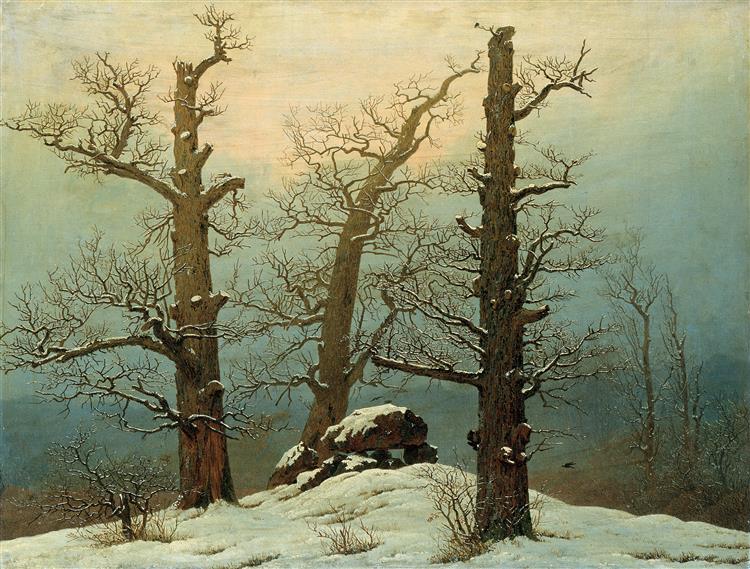
Dolmen in snow, by Caspar David Friedrich (1807)
String Quartet no.8 in E minor Op.59/2 ‘Razumovsky’ (1806, Beethoven aged 35)
Dedication Count (later Prince) Andrey Kirillovich Razumovsky
Duration 38’
1.Allegro
2.Molto adagio ‘Si tratta questo pezzo con molto di sentimento’
3.Allegretto (second section marked ‘Maggiore – Thème russe’
4.Finale. Presto
Listen
written by Ben Hogwood
Background and Critical Reception
Beethoven is thought to have written the three Razumovsky string quartets between April and November 1806 – during which he redefined the parameters of a form shaped by Haydn and Mozart. When you stop to consider he was working on the Fourth Piano Concerto, the Violin Concerto and the Fourth Symphony at the time, it offers some perspective on his capabilities as a composer!
The first ‘Razumovsky quartet’ in F major drew parallels to the Eroica symphony, but the second is a very different work, set in E minor – a key seen by Lewis Lockwood to be “a bleak and distant key in the tonal system of the period”. As Jan Swafford goes on to note, “The beginning is as curiously fragmentary as the previous quartet’s was curiously sustained. The feeling of the minor mode here is not tragic but mysterious, with startling harmonic jumps.”
As for the second movement, contemporary composer and friend Carl Czerny recalled Beethoven saying that the E-major slow movement fell into his mind “when contemplating the starry sky and thinking about the music of the spheres”.
Thoughts
There is high drama in the first movement of this quartet, the polar opposite to its predecessor. The sweep of the first two chords is unlike anything we have heard in Beethoven’s music for string quartet to date – the first chord with 9 notes, the second with 7. Together they make a gesture whose impact is felt throughout the work, and the follow-up – a kind of stunned statement – also carries thematic importance.
The first movement moves between this loud dynamic and soft, dramatic responses, the atmosphere tense and febrile. Whenever the intensity grows the chords reappear in different guises, and there are some striking discords as the movement heads to its thoughtful close.
The slow movement is placed second, a much richer affair than the first quartet – but equally expressive, the four instruments showing off a very full bodied sound at climactic points. Again, slow music for Beethoven has a heavenly air in its stillness – though a central section disturbs this piece with harsh double stopped violin, imparting the atmosphere of the first movement.
The scherzo is both elegant and serious to begin with, though at times becomes full-bodied and heavy. The trio, on the other hand, is light footed, its perky tune shared between the instruments. The finale’s dotted rhythms provide the backing for a folksy tune on the violin, with the unmistakable feeling of turning for home. Though starting in C major, E minor is the obvious destination, and so it proves with music of terrific power and poise. It’s easy to forget just four instruments are involved!
This is further evidence of Beethoven’s total reimagining of the string quartet, elevating the medium to a higher and much more ambitious plane. Each quartet is now a fully fledged drama, with a huge dynamic range and more meaningful emotions than we have yet heard from any composer.
Recordings used and Spotify links
Melos Quartet (Wilhelm Melcher and Gerhard Voss (violins), Hermann Voss (viola), Peter Buck (cello) (Deutsche Grammophon)
Borodin String Quartet (Ruben Aharonian, Andrei Abramenkov (violins), Igor Naidin (viola), Valentin Berlinsky (cello) (Chandos)
Takács Quartet (Edward Dusinberre, Károly Schranz (violins), Roger Tapping (viola), Andras Fejér (Decca)
Tokyo String Quartet (Peter Oundjian, Kikuei Ikeda (violins), Kazuhide Isomura (viola), Sadao Harada (cello) (BMG)
Végh Quartet (Sándor Végh, Sándor Zöldy (violins), Georges Janzer (viola) & Paul Szabo (cello) (Valois)
Amadeus String Quartet (Norbert Brainin, Siegmund Nissel (violins), Peter Schidlof (viola), Martin Lovett (cello)
The quartets listed above rise to the technical challenge offered by Beethoven, each one capturing the symphonic structure and scope of the piece. The Amadeus Quartet deliver a heartfelt if slightly glossy reading, while those by the Tokyo, Borodin and Melos Quartets are ideally poised and played. The Végh Quartet is a classic recording.
You can chart the Arcana Beethoven playlist as it grows, with one recommended version of each piece we listen to. Catch up here!
Also written in 1806 Wölfl Piano Concerto no.5 ‘Grand Concerto Militaire’ Op.43
Next up String Quartet no.9 in C major Op.59/3 ‘Razumovsky’
Published post no.2,138 – Thursday 4 April 2024

