
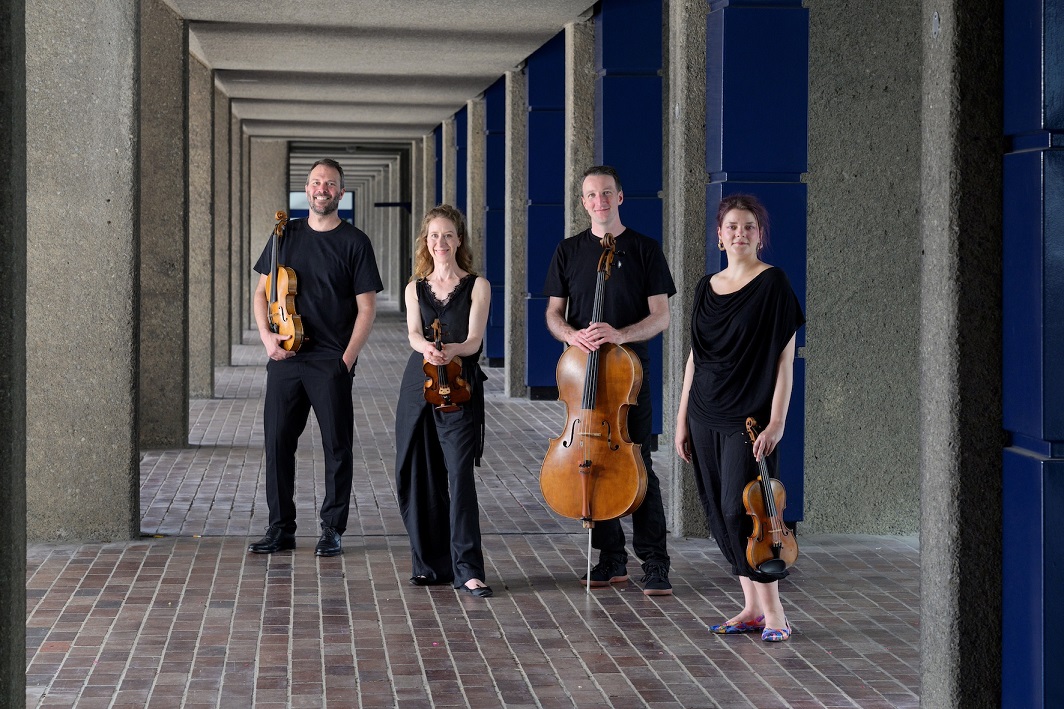
Heath Quartet [Maja Horvat & Sara Wolstenholme (violins), Gary Pomeroy (viola), Christopher Murray (cello)]
Haydn String Quartet in G major Op.33/5 ‘How Do You Do?’ (1781)
Bacewicz String Quartet no.6 (1960)
Locke Suite III in F (c1660)
Beethoven String Quartet no.16 in F major Op.135 (1826)
St John’s Church, Waterloo, London
Sunday 28 September 2025, 6pm
Reviewed by Richard Whitehouse
This early evening concert marked not just the start of London Chamber Music Society’s new season but also that of its first at St John’s Waterloo, following some 17 seasons in residence at King’s Place. The actual programme, however, could not have been more typically LCMS.
What better than to start with a Haydn quartet? His Op. 33 abounds in ‘less is more’ writing, not least the fifth in this set whose buoyant opening Vivace features a cadential figure which provides the nickname, then a Largo whose keening melody for first violin and cadenza-like passage betrays likely operatic origin. The Heath Quartet was equally inside the Scherzo with its amiable impulsiveness, while the final Allegretto had a genial humour that carried through to its good-natured payoff. A piece deserving of greater prominence within the Haydn canon.
As does the Sixth Quartet in Grażyna Bacewicz’s output. Evidently a breakthrough in terms of her writing for strings, its stealthy yet never brazen Modernism is clear from the opening movement in its subtle overhaul of sonata design, then the Vivace with its intensive rhythmic interplay. A ‘song without words’ centred on cello, the slow movement is a soulful interlude prior to a final Allegro as makes inventive play with rondo design – the widening expressive gulf between its stable refrain and its unpredictable episodes deftly sidestepped at the close.
Purcell’s music for consort might be the most directly acknowledged precursor of the string quartet, but that by Matthew Locke is hardly less significant and preceded it by almost two decades. This third of his six four-part suites is no exception – the substantial and teasingly discursive Fantasia being followed with an elegant Courante and a soulful Ayre then a (surprisingly?) trenchant Saraband. Throughout, the Heath’s seamless interplay was such as to relativize any distinction between a consort of viols and the ensemble of strings it became.
An ensemble taken to a peak of perfection on the cusp of the Romantic era with Beethoven’s last string quartet. Here the Heath judged the equable poise of its opening Allegretto then the quixotic humour of its scherzo to perfection. Neither was there any lack of feeling in a slow movement whose pathos becomes the greater for its understatement; the ‘difficult decision’ that informs the finale duly rendered with a sure sense of this music’s venturing towards its playful conclusion. Beethoven was rarely so profound as when he was being this disarming. A persuasive start to a new season and a new chapter in the illustrious history of the LCMS. A wide range of recitals is scheduled between now and June, while those unfamiliar with St John’s need have no doubt as to the excellence of its acoustic or attractiveness of its setting.
Click on the links for more information on the Heath String Quartet, the London Chamber Music Society and events at St. John’s Church, Waterloo. You can also click for more on composer Grażyna Bacewicz
Published post no.2,676 – Friday 3 October 2025
 Arcana.fm
Pingback: In concert – Heath Quartet @ London Chamber Music Society, St John’s Church Waterloo – Haydn, Bacewicz, Locke & Beethoven - LagacyNews