
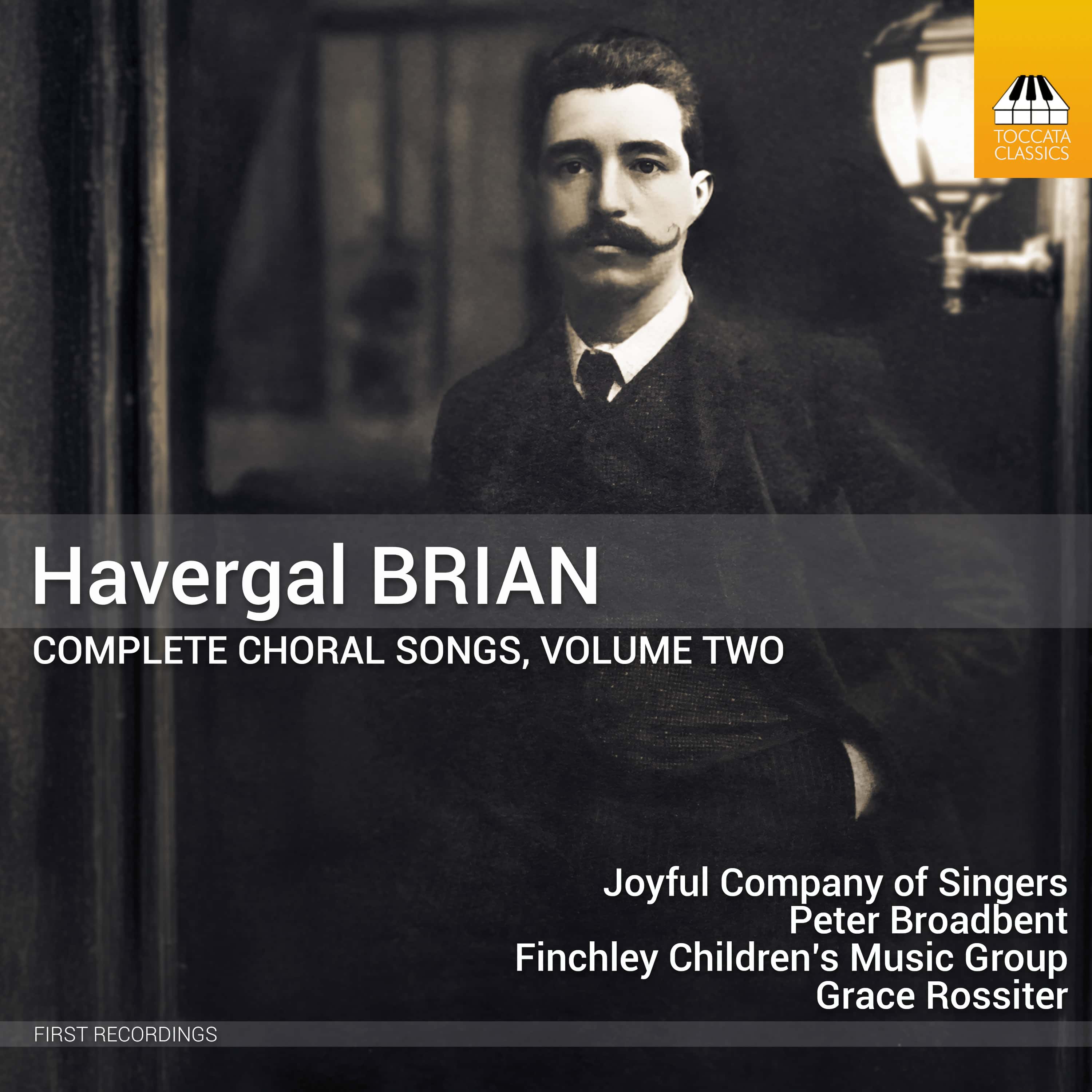
aJoyful Company of Singers / Peter Broadbent; bFinchley Children’s Music Group / Grace Rossiter with cGavin Roberts, dJohn Evanson (pianos)
Havergal Brian
Stars of the Summer Night (1905)a
Tell me, thou soul of her I love (1906)a
Rondel: In a Fairy Boat (1906)a
Fairies’ Song (1908)a
Daybreak (1910)a
A Child’s Prayer (1914)bd
If I had but two little wings (1914)bd
Little White Lily (1914)bd
Pastoral: The Shepherd (1914)a
Infant Joy (1914)a
The Lamb (1914)ac
Laughing Song (1914)ac
The Lost Doll (1914)bd
The Dream (1914)ac
The Echoing Green (1914)ac
The Moon (1914)bd
The River (1914)bd
The Mountain and the Squirrel (1914)bd
What does little birdie say? (1914)bd
He was a rat (1914)a
The Fairy Palace (1915)ac
The Phantom Wooer (1918)a
Tell me, where is fancy bred (1919)a
It was a lover and his lass (1919)a
Absence (1919)ac
Pack clouds away (1919)ac
Spring, the sweet Spring (1919)ac
Introit (1924)a
Vital Spark of Heavenly Flame (1924)a
Shall I then be spared? (1924)a
O Happiness, celestial fair (1924)a
Sweet Solitude (1924)a
Toccata Classics TOCC0680 [66’43’’]
English texts included
Producer Michael Ponder
Engineer Adaq Khan
Recorded a11 & 12 December 2021, c12 &13 March 2022 at St Jude on the Hill, Hampstead Garden Suburb, London; b26 November 2022 at St Silas, Kentish Town, London
Reviewed by Richard Whitehouse
What’s the story?
Toccata Classics rounds off coverage of Havergal Brian’s choral songs (aka part-songs) with a second volume that, as with its predecessor [TOCC0395], underlines the composer’s sheer versatility in a genre which occupied his thinking through almost two decades of his output.
What’s the music like?
It was with choral songs that Brian first attracted attention, settings of Henry Longfellow and James Thomson [tracks 1-3] testifying to his assurance in SATB or double-choir media when combining harmonic richness with a melodic eloquence and a rhythmic subtlety equalled by few of his contemporaries. His settings of fairy-themed verse by Bernard Weller and Gerald Cumberland [4/12], never coy in their whimsicality, show comparable ease writing for upper voices with a streamlined texture that prefigures his choral songs from the following decade.
Those months either side of the beginning of the First World War were to bring by far Brian’s largest number of choral songs – ostensibly as his means of accruing income while financially adrift in London, though the technical finesse of almost all those that survive are indicative of stylistic changes in his idiom also taking place. Much the most frequently encountered poet is William Blake [15-18, 22/23], with several settings from Songs of Innocence and Experience no less insightful or idiomatic than more familiar ones by later composers. By the same token, settings of Shakespeare and Thomas Nashe [10/11, 20] provide a distinctive take on often-set texts, whereas unison settings of Charles Kingsley, Ralph Emerson or Alfred, Lord Tennyson [21, 26/27] have a disarming if never ‘knowing’ naivety that transcends their respective texts.
Two enchanting Cumberland settings were most likely derived from an operetta for children duly abandoned, while those from such diverse authors as Matilda Betham-Edwards, Samuel Coleridge, George MacDonald, Robert Burns or Thomas Heywood [7-9, 13/14] between them tread a convincing path in terms of their suitability for amateur or professional singers. Most fascinating is a group composed during that interim between the first and second parts of the Gothic Symphony: settings of Hannah More [28-30] of a canonic and textural intricacy soon heard on a far more expansive scale, as was the fervency of totemic lines by Alexander Pope [6] and methodical treatment accorded the ‘Amen’ [5]. Settings of Thomas Lovell Beddoes [31] or Laura Richards [32], respectively lurid and sardonic, vividly round off this selection.
Does it all work?
It does, not least with the responsiveness to each song of the two choirs – Joyful Company of Singers resolutely unfazed by Brian’s demands in the ‘adult’ songs, as is Finchley Children’s Music Group in those by no means child-like songs for younger voices. Peter Broadbent and Grace Rossiter have marshalled their forces ably, while Gavin Roberts and John Evanson are not found wanting in piano parts which are often much more than accompaniments. Full texts are included, while John Pickard’s booklet note sets forth a wealth of pertinent observations.
Is it recommended?
It is, notwithstanding that the first volume is the more recommendable to those having yet to encounter this significant aspect of Brian’s output. Those who have done so should certainly acquire its follow-up album (which was recorded at the same sessions) without further delay.
Listen / Buy
You can hear excerpts from the album and explore purchase options at the Toccata Classics website. Click on the artist names for more on Grace Rossiter, Peter Broadbent, Finchley Children’s Music Group and Joyful Company of Singers. Meanwhile click on the name for the Havergal Brian Society
Published post no.3,030 – Sunday 27 September January 2026

