Unknown's avatar

About Arcana

My name is Ben Hogwood, editor of the Arcana music site (arcana.fm)

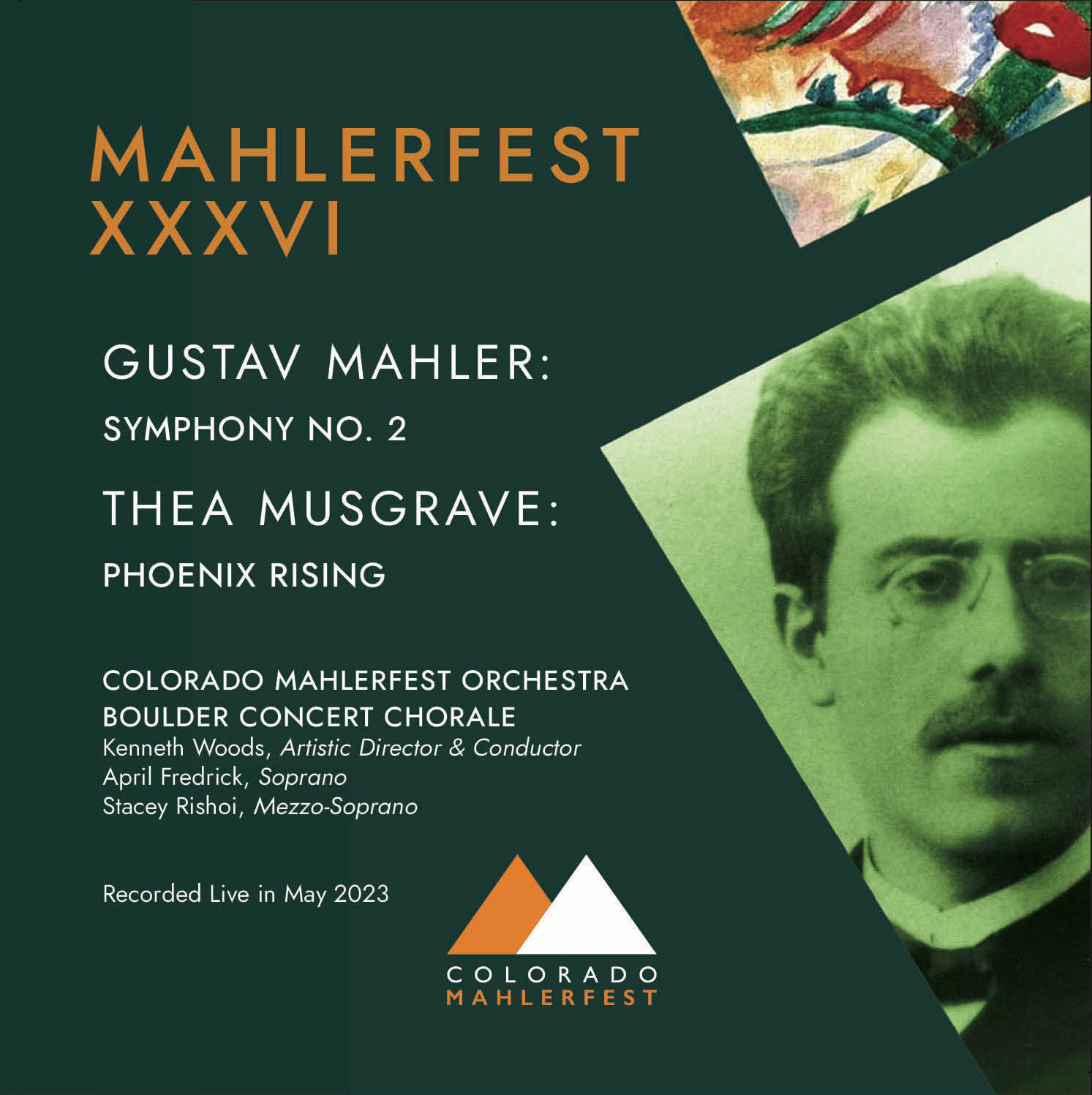
On Record – MahlerFest XXXVI: Kenneth Woods conducts ‘Resurrection’ Symphony & Musgrave’s Phoenix Rising

April Fredrick (soprano), Stacey Rishoi (mezzo-soprano), Boulder Concert Chorale, Colorado MahlerFest Orchestra / Kenneth Woods

Musgrave Phoenix Rising (1997)
Mahler Symphony no.2 in C minor ‘Resurrection’ (1888-94)

Colorado MahlerFest 195269301194 [two discs, 104’02”]
Live performances on 21 May 2023, Macky Auditorium, Boulder, Colorado

Reviewed by Richard Whitehouse

What’s the story?

Last year’s edition of MahlerFest continued its latest, not-quite-chronological traversal of the symphonies with the Second – appropriately coupled on this release (as in the concert) with a work such as considers ‘resurrection’ from a very different while no less relevant perspective.

What’s the music like?

Six years in the writing, Mahler’s Second Symphony fairly laid the basis for his reputation as a composer at its Berlin premiere in 1895. It is a measure of this performance that it captures something of the shock or excitement no doubt in evidence back then, not least in an opening movement with Kenneth Woods notably more interventionist tempo-wise as compared to that of the Third Symphony a year before. What emerges is imposing but never diffuse, at its most gripping in that baleful lead-in to a development whose terseness duly accentuates its impact, with the pathos of the second subject on its reprise making the coda’s sardonic recessional the more acute. After which, the second movement feels the more enticing through its alternation of warm sentiment with capering animation while heading to a conclusion of beatific repose.

There is no lack of incident in a scherzo whose glancing irony is leavened yet not lessened by its trios, the first as soulful with its lilting trumpets as the second is ominous in its import; but not before Stacey Rishoi has characterized the Urlicht setting with rapt inwardness. What to say about the finale other than, while this may not be the most overwhelming take on its vast fresco, it is matched by relatively few as regards an organic unfolding that sees the movement whole. Its contrasting elements here fuse with unforced cohesion to a fervent rendering of the chorale episode then on to a surging Toten-marsch – the kinetic momentum carried through to a methodical reprise of earlier ideas, then a rendering of Klopstock’s text (much altered by the composer) as only grows in intensity before the majestic affirmation of its closing pages.

As the ‘first half’, Thea Musgrave’s Phoenix Rising provides an ideal complement. The much esteemed (latterly more in the US than the UK) nonagenarian has written often for orchestra, but seldom with such immediacy than in a piece whose formal and expressive trajectory feels nothing if not symphonic in its progress. Comparison with the 2016 studio recording by BBC National Orchestra of Wales and William Boughton (Lyrita SRCD372) confirms that, passing tentativeness in ensemble excepted, Woods’s reading demonstrably makes more of this aspect.

Does it all work?

Yes, pretty much always. As on previous releases in this ongoing Mahler cycle, the Colorado MahlerFest Orchestra punches appreciably above its weight in music which should never fall prey to wanton virtuosity. The unyielding acoustic of Macky Auditorium is less an issue than before, with the finale’s offstage brass adeptly managed. April Fredrick brings her customary eloquence to bear on this movement, and the Boulder Concert Chorale – as prepared by Vicki Burrichter – rises to the occasion with notable fervency as this work reaches an ecstatic close.

Is it recommended?

It is. There have been too many superfluous Mahler cycles, but this traversal is shaping up as one of the most worthwhile and more than the memento of a memorable occasion. Hopefully such standards will be maintained by the Sixth Symphony as part of next year’s 37th edition.

Buy

For further purchase options, visit the MahlerFest website – and for more information on the festival itself, click here. Click on the names for further information on conductor Kenneth Woods, soloists April Fredrick, Stacey Rishoi and composer Thea Musgrave

Published post no.2,244 – Friday 19 July 2024
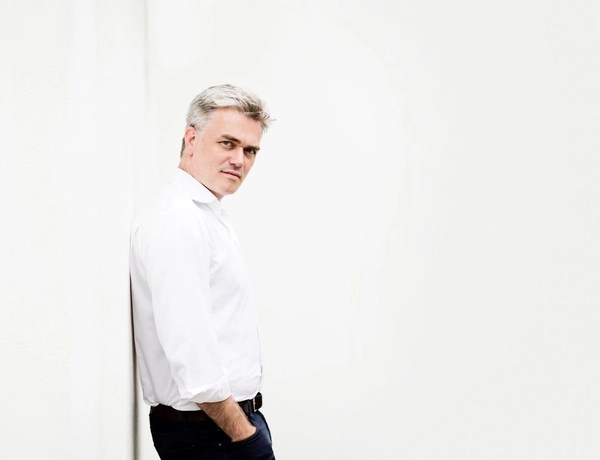
In concert – Mary Bevan, CBSO / Edward Gardner: Schubert – Symphony no.9 & Songs

Mary Bevan (soprano), City of Birmingham Symphony Orchestra / Edward Gardner

Schubert
Rosamunde D797 – No. 3b, Romanze (1823)
Der Erlkönig D328 (1815, orch. Berlioz 1860)
Die Forelle D550 (1816, orch. Britten 1942)
Im Abendrot D799 (1825, orch. Reger 1914)
Geheimes D719 (1821, orch. Brahms, 1862)
Symphony no.9 in C major D944 ‘Great’ (1825-6, rev. 1828)

Symphony Hall, Birmingham
Wednesday 17 May 2024

Reviewed by Richard Whitehouse Pictures by Benjamin Ealovega (Ed Gardner), Victoria Cadisch (Mary Bevan)

July concerts no longer a consistent fixture in the City of Birmingham Symphony Orchestra’s schedule, it made sense to end the current season with the intended programme for the fourth and final volume of this orchestra’s Schubert cycle with former chief guest conductor Edward Gardner.

If not his final such project, the ‘Great’ was the final symphony that Schubert finished and the culminating orchestral work of his last decade. Now, as almost two centuries ago, it is not an easy work to being off – but this account hit the ground running with a flowing yet purposeful introduction that elided seamlessly with the initial Allegro. Gardner kept momentum on a sure yet flexible rein over those impetuous and capricious themes of its exposition; underlining the subtly eddying tension of its development and a propulsive coda whose link-up with the tempo of that introduction was marred only by the too emphatic final gesture. Respectively plaintive or consoling, the Andante’s alternate episodes were brought into eloquent accord – the fanfare -riven anguish at its climax then the stark fatalism towards its close being especial highlights.

The essential link between the scherzos of Beethoven and Bruckner, the third movement had the right buoyancy but also a suavity in keeping with the Viennese character of its dance-like themes, and complemented by those of its trio whose lilting elegance were tinged by wistful regret. Launched with a commanding call-to-attention, the Finale did not lack for vigour but, unlike so many performances, Gardner was mindful not to rush either here or in the capering second theme whose relentless string accompaniment was vividly rendered. The development more than fulfilled its purpose as an extended transition into the reprise, then the coda opened with a frisson of anticipation such as underpinned the closing pages as they powered towards the decisive but never headlong close to what was a convincing and engrossing performance.

Regarding repeats, Gardner observed that of the first movement’s exposition but not those in the second half during either scherzo or trio, and that of the finale’s exposition. This at least made matters easier for the players, and left options open for their inclusion in the recording.

That forthcoming release on Chandos will hopefully find room for the five songs that formed the first half of this concert, with each of them arranged by a different composer. The pensive Romanze from Schubert’s incidental music to Rosamunde was heard in the composer’s own orchestration, with the compact psychodrama of Der Erlkōnig in a resourceful and nowadays overlooked orchestration by Berlioz. The looping but not always ingratiating playfulness of Die Forelle was expertly attended to by Britten, while the pensive soulfulness of Im Abendrot summoned an appropriate response from Reger; the sombre resignation of Geheimnis making for a welcome encore in its orchestration by Brahms. Throughout the selection, Mary Bevan’s veracity of emotional response and her clarity of enunciation were qualities worth savouring.

This programme may have concluded the Schubert cycle by Gardner and the CBSO, though hopefully it will not see of this partnership in recorded terms – the symphonies of Schumann, and maybe Brahms, being well worth considering as additions to the orchestra’s discography.

For details on the 2024-25 season A Season of Joy, head to the City of Birmingham Symphony Orchestra website. Click on the names to read more about soprano Mary Bevan and conductor Edward Gardner

Published post no.2,243 – Thursday 18 July 2024

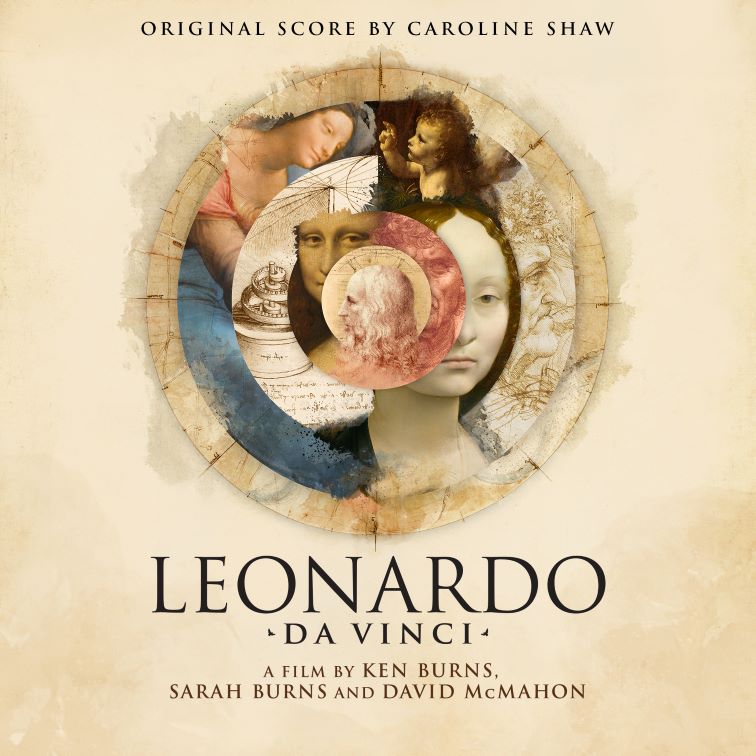
New music – Caroline Shaw: Leonardo da Vinci (Original Score) (Nonesuch)

published by Ben Hogwood, with text appropriated from the press release

The original score for Ken Burns’s new two-part documentary, LEONARDO da VINCI, with new compositions by Caroline Shaw, is available via Nonesuch Records on 25 October. The album features performances by the composer’s long time collaborators Attacca Quartet, Sō Percussion, and Roomful of Teeth as well as John Patitucci. Shaw wrote and recorded new music for LEONARDO da VINCI, marking the first time a Ken Burns film has featured an entirely original score. The video for Intentions of the Mind, from the album, can be viewed here:

LEONARDO da VINCI is directed by Ken Burns, Sarah Burns, and David McMahon. The film, which explores the life and work of the fifteenth century polymath Leonardo da Vinci, is Burns’s first non-American subject. It also marks a significant change in the team’s filmmaking style, which includes using split screens with images, video, and sound from different periods to further contextualize Leonardo’s art and scientific explorations. LEONARDO da VINCI looks at how the artist influenced and inspired future generations, and it finds in his soaring imagination and profound intellect the foundation for a conversation we are still having today: what is our relationship with nature and what does it mean to be human?

“No single person can speak to our collective effort to understand the world and ourselves,” said Ken Burns. “But Leonardo had a unique genius for inquiry, aided by his extraordinary skills as an artist and scientist, that helps us better understand the natural world that we are part of and to appreciate more fully what it means to be alive and human.”

“To help give depth and dimension to Leonardo’s inner life, and to carry our viewers on his personal journey, we enlisted the composer Caroline Shaw,” McMahon says in the album’s liner note. “Caroline’s existing body of music—joyful, daring, at times transcendent, and wholly unique—seemed to speak directly to Leonardo, a seeking soul who, 500 years after his death, can come across as strikingly modern. A fully original score, we believed, would add crucial connective tissue to areas where the record of Leonardo’s life is thin and it’s possible to briefly lose his trail. The music Caroline created is dynamic, enthralling and filled with wonder.

“This soundtrack is a testament to the inspired efforts of Jennifer Dunnington, who marshaled it into being, the brilliant musicians and vocalists who, with the help of Alex Venguer, Neal Shaw, Colton Dodd and Tim Marchiafava, made it soar, and most of all Caroline Shaw, who might be Leonardo’s soulmate from across time,” he continues. “With her help, the Leonardo who emerges is no wizard shrouded in mystery, but a prideful, obsessive, at times lonely or flustered, occasionally ecstatic, and, in the end, content man who is in ways both modern and thoroughly of his time.”

“As we set out to explore Leonardo’s life, we realized that while he was very much a man of his time, he was also interested in something more universal,” said Sarah Burns. “Leonardo was uniquely focused on finding connections throughout nature, something that strikes us as very modern today, but which of course has a long history.”

You can read more about Caroline Shaw at her website – and also more about Nonesuch here

Published post no.2,242 – Wednesday 17 July 2024

Switched On – Luke Elliott: Every Somewhere (AKP Recordings)

by Ben Hogwood

What’s the story?

The theme of Every Somewhere is the relationship between humans and the natural world – a theme that has preoccupied a number of artists in recent years.

Luke Elliott, a UK-born musician and producer based in Amsterdam, used modular and analogue synthesizers to make this work, sampling and re-sampling material together with fresh ideas. Talking about the album, he says how “the crossover between artificial sound and nature became a central theme, a subject for particular consideration, whether by “leaning into the sounds of people shouting alongside bird calls and breezes” or by incorporating a friends’ recording of the sea organ of Zadar, a large-scale land art instrument which plays music via sea waves passing through its tubes.” This appears on the opening Better Start Being.

Every Somewhere is dedicated to Elliott’s late cat Agatha (below), who was by his side – and on his lap! – during much of the record’s construction.

What’s the music like?

This is ambient music, developed through rich colours. Elliott writes with a refreshing freedom, and with positive energy, his compositions unfolding with an easy and instinctive charm. The music might be mostly electronic but it does feel as though it was recorded outdoors, in the close company of the listener.

Often the light is dappled on Elliott’s compositions, with a really appealing sense of light and shade. Go With Curiosity pulses with rhythmic invention and riffs of a semi-serial quality, while Land Soft has a similar energy but in a more tonal plain. Stellar Overflow takes a wide panoramic look, a lovely restful track.

Shelter In Western Regions, a co-write with Ryan J Raffa, has a fulsome bassline, Even The Moon Is Leaving has a lush backdrop, while Presolar Friends feels more personal in spite of its similarly wide scope.

Does it all work?

Yes. Elliott writes fluently, and each track has its own pleasing structure within the whole. The wide-open sound lends itself to headphones or a surround sound system, with stimulating audio perspectives.

Is it recommended?

It is – there is plenty to enjoy here, either on a purely ambient, background level, or through more detailed listening.

For fans of… Tim Hecker, Matthewdavid, Kaitlyn Aurelia Smith

Listen & Buy

Published post no.2,240 – Monday 15 July 2024

Switched On – QOA: SAUCO (Leaving Records)

by Ben Hogwood

What’s the story?

QOA is Argentinian producer Nina Corti, a musician and sound artist. SAUCO is her sonic journey, ‘crafted to cultivate poetic gestures amidst Fauna, Flora, Fungi, Mineral Waters, Wind and Earth’.

It is a kind of love letter to Argentinian natural history, bringing forward the natural inhabitants of the country and putting them in the spotlight.

What’s the music like?

In a word, fresh! There is an immediately appealing lightness to Corti’s touch, a weightless quality that means her music is almost always airborne through its lightness.

Natural phenomena are always close at hand, with sounds captured from the Argentinian wilderness. Each of the nine tracks are inspired by a lifeform native to the country, and so are effectively character studies.

Sauco is a kind of magical tree, reflected in its elusive light, whereas Liquen, starting close, ends up beyond the aural horizon. Muitu introduces a beat to steady the distant voices, while Lippia alba, a multi-branched shrub, is represented by music that spreads out in many different directions. By the time we get to Senna the music becomes minimal and the atmospherics take over, but the tables are turned by Anartia (a butterfly from the peacock family) whose dance is a riot of colour.

The musical language reflects QOA’s time spent as a member of a Gamelan collective, with vibrant hooks, flighty motifs and sudden, lush bursts of instrumental colour. These can all be glimpsed on the album’s most intriguing track, Cievrvo De Los Pantanos, a portrait of a marsh deer that is by turns playful, mysterious and elusive.

Does it all work?

It does. The wide sonic perspective Corti uses means the musical shapes are constantly shifting, their vibrant colours always on show.

Is it recommended?

Yes. This is very fresh and free music, elusive too – but always colourful and often joyful. QOA has made a musical celebration of nature, a charming and invigorating album

For fans of… Matthewdavid, Susumu Yokota, Terry Riley, John Cage

Listen & Buy

Published post no.2,240 – Monday 15 July 2024