Unstern are described in the press release for this album as a ‘devotional music outfit’, a label that makes perfect sense when you listen to their music.
At its heart are the workings of ambient artist Arzat Skia and pianist Leo Svirsky, with studio collaboration from Civilistjävel!, Skia and Stefan Betke. While leaning heavily on electronics there is a good deal of acoustic input, from two pianos ‘refracting across the stereo field, processed recordings from the Peruvian Amazon, bowed percussion by Greg Stuart, alongside strings and renaissance meantime organ recorded at Orgelpark in Amsterdam.
The idea is to produce an audio illusion, where incremental repetition leads to an eventual departure from the music heard at the start, inspired by but not limited to the craft of Morton Feldman. The album title – translating as The day goes – links up with that.
What’s the music like?
Es Geht Der Tag works on several levels. As background music it is sonorous and sublime, its foreground giving a deep sense of perspective made even more rounded with the bass of the opening track, whose curious title – All the Kingdoms of the World in a Moment Of Time – suddenly becomes clear. It is as though ancient and modern civilizations are aligning in the same place, and the wide range of the spectrum gives it a huge spatial arc.
And yet it works as music without any of the floral descriptions, slow moving progressions that are both soothing and energising. We hear the reassuring tread of the organ pedals during Of Fire And The Many-Eyed Wheels, with thicker clouds of ambience up top and an insistent, throbbing percussion right at the far end.
Malign Star has a slow moving stillness and distance, cast by what sounds like a muted trumpet, ending up as a disparate chorale. In The Roar of Your Channels has a colder, static ambience, but Es Geht der Tag sur Neige introduces heavy footprints and an even colder outlook, the sense of snow beneath the feet difficult to shake off!
Does it all work?
It does. You can approach this music from several directions – from the thick ambience of GAS and the like, the reserved yet intense writing of Morton Feldman, or the more processed chillout music of Chicane. All are valid departure points to end up in an extremely chilled-out place.
Is it recommended?
It is. This is a rather special album, its mixture of ancient and contemporary creating a strange tension but ultimately a wonderful sense of calm. Listen and fall under its spell.
For fans of… GAS, Loscil, Morton Feldman, Arvo Pärt, Sofia Gubaidulina
Music and libretto by Sir Michael Tippett Sung in English with English surtitles
Jo Ann – Francesca Chiejina (soprano), Donny – Sakiwe Mkosana (baritone), Nan – Sarah Pring (mezzo-soprano), Merlin – Lucia Lucas (baritone), Pelegrin – Joshua Stewart (tenor), Regan – Samantha Crawford (soprano), Presenters – Grace Durham (mezzo-soprano), Oskar McCarthy (baritone)
Keith Warner (director), Michael Hunt (associate designer), Mariana Rosas (chorus director), Nicky Shaw (designer), Simone Sandrini (choreographer), John Bishop (lighting designer), Matt Powell (video designer)
Birmingham Opera Company Chorus, Actors and Dancers, City of Birmingham Symphony Orchestra / Alpesh Chauhan
The Dream Tent @ Smithfield, Birmingham Sunday 7 July 2024
reviewed by Richard Whitehouse Photos (c) Adam Fradgley
Around a decade ago, Birmingham Opera Company mounted a production of Tippett’s opera The Ice Break which vindicated this opera as a dramatic entity, so making its composer’s fifth and final opera New Year a logical further step in the rehabilitation of a latterly neglected and frequently derided dramatist. What was seen and heard tonight was typical of BOC only in its playing fast and loose with a work that, far from representing a creative decline, finds Tippett pushing – unequivocally even if erratically – against the boundaries of what may be feasible.
Since its staging at Houston in 1989 then at Glyndebourne the following summer, New Year has barely surfaced in considering what was a productive and diverse era for opera in the UK – occasional revivals of its suite a reminder of those riches that more than outweigh any dross. Much of the problem lies in just what this work is – a masque whose ‘‘primary metaphor’’ is dance. What better than to locate it in a ‘Dream Tent’, which here functions as the scenic and sonic environment where ‘‘Somewhere and Today’’ collides with ‘‘Nowhere and Tomorrow’’?
Keith Warner’s direction makes resourceful use of the space therein. At its centre, a circular platform enables the presenters to comment on the action, as well as a means of bringing its climactic aspects into acute focus. At either end are a house where the humans are domiciled, then a white cube that opens-up to reveal a spaceship from where the time-travellers emerge. Along either side are gantries for chorus and orchestra – the former as volatile in its comings and goings as the latter is inevitably static, but their synchronization was hardly ever at fault.
Above all, such an array allows free rein to Simone Sandroni’s choreography – as animated or visceral as the scenario demands and abetting a sense of the opera playing out in real-time to onlookers either side of the dramatic divide, which duly blurs in consequence. Both Nicky Shaw’s designs and Matt Powell’s video make acknowledgement of that period from which New Year emerged, while John Bishop’s lighting comes decisively through the haze of ‘dry ice’ to illumine the production and denote the proximity of this opera to the heyday of MTV.
Vocally there was little to fault. As the reluctant heroine Jo Ann, Francesca Chiejina overcame initial uncertainty for a rendition affecting in its vulnerability; to which the Donny of Sakiwe Mkosana was a telling foil in its reckless self-confidence and excess of adrenalin. They were well complemented by the Merlin of Lucia Lucas, duly conveying hubris poised on the brink of disaster, and the Pelegrin of Joshua Stewart whose growing desire to bring together these separate but not thereby competing worlds bore eloquent fruit in his love-duet with Jo Ann.
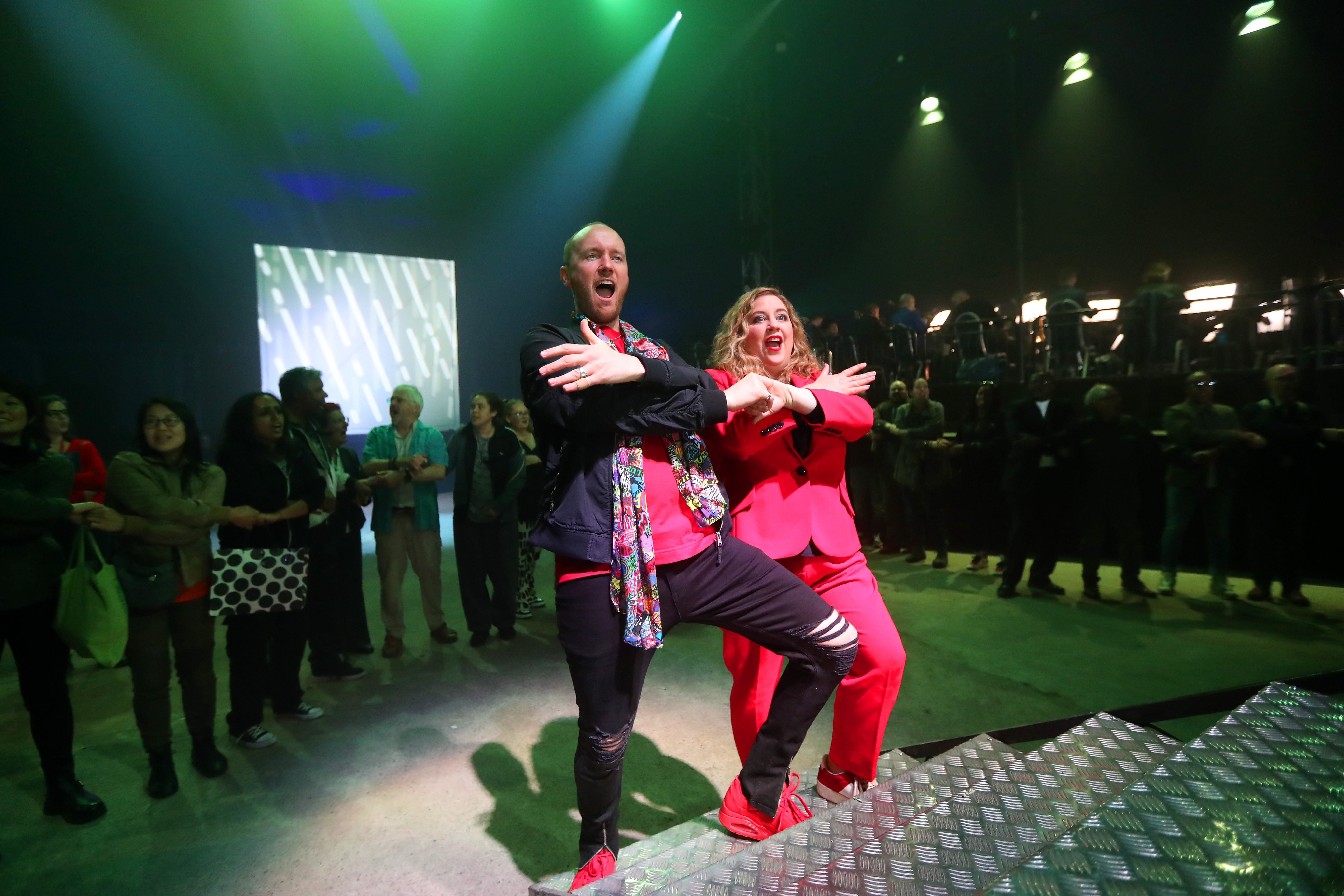
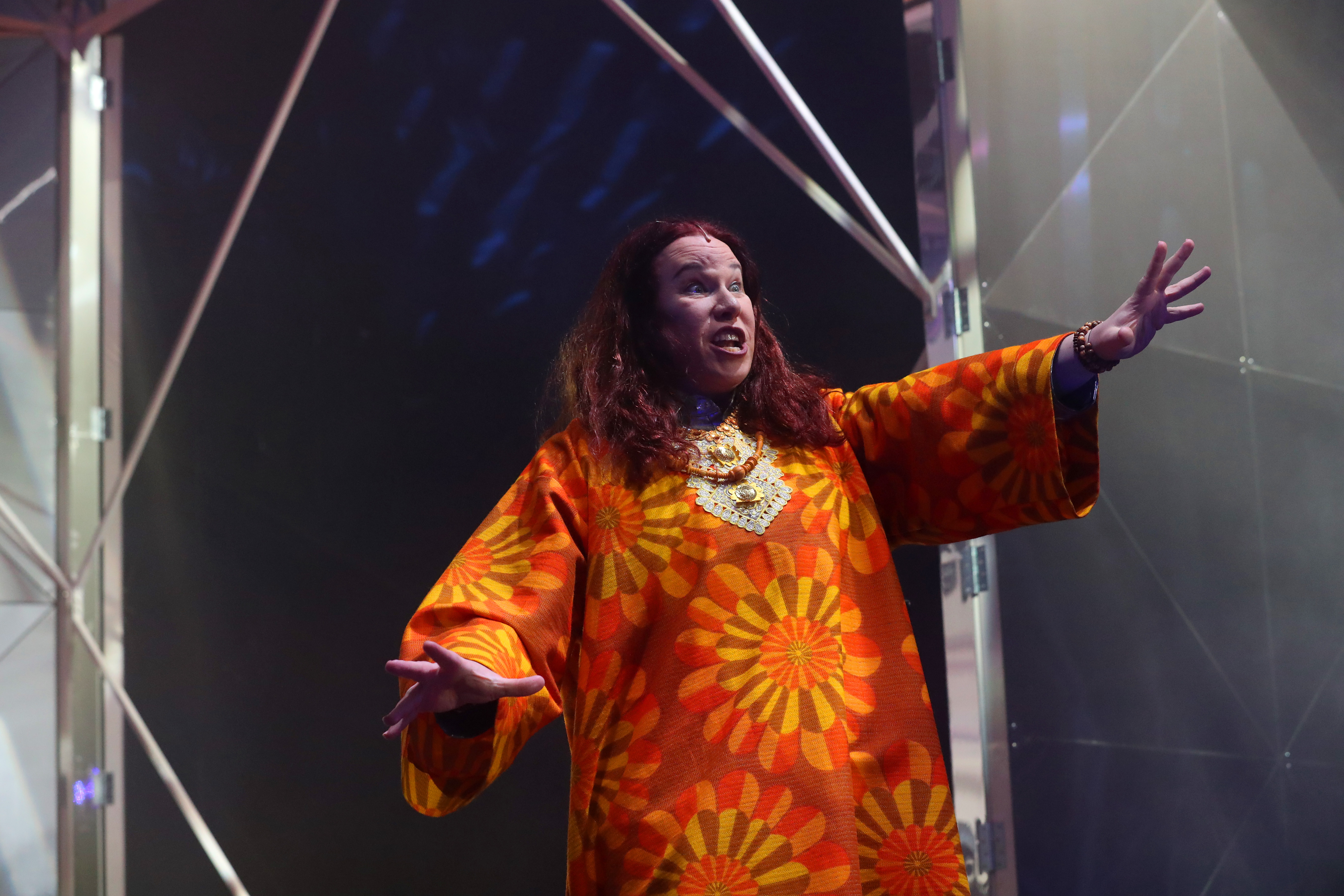
It was those other two main roles, however, that dominated proceedings. Sarah Pring gave a powerful while never inflexible portrayal of Nan, her innate fervency in contrast to the steely authority of Samantha Crawford (above) whose Regan approaches the human world with something between trepidation and disdain – not least in her confrontation with Donny, where Tippett’s would-be rap provoked some amusement. Splitting the role of Presenter worked effectively, Grace Durham and Oskar McCarthy (below) duly enhancing the stage-action with no little panache.
Not for the first time, BOC Chorus came into its own for what is among the most extensive and immediate of Tippett’s choral contributions to opera – the oft-favoured device of Greek Chorus afforded a visceral twist as it conveys the ominous and often violent attitudes of ‘the crowd’. That many of those involved have signed-up specifically for the occasion only adds to the rawness and physicality of its collective presence: something that the composer was at pains to capture, and which could not have been realized this directly in earlier productions.
Conducting the City of Birmingham Symphony Orchestra with typical discipline and energy, Alpesh Chauhan brought requisite vibrancy and clarity to Tippett’s writing. Less purposefully wrought than in his previous operas, there is no lack of subtlety or imagination – the frequent reliance on percussive sonorities to sustain the overall texture hardly an issue when so deftly realized as here. Is there a more moving passage in his output than the dance for Jo Ann and Pelegrin after their duet – Tippett’s musical past and present brought into disarming accord.
Playing for around 105 minutes, New Year is relatively expansive next to Tippett’s preceding two stage-works so that certain aspects of those outer acts do verge on diffuseness. That this hardly came to mind on the opening night was tribute to the conviction of those involved in seeking to reassess what this opera might be and, moreover, what it is there to do. Far from having run out of ideas, Tippett had a surfeit of these that he struggled to make cohere but in which he so nearly succeeded. Do see this engaging and enlightening production from BOC.
As part of Arcana’s occasional Sunday look at the serenade, we cannot leave out one of the finest examples in the form. Mozart‘s Gran Partita, composed in 1781, was written for 13 instruments – wind ensemble and double bass – and is in seven movements. It is a special piece of music, not least in the third movement Adagio. Here it is in a 1991 performance from the Bavarian Radio Symphony Orchestra conducted by Sir Colin Davis:
Cio-Cio San – Maki Mori (soprano), Pinkerton – Pene Pati (tenor), Suzuki – Hiroka Yamashita (mezzo-soprano), Sharpless – Christopher Purves (baritone), Goro – Christopher Lemmings (tenor), Kate – Carolyn Holt (mezzo-soprano), Yamadori/Bonze – Sanuel Pantcheff (baritone), Imperial Commissionaire – Jonathan Gunthorpe (bass), Yakuside – Matthew Pandya (bass), Cousin – Abigail Baylis (soprano), Mother – Hannah Morley (mezzo-soprano), Aunt – Abigail Kelly (soprano), Ufficiale – Oliver Barker (bass)
Thomas Henderson (director), Laura Jane Stanfield (costumes), Charlotte Corderoy (assistant conductor), Charlotte Forrest (repetiteur), Daniel Aguirre Evans (surtitles)
CBSO Chorus, City of Birmingham Symphony Orchestra / Kazuki Yamada
Symphony Hall, Birmingham Saturday 29 June 2024
reviewed by Richard Whitehouse Photo (c) Yuji Hori
The current season by the City of Birmingham Symphony Orchestra ended on an undoubted high with this performance of Madama Butterfly – if not Puccini’s greatest opera, then likely his most affecting and one with which Kazuki Yamada demonstrably feels an acute empathy.
Semi-stagings can be a mixed blessing, but Thomas Henderson fulfilled this task admirably through several strategically placed screens at either end and across the rear of the stage that enabled the singers to enter or exit without detriment to musical continuity. The costumes by Laura Jane Stanfield brought authenticity without risk of caricature, while whoever handled the lighting should be commended for so discreetly intensifying those emotional highpoints – notably when the ‘heroine’ meets her end in what felt as powerful visually as it did aurally.
The cast was a fine one and dominated (as it needed to be) by the Cio-Cio San of Maki Mori – her unforced eloquence and innate goodness evident throughout, while her only occasionally being overwhelmed by the orchestra underlined her technical assurance. A pity that Pene Pati was not on this level as, apart from his rather cramped tessitura in its higher register, his was a Pinkerton neither suave not alluring but precious and self-regarding – with barely a hint of remorse when forced to recognize the consequences of his actions. Hiroka Yamashita had all the necessary empathy as Suzuki, while Christopher Purves gave a memorable rendering of Sharpless – unsympathetic as to profession yet emerging as a hapless participant conveying real humanity, if unable to prevent what could hardly be other than a tragedy in the making.
Smaller roles were well taken, not least Carolyn Holt as a well-intentioned Kate and Samuel Pantcheff as a yearning if not over-wrought Yamadori. The CBSO Chorus gave its collective all in a contribution that goes a long way to defining the culture and atmosphere in a turn-of-century Nagasaki riven between its Oriental tradition and Occidental intervention. Otherwise, the CBSO was the star of this show in responding to Yamada’s direction, as disciplined as it was impulsive, with a precision and finesse maintained over even the most opulently scored passages. It is often overlooked just how wide-ranging Puccini’s idiom had by then become, with its impressionist and even modal elements duly subsumed into music whose Italianate essence is consistently enhanced while without sacrificing any of its immediacy or fervour.
Some 120 years on and attitudes to what this opera represents have inevitably changed, but it is a measure of Puccini’s theatrical acumen that anti-imperialist sentiment abounds in the narrative without drawing attention to itself conceptually or musically. Conducting with an audible belief in every bar, Yamada ably maintained underlying momentum – not least those potential longueurs in the initial two acts, while his handling of the third act made an already compact entity the more devastating in its visceral drama and ultimately unresolved anguish.
Overall, a gripping account of an opera too easy to take for granted as well as an impressive demonstration of the CBSO’s musicianship after just a year with Yamada at the helm. And, if ‘joy’ was in relatively short supply this evening, next season should more than make amends.
For information on the new CBSO season for 2024-25, click here
From Emika’s own words: “I’ve had this sound in my head for many years, this record saved my life”.
Haze finds Emika unifying a lot of the elements that have been present in her music so far – in the words of the Bandcamp commentary, ‘a blend of her neoclassical descending melodies, signature breathy, female vocals, icy pianos, heavy sub-bass vibrations and layered Hazy beats. Let’s call it Emika’s love-affair with the Future Garage genre.’
What’s the music like?
This is music to dive into, as Emika hits the sweet spot between pure ambience and busy musical activity. The latter brings positive energy through glitchy beats, murmured vocals and piano-driven motifs, often manipulated in music that wraps the listener up like cotton wool.
Emika cleverly weaves in thematic unity between the pieces, with slowly descending motifs that are presented with different backdrops or energy, the beats usually moving quickly and delicately in the middle ground.
(star key) is a beauty for the morning after, the familiar descending motif given fluttering beats and expansive production for company and setting the mood for the rest of the album. The breakbeats are crisply executed, reminiscent of Bicep or Burial but striking out individually too.
As the album progresses the pieces get shorter, their one-word titles (Ache, Shards, Rain, the beat-driven Waltz), are borne out in music of descriptive, cold elegance. Smoke is a beauty, with chord progressions of frozen beauty, while Writer exerts thoughtful arpeggios and breathy vocals that float on air. Low End feels like a piece of ‘Netflix noir’, and indeed much of the music would be very much at home providing the soundtrack for an Alex Garland series.
Does it all work?
It does. This is atmospheric music, perfect for mindful contemplation but with plenty of energy to reward foreground listening.
Is it recommended?
Very much so. Emika is one of those consistently versatile artists who is often on the move in a good way – and that is certainly the case here. Lively yet ambient, Haze is the ideal antidote to the overexposure and overstimulation given to us by the modern world.







 Arcana.fm