Unknown's avatar

About Arcana

My name is Ben Hogwood, editor of the Arcana music site (arcana.fm)

In concert – Philharmonia Orchestra Music of Today: Messiaen’s Quartet for the End of Time

Mark van de Wiel (clarinet, above), Zsolt-Tihamér Visontay (violin), Karen Stephenson (cello), Tom Poster (piano)

Messiaen Quatuor pour le fin du temps (Quartet for the End of Time) (1941)

Royal Festival Hall, London
Thursday 7 March 2024 (6pm)

Reviewed by Ben Hogwood Pictures (c) Guy Wigmore (Mark van de Wiel, Zsolt-Tihamér Visontay), Marina Vidor (Karen Stephenson), Elena Urioste (Tom Poster)

The Philharmonia Orchestra’s long-running Music of Today series continued with an opportunity to experience Olivier Messiaen’s 1941 masterpiece. Given its first performance in a German prisoner-of-war camp (in what is now Zgorzelec, Poland), the Quatuor pour la fin du tempsQuartet for the End of Time – was very much a product of circumstances.

The composer, in one of his rare forays into chamber music, had just three instruments available to him, plus himself at the piano. He thrived on the restrictions, using the New Testament book of Revelation as his stimulus to create an eight-movement piece that if anything has grown in stature and relevance with every passing year.

Tonight’s venue may have been a great deal more spacious than the cramped conditions of the premiere, but the quartet here lacked nothing in close-up intimacy, the sizeable audience leaning forward in their seats to engage with the music. Initially it was the piano of Tom Poster (below) that provided a strong foundation, his spacious chords catching the chill of the dawn air in Liturgie de cristal as the other three instruments circled with attractive birdsong, the music awakening softly.

The Vocalise, pour l’Ange qui annonce la fin du temps (Vocalise, for the Angel who announces the end of time) provided a firm reality check, though here too its dramatic lines were clear and spacious rather than combative, the players continuing to find an inner serenity through Messiaen’s writing. Violinist Zsolt-Tihamér Visontay and cellist Karen Stephenson thrived on these long melodic phrases, derived from plainchant.

The emotive centre of this performance was undoubtedly the solo for clarinet, Abîme des oiseaux (Abyss of birds), an incredibly moving soliloquy played with exceptional technique by Mark van de Wiel. Some of the notes started with barely audible attack while others were at the outer limits of his volume in a performance of incredible poise and control. Standing while the other musicians sat, he also let the silences between notes speak as loudly as the phrases themselves, so that even the persistent coughing of the audience was rendered into silence.
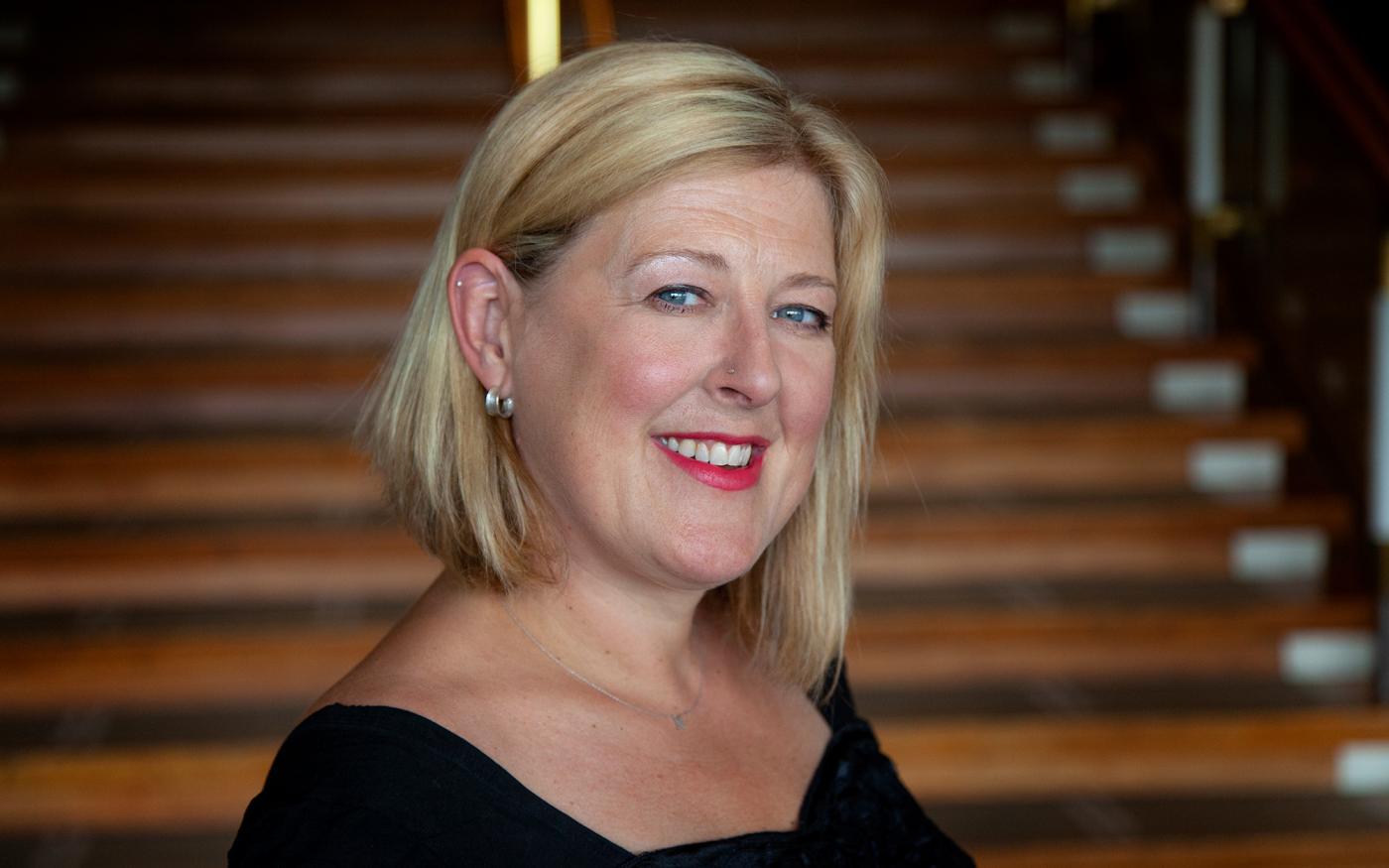
The delicate Intermède broughout out the dance elements of Messiaen’s writing, before Stephenson (above) and Poster gave a thoughtful, meditative Louange à l’Éternité de Jésus (Praise to the eternity of Jesus), beautifully played and appropriately reverent. This ensured a vivid contrast with the following Danse de la fureur, pour les sept trompettes (Dance of fury, for the seven trumpets), where the four instruments played their angular melodies with commendable precision.

Fouillis d’arcs-en-ciel, pour l’Ange qui annonce la fin du temps (Tangle of rainbows, for the Angel who announces the end of time) found Visontay (below) to the fore in the audio balance, van de Wiel slightly backward in the mix, before Visontay and Poster led us to the end itself with a radiant Louange à l’Immortalité de Jésus (Praise to the immortality of Jesus). This remarkable piece of music continues to carry a strong impact, and as the two instruments strained at the edge of audibility, Visontay reaching the highest pitch, the sense of arrival was all-consuming.

They put the seal on a memorable performance, one of the more emotive ‘rush hour’ concerts you could wish to hear, and one whose impact was felt far beyond that evening’s orchestral concert.

You can listen to a recording of Quatuor pour le fin du temps below, with Mark van de Wiel and Zsolt-Tihamér Visontay joined by cellist Mats Lidström and pianist Min-Jung Kym on the Psalmus label:

Meanwhile you can find more information on further concerts at the Philharmonia website

Published post no.2,111 – Friday 8 March 2024
Switched On – Aidan Baker: Pithovirii (Glacial Movements)

by Ben Hogwood

What’s the story?

Aidan Baker’s principal currency in music is the electric guitar, but in reality he is a multi-instrumentalist, able to use the guitar along with electronic manipulation, and in a way that moves easily between musical forms.

Pithovirii, the Canadian composer’s first release on the Glacial Movements label, takes its inspiration from Vladimir Sorokin’s novel Ice Trilogy. This led Baker down a rabbit hole, reading about the destructive Tunguska meteor that fell on Siberia in 1908, flattening an estimated 80 million trees, and then more reading about truly ancient viruses found in glacier ice – known as ‘pithovirii’.

Using his electric guitar with effects pedals, Baker has attempted a musical depiction to convey the idea of glacial density, and “stasis within which lurk potentially malevolent microbiome”.

What’s the music like?

Baker certainly catches the almost complete stasis of a glacier in the two long-form tracks that make up Pithovirii. There is an ominous feel to Sibericum, a kind of omnipresent threat that hovers over the music. As it slowly evolves the dark colours of Baker’s vision come in to view, dense clouds of sound working in slow-moving waves that wash over the listener. This is certainly musical ambience, and is meditative to a degree, but it is also quite oppressive in the way it takes over the sonic spectrum, working as a very gradual crescendo.

Massiliensis is named after a mysterious form of bacteria that appears to still be under exploration. The light ‘hiss’ that Baker has around the edge of the sound is both ambient and disarming, as a long unison note makes itself known, slightly metallic in texture – and the hiss becomes a thick, woolly drone of sound. As the track unfolds the sonics combine to make the audio equivalent of hearing a massive church organ from the far end of the building, sustaining a long note whose overtones work in and out of consciousness – and gradually change and even modulate over time, taking over most of the aural spectrum. The thick outer coating to the music remains, fed through Baker’s electronic prism.

Does it all work?

It does, with a couple of caveats. The obvious criticism to level at Baker’s work would be that there is not a lot going on – but that is the whole point. To fully experience and appreciate these big blocks of sound the listener needs to be somewhere quiet, with all frequencies available.

Is it recommended?

Yes. Baker is a natural fit for Glacial Movements (in title alone!) but he has written two extremely evocative pieces here. Together they make a whole that somehow captures the state of the remote ice regions of our planet in this day and age.

Listen & Buy

Pithovirii is released tomorrow, Friday 8 March – at which point you will be able to hear it in full here:

Published post no.2,110 – Thursday 7 March 2024

Switched On – Various Artists: Future Sounds Of Kraut Vol. 2 – Compiled by Fred und Luna (Compost)

by Ben Hogwood

What’s the story?

A shadow hangs over the release of this compilation, the second in Compost’s exploration of Kraut. It was compiled by Fred und Luna, the muses of musician, author and photo/film maker Rainer Buchmüller – who calls his music either Elektrokraut or Krautelektro.

Very sadly Buchmüller passed away on February 8th 2024, and Compost issued this tribute: “We are deeply saddened that we lost a very close friend, a true creative musician, artist, poet, soulmate and beloved human being with a great sense of humour. Rainer Buchmüller aka Fred und Luna died after a long carcinosis. Our thoughts and prayers in these days of mourning are with his wife and family. Rainer Buchmüller aka Fred und Luna has made several albums, first one on Frank Wiedemann’s Bigamo label, then three albums plus several Maxi – Singles and 7 inches on Compost Records and Elaste Records. Rainer had several alter egos, too. Under his Fred und Luna moniker he recently compiled the highly acclaimed “Future Sounds Of Kraut” compilation series for Compost. Rainer also wrote circa 120 poems in the vein of Ernst Jandl, Dada, Kurt Schwitters. Rainer, we love you! R.I.P.”

What’s the music like?

Buchmüller has left us an extremely enjoyable compilation, framed by his own Intro and Outro, and featuring the Kraftwerk-influenced electronica of Monotonikum from 2016 in the middle. The tone is friendly, the intro asking, “Future sounds of Kraut…what’s it all about?” before moving into Sankt Otten’s warm-hearted Angekommen In Der Letzten Reihe.

There are some notable contributions from Roman Flügel, whose Rules is a typically intricate mix of riffs and creative drum work, and Thomas Fehlmann, the spacey Permanent Touch. Other highlights include the glittery electro of Ghost Power’s Vertical Section, the colourful swirls of Gilgamesh Mata Hari Duo’s Johan, and the bossa beat that backs a brooding soundscape in I:Cube’s Basso. Lucas Croon’s Krautwickel has a really strong forward drive and shuffling drum track, a classic piece of Krautrock, while Sordid Sound System’s It’s About Time bounces around the stereo picture, a low-slung groove.

Does it all work?

Almost all – the only possible exception being Minami Deutsch’s Your Pulse, whose breathing can be off-putting and will likely divide opinion.

Is it recommended?

It is, enthusiastically. Future Sounds of Kraut Vol.2 is packed with good music, and its release is the best possible way to honour Buchmüller in the sad news of his passing.

Listen & Buy

Published post no.2,109 – Wednesday 6 March 2024

Playlist – Bedřich Smetana (born 2 March 1824)

by Ben Hogwood

This month we mark 200 years since the birth of Czech composer Bedřich Smetana in Litomyšl, east of Prague, on 2 March 1824.

Smetana is fondly regarded as the father of Czech music, his output spearheaded by the remarkable cycle of six symphonic poems Má vlast (My Country), containing vivid descriptions not just of the Czech countryside but also its architecture and history.

A new recording of the cycle has just been issued by the Czech Philharmonic Orchestra and their conductor Semyon Bychkov, on the Pentatone label, and it is included on the playlist below. However – as I hope you will find – there is a lot more to Smetana than this wonderful sequence alone.

The String Quartet no.1, subtitled From My Life, is a poignant tale of the composer’s life and subsequent deafness, unforgettably portrayed in the finale by the first violin. Also worth investigating in the composer’s chamber music output are the Second String Quartet and Piano Trio, while the inclusion of Richard III shows a depth of Smetana’s orchestral writing that is yet to be fully exploited in concert or on record. Make a note, too, of his contribution to Romantic piano music, in a series of attractive polkas.

Smetana’s contribution to opera is perhaps his principal legacy. Two works in particular stand out – The Bartered Bride, from 1866, and Dalibor, completed two years later. While very short excerpts from these are included in the playlist, I have included links to complete performances so that you can become acquainted with them.

Hopefully Smetana’s music will be celebrated in the concert hall as the year progresses, for it is generously melodic and passionate. The more you hear, the more rewarding it becomes!

Published post no.2,108 – Tuesday 5 March 2024

Switched On – Cristian Vogel: NEL Adventures (EPM Music)

by Ben Hogwood

What’s the story?

This is a compilation of more recent EPs recorded by Cristian Vogel under his NEL alias. The eleven tracks cover four separate releases, and as a bonus add two new tracks.

The NEL alias has a reputation for enabling the Chilean producer to explore a side looking at tougher rhythmic profiles, largely using modular synthesizers and improvised material.

What’s the music like?

The live approach pays dividends for Vogel on this compilation. Each of the tracks on NEL Adventures teems with life, packed to the gills with plenty of melodic and percussive ideas.

Vogel is very clever with his use of rhythm, not for art’s sake but generating positive energy as the percussive motifs ricochet across the stereo picture. The pinball percussion of Mirabelle is a case in point, the rhythms gradually giving way to a bell-like figure, while The Misty Quay sounds like a much older ‘90s piece of techno, its jagged riffing given counter melodies in a modular extravaganza.

Complementing the bright invention are darker tracks like Shadowgraphs, which explores deeper waters with dark keyboards, and Orchid, which presents a thoughtful exterior in spite of its solid beat. Understory cuts deep with its sharp synth riff and uncompromising beat.

The new tracks make a strong impact. Gullane nips along with constructive mechanical ideas, the ideas bubbling up to the top while the clipped rhythm chugs along behind. Earthsea is full of energetic crossrhythms, initially delicate but developing into bright block chords.

Fortuna is arguably the pick of the lot, its liquid ideas given a strong drum beat and clever sonics that bounce around as though the listener is in a gigantic pipe. Tyrkisk Peber runs it close, a shimmering mass of keyboards that generate even more momentum when the drums arrive.

Does it all work?

Yes. Vogel explores a wide range of colours in his work, though you might find some of the more dizzying cuts – such as The Insight – a bit too ‘heady’ at earlier hours in the day!

Is it recommended?

It certainly is. Vogel has built up an extremely sound reputation in techno circles, but this essential addition to the catalogue shows he is in no way resting on his laurels. His music is still packed full of ideas and invention, with wit and humour round the edges too. There is a whole load to enjoy here!

For fans of… Joey Beltram, Etienne de Crecy, Richie Hawtin

Listen & Buy

Published post no.2,107 – Monday 4 March 2024