Wil Bolton, a musician and artist based in East London, was persuaded by The Slow Music Movement to create a more beat-based, electronic approach to his ambient works. They set him this goal after a long period of successful ambient works written largely free of beats, but here he sets to work with rhythm tracks generated with the help of a vintage 7” of heart sounds.
What’s the music like?
Perhaps not surprisingly the pulse of the music here tends towards the slow side, unfolding with an easy manner and a charming sub-set of friendly bleeps, pockets of ambient wide noise and consonant harmonies that perform subtle shapeshifting moves in the foreground.
They proceed with an incredibly relaxed manner, the listener immediately put at ease while they are taken into a colourful area of textures that ripple gradually or move in and out of focus, the musical light dappled and refracted as part of an ongoing process.
With all of the tracks over five minutes in length there is time for the listener to dive deep into each of the six sound worlds, with soft nuggets of rhythm prompting and nudging at each turn. Patina is a great example, the subtle percussion complemented by long, held notes and pockets of synthesizer activity that sits on the edge of dub music. Sandalwood is a little sharper in tone while Rails Overhead is relatively dark.
Does it all work?
It does – but Null Point is definitely most effective as a continuous listen over 40 minutes, allowing the mind and aural responses to slow down in line with its workings.
Is it recommended?
Yes. Null Point is not a dead end, as its title suggests – rather it is a place to go where listeners can feel safe from musical harm! Slower heart rates and lower blood pressure are a given as a result.
For fans of… Marconi Union, Ultramarine, Brian Eno, Ulrich Schnauss
Listen & Buy
Published post no.2,081 – Thursday 8 February 2024
In which Nick Schofield spreads his wings, expanding from solo synth performance to include an ensemble that keeps keyboards front and centre but leans on piano, adding bass, voice, clarinet and violin.
What’s the music like?
Colourful and bursting with growth, the sort of music you might expect to hear with the advent of spring. The track titles are indicative of the music we hear – from the short Meadows to the more substantial Resonant World, these are character pieces that paint their surroundings in rather lovely technicolour.
With tracks like On Air, Schofield is most definitely operating with his mind outside of the studio, as the clarinet burbles, the violins swell and reverberant piano is caught ‘on the wing’. evoking big spaces and wide-open textures. Generally the piano is at the centre of the arguments, which are – as Schofield’s Bandcamp commentary states – convivial.
Fine Tune has deep colours, rich blues and purples perhaps, while Joy Cry builds up whole consonant harmonies with prayerful violin loops. Morning Doves uses mottled piano chords with playful clarinet and violins evoke the birds, and while Resonant World employs similar tactics the piano loop is reminiscent of Stravinsky. Heartfelt has a whiff of Acker Bilk about the clarinet work, in a good way!
Does it all work?
It does. There may not be immediately obvious melodies in Schofield’s work here but after a few listens the fragments and loops prove very hummable. The textures are extremely restful, and credit should go to the musicians – Philippe Charbonneau (fretless and double bass), Yolande Laroche (clarinet and voice) and violinist Mika Posen.
Is it recommended?
It is – and Ambient Ensemble has some very attractive colours to share as its tableaus unfold.
For fans of… Group Listening, Cinematic Orchestra, Bonobo
Listen & Buy
Ambient Ensemble will be released on Friday 9 February – a listening link will appear here then.
Published post no.2,080 – Wednesday 7 February 2024
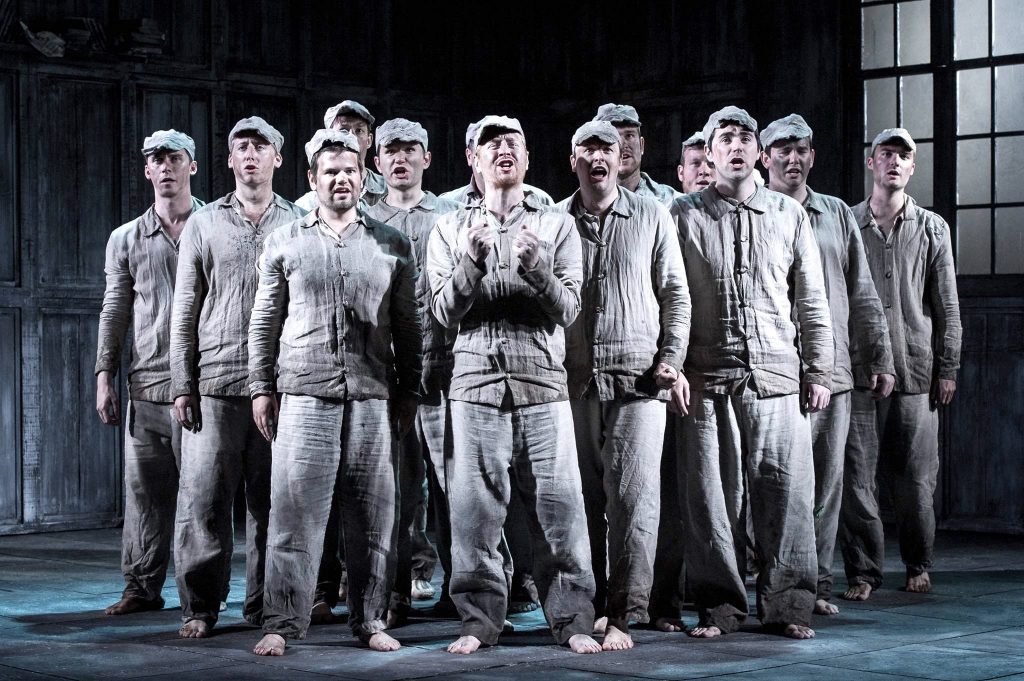
Beethoven’s Leonore as seen in a production by Buxton Opera, 2016
LeonoreOverture no.2 Op.72b, used by Beethoven for a revision of his opera in three acts (1804-05, Beethoven aged 34)
Duration 14’30”
by Ben Hogwood
Background and Critical Reception
As the writer Herbert Glass points out, in program notes written for a concert by the Los Angeles Philharmonic, “Beethoven spent more time writing the overture to Fidelio than Rossini and Donizetti spent on entire operas, overture included”! He goes on to qualify this investment of time, asserting that “No. 3…distils the essence of the opera itself, transmitting its power in less than a quarter-hour’s playing time’.
No.3 – confusingly – is the second in order of composition, following no.2 which was used in the first performance of the opera. No.1 – a heavily trimmed version – would follow later, with the Fidelio overture itself a reinvented prelude to the finalised opera.
Robert Simpson, in an essay about Leonore and the resultant Fidelio, points out that the advantage of this overture over its predecessor is “its very accurate delineation of all these key relationships” – by which he means the conflict between the opera’s ‘home’ key of ‘C’ and the ‘prison’ key of B flat major, where the malevolent character Pizarro is found. He describes Beethoven using C major as “an open sky”, and B flat as “the oppressive atmosphere of the jail”, then discussing at length the key of Florestan (A flat major) and Leonore herself (E major). His conclusion is that “no-one will ever exhaust all this great music, surely the greatest ever written for the theatre”.
Thoughts
While listening to the Leonore Overture no.2 I noted that the orchestral dialogue ‘operates on the scope more of a symphonic poem than an overture’ – and that is even more a case in point with the third overture. As an orchestral piece it may be longer but it is a thrilling listen, especially when Beethoven’s ‘open sky’, as Simpson calls it, is found.
To get there we have to traverse the awful claustrophobia of the prison, but there are always shafts of light – the flute solo in Florestan’s key around two-thirds of the way through, and the offstage trumpets that set an incredibly vivid scene. After the uncertain groping in the dark, the blazing light of C major. On the way there we experience some trials, most noticeably a striking dischord right before the end – a wonderful dramatic touch that carries the deepest possible impact.
Recordings used
Berliner Philharmoniker / Herbert von Karajan (DG) Cleveland Orchestra / George Szell (Sony) Orchestre Lamoureux, Igor Markevitch (DG) Chamber Orchestra of Europe / Nikolaus Harnoncourt (Teldec) Philadelphia Orchestra / Riccardo Muti (EMI)
Once again Herbert von Karajan, with the silvery strings of his Berliner Philharmoniker machine, comes up trumps with a wholly satisfying version. Yet Igor Markevitch is arguably more dramatic still, his final pages a terrific release of tension built up earlier, in a reading that undercuts most others by a minute. Any of the other three serve as ideal guides, too.
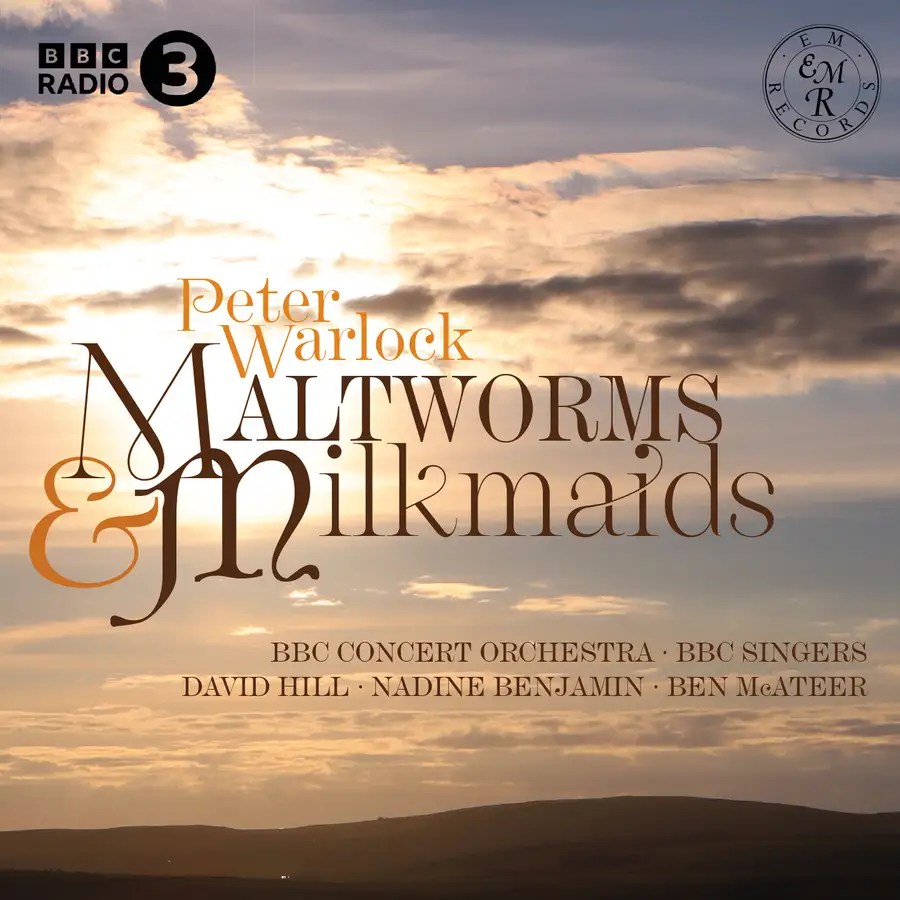
Warlock As Ever I Saw (1918, orch. anon) An Old Song (1917-23) Mr Belloc’s Fancy (1921/30, orch. Frederick Bye) Captain Stratton’s Fancy (1921, orch. Peter Hope) Serenade (1921-2) Milkmaids (1923, orch. Henry Geehl) Adam Lay Ybounden (1922, orch. Reginald Jacques) Little Trotty Wagtail (1922, orch. David Lane) The Birds (1926, orch. anon) The Country-man (1926, orch. Gerrard Williams) Yarmouth Fair (1924, orch. Kenneth Regan) Sorrow’s Lullaby (1926-7) One More River (1925) Maltworms (1926, with E. J. Moeran) Capriol (1926-8) A Sad Song (1926) Pretty Ring Time (1925) The First Mercy (1927, orch. Fred Tomlinson/John Mitchell and William Davies) Three Carols (1923)
Nadine Benjamin (soprano), Ben McAteer (baritone), BBC Singers, BBC Concert Orchestra / David Hill
EM Records EMRCD080 [73’52”] English texts included. Orchestrations by Warlock unless stated Producer Neil Varley Engineer Robert Winter Recorded 14-16 January 2022 at the Colosseum, Watford
Reviewed by Richard Whitehouse
What’s the story?
The always enterprising EM Records issues yet another ‘first’ in the guise of this collection featuring the songs with orchestra by Peter Warlock (aka Philip Heseltine), which includes many of those orchestrated by others with two-thirds of them here recorded for the first time.
What’s the music like?
Although his output barely extended beyond a decade and centred largely upon miniatures, Warlock left a substantial legacy of songs whose piano accompaniments mostly respond well when arranged for larger forces. Most of them are divided between soprano and baritone, in which latter Ben McAteer fairly captures their essence – whether the modal poise of the early If Ever I Saw, the heady (slightly forced?) jollity of those ‘fancies’ inspired by Mr Belloc and Captain Stratton, or the deftly barbed humour of Milkmaids. He draws tangible pathos from The Countryman and panache from Yarmouth Fair, with the rumbustious One More River and uproarious The Cricketers of Hambledon duly given their head. A highlight is the first recording of Maltworms, co-written with Ernest Moeran and rendered with suitable levity.
Nor is Nadine Benjamin other than fully attuned to the sentiments of her selection. Hence the soulfulness of A Sad Song or limpidity of Pretty Ring Time, both heard in what are Warlock’s only orchestrations of his solo songs, with The First Mercy an eloquent setting of words by frequent collaborator Bruce Blunt. Most affecting, though, is Sorrow’s Lullaby where soprano and baritone combine for a lengthy and often plangent setting of Thomas Beddoes in which the stark introspection of Warlock’s masterpiece The Curlew is never far beneath the surface.
The BBC Singers make their presence felt in the carol Adam Lay Ybounden and the whimsical Little Trotty Wagtail and winsome The Birds. No compromise is brooked in the rousing Fill the Cup, Philip or wistful choral incarnation of The First Mercy, then a closing trio of carols takes in the capricious Tyrley, Tyrley, the serene Balulalow and the aminated As I Sat Under a Sycamore Tree for a suitably rousing conclusion. Warlock would surely have approved and, had he known of the Singers’ recent travails, doubtless have responded in no uncertain terms.
The BBC Concert Orchestra gives of its best throughout under the astute direction of David Hill, duly coming into its own with the three orchestral pieces that Warlock completed. The evergreen suite Capriol is heard in its seldom heard and appealingly astringent version for full orchestra, the Serenade commemorates Delius’s sixtieth birthday in suitably rapturous terms, and the little-played An Old Song exudes a potent atmosphere as indicates what might have been possible had Warlock felt able to realize his musical ambitions on a larger canvas.
Does it all work?
It does, especially when heard in the continuous sequence as presented here. Warlock might increasingly have fretted about his ability as a composer, but the best of what he did achieve is sure to keep his name alive well beyond the approaching centenary of his untimely demise.
Is it recommended?
It is and not least when the presentation – with full texts, together with detailed notes from David Lane (vice-chairman of the Peter Warlock Society) reflects the always high standards of EM Records. In the words of a latter-day songster, ‘‘a splendid time is guaranteed for all’’.
Lalo Overture to Le Roi d’Ys (1875-88) Namouna: Valse de la cigarette from Namouna; Suite no.1; Suite no.2 (1868-71) Symphony in G minor (1886)
Estonian National Symphony Orchestra / Neeme Järvi
Chandos CHAN 20183 77’22” Producer and Engineer Kaspar Karner Recorded 6-8 June 2022, Estonia Concert Hall, Tallinn, Estonia
Reviewed by Ben Hogwood
What’s the story?
After a successful album of French Music for the Stage, the Estonian National Symphony Orchestra and Neeme Järvi team up for more 19th century explorations, alighting on a composer the octogenarian pioneer has somehow not previously recorded.
Their chosen program brings together several companion pieces by Édouard Lalo, returning to the stage for suites from his ballet Namouna and the overture to his opera Le Roi d’Ys, before adding the Symphony in G minor as a substantial complement.
What’s the music like?
Lalo was a tuneful composer throughout his career, and these works are full to bursting with attractive melodies and colourful orchestration. The structure of the album is ideal, starting with the overture to his only opera, Le Roi d’Ys. This occupied him for 12 years, by which time the overture had changed complexion, becoming a dramatic standalone piece that could work well as a concert opener, especially with its brassy ending.
The Namouna Suites are full of charm and elegance, but are also shot through with fantasy and more than a little glamour. Initially Lalo was not given a storyline to work with, and when he was given an outline of a story from Casanova’s Memoirs he suddenly had little time to complete the work. Ill health ensued, but thanks to fellow-composer Charles Gounod helping with the orchestration he was able to get the characterful work across the line. It is full of good ideas,
Finally the Symphony in G minor, completed in the same time period as more famous cousins by Franck (in D minor) and Saint-Saëns (the Organ symphony). Its relative neglect is unfortunate, for it is a fine piece if looking a little further back for its inspiration, incorporating influences from Mendelssohn, Schubert and possibly Bizet. It is carefully structured and develops its material quite studiously, but there is an attractive lightness of touch to some its themes, some welcome weight in the Scherzo and finale, and a touching tenderness to the slow movement where the strings come to the fore. The convincing finale generates a good deal of positive energy, Lalo’s musical arguments adding up to a satisfying finish.
Does it all work?
It does – thanks to excellent performances. Järvi, of course, is a seasoned professional, but the orchestra follow his sleights of hand to the letter. The Valse de Cigarette from Namouna is a particular delight, playing around with the rhythm to induce a smile, while the brass at bring extra power and panache whenever they are employed, emphasising the Wagnerian links. The colourful shading of Namouna is aided by the Chandos engineers, who give the orchestra the ideal depth, while the performance of the Symphony in G minor has clarity and poise.
Is it recommended?
It is, enthusiastically. Lalo’s orchestral music is still underrepresented in the concert hall, but there is a growing body of highly proficient recordings of the extremely likeable works hovering round the edges of his output. This attractive album goes straight into the top bracket of modern recordings of his music.





 Arcana.fm