The latest post from the Erased Tapes label on Bandcamp is a deeply personal one. Portland based recording artist David Allred chose the mark the birthday of a close friend on 5 November with a new song. Nothing too unusual about that, you might think – only the stranger has been missing for 12 years. In his own words, Allred says:
“‘Hey Stranger’ is about a close and deeply troubled lifelong friend who disappeared without any trace or explanation, and the experience of navigating an undying paranoia that he might appear back into my life when I least expect it. I find myself scanning crowded public places to assure that he’s not in my presence as often as I wonder where he is and how he is doing. It’s his birthday on November 5 and here is Hey Stranger (Take 2), written in dedication to him. Happy Birthday, J. You are deeply loved and missed, and you always have a friend when you need one.”
A deeply moving utterance, Hey Stranger is both troubling and strangely comforting – in the fact that, although missing, Allred’s friend still has people out there thinking of him and rooting for him.
Let’s hope this desperately sad story has a peaceful and somehow uplifting ending.
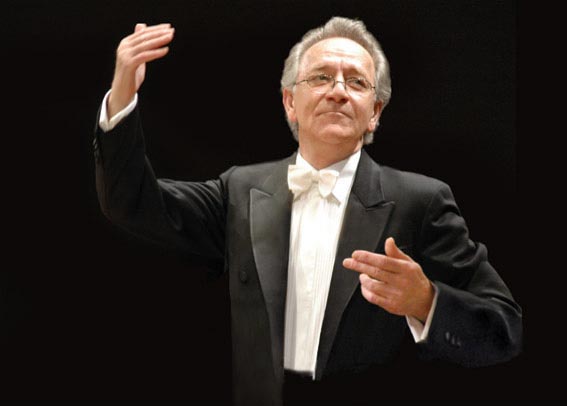
This week we learned of the death of a legendary Russian conductor, Yuri Temirkanov, at the age of 84. Temirkanov enjoyed extended stints as principal conductor of the Royal Philharmonic Orchestra and also the St. Petersburg Philharmonic Orchestra. You can read in detail about his critical reception at the Gramophone website, but to complement it, here is a playlist of recordings loaded with his repertoire specialities from his home country:
Ilya Gringolts (violin), BBC Symphony Orchestra / Roderick Cox
Debussy Prélude à l’après-midi d’un faune (1891-4) Wennäkoski Prosoidia (BBC co-commission: world premiere) Lyatoshinsky Grazhyna Stravinsky The Firebird – suite (1919)
Barbican Hall, London Friday 3 November 2023
Reviewed by Ben Hogwood. Pictures courtesy of BBC/Mark Allan
If the number of concertgoers whistling the Finale of Stravinsky’s Firebird down Silk Street to the tube was anything to go by, this typically creative BBC Symphony Orchestra program had made its mark.
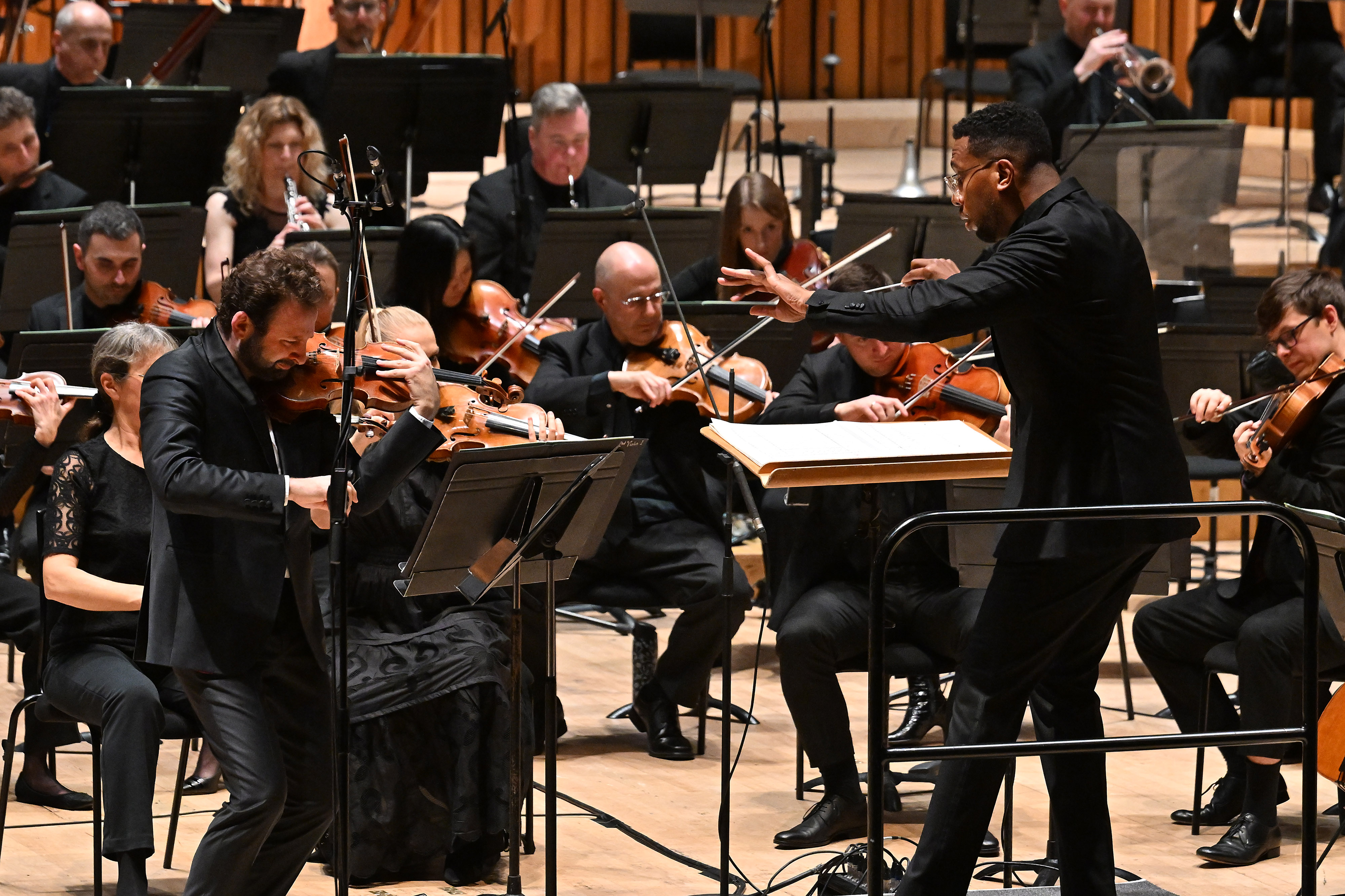
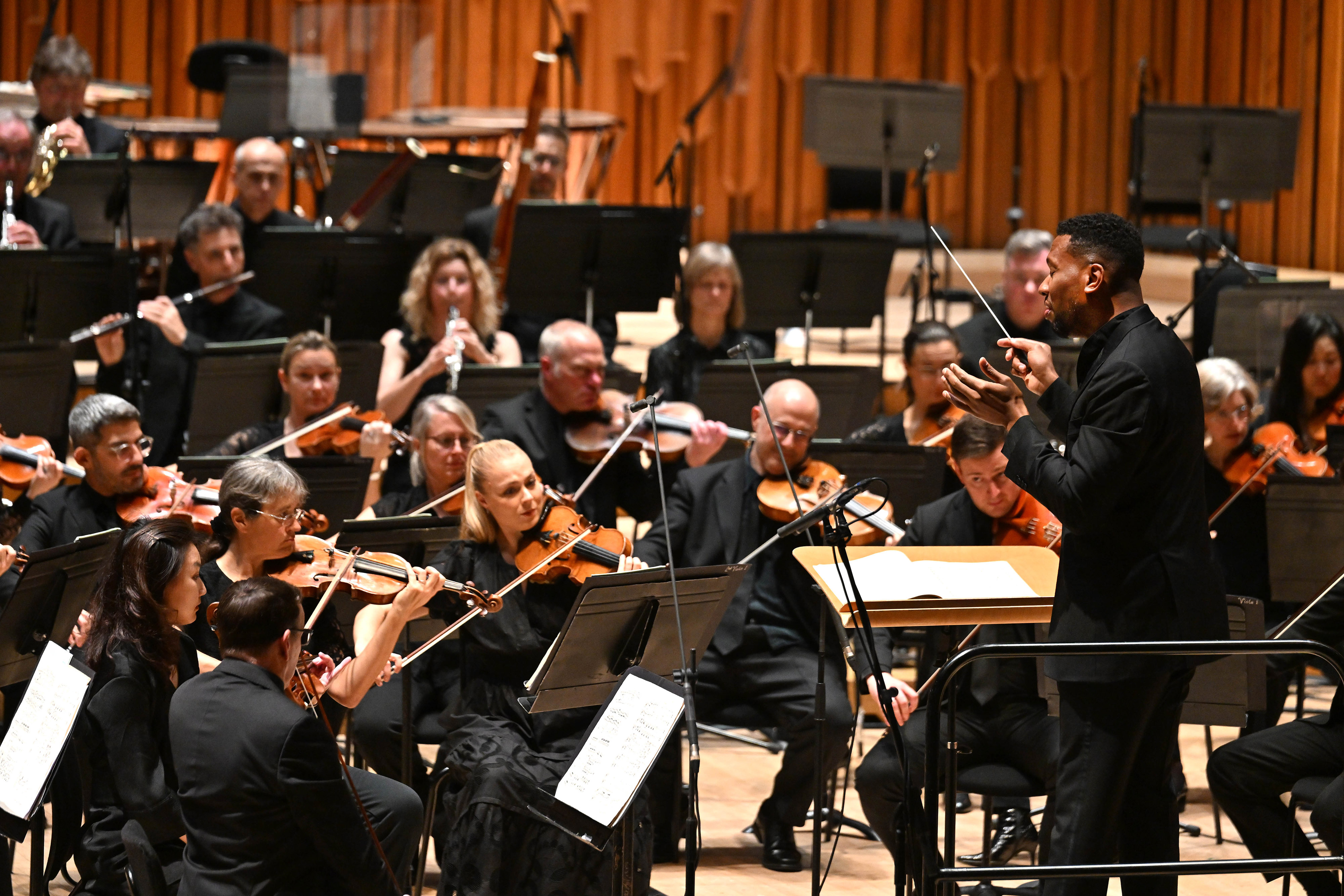
This was in spite of a late change of conductor, Roderick Cox replacing the indisposed Eva Ollikainen – yet the transition was seamless, Cox an alert and subtly commanding presence who clearly enjoyed making music with his new charges. All those qualities were evident in a hazy, sensuous account of Debussy’s Prélude à l’après-midi d’un faune, the temperature raised in spite of the autumnal weather outside. This is, as Paul Griffiths observed in the booklet notes, where Debussy’s ‘music begins here afresh. So does modern music generally.’ Daniel Pailthorpe’s flute solo set the tone, the BBC Symphony Orchestra revelling in alluring wind melodies and hazy, soft-focus strings. The sense of the new – even 120 years after completion – was tangible throughout.
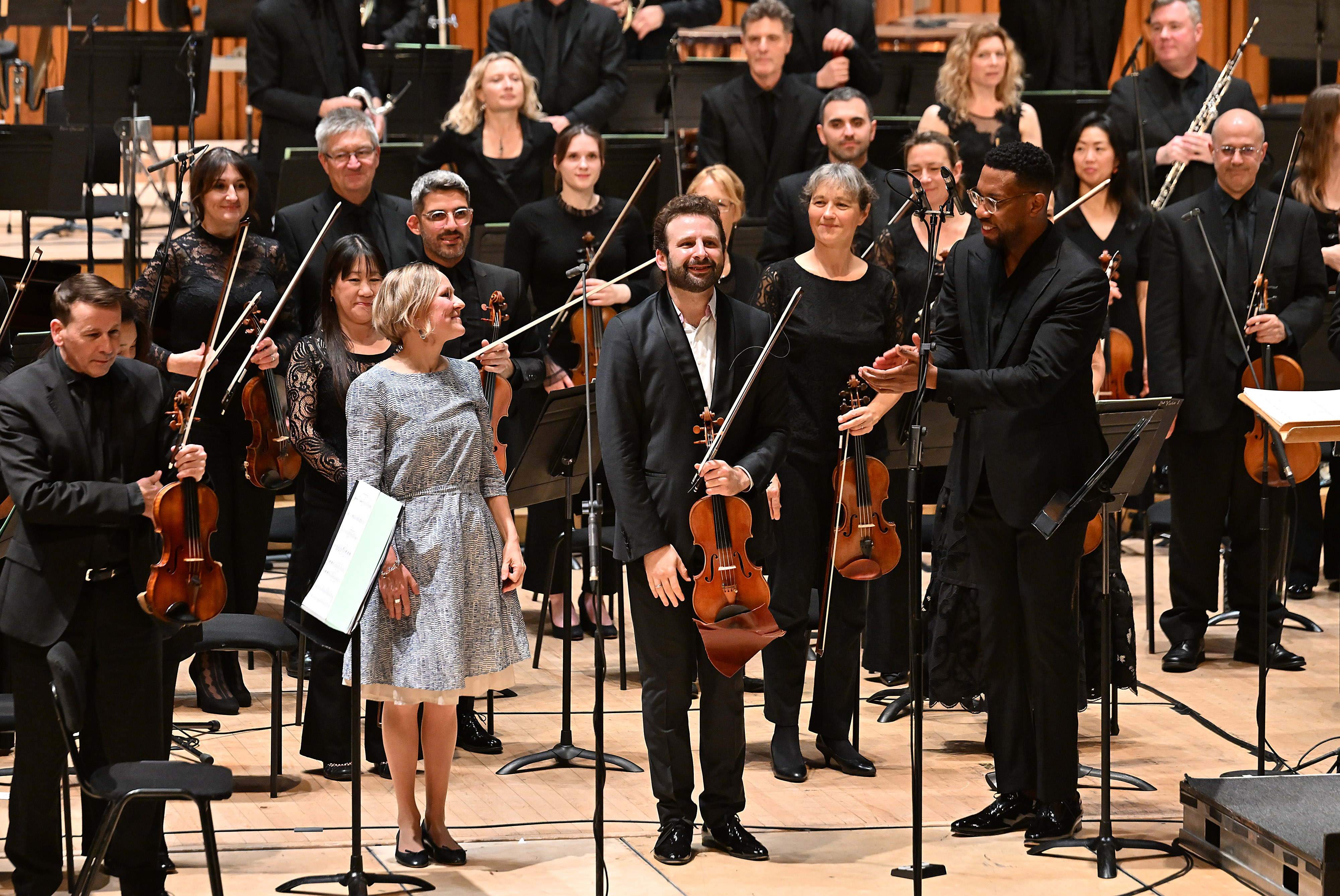
Lotta Wennäkoski’s Prosoidia was also new – still drying on the page in fact, as this was the world premiere of a co-commission from the BBC SO, Lahti SO and Norrlands Opera for violin and orchestra. Though not billed in the title as a violin concerto it assumed that function, though Ilya Gringolts (above) moved between his own solo statements and conversations as part of the orchestra. Throughout he showed impeccable technique and great expression. The orchestra’s role was headed by percussion and harp, with some exquisite shading especially in the quiet music. How refreshing to hear a composer confidently writing music that the audience strained to hear, the resultant effect all the more powerful for this restraint. Here Wennäkoski was reflecting linguistic instructions inspired by ‘prosody’ – the word referring to the musical properties of speech: rhythm, pitch, stress and pauses. Her focus gave the work a moving humanity, a concerto where wordless instrumental voices spoke with great intensity.
The second movement, Word Stress, had a primal savagery, the orchestral voices clamouring to be heard and on occasion drowning the violin. Here the influence of Bartók was palpable, Wennäkoski drawing perhaps on her studies in Budapest. A moving third movement followed, inspired by Ingmar Bergman’s film Cries and Whispers – and in particular a scene where the voices are replaced by the Sarabande from Bach’s Cello Suite no.5. Written in memory of the recently departed Kaija Saariaho, Wennäkoski’s teacher, it was an intimate discourse, recalling the equivalent passage in Berg’s Violin Concerto where the composer also quotes from Bach. Here the approach was less explicit but formed an engaging tableau, where the dynamic dimmed and textures became spare at the thoughtful close. A concerto with an appealing economy and frank musical language, Prosoidia deserves a regular place in the repertoire.
After the interval we heard music from Boris Lyatoshinsky, described in Martin Anderson’s composer profile as ‘the first explicitly Ukrainian composer of the modern age’. Grazhyna, a symphonic poem about a fictitious 15th century female Lithuanian chieftain, cast its eyes back to Liszt and Saint-Saëns in its orchestral narrative, but the modern harmonic language of 1955 spoke more of Myaskovsky and Shostakovich’s music for the stage, not to mention the lasting influence of Lyatoshinsky’s teacher Glière. Roderick Cox presided over a convincing interpretation, impressively grasping the piece in spite of what was surely limited preparation. From the brooding violas portraying the River Neman, we heard a plangent cor anglais lament from Max Spiers, then a high voltage tutti as the battle scene raged. Though short on distinctive melodies, Grazhyna was dramatic to the last as the river music returned, capping an atmospheric and compelling account.
This was also the case for Stravinsky’s 1919 suite from The Firebird, fashioned by the composer into a crowd-pleasing five movements, and creeping in stealthily on the lowest strings. This was an assured interpretation, Cox cajoling the well-drilled BBC SO through a thrilling Infernal Dance, having enjoyed the vivid colours of The Princesses’ Round Dance. The bassoon of Andrea de Flammineis excelled in the Berceuse, where Stravinsky’s ‘sweet and sour’ melodies were in evidence, before the bold as brass Finale that sent the audience home whistling. This was an impressive concert all round, showing the strength in depth the BBC Symphony Orchestra possess these days. Their ensemble, a winning combination of experience and raw talent, is enjoying a purple patch.
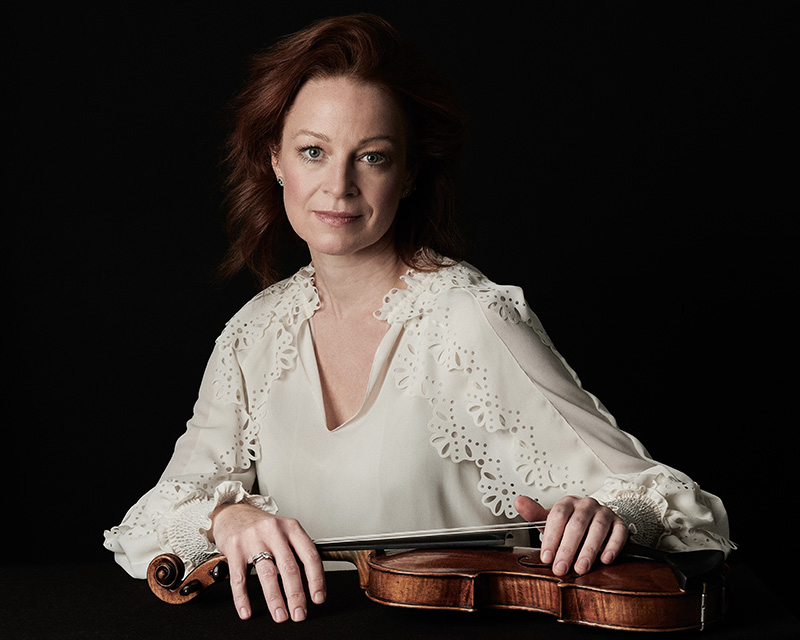
Carolin Widmann (violin, below), City of Birmingham Symphony Orchestra / Nicholas Carter
Haydn Symphony no.96 in D major Hob.1/96 ‘Miracle’ (1791) Ligeti Violin Concerto (1989-93) Brahms Symphony no.3 in F major Op.90 (1883)
Symphony Hall, Birmingham Wednesday 1 November 2023
Reviewed by Richard Whitehouse
Tonight’s concert by the City of Birmingham Symphony Orchestra saw a collaboration with the well-regarded Nicholas Carter – former chief conductor of the Adelaide Symphony, now holding that position with Bühnen Bern alongside guest appearances in Europe and the US.
Few conductors would nowadays begin a programme with a Haydn symphony, and Carter’s take on no.96 did not lack for conviction. The Miracle of a falling if harmless chandelier may have taken place at the premiere of no.102 but does not lessen the quality of this work, its slyly portentous Adagio introducing an Allegro whose motivic unity is most evident in a tensile development and agile coda. With felicitous writing for oboe (rendered so by Helena Mackie) and violin (a welcome ‘guest lead’ from Zoë Beyers), the Andante is the highlight – Carter making the most of antiphonal violins where the gains in clarity or incisiveness were never in doubt. Steady but with a lilting grace then a piquant trio, the Minuetto was a perfect foil to the final Vivace – its energetic interplay duly capped by a coda of uninhibited verve.
Good that the CBSO marked György Ligeti’s centenary with his Violin Concerto, combining the composer’s love of polyrhythms and varied tunings with a heady recall of his Hungarian heritage. No stranger to this piece, Carolin Widmann emphasized the teasing reticence of its Praeludium and found aching nostalgia in the folk inflections of its Aria-Hoquetus-Choral. The coruscating build-up of its Intermezzo and finely wrought intensity of its Passacaglia were well judged, Carter bringing out the strangeness of orchestral writing with its extremes of register and an array of unorthodox instruments. The final Appassionato was trenchantly done, and while Widmann’s overly matter-of-fact cadenza robbed the closing ensemble bars of their barbed humour, it proved a small blemish on this otherwise captivating performance.
Brahms’ Third Symphony has done well by the CBSO in recent seasons, and Carter’s reading was no exception. Any hint of stolidity at the outset of the initial Allegro had gone during the exposition’s repeat, then the development accrued a momentum such as carried through to the end of this movement. The coda’s transfigured poise (Brahms’ riposte to Tristan?) was no less evident in the Andante, its melodic simplicity belying an emotional ambiguity as was implied by its ruminative asides before suddenly being made explicit during the confiding final pages.
The Poco allegretto was (rightly) taken not as an extra slow movement, rather an intermezzo of a pathos which was accentuated by its deft forward motion. The final Allegro then brought a culmination in all respects – Carter alive to its stark contrasts between the speculative and the combative, with a thrilling transition into the reprise then a coda that recalled the work’s defining motto with mingled aspiration and benediction on its way to an ending of perfectly judged repose. Never the easiest symphony to bring off, this was a Brahms Three to savour.
Carter will hopefully be working with this orchestra again soon. Next Wednesday’s concert brings Cristian Macelaru in a programme with Sibelius and Mendelssohn, while Thursday’s Centre Stage recital has a welcome revival of the Clarinet Quintet by Elizabeth Maconchy.
You can read all about the 2023/24 season and book tickets at the CBSO website. Click on the artist names for more information on violinist Carolin Widmann and conductor Nicholas Carter, and for more about composer György Ligeti
Arcana does not often publish news about live events, but is very happy to make a biased exception in this case, since our editor is Norwich-born and bred!
The Norfolk & Norwich Festival is one of the jewels in the crown of East Anglia’s cultural year, and next year’s model looks like being no exception, with an imaginative pairing of artists and venues. Here is more detail from the press release:
NORFOLK & NORWICH FESTIVAL 2024 FRIDAY 10 – SUNDAY 26 MAY 2024
NORFOLK & NORWICH FESTIVAL ANNOUNCES FIRST SEVEN SHOWS FOR 2024 AHEAD OF THE FULL PROGRAMME ANNOUNCEMENT NEXT YEAR
CORAZÓN – A WORLD PREMIERE FROM CIRCUS GROUP CIRCOLOMBIA CREATED ESPECIALLY FOR THE ADNAMS SPIEGELTENT
INITIAL ARTISTS INCLUDE KENNY ANDERSON (AKA KING CREOSOTE) AND NORFOLK BORN MUSICIAN LAURA CANNELL WITH THE LIVE VERSION OF HER ALBUM ANTIPHONY OF THE TREES
CLASSICAL CONCERTS FROM MAHAN ESFAHANI WITH BRITTEN SINFONIA, AND AURORA ORCHESTRA
NIGHT PIPES – AN UNIQUE NIGHT-TIME MEDITATION FEATURING THE MUSIC OF MESSIAEN AT NORWICH CATHEDRAL ON THE NEWLY REBUILT ORGAN
EAST ANGLIA’S ACCLAIMED POET AND PERFORMER LUKE WRIGHT BRINGS HIS LATEST SHOW SILVER JUBILEE
2024 FESTIVAL RUNS 10 MAY – 26 MAY 2024, PUBLIC BOOKING FOR FIRST SHOWS OPENS ON WEDNESDAY 8 NOVEMBER 2023
With a full programme for 2024 set to be announced in the New Year, Norfolk & Norwich Festival have today announced the first shows to go on sale for next year’s programme.The Festival will run for 17 days from 10 May – 26 May 2024 with artists from around the world and across the region presenting a huge variety of work and events in Norwich and across the county.
All the way from South America and created especially for the Festival’s Adnams Spiegeltent, Circolombia will present the World Premiere of Corazón (‘heart’ in Spanish). Founded in 2006, Circolombia showcase the talents of young Columbians, and is known for producing high-energy modern circus shows with a distinctive Latin feel. Having toured across the world, performing at festivals from Adelaide to Edinburgh, they arrive to headline the Spiegeltent in Festival Gardens between 15 – 26 May. Corazón will be in keeping with their acclaimed style – a circus concert full of breathless acrobatic feats and infectious music.
On the opening weekend Aurora Orchestra will return to the Festival for the first time in seven years with Beethoven’s Symphony No. 3. Performed entirely from memory, audiences will be treated to a delightfully intimate concert on 11 May at Norwich Cathedral.
The Festival welcomes back leading champion of the harpsichord Mahan Esfahani. Performingwith Britten Sinfonia on 25 May, they’ll complete their season-long Bach collaboration at St Peter Mancroft in Norwich. Alongside the complete cycle of Bach’s uplifting and era-defining keyboard concertos, they will perform a programme of Bach’s second orchestral suite, which doubles as a flute concerto, and the baroque concerto the fifth Brandenburg. They are joined by violinist Jacqueline Shave.
Also on the opening weekend, Ashley Grote will present a unique, meditative performance on the newly rebuilt Norwich Cathedral organ, on 12 May. Norwich Cathedral has one of the largest pipe organs in the country, featuring an incredible 5,767 pipes that range from ten metres to just an inch long. In a programme of Olivier Messiaen, the Cathedral Master of Music will play three towering works of the organ repertoire, displaying the full range of the instrument.
Kenny Anderson (aka King Creosote) will bring his emotive brand of folk-pop to the Festival for one night on 18 May at Norwich Cathedral. King Creosote has released over 100 records since his debut in the 1990s, and his songs have been covered and performed by artists including Simple Minds and Patti Smith. His latest album, I DES explores a kaleidoscopic musical terrain with vibraphones, accordions, e-bows and samplers.
Norwich born, international musician Laura Cannell will present the live version of her seventh solo album Antiphony of the Trees – a concert focused solely on the recorder and taking inspiration from the sound of the birdsong which cuts through the crisp air of the fen valley where she lives. Armed with bass, tenor, alto and double recorders, she will transcribe birdsong into a minimalist solo chamber music.
Fellow East Anglian and Festival favourite Luke Wright returns with his latest critically acclaimed show Silver Jubilee. For twenty-five years, Luke has built a reputation for being one of Britain’s most popular live poets. With sold out shows across the world, he regularly tours with John Cooper Clarke and The Libertines. Silver Jubilee provides a warm, funny and honest hour of poems and stand-up with the directness and pathos for which he has come to be known. The show includes some wild experiments in the form of a nervous kitten called Sir John Betjeman and a healthy smattering of drum ‘n’ bass.
Daniel Brine, Festival Director said: “It always feels like we’re up and running each year with the announcement of the first shows. While it’s only a tiny taste of what’s to come, there’s a nice representative blend of the local and the international – something that’s particularly important to our Festival. We’re also really excited to present a brand new show from the fantastic Circolombia – a show packed full of their trademark music and energetic circus skills, but one unusually created specifically for a Spiegeltent.”






 Arcana.fm