
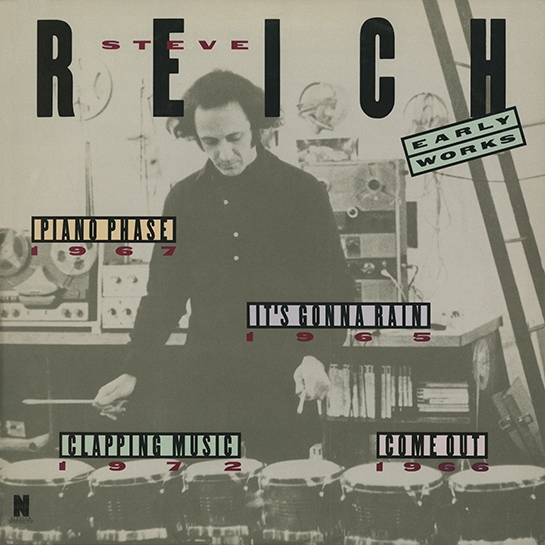
by Ben Hogwood
After Come Out was over, I remember thinking, “What is this? Am I gonna be a mad scientist trapped in a loft with a tape recorder? So, I immediately thought, “I’ve got to return to live music.” – Steve Reich, talking to Michael Tilson Thomas (from Steve Reich: Conversations)
Background
Having vowed to return to live music, Reich encountered difficulties. “Unfortunately, it seemed to me at the time impossible for two human beings to perform that gradual phase shifting process, since the process was discovered with, and was indigenous to, machines.”, he says in Writings on Music.
Yet he was in for a welcome surprise, realising that having recorded a short loop on the piano, he could indeed play against it as though he were a second tape recorder. “Doing it is really incredible”, he recounted to MTT, “because the only way I can do it is to close my eyes and listen as closely as possible so that I don’t move two sixteenths ahead, or just get stuck in unison.”
The rhythmic interval of a sixteenth is critical, for while the two musicians begin in unison, the second starts to gradually increase their tempo so that the phase shifting begins, and eventually they move one beat (one sixteenth) ahead. This continues until both align back in unison, at which point a new melodic pattern is introduced, and the shifts begin from scratch. The home key is B minor, and the piano notes are largely mid-range.
Listen
Thoughts
Piano Phase is one of Reich’s most hypnotic works, and once again it rewards the active listener with a dazzling array of riffs that can be picked out of the crowded textures seemingly at will. The shifts of rhythmic emphasis are thrilling, and as the second pianist moves ahead of the first there are moments of euphoria when torrents of notes are unleashed like a waterfall, then reassuring blocks where everything falls metrically into line.
There are dancing figurations created by the constant movements, the left hand acting as the ‘legs’ to support the movement in the right hand’s ‘upper body’ figurations. These shapes constantly shift in the listener’s imagination.
Halfway through, when you might expect the piece to drag, it regenerates, fresh energy added as the rhythms bounce off each other, while fifteen minutes in and what seemed to be a simple, single line is now a dazzling wall to well ringing of bells, with very little bass
By the end the melodic elements are almost done, bouncing between two notes a tone apart and seemingly trapped in a vacuum. This feels like exactly the right point for the piece to stop, which it does in unison. As always, the quiet at the end of a minimalist piece feels like the loudest part of all, until things subside to silence – yet the effect lingers, the musical equivalent of a double espresso.
Quotes / Legacy
“It’s one pattern, but it’s a completely different way of playing the piano…it requires a completely different skill set. You’re playing the piano like a percussionist. You were asking the performers to do something that up until that point people had not been asking performers to do.” – composer Michael Gordon on discovering Piano Phase (from Steve Reich: Conversations)
Is it too fanciful to suggest modern pop songs such as Alex Warren’s Fever Dream have been indirectly influenced by Reich’s workings?
Recordings
There are several. Reich’s first recording, made with Double Edge, Edmund Niemann (piano), Nurit Tilles (piano) clocks in at just over 20 minutes. Ensemble Avantgarde on Wergo are 18’40”, while Vincent Corver and Keith Ford are a nippy 13’40” with their account for CPO. All are enjoyable, though Reich’s is more authoritative. You can compare on this Tidal playlist
Also written / released in 1967 The Beatles Sgt. Pepper’s Lonely Hearts Club Band; The Jimi Hendrix Experience Are You Experienced; Shostakovich Seven Romances on Poems by Alexander Blok; Stockhausen Hymnen
Next up: Violin Phase (1967)
Published post no.3,059 – Monday 26 October 2026

