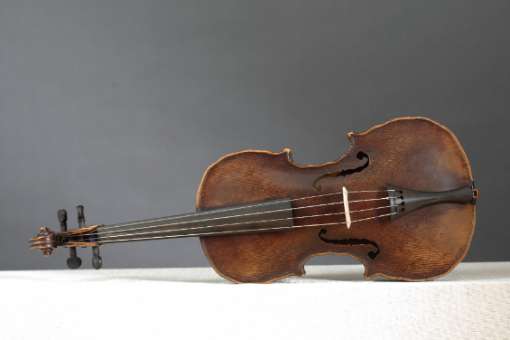
Commemorative medal for Ludwig van Beethoven – Gold-plated bronze medal from the BH Mayer foundry based on a design by Rudolf Mayer, Pforzheim, 1903 (picture courtesy of the Beethovenhaus, Bonn)
Bagatelle in C major WoO 56 for piano (c1803-4, Beethoven aged 33)
Dedication not known Duration 2’45”
Listen
written by Ben Hogwood
Background and Critical Reception
Although Beethoven published a 24 bagatelles in collections through his life, beginning with the seven published as Op.33 in 1802, there were a number of short pieces that did not get as far as publication. They reveal something of the composer’s sketchpad, and some of the directions in which he was experimenting.
Bryce Morrison remarks briefly in his Chandos booklet note that the piece is ‘less interesting’, but Keith Anderson, writing for Naxos, observes that ‘the undated Bagatelle is a curiously capricious little piece, with its imitative entries and sudden whimsical shifts of key’.
Thoughts
Beethoven’s Bagatelles are never without incident, and though to the untrained observer a Bagatelle in C major would seem to be something of a routine encounter, this is far from the case.
The music starts with Beethoven lost in thought, and the implication is that a fugal exercise is about to begin, albeit one with a chromatic melody. This breaks off in mid-phrase, and the music restlessly moves around in search of a key, the left hand wandering off and having to be brought back into line. The ending resolves happily enough in C major, but there is a distracted feeling to this particular Bagatelle.
Recordings used and Spotify playlist
Jenő Jandó (Naxos) Mikhail Pletnev (DG) Ronald Brautigam (BIS) John Lill (Chandos)
Beethoven bagatelles encourage experimentation among pianists, and comparing the versions from Mikhail Pletnev, Ronald Brautigam and John Lill is very instructive. The first two are quick, while Lill gives a thoughtful account. Brautigam has plenty of air to fill in his reverberant recording, while the Jenő Jandó version shares a track with the Presto in C minor – the Bagatelle itself beginning at 4’13”.
You can chart the Arcana Beethoven playlist as it grows, with one recommended version of each piece we listen to. Catch up here!
“Tremate, empi tremate”, Op.116 for soprano, tenor, baritone and orchestra (1803-4, published 1814. Beethoven aged 33 at time of composition)
Dedication Not known Text Niccolo Bentini Duration 9′
Listen
by Ben Hogwood
Background and Critical Reception
A dramatic trio for three vocal soloists and orchestra, Tremate, empi, tremate has its origins in Beethoven’s lessons with Salieri. It is thought Beethoven drafted the work early on in 1802, but it did not receive a first performance for quite some time. It was scheduled for April 1803, but that concert became full of new works such as the first two symphonies, the Piano Concerto no.3 and Christ on the Mount of Olives. The première of the trio finally occurred several years later during a similarly large concert on 27 February 1814, alongside the Seventh and Eighth Symphonies and Wellington’s Victory. Nicholas Marston’s note for Hyperion tells us that the vocal parts were sung by the star soprano Anna Milder-Hauptmann (Beethoven’s first Leonore), Giuseppe Siboni and Carl Weinmüller, who created the role of Rocco in Fidelio.
Salieri is likely to have suggested the text – Tremate, empi, tremate translating as Tremble, guilty ones, tremble – and which tells a turbulent love story. Soprano Chen Reiss, interviewed for Arcana, talked about the piece. “It reminded me a little of the trio in Fidelio with the Father and the two lovers. Marzelline is thinking that Fidelio is a man, and she’s in love with him, and the father basically gives his blessing. It is of course a different story altogether, but the ending is very dramatic. I think it’s a very good piece to perform as an encore in a concert, don’t you agree?”
Given the way the voices combine, and the dramatic third part, she has a strong point. “Yes. I think it is very well conducted, with the middle part which has these beautiful long lines. I think it is an early piece, and of course Beethoven has these dramatic parts, which come later, but he also has a very good sense of lyricism and melodic beauty, a pureness which reminds me very much of Mozart and Haydn. You see it in these early works that he was more classical, and then he became much more dramatic.”
Thoughts
Tremate certainly is a dramatic piece of music, and Beethoven wastes no time in making a bid for his audience with a call to arms from the bass. The soprano and tenor – now a couple – respond but the baritone declares “I want them both restrained”. He is the poisoned onlooker, the other two declaring their innocence.
As the dramatic scene unfolds so too does Beethoven’s vocal writing, with the voices dominating and very little chance for breath between their thoughts, certainly in the breathless opening. The second section gives the soprano and tenor more room to declare their love, finishing each others musical sentences to ‘classical’ accompaniment from the small orchestra. The bass is never far from their side, however, still lamenting his lot.
After a tender clinch we return to the stormy music of the opening, with rolling timpani and braying horns as the three soloists face off. Translated, the text reads, “Cruel stars, I have tolerated for long enough this violent cruelty” – which would still seem to mean a dreadful outcome for the bass and togetherness for the other two.
It is another example of Beethoven’s dramatic vocal writing, though does give the impression to start with that it is trying all the tricks to impress his teacher. There is never a dull moment, that’s for sure!
Spotify playlist and Recordings used
Diana Tomsche (soprano), Joshua Whitener (tenor), Kai Preußker (baritone), Heidelberg Symphony Orchestra / Timo Jouko Herrmann (Hänssler)
Reetta Haavisto (soprano), Dan Karlström (tenor), Kevin Greenlaw (baritone), Turku Philharmonic Orchestra / Leif Segerstam (Naxos)
Janice Watson (soprano), John Mark Ainsley (tenor), Gwynne Howell (bass), Corydon Orchestra / Matthew Best (Hyperion)
Chen Reiss (soprano), Jan Petryka (tenor), Paul Armin Edelmann (baritone), Beethoven Philharmonie / Thomas Rosner (Odradek)
Four fine recordings – but by a whisker the finest is the newest, headed by Chen Reiss. The playlist below collects five versions together, while a clip from the sixth – with Janice Watson and company – can be heard on the Hyperion website
The below playlist collects all three recordings referred to above:
You can chart the Arcana Beethoven playlist as it grows, with one recommended version of each piece we listen to. Catch up here!
Notturno in D major Op.42 arranged for viola and piano by Franz Xaver Kleinheinz under Beethoven’s guidance) (1804, Beethoven aged 33)
Dedication unknown
Duration 28′
1. Marcia: Allegro
2. Adagio
3. Menuetto: Allegretto
4. Adagio – Scherzo: Allegro molto – Adagio – Allegro molto – Adagio
5. Allegretto alla Polacca
6. Andante quasi allegretto – Variations 1-4 – Allegro – Tempo I
7. Marcia: Allegro
Listen
by Ben Hogwood
Background and Critical Reception
Nicholas Marston, writing booklet notes for a Hyperion recording of the Notturno, notes, “The growing amateur market for music in the late eighteenth and early nineteenth centuries encouraged publishers to increase their profits by issuing suitable works in all manner of instrumental arrangements.”
In this spirit, the Notturno in D major is essentially a recasting of the Serenade in D major Op.8, a versatile piece where Beethoven had already authorised an arrangement for flute and piano. This one, completed with the composer’s compliance, was for Beethoven’s own instrument (the viola) and piano.
Beethoven, says Marston, “had little respect for the practice and attempted to exercise some control over it”. Yet the Nocturne was released by the Leipzig publisher Hoffmeister and Kühnel in 1804 in an arrangement by Franz Xaver Kleinheinz (c1770-1832), who was also responsible for the arrangement of Beethoven’s Serenade Op.25 for flute and piano. The score was approved by Beethoven, though not without corrections – made in a fit of pique.
The piece retains its substantial dimensions, being in the originally cast seven movements.
Thoughts
Kleinheinz has, to these ears at least, done a thoroughly good job with Beethoven’s original, giving the viola one of its most substantial pieces from the early 19th century. The brisk, upbeat first movement falls nicely into the instrument’s confines, while the tender side of the viola is revealed in soft, soulful double stopping in the second movement Adagio, together with lyrical passages and a central episode in the minor key with more serious thinking.
The Menuetto is brisk and breezy, while the drama heightens in the central fourth movement Adagio, with several abrupt changes of speed and mood. The relative turmoil of this is complemented by the nimble Allegretto alla Polacca. The substantial penultimate movement Andante quasi Allegretto finds a great deal of expression in the viola’s hands, while the final Marcia has an appreciable heft.
Recordings used and Spotify links
Paul Coletti (viola), Leslie Howard (piano) (Hyperion)
Gérard Caussé, François-René Duchâble (Erato)
Nobuko Imai, Roger Vignoles (Chandos)
Nils Mönkemeyer, Nicholas Rimmer (Genuin)
Simon Rowland-Jones, Niel Immelman (Meridian)
Some fine versions here, especially those of Nobuko Imai, Gerard Caussé and Paul Coletti. Coletti and Howard provide excellent companion pieces int the fiery early Mendelssohn sonata and Schumann’s Märchenbilder to put the piece in context.
You can listen to clips from the Coletti-Howard account on the Hyperion website, while the rest you can hear in full on this Spotify playlist:
You can chart the Arcana Beethoven playlist as it grows, with one recommended version of each piece we listen to. Catch up here!
Also written in 1804 Eberl Symphony in D minor, Op. 34
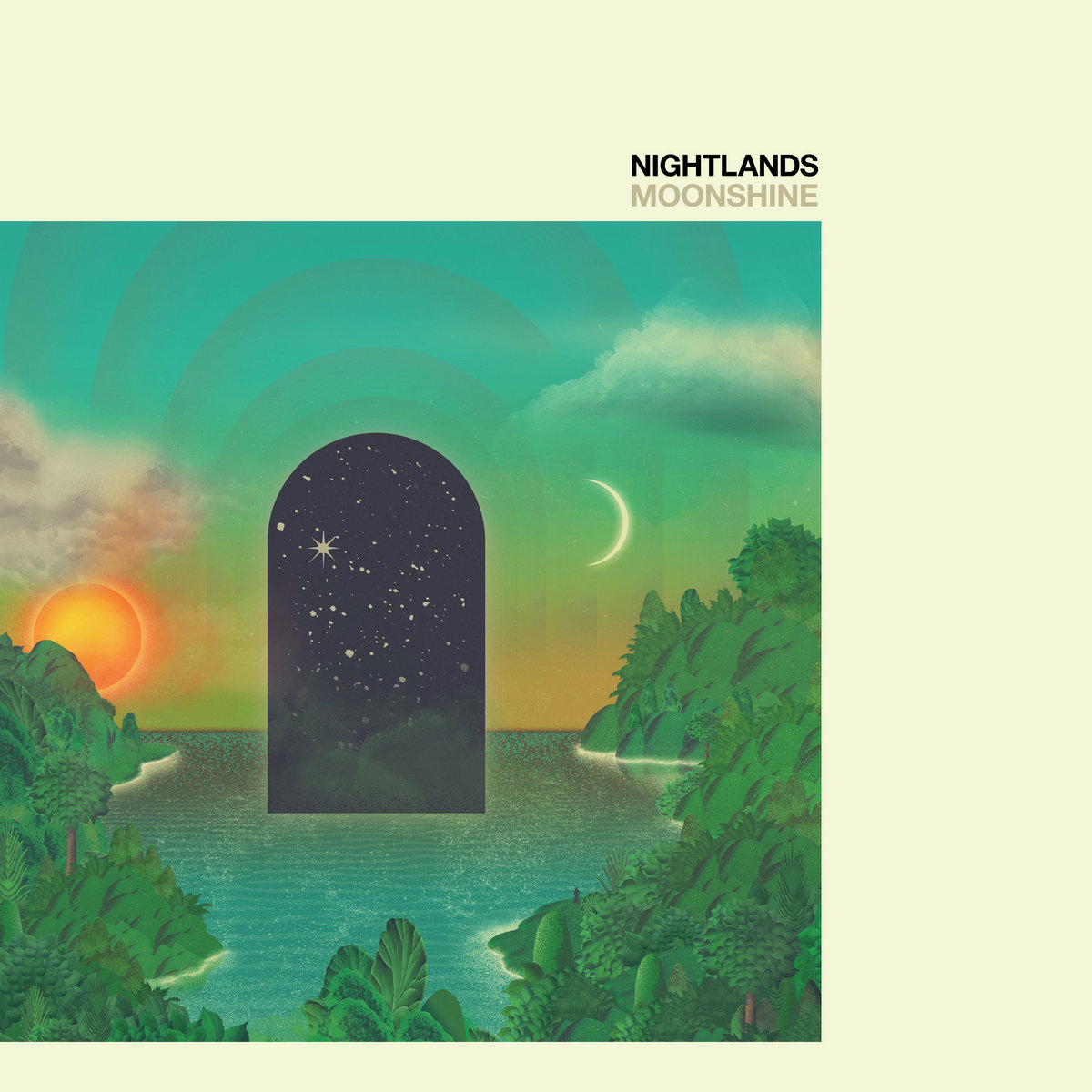
Nightlands, the solo project of The War On Drugs bassist Dave Hartley, has reached its third instalment. Moonshine reflects a change in the pace of his home personal life, since leaving Philadelphia for the relatively deserted area of Asheville.
When crafting his music, Hartley has looked to build massive layers of keyboards and vocals on top of each other, creating ‘stacks’ of sound. They are in keeping with the album’s artwork, as the press release describes. “The surrealistic album art by Austin-based illustrator Jaime Zuverza depicts an archway opening to the stars over the surface of an idyllic sea flanked by both moon and sun”, it says. “Similarly, Moonshine reveals portals within portals leading to ever deeper places in Hartley’s vocal-centered labyrinth.”
What’s the music like?
As wide open as that introduction suggests it will be, but in spite of the big textures there is a touching intimacy too. On occasion it feels like the one person you are talking to has gone out for a quick smoke under the stars in a massive vista, and will be back inside shortly. The music pans out to give space to these thoughts, which are often tender and warm.
They are not without sharp-edged feeling, however. Stare Into The Sun has a direct observation on political machinations. “You’ve got your sheep but you’re no shepherd”, sings Hartley. “What does it mean…to buy everyone, and send someone’s son to Afghanistan?” No Kiss For The Lonely is equally pertinent, with its observation of “no love for you refugees, no rest for the weary”.
Most of the time, however, the album inhabits a calming place, the big vocals and keyboards complemented by languid saxophone lines and impressively supple rhythm tracks. The music unfolds with a slow and very natural groove, and Hartley’s warm-hearted vocals become its principle feature, often finding a style of music akin to a less troubled Bon Iver.
With You is a prime example, inhabiting a serene and content place, while Blue Wave goes even calmer, its keyboards like a slowly running stream.
Does it all work?
It does, especially at either end of the day. Moonshine has some very evocative moments, and it is beautifully written, rewarding background listening but also offering more to those paying attention to the lyrics.
Is it recommended?
Is it recommended?
Yes – an album of starry Americana that deserves its place in the moonlight.
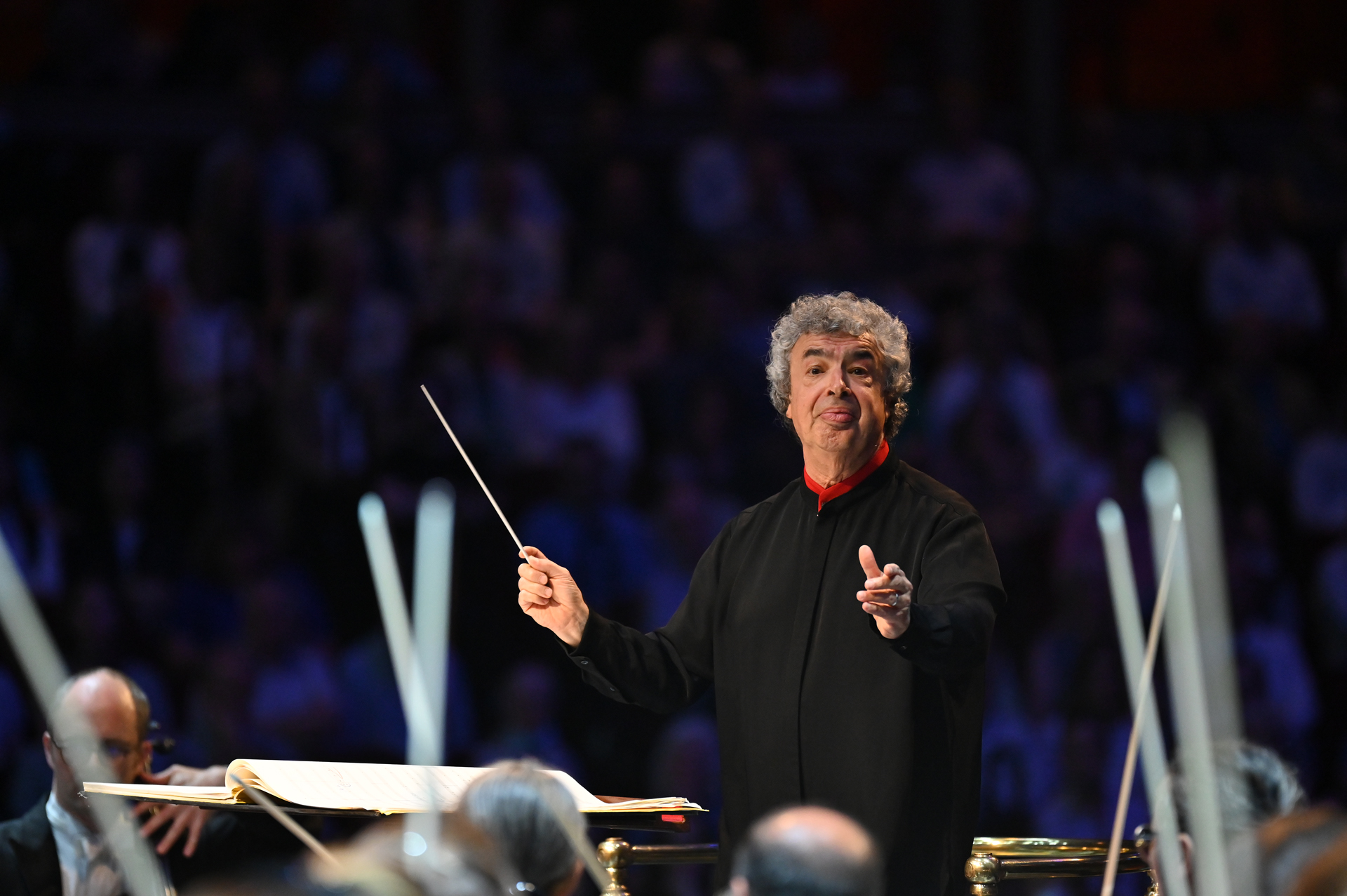
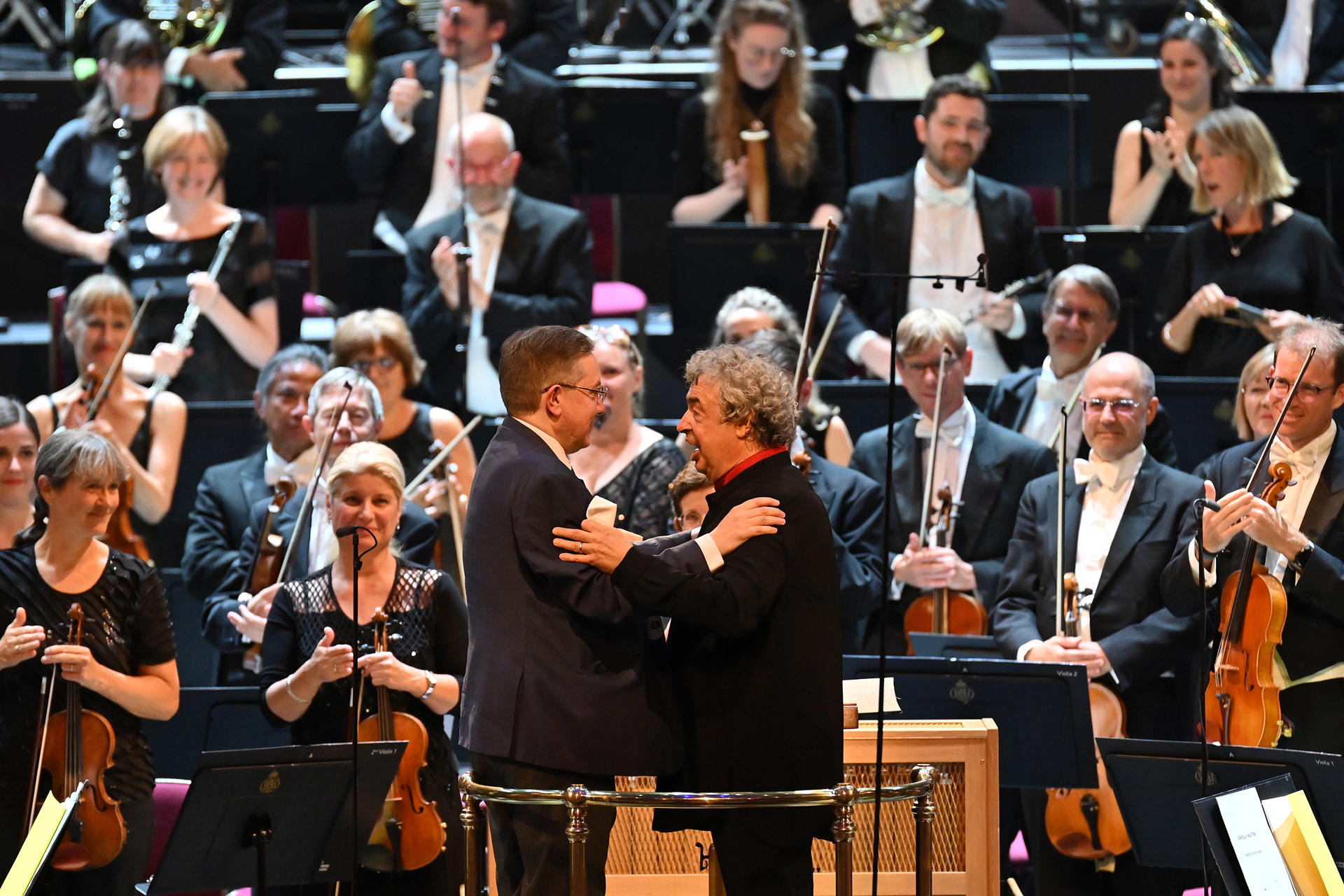
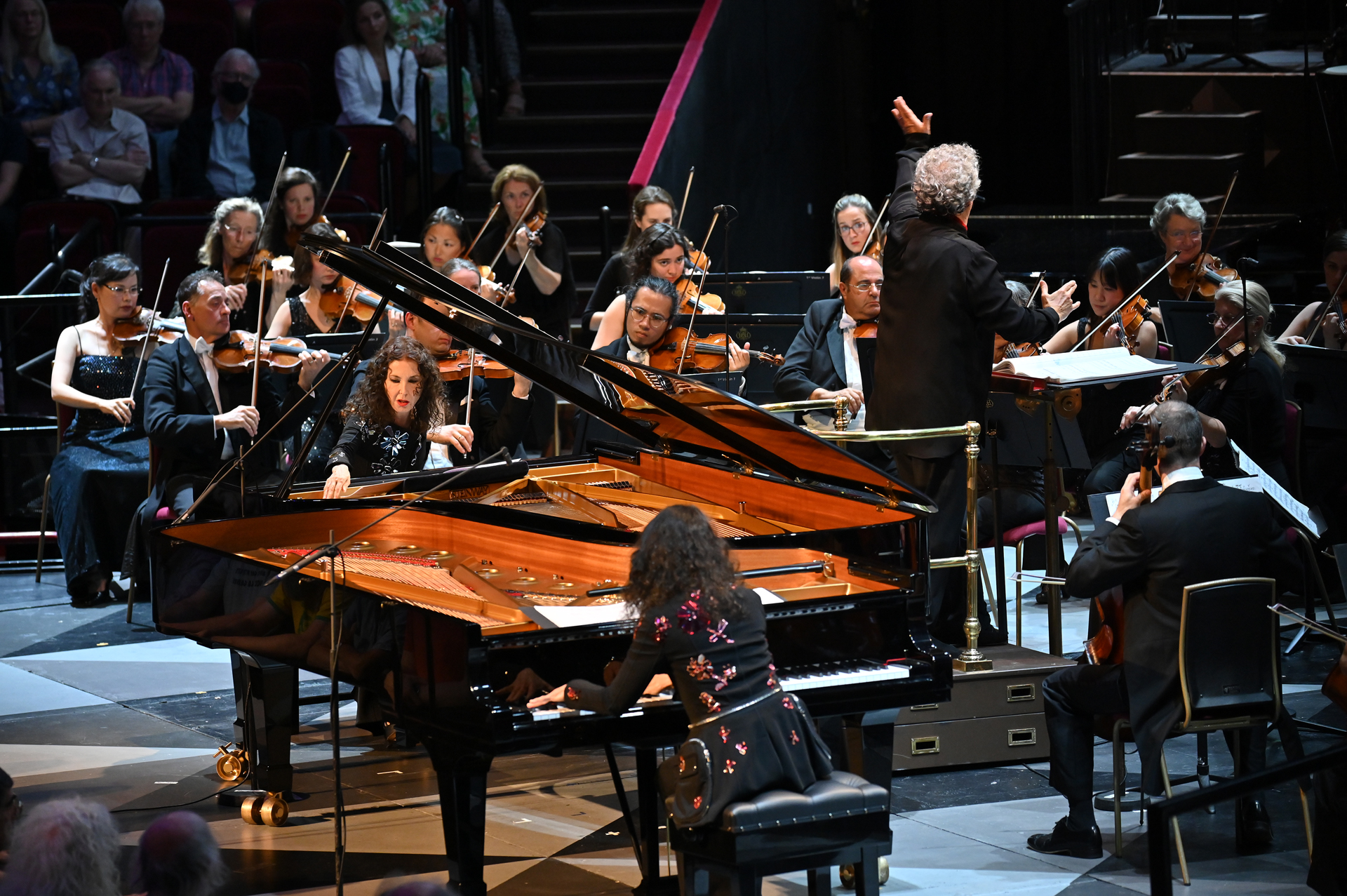
Prom 26 – Katia and Marielle Labèque (pianos), BBC Symphony Orchestra / Semyon Bychkov (above)
Anderson Symphony No. 2 ‘Prague Panoramas’ (2020-22) (BBC co-commission: World premiere of complete work) Martinů Concerto for Two Pianos and Orchestra H292 (1943) Rachmaninoff Symphonic Dances Op.45 (1940)
Royal Albert Hall, London Friday 5 August 2022
Reviewed by Richard Whitehouse Photo (c) Chris Christodoulou
An unusually well-assembled concert this evening with what might be termed a programme of ‘three-by-threes’ – each of these three works having three movements which, in each case, results in a broadly symmetrical design, not least the Second Symphony by Julian Anderson (with the conductor, below).
Inspired by Josef Sudek’s photographs of Prague while utilizing two medieval Czech hymns, Prague Panoramas (might Prague Pictures be even more apposite?) is typical in its fusing evocativeness with precision. Not least the preludial opening movement, its stark alternation of quick-fire chords and silence evolving into aspiring melodic lines as build to a tumultuous if quickly curtailed climax, though this linear aspect comes to dominate the nocturnal central movement with its expressive intensifications then fades against a backdrop of bell resonance and luminously modal polyphony. The finale is a deftly organized rondo – its energetic main material, inspired by Josef Lada’s almost Rabelaisian depictions of pub brawls, interspersed with more lyrical ideas through to the heady peroration later subsiding into a calm postlude.
Although its first two movements had been heard in Munich and Prague, this was the work’s first complete performance and found the BBC Symphony at its collective best – not least the lambently interweaving woodwind and strings, the visceral impact of brass and a substantial array of percussion whose contribution was pervasive. Semyon Bychkov (under-appreciated as an exponent of contemporary music) duly brought out that unity-within-diversity such as gave this work an underlying focus across the 32 minutes of its eventful yet cohesive course.
From Prague-inspired music by a British composer to that by a Czech composer in America – Martinů’s Concerto for Two Pianos may never have gained the plaudits of his earlier Double Concerto but it typifies this composer’s exile in a tried-and-tested interplay of folk-inflected melodicism with a harmonic acerbity recalling Prokofiev and rhythmic dexterity redolent of Stravinsky. Its undoubted highlight is a central Adagio whose almost ‘harmonie’ woodwind writing and circling piano figuration (had the composer come across the gamelan-influenced music of Colin McPhee?) feels mesmeric and affecting. Neither outer movement comes close in their audibly contrived amalgam of the rumbustious and lyrical, but this is music in which Katia and Marielle Labèque excel and tonight’s performance could rarely have been equalled.
Nor was there any doubting Bychkov’s authority in Rachmaninoff’s Symphonic Dances that followed the interval. Admittedly this now regularly played while technically exacting piece needed more rehearsal than the BBCSO was able to give it on this occasion, though the outer sections of the first dance had just the right ominous incisiveness and its middle part featured winsome alto saxophone from Martin Robertson. The second dance had irony and angularity aplenty, as was slightly offset by the strings’ less than unanimous response towards the close.
Its sombre ambivalence and intricate textures give the central span of the final dance a quality unique in this composer: if Bychkov might have endowed it with even greater intensity, there was no doubting his identity with this music here or on the way to its resplendent apotheosis.