Here is a third symphony on the theme of spring in four days! This one is not so well known as the works we have enjoyed from Dvořák and Schumann – but it was well-received in its time.
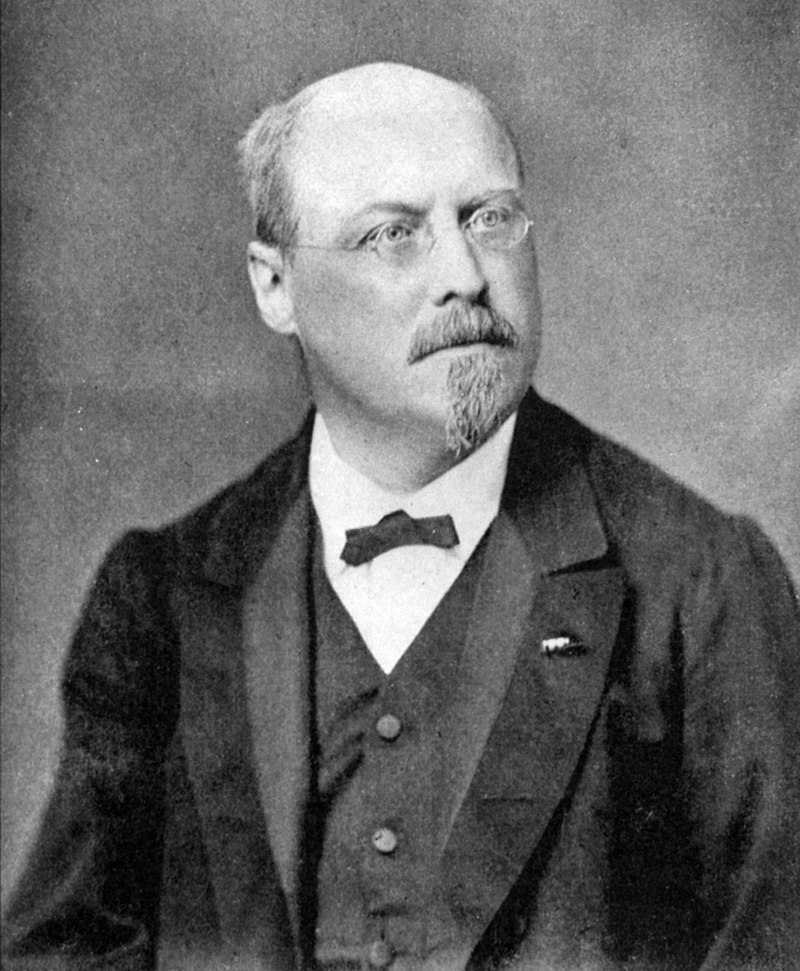
Composer Joachim Raff was born 200 years ago this month. A big part of his prodigious output of compositions are the eleven symphonies, of which the last four are based on the four seasons.
That means the Symphony no.8 in A major, his Op.205, is based on spring, taking the title Frühlingsklänge (Sounds of Spring) Completed in 1876, it is mostly a bright and airy piece, with elements of Mendelssohn, Brahms and Schumann but also with Raff’s own fresh melodic inspiration.
The first movement delights in Spring’s Return, while the second – During Walpurgis Night – is much darker. The slow Larghetto, subtitled With the first bunch of flowers, is a tender aside, before the energetic Wanderlust completes a most enjoyable piece. Have a listen below, in a recording available on CPO from the Philharmonia Hungarica and conductor Werner Andreas Albert:
Schumann String Quartet no.3 in A major, Op.41 No. 3 (1842) Beethoven String Quartet no.11 in F minor, Op.95 ‘Serioso’ (1810-11)
CBSO Soloists [Jonathan Martindale and Stefano Mengoli (violins), Christopher Yates (viola), Helen Edgar (cello)]
CBSO Centre, Birmingham Friday 6 May 2022
Written by Richard Whitehouse
The Centre Stage series, featuring members of the City of Birmingham Symphony Orchestra, continued this afternoon with a coupling of string quartets which, written just three decades apart, could hardly be more contrasted in terms of their aesthetic stance or emotional impact.
It made sense to reverse the advertised playing order. Schumann’s Third Quartet may be the last of his trilogy, but the initial movement is an ideal means of ushering in any programme – its gentle introduction then ruminative Allegro segueing with an unforced eloquence amply conveyed by these players. Most impressive was the ensuing scherzo – its variations on an agitated theme maintaining impetus right through to the restive closing bars. In his opening remarks, Jonathan Martindale spoke of the anguish beneath this music’s seeming sanguinity as is confirmed by those stealthy episodes that twice disrupt the Adagio’s repose before its main ideas find uneasy accord. No such issue affects the final Allegro, its rhythmic dexterity faltering a little but its determined progress towards an affirmative outcome never in doubt.
Whereas Schumann’s quartet typifies the mid-Romantic zeitgeist, Beethoven’s Serioso finds the latter composer’s late-Classicism at its most provocative – not least in terms of a formal concentration that barely exceeds 20 minutes. The present account underlined this in a lithe take on the opening Allegro which exuded a volatility such as (rightly) carried over into the next movement – its Allegretto marking indicative of a restlessness made more poignant by the extended coda’s burgeoning lyricism. Yet, as the ambiguous final cadence attests, there can be no let-up with a scherzo whose ‘serioso’ marking reinforces this as music-making in earnest. Its tense angularity is hardly less evident in the lurching progress of a finale whose breezily nonchalant conclusion is as unexpected as it was vividly realized on this occasion.
An arresting and persuasive juxtaposition which will hopefully be evident (if a little less starkly) in the next Centre Stage concert just over a month from now, when several of this afternoon’s players reassemble for early chamber works by Vaughan Williams and Fauré.
You can find further information on CBSO Centre Stage concerts on the CBSO website
Continuing the theme of spring started by Dvořák‘s Eighth Symphony yesterday, here is a performance of Schumann‘s equally uplifting First Symphony, the ‘Spring’, in an account from the Chamber Orchestra of Europe and Yannick Nézet-Séguin:
It is a beautiful spring day outside Arcana’s ‘head office’ today…so to celebrate, one of Dvořák‘s sunniest symphonies is on the playlist. Here is a performance given by the Frankfurt Radio Symphony Orchestra and Manfred Honeck, in celebration of the green season:
Prokofiev Symphony no.1 in D major Op.25 ‘Classical’ (1916-17) Bruch Violin Concerto no.1 in G minor Op.26 (1866-8) Mendelssohn Symphony no.3 in A minor Op.56 ‘Scottish’ (1829-42)
Daishin Kashimoto (violin, below), City of Birmingham Symphony Orchestra / Kazuki Yamada (above)
Symphony Hall, Birmingham Wednesday 4 May 2022, 2.15pm
Written by Richard Whitehouse
Just under a year before he becomes chief conductor, Kazuki Yamada was back with the City of Birmingham Symphony Orchestra for a programme of well-established favourites, which no doubt accounted for the gratifyingly full house that duly greeted his arrival on the podium.
There was humour aplenty in this account of Prokofiev’s Classical Symphony – not least with Yamada almost acting out the initial Allegro’s whimsical second theme, but the highlight was a Larghetto whose sometimes disjunct episodes came together effortlessly. The outer sections of the ensuing Gavotte seemed a little too mannered to be convincing, but the Finale found conductor and orchestra at one in conveying the scintillating wit but also winsome pathos of its main themes, with a pointing of incidental detail then audible ‘lift off’ to the closing bars.
His decade as first concert-master of the Berlin Philharmonic likely accorded him less profile as a soloist, but his take on Bruch’s First Violin Concerto confirmed Daishin Kashimoto as a force to be reckoned with. Determined not to undersell the Prelude, he and Yamada brought out this music’s sombreness as keenly as its lyricism and, at its climax, a tempestuous energy that found the CBSO at its collective best. Nor was there any lack of emotional gravitas in the Adagio, Kashimoto drawing out its rapturous lyricism without neglecting those more intimate asides which resonate long after the music ceases. Emerging with real anticipation, the final Allegro had no lack of underlying impetus and, in its second theme, a high-flown eloquence that set the seal on this movement, and this piece overall, going into the decisive closing bars.
If the second-half performance of Mendelssohn’s Scottish Symphony was not so consistently satisfying, it reaffirmed just why this work (and this composer) has remained a favourite of Birmingham audiences over the decades. Many latter-day accounts tend toward a decidedly Classical brusqueness, but Yamada chose never to rush the opening movement such that the poignancy of its introduction (rightly) persisted through those agitated contrasts of its main Allegro – the absence of an exposition repeat barely detracting from the music’s emotional weight. Effervescent without being overdriven, the scherzo provided ideal contrast between this and an Adagio whose alternate fervour and rhetoric never skirted that sentimentality as was once all too familiar – with Yamada ensuring clarity through even the densest textures.
As in the Bruch, this performance adhered to the ‘attacca’ indications by which Mendelssohn helps to maintain long-term cohesion. That into the finale launched this movement in bracing fashion and if impetus marginally faltered over the latter stages, the pathos at the outset of its coda made for an ideal transition into the peroration which, uplifting or grandstanding as one hears it, ensures a rousing conclusion that seldom fails to bring the house down. Which it did at the close of a reading that found the burgeoning CBSO/Yamada partnership in fine fettle.
Yamada will be back with this orchestra for the start of the 2022/23 season (details of which have just been announced), while next week brings the season’s last appearances with Mirga Gražinytė-Tyla for a brace of programmes that feature Tchaikovsky, Bruckner and Brahms.
For more information on the CBSO’s 2021/22 season, visit their website, and for details on the newly announced 2022/23 season clickhere. Meanwhile for more information on the artists, click on the names to access the websites of Kazuki Yamada and Daishin Kashimoto




 Arcana.fm