
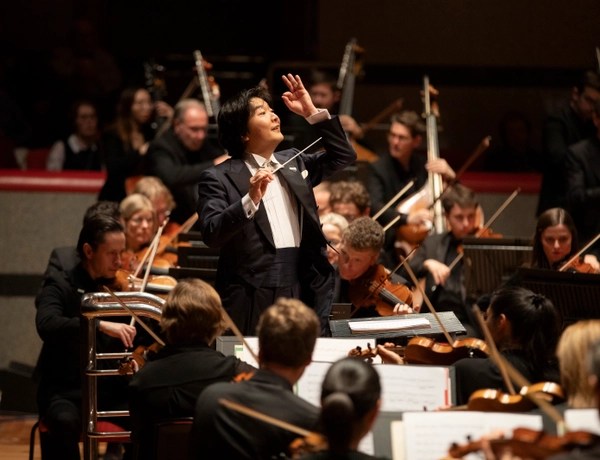
In concert – Janai Brugger, CBSO / Kazuki Yamada: Copland, Tower, Price & Adams

Janai Brugger (narrator/soprano), CBSO Chorus (Julian Wilkins, chorus-master), City of Birmingham Symphony Orchestra / Kazuki Yamada

Copland Fanfare for the Common Man (1942); Lincoln Portrait (1942)
Tower Fanfare for the Uncommon Woman (1989)
Price orch. Rosner The Heart of a Woman (c1930-50)
Adams Harmonium (1980-81)

Symphony Hall, Birmingham
Saturday 4 July 2026

Reviewed by Richard Whitehouse

Marking the 250th anniversary of American independence, the City of Birmingham Symphony Orchestra and music director Kazuki Yamada duly pulled out the stops with a programme that placed musical achievements from the past century within an unlikely yet stimulating context.

The first half unfolded as two diptychs focussing, respectively, on male and female concerns. Thus a brazen but never brash take on Copland’s Fanfare for the Common Man preceded his Lincoln Portrait – its sentiments as apposite to World War Two as to the American Civil War, after whose Battle of Gettysburg Lincoln made his famous ‘Address’. Yamada drew nobility and fervour from its lengthy preamble, then Janai Brugger delivered its subsequent narration with enough poise and understatement to offset any risk of hubris during the climactic stages.

Initiated by a visceral reading of Joan Tower’s Fanfare for the Uncommon Woman, its brass and percussion deployed in notably combative manner, the female response continued with Florence Price’s The Heart of a Woman. Not so much a song-cycle as a ‘themed’ collection which has only recently been assembled from its composer’s extensive contribution to this genre, its 10 settings of black American authors have been orchestrated by Israeli-American composer Lior Rosner with no mean subtlety and eloquence, though on occasion softening the harmonic piquancy with which Price seeks to highlights aspects of her own experience.

Wistful and rapturous by turns, these merge into a rather generalized sequence lacking any more cumulative intensity to justify it as a whole; the exception being Don’t you say no to me which, with its vivid (if slightly self-conscious) elements of blues and ragtime, sounds like a number such as Ella Fitzgerald might have recorded in her youth. Brugger (with kit-percussionist Alex Henshaw-Van den Bos) made the most of its insouciance, with Yamada encouraging the orchestra to a warmly empathetic response elsewhere. Hardly a revelatory discovery, but attractive and affecting music such as reinforced the impression that Price is at her best freed from those formal constraints encountered in her symphonies or concertos.

After the interval came Harmonium, by which John Adams established his wider reputation almost 45 years ago. Now as then, its overall impact belies its relative concision and, while its streamlined ebb and flow arguably overrides the manifest ambivalence in John Donne’s Negative Love then emphasizes predictability over pathos in Emily Dickinson’s Because I could not stop for Death, the integration of chorus and orchestra is unfailing. To this end, coordination was not all that it might have been though the seminal passages were tellingly realized – not least that seismic build-up into a setting of Dickinson’s Wild Nights whose heady crescendos then raptly inward ending, both among its composer’s finest inspirations, were conveyed with conviction boding well for the CBSO performance at this year’s Proms.

Before that London concert, however, audiences in Birmingham can enjoy more Adams when Edward Gardner conducts his epic Harmonielehre and Edgard Varèse’s ambitious Amèriques, with the CBSO and CBSO Orchestral Residency Musicians at Symphony Hall on July 17th.

To read more about the CBSO’s 2026/27 season, visit the CBSO website. Click on the names to read more on chief conductor Kazuki Yamada, soloist Janai Brugger, the CBSO Chorus and composers Joan Tower and Florence Price

Published post no.2,939 – Monday 6 July 2026

In concert – Janai Brugger, Karen Cargill, CBSO Chorus & CBSO / Markus Stenz: Mahler ‘Resurrection’ Symphony

CBSO season finale: Mahler.

Mahler Symphony no.2 in C minor ‘Resurrection’ (1888-94)

Janai Brugger (soprano), Karen Cargill (mezzo-soprano), CBSO Chorus, City of Birmingham Symphony Orchestra / Markus Stenz

Symphony Hall, Birmingham
Saturday 25 June 2022

Written by Richard Whitehouse Photos courtesy of Beki Smith

At the end of another season by the City of Birmingham Symphony Orchestra what could be more fitting than the symphony to have been programmed by the orchestra’s last five principal conductors, defining the Simon Rattle era and been scheduled during the majority of seasons ever since?

Tonight’s performance (and that on the previous Wednesday) was to have been conducted by Mirga Gražinytė-Tyla, but maternity leave occasioned an infrequent UK appearance (at least since his highly regarded tenure with London Sinfonietta in the mid-1990s) for Markus Stenz, who has recorded a Mahler cycle with the Gürzenich Orchestra of Cologne as centrepiece of his discography majoring on 20th-century music and that of the post-war era. A ‘Resurrection’, indeed, where this work’s ‘darkness to light’ trajectory seemed by no means a fait accompli.

Many are the conductors who, even now, ride roughshod across the first movement’s fraught trajectory or fall victim to a deceptively sectional unfolding; under Stenz, there was no doubt as to the cohesion with which dramatic and pastoral elements were drawn into an integrated and dynamic whole. Suffused if not overloaded with pathos, those closing pages carried over the ensuing (two-minute) pause into an Andante whose alternation of the genial and ominous was pointedly but never self-consciously evident. Felicitous playing here from CBSO strings and woodwind, then by the brass in a scherzo whose barbed irony and ‘dancing on a volcano’ volatility was tangible. Stenz was right to proceed directly through the latter four movements with minimal pause – so ensuring an intensifying emotional curve into those conflicts ahead.

First, Karen Cargill made for an eloquent though not ideally steady exponent of the ‘Urlicht’ setting with its calm before the storm of the vast closing movement. Positioned at upper left of the platform, she and Janai Brugger gave of their best in a setting of Friedrich Klopstock’s (suitably Mahler-ized) hymn Die Auferstehung where the relatively lean CBSO Chorus gave notice of its long familiarity in this music. The route taken there brought out the best from the CBSO but also Stenz’s interpretive focus – the starkly contrasted orchestral episodes evincing a formal logic and expressive inclusiveness that, with playing of unfailing clarity (not least by his antiphonal placing of the violins), ensured the finale never degenerated into a sequence of dramatic tableaux – the sureness of Mahler’s symphonic reach tangible throughout its course.

At around 85 minutes, this was a spacious while never lethargic reading which positioned the work as a precursor to the existential symphonic battles ahead rather than the culmination of a symphonic lineage stretching back to Beethoven’s Fifth. Nor was there any impersonality or lack of conviction with Stenz’s approach – his grip on the formal dimensions of the outer movements being matched by his conception of the work as a cohesive and cumulative unity. The CBSO’s playing married assurance with a palpable sense of responding ‘to the moment’.

Birmingham might have waited until 1975 to hear Mahler Two, but it gave the premiere of Stanford’s Requiem back in 1897 and gives this work again when Martyn Brabbins directs the CBSO in a revival next Saturday. An event which, in itself, is of no mean significance.

For more information on the CBSO visit their website, and for more on the soloists click on the names to read about Janai Brugger, Karen Cargill and conductor Markus Stenz