
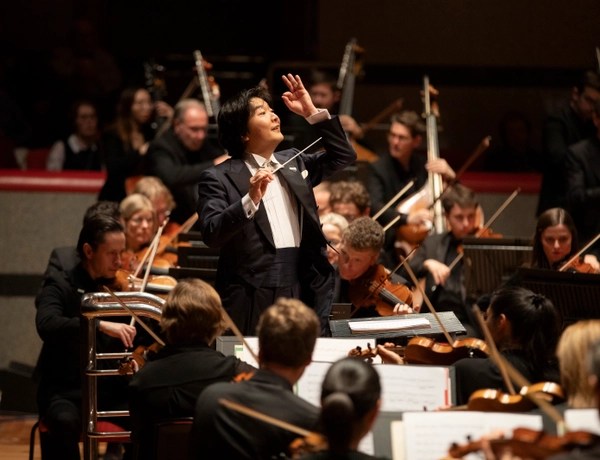
In concert – Janai Brugger, CBSO / Kazuki Yamada: Copland, Tower, Price & Adams

Janai Brugger (narrator/soprano), CBSO Chorus (Julian Wilkins, chorus-master), City of Birmingham Symphony Orchestra / Kazuki Yamada

Copland Fanfare for the Common Man (1942); Lincoln Portrait (1942)
Tower Fanfare for the Uncommon Woman (1989)
Price orch. Rosner The Heart of a Woman (c1930-50)
Adams Harmonium (1980-81)

Symphony Hall, Birmingham
Saturday 4 July 2026

Reviewed by Richard Whitehouse

Marking the 250th anniversary of American independence, the City of Birmingham Symphony Orchestra and music director Kazuki Yamada duly pulled out the stops with a programme that placed musical achievements from the past century within an unlikely yet stimulating context.

The first half unfolded as two diptychs focussing, respectively, on male and female concerns. Thus a brazen but never brash take on Copland’s Fanfare for the Common Man preceded his Lincoln Portrait – its sentiments as apposite to World War Two as to the American Civil War, after whose Battle of Gettysburg Lincoln made his famous ‘Address’. Yamada drew nobility and fervour from its lengthy preamble, then Janai Brugger delivered its subsequent narration with enough poise and understatement to offset any risk of hubris during the climactic stages.

Initiated by a visceral reading of Joan Tower’s Fanfare for the Uncommon Woman, its brass and percussion deployed in notably combative manner, the female response continued with Florence Price’s The Heart of a Woman. Not so much a song-cycle as a ‘themed’ collection which has only recently been assembled from its composer’s extensive contribution to this genre, its 10 settings of black American authors have been orchestrated by Israeli-American composer Lior Rosner with no mean subtlety and eloquence, though on occasion softening the harmonic piquancy with which Price seeks to highlights aspects of her own experience.

Wistful and rapturous by turns, these merge into a rather generalized sequence lacking any more cumulative intensity to justify it as a whole; the exception being Don’t you say no to me which, with its vivid (if slightly self-conscious) elements of blues and ragtime, sounds like a number such as Ella Fitzgerald might have recorded in her youth. Brugger (with kit-percussionist Alex Henshaw-Van den Bos) made the most of its insouciance, with Yamada encouraging the orchestra to a warmly empathetic response elsewhere. Hardly a revelatory discovery, but attractive and affecting music such as reinforced the impression that Price is at her best freed from those formal constraints encountered in her symphonies or concertos.

After the interval came Harmonium, by which John Adams established his wider reputation almost 45 years ago. Now as then, its overall impact belies its relative concision and, while its streamlined ebb and flow arguably overrides the manifest ambivalence in John Donne’s Negative Love then emphasizes predictability over pathos in Emily Dickinson’s Because I could not stop for Death, the integration of chorus and orchestra is unfailing. To this end, coordination was not all that it might have been though the seminal passages were tellingly realized – not least that seismic build-up into a setting of Dickinson’s Wild Nights whose heady crescendos then raptly inward ending, both among its composer’s finest inspirations, were conveyed with conviction boding well for the CBSO performance at this year’s Proms.

Before that London concert, however, audiences in Birmingham can enjoy more Adams when Edward Gardner conducts his epic Harmonielehre and Edgard Varèse’s ambitious Amèriques, with the CBSO and CBSO Orchestral Residency Musicians at Symphony Hall on July 17th.

To read more about the CBSO’s 2026/27 season, visit the CBSO website. Click on the names to read more on chief conductor Kazuki Yamada, soloist Janai Brugger, the CBSO Chorus and composers Joan Tower and Florence Price

Published post no.2,939 – Monday 6 July 2026
America @ 250 – Fanfares for the Common Man and Uncommon Woman, and a hymn by William Billings

by Ben Hogwood

On the 250th anniversary of American independence, Arcana marks the occasion with two related fanfares. The first, well known and loved, is Aaron Copland‘s Fanfare for the Common Man, the powerhouse piece for brass and percussion that also ends his Symphony no.3:

In response, however, you might not yet know this significant piece with which Joan Tower announced her arrival on the orchestral stage, the Fanfare for the Uncommon Woman:

Finally I wanted to add a personal favourite by one of the founding fathers of American music, William Billings. The eighteenth century composer wrote a large number of hymns, and here is one of the pick – to the tune Africa:

Published post no.2,937 – Saturday 4 July 2026

National Album Day – Celebrating Women In Music: Joan Tower & Dame Evelyn Glennie

by Ben Hogwood

Happy National Album Day!

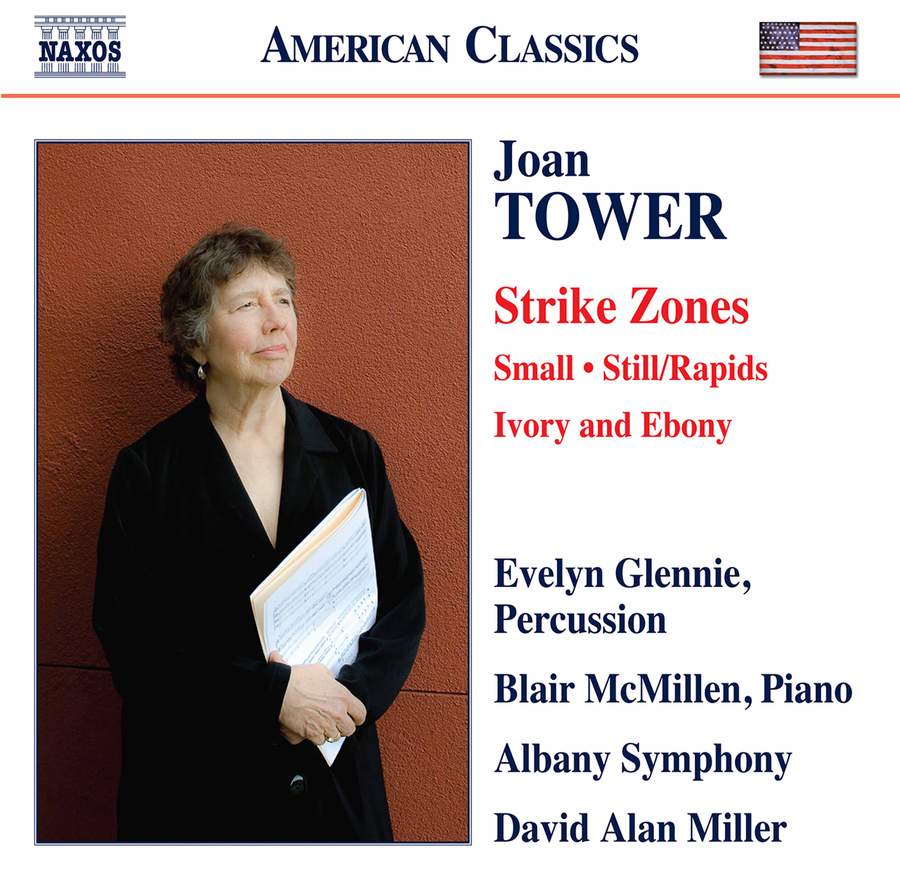
This year’s incarnation is ‘Celebrating Women In Music’, and there are two I would like to celebrate on this particular album, released by Naxos earlier this year. Percussionist Dame Evelyn Glennie will not need much introduction, for she is probably a familiar figure to you – but I would like to add to that the name of American composer Joan Tower.

Born in 1938, Tower has recently come to greater prominence thanks to the release of some excellent new recordings on the Naxos label. The latest is headed by Strike Zones, a concerto written for Glennie.

To quote from Tower’s program note: “Most percussion instruments are struck (hence the word ‘strike’ in the title) and I decided to have the percussion placed across the front of the stage with the soloist moving from one ‘zone’ to another – starting with the more fragile vibraphone and ending with a tour de force of drums. The other ‘zones’ include a marimba solo, a cymbal/hi-hat group, an ensemble of smaller/softer instruments (like the maraca, piccolo woodblock, castanet), a xylophone solo, and a trio with two other players placed in the hall echoing/‘reverberating’ the glockenspiel (with crotales) and the castanets (with more castanets)”

It is a piece of high drama, a composition with some compelling arguments and fascinating textures, best experienced on a big audio system or headphones.

Strike Zones is complemented by Still/Rapids, another substantial work for piano and orchestra. Rapids was a repeat commission from pianist Ursula Oppens, and is a fast-paced work – to which Tower has added the slow introduction Still. The two sections make a piece that proves every bit as dramatic as Strike Zones, with the unmistakable feeling of the American outdoors.

Meanwhile Small, also written for Dame Evelyn Glennie, is written for tiny percussion instruments – a rather lovely contrast to Strike Zones. Completing the album is Ivory and Ebony, which, as you might have guessed, is a piece for piano, commissioned by the San Antonio International Piano Competition.

I would urge you to have a listen, as Joan Tower’s music is both approachable and powerful. Hers is a distinctive musical voice well worth getting to know.

Live review – Kensington SO / Russell Keable: William Schuman 3rd Symphony, Adams, Bernstein & Tower

Kensington Symphony OrchestraRussell Keable (above)

St. John’s, Smith Square, London. Monday October 15, 2018

Tower Fanfare for the Uncommon Woman No. 1 (1986)
Bernstein Divertimento (1980)
Adams Doctor Atomic Symphony (2007, rev 2008)
Schuman Symphony No. 3 (1941)

Written by Richard Whitehouse

The Kensington Symphony Orchestra‘s 63rd season got off to a most impressive start with tonight’s concert of American music (simultaneously continuing the Americana ’18 festival taking place at St John’s during this year), opening with the Fanfare for the Common Woman with which Joan Tower launched her wider reputation over three decades ago. Rhythmically bracing while not without harmonic subtlety, it provided a fitting showcase for the KSO brass and percussion as well as a pertinent tribute to this composer in the year of her 70th birthday.

Leonard Bernstein‘s centenary was marked with his Divertimento, seven succinct movements that touch upon most of his salient traits and a reminder that his latter-day creativity was one where less equals more. Highlights include a delectable Waltz (enjoying frequent exposure on Classic FM), wistful Mazurka, evocative Blues then a rousing March: The BSO Forever whose Johann Strauss take-off duly makes for an uproarious close. Suffice to add the KSO was not found wanting in a piece written for the Boston Symphony’s own 100th birthday.

As Russell Keable‘s opening remarks made plain, John Adams’s Doctor Atomic Symphony was an altogether more serious proposition. First heard at the 2007 Proms, the rather diffuse 45-minute work in four movements was duly streamlined into a continuous structure lasting barely half an hour. Surprising, then, that the result seems less than cohesive – its reworking of material from the composer’s third opera one of cinematic contrast than symphonic unity. Some of his most virtuoso orchestral writing, which the KSO tackled with relish, is hampered by the recourse to post-minimalist gestures that remain Adams’s (unwitting?) stock-in-trade. Even the final section, a setting of John Donne‘s sonnet Batter my heart with its baritone part taken by trumpet (here the mellifluous Stephen Willcox), felt less than truly affecting.

After the interval, a welcome revival (likely the first in London for two decades) for William Schuman‘s Third Symphony. One of a triumvirate of such pieces by American composers to emerge either side of the Second World War, it evinces a formal integration and expressive panache that its composer never surpassed – not least in the way its four movements are arranged in two larger parts such as complement each other unerringly, and with a steadily accumulating momentum which emerges across the whole in what is itself a marvel of tensile dynamism.

Keable delineated the variations of the initial Passacaglia with assurance, ensuring textural clarity here and in the ensuing Fugue while underlining how the numerous woodwind and brass solos emerge naturally from the string polyphony rather than sounding laminated onto it. Nor was there any lack of emotional poise with the Chorale, its understated eloquence in contrast to the inexorably mounting impetus of the closing Toccata whose final pages are as visceral as any in the symphonic literature – not least when rendered with such verve as here.

A memorable reading of a seminal though under-appreciated piece such as the KSO has long championed. Hopefully future seasons will see revivals of comparable American works – the Second Symphony of Roger Sessions and Seventh (Variation) Symphony of Peter Mennin.

For further information on the Kensington Symphony Orchestra you can visit the orchestra’s website