
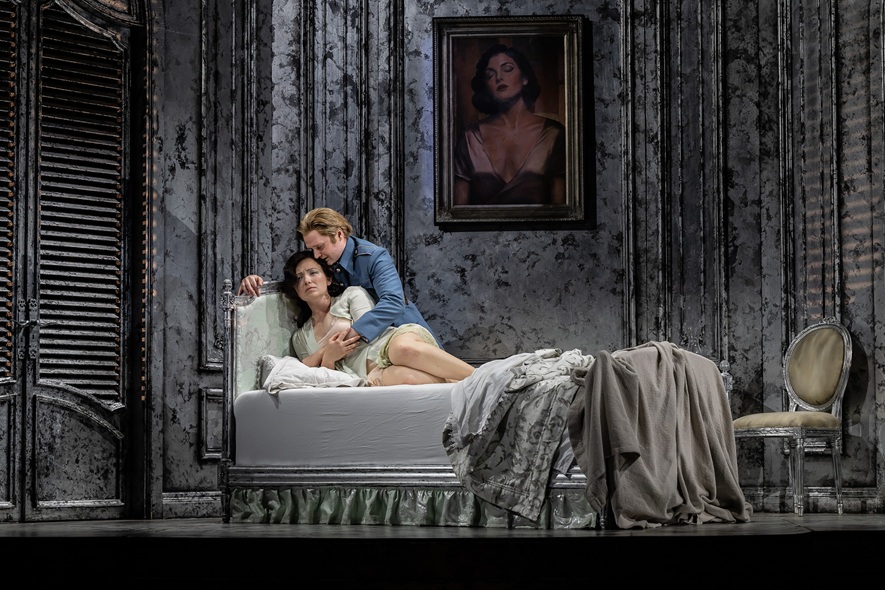
© Copyright Clive Barda 2026
Violetta Valéry – Madison Leonard (soprano); Alfredo Germont – Oleksiy Palchykov (tenor); Giorgio Germont – Roland Wood (baritone); Gastone de Letorières – Sam Harris (tenor); Baron Douphol – Chuma Sijeqa (baritone); Doctor Grenvil – Henry Waddington (bass baritone); Annina – Mathilda Bryngelsson (mezzo-soprano); Flora Bervoix – Alexandria Moon (mezzo-soprano); Marchese d’Obigny – Sam Young (baritone); Giuseppe – Matthew Sotillo-Cooke (tenor); Messenger – Peter Lidbetter (bass); Flora’s Servant – Sisa Mjekula (baritone)
Garsington Opera Chorus, Philharmonia Orchestra / Douglas Boyd
Director Louisa Muller; Designer Christopher Oram; Lighting Designer Marcus Doshi; Movement Director Matthew Steffens
Reviewed by Tom Hardwick
Garsington Opera started its 2026 season with a punchy, classy La Traviata, its first production of a reliable standby of the repertoire. Giuseppe Verdi’s adaptation of Alexandre Dumas Fils’s 1852 play La Dame aux camélias narrates the relationship between tubercular courtesan Violetta Valéry and Alfredo Germont, doomed by his father’s insistence that she break off the affair so his daughter can make a respectable marriage. Will Violetta and Alfredo be allowed to reconcile before she breathes her last?
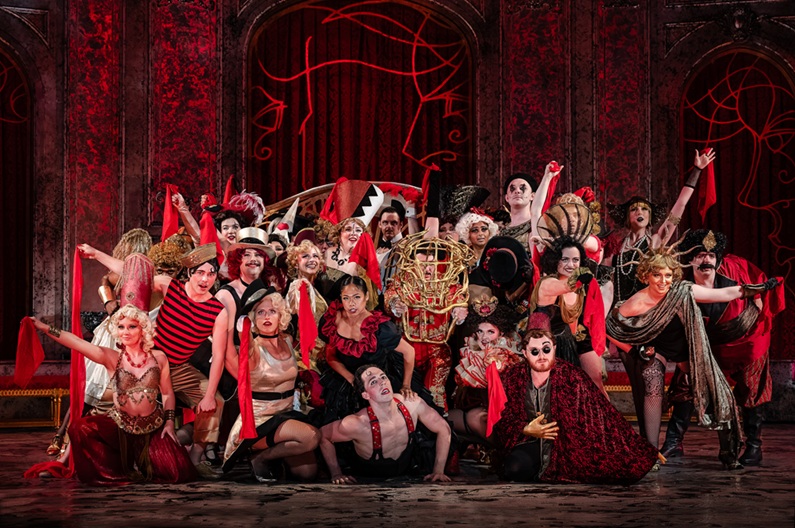
Before the opera’s 1853 première at La Fenice, objections from the Venetian censor’s office obliged Verdi to set Dumas’s contemporary story around 1700. In Louisa Muller’s production, which premiered at Santa Fe in 2024, the setting was updated to Paris in the late 1930s. Germont père’s unyielding morality is still believable rather than anachronistic, while Muller and designer Christopher Oram could indulge in an inter-war baroque silver leaf revolving set, chrome-plated accoutrements, and stylish costumes and wigs. In Act 2’s vaguely de Lempicka / Cocteau-inspired fancy dress ball, the well-disciplined Garsington chorus made brisk work of Verdi’s party goers posing as Gipsy fortune-tellers and matadors (spirited dancers Nikki Cheung and Jonathan Milton), before they synchronised to pass comment on Alfredo’s denunciation of Violetta. Smaller roles were well cast in a strong ensemble, particularly Mathilda Bryngelsson as Annina and Alexandria Moon as Flora.
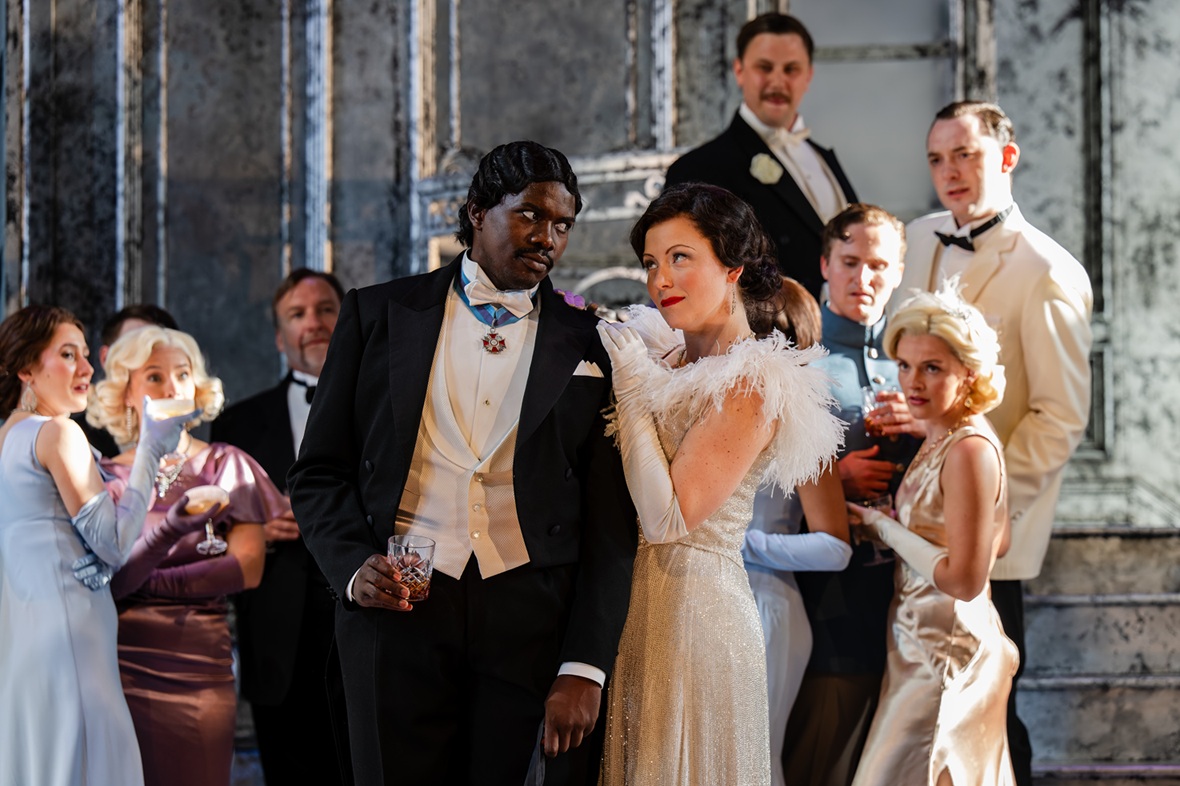
Violetta and Alfredo’s love happens largely offstage. Their relationship is defined by anticipation and by its dissolution. In act one Violetta dreams of love with Alfredo before dismissing it as a fantasy and resolving to live for pleasure. Act two sees Germont père, a remorseless humbug carefully sung by Roland Wood, dapper and imposing in military uniform (was this really necessary?), browbeat Violetta into submission. Oleksiy Palchykov and Madison Leonard, as Alfredo and Violetta, had sung the (happier fated) lovers in Garsington’s L’elisir d’amore last year, and made an attractive couple with plausible chemistry. Palchykov was an eager and enthusiastic Alfredo with an easy-going, fluid line and great diction. However American soprano Leonard, who was a stand-out Sophie in Garsington’s 2021 Rosenkavalier, gave the performance of the night. Her Violetta was assertive, strong, and angry rather than the usual wet tart with a heart: a powerful view of the role. As twilight deepened outside the see-through wings of the theatre at Wormsley, Violetta did not go gentle into that good night.
Douglas Boyd conducted the Philharmonia Orchestra through the score at almost breakneck pace without sacrificing detail. There’s always something rather jarring about the country house opera principle of confronting extremely well-dined opera goers with tragedy, but the company left the audience enraptured. Do what you can to get a ticket.
La Traviata runs until 24 July 2026 – and you can find more information on the production and explore ticket options at the Garsington Opera website
Published post no.2,904 – Monday 1 June 2026

