Violetta Valéry – Madison Leonard (soprano); Alfredo Germont – Oleksiy Palchykov (tenor); Giorgio Germont – Roland Wood (baritone); Gastone de Letorières – Sam Harris (tenor); Baron Douphol – Chuma Sijeqa (baritone); Doctor Grenvil – Henry Waddington (bass baritone); Annina – Mathilda Bryngelsson (mezzo-soprano); Flora Bervoix – Alexandria Moon (mezzo-soprano); Marchese d’Obigny – Sam Young (baritone); Giuseppe – Matthew Sotillo-Cooke (tenor); Messenger – Peter Lidbetter (bass); Flora’s Servant – Sisa Mjekula (baritone)
Garsington Opera Chorus, Philharmonia Orchestra / Douglas Boyd
Director Louisa Muller; Designer Christopher Oram; Lighting Designer Marcus Doshi; Movement Director Matthew Steffens
Garsington Opera, Wormsley Sunday 31 May 2026
Reviewed by Richard Whitehouse
Among Verdi’s most often revived works, despite a somewhat fraught premiere at La Fenice, La traviata has long since became a victim of that familiarity breeding contempt. From which vantage this production, itself a first for Garsington Opera, affords something of a corrective.
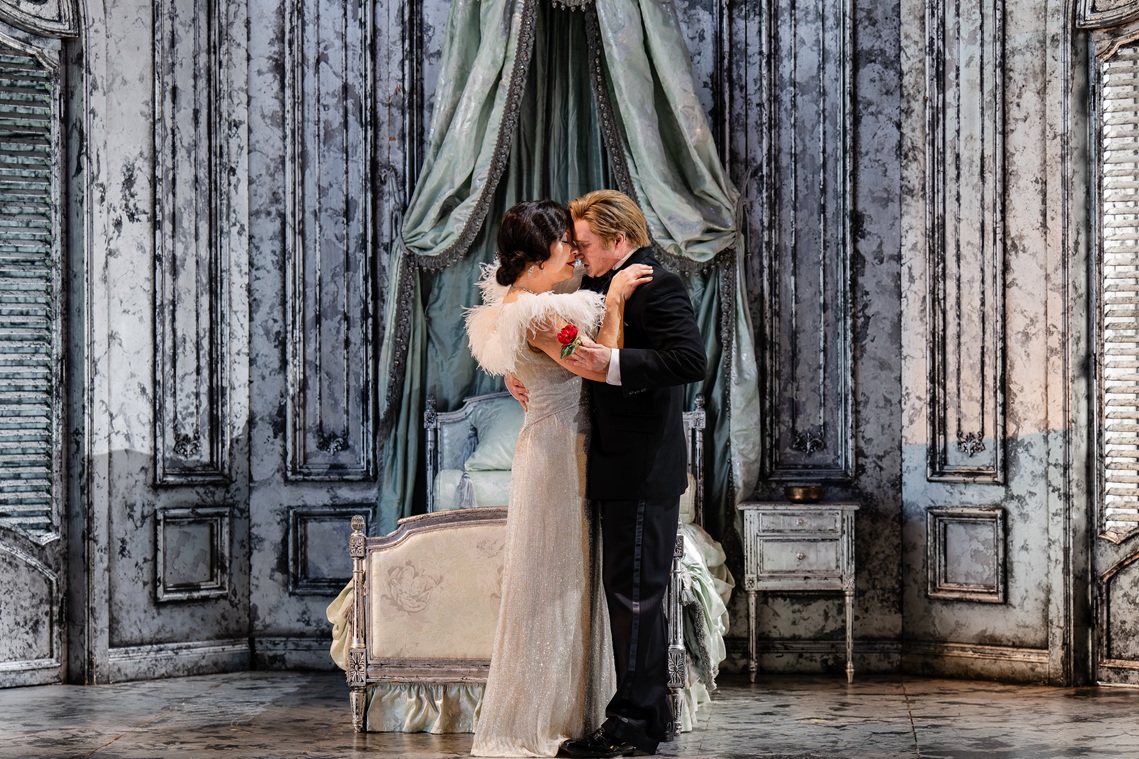
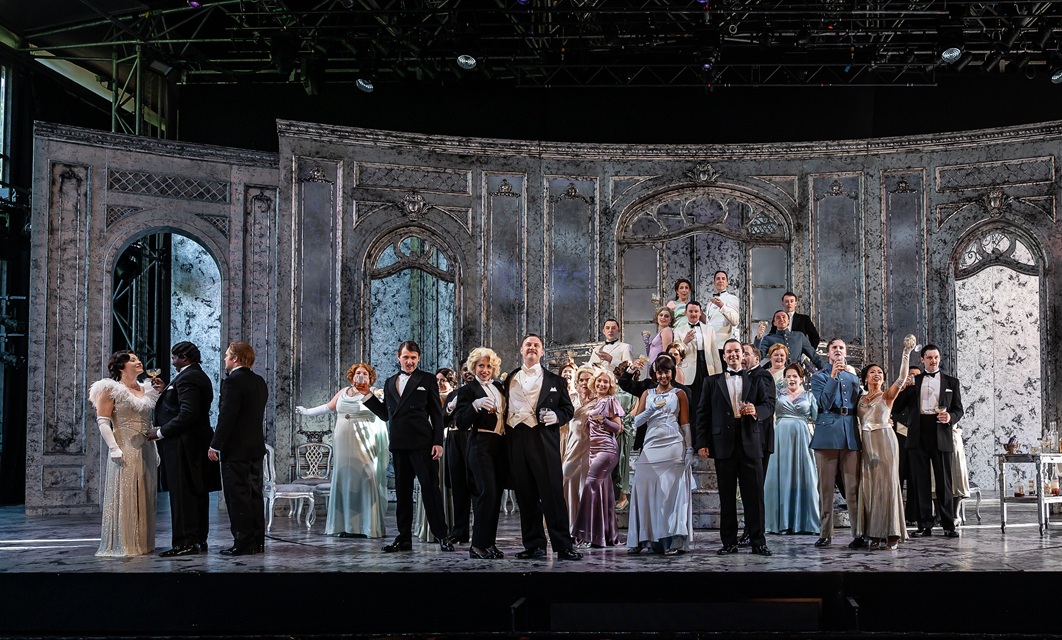
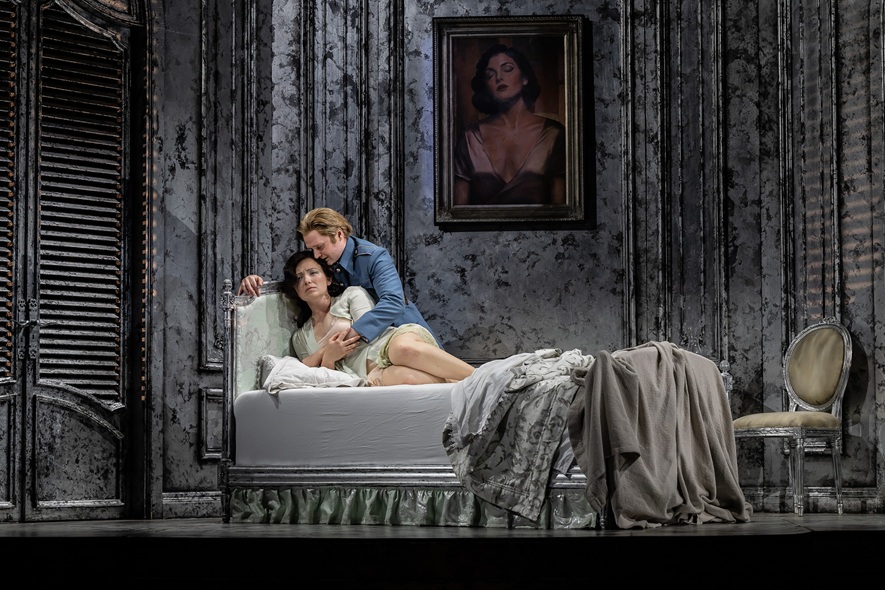
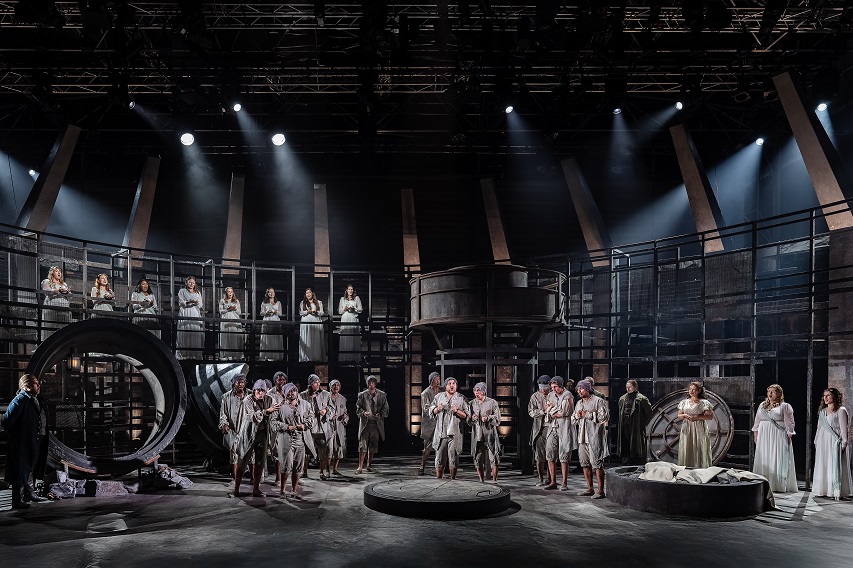
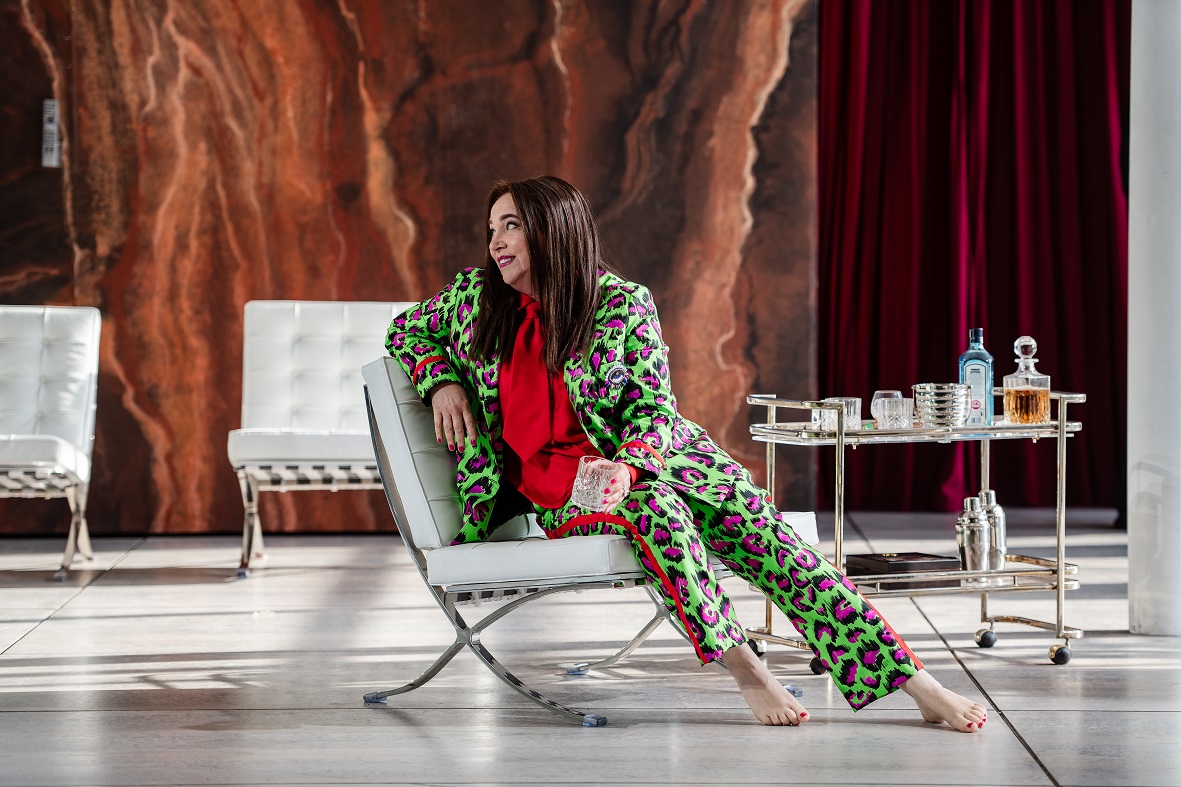
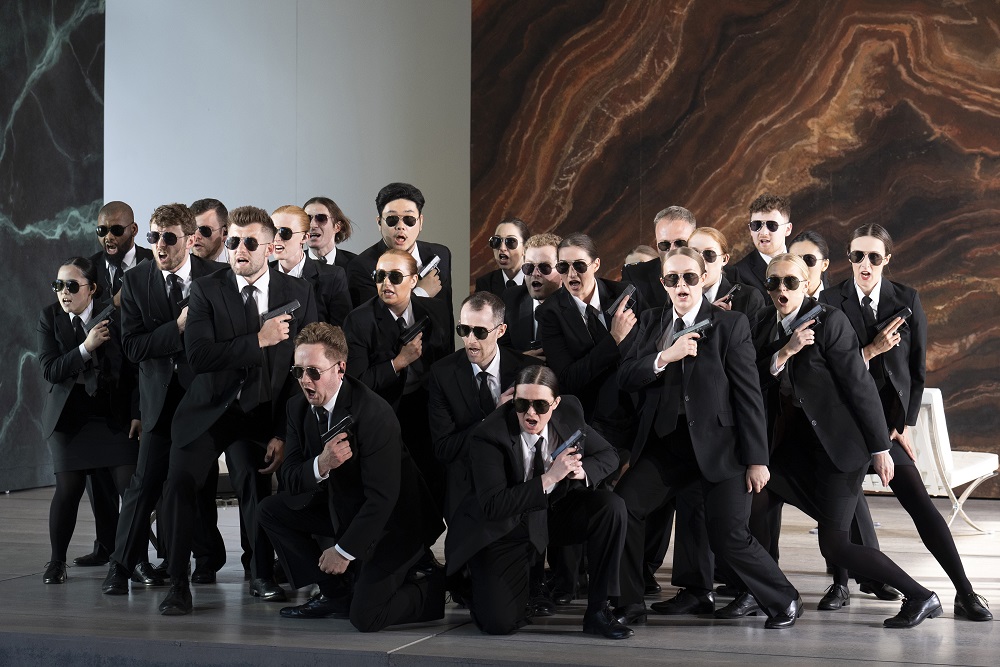
First unveiled at Santa Fe Opera two years ago, Louisa Muller’s staging provides a welcome abstraction – blurring the sense of any specific time or place without sacrificing that dramatic realism Verdi was intent on conveying in his handling of Piave’s skilful libretto. What comes over most readily is the interplay of outward (public) show and inward (private) confessional – abetted by Christopher Oram’s arresting and deftly rotating sets, along with Marcus Doshi’s alternately garish or spectral lighting and Matthew Steffens’s fluid yet alluring choreography.
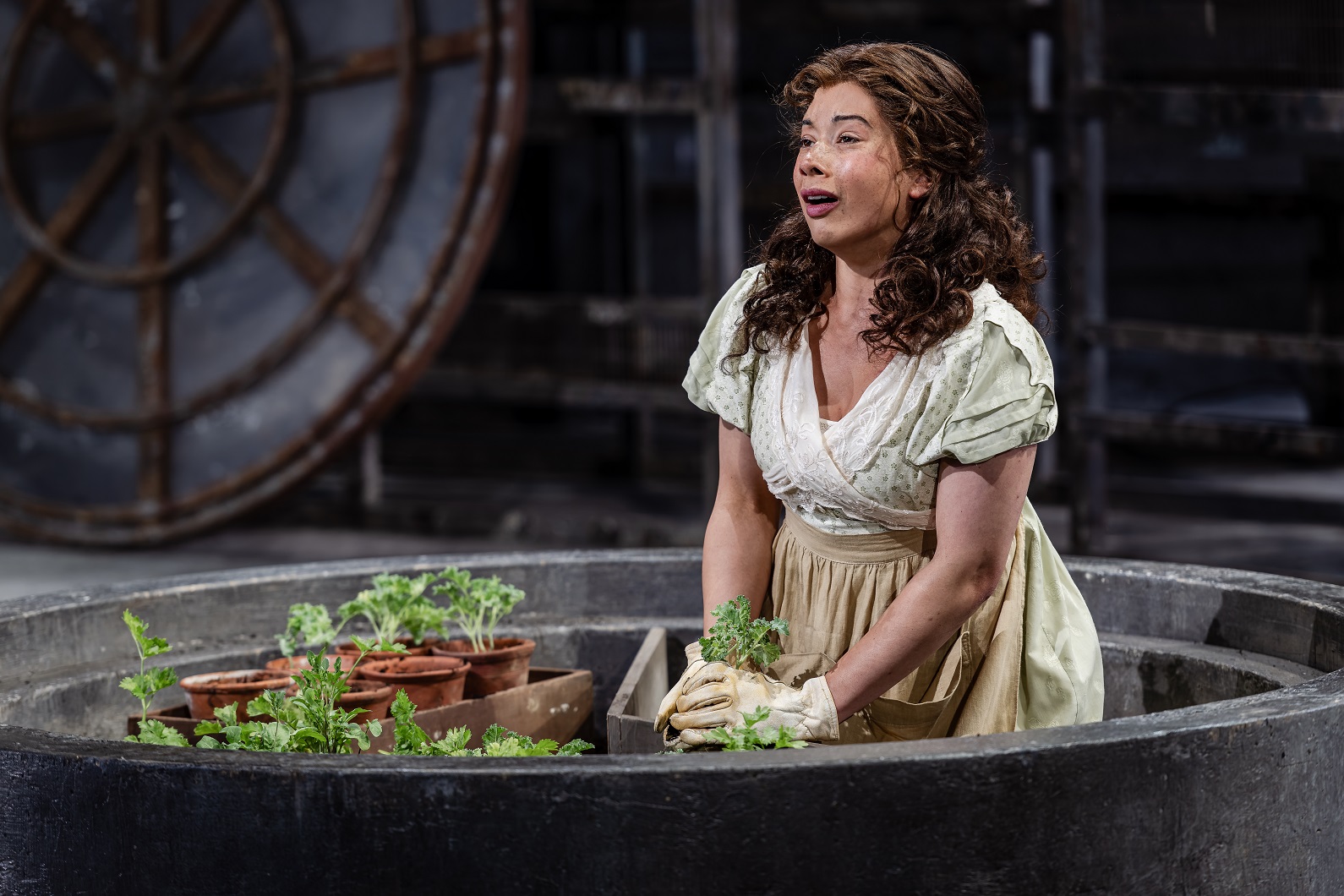
Cast-wise the evening is dominated by Madison Leonard’s Violetta, a victim of circumstance too capricious to warrant respect if never too obstinate to seem other than empathetic. Caught between the dictates of her own desires and those of a society intent on having a piece of her, she presides over or propels the action even at her most vulnerable and has the vocal presence to match. Hardly her equal emotionally, Oleksy Palchykov is a steadfast Alfredo as out of his depth in this social milieu as in affairs of the heart, while always believable in his protestation of love as to override those admittedly selfish warnings from his father. To which end Roland Wood is a forthright but never unyielding Germont, drawn unwillingly yet inevitably into that ‘love triangle’ such as makes this opera far more social commentary than escapist indulgence.
Smaller roles are unobtrusively well taken, among them Mathilda Bryngelsson’s supportive if uncomplaining Annina and Henry Waddington’s brooding yet compassionate Doctor. Chuma Sijeqa brings panache to the otherwise vacuous Douphol, with Alexandria Moon’s Flora and Sam Harris’ Gastone pertinent cameos both as confidants of Violetta or Alfredo respectively, and Sam Young not a little amusing as Flora’s lover d’Obigny. Neither can Garsington Opera Chorus be faulted for its contributions which, in themselves, mark something of a departure for Verdi by eschewing the brazenness of his earlier ‘crowd scenes’ for something altogether subtler and more insinuating. Verdi might not have drawn attention to the psychology of his situations as did Wagner, but this does not make his approach any less probing or insightful.
Douglas Boyd steers a confident and assured course across an opera which can all too easily become episodic whatever its relative concision. He is no less mindful of a need to underline the restraint in orchestral writing that finds Verdi exploring more equivocal and ambivalent shades of expression; not least the fateful preludes to the first and third acts which, between them, encapsulate this drama’s emotional as surely as its motivic essence. Suffice to add that the Philharmonia renders the score with a finesse not always to be expected in the opera-pit.
A finesse, moreover, maintained throughout a final scene whose gradual evanescence makes the implacability of its closing chords the more startling. They undoubtedly set the seal on a production which, taken overall, restores to this opera an integrity it should always have had.
La Traviata runs until 24 July 2026 – with performances on 13, 20, 24 & 28 June, then 9, 11, 16, 20 & 24 July. You can find more information on the production and explore ticket options at the Garsington Opera website
Violetta Valéry – Madison Leonard (soprano); Alfredo Germont – Oleksiy Palchykov (tenor); Giorgio Germont – Roland Wood (baritone); Gastone de Letorières – Sam Harris (tenor); Baron Douphol – Chuma Sijeqa (baritone); Doctor Grenvil – Henry Waddington (bass baritone); Annina – Mathilda Bryngelsson (mezzo-soprano); Flora Bervoix – Alexandria Moon (mezzo-soprano); Marchese d’Obigny – Sam Young (baritone); Giuseppe – Matthew Sotillo-Cooke (tenor); Messenger – Peter Lidbetter (bass); Flora’s Servant – Sisa Mjekula (baritone)
Garsington Opera Chorus, Philharmonia Orchestra / Douglas Boyd
Director Louisa Muller; Designer Christopher Oram; Lighting Designer Marcus Doshi; Movement Director Matthew Steffens
Reviewed by Tom Hardwick
Garsington Opera started its 2026 season with a punchy, classy La Traviata, its first production of a reliable standby of the repertoire. Giuseppe Verdi’s adaptation of Alexandre Dumas Fils’s 1852 play La Dame aux camélias narrates the relationship between tubercular courtesan Violetta Valéry and Alfredo Germont, doomed by his father’s insistence that she break off the affair so his daughter can make a respectable marriage. Will Violetta and Alfredo be allowed to reconcile before she breathes her last?
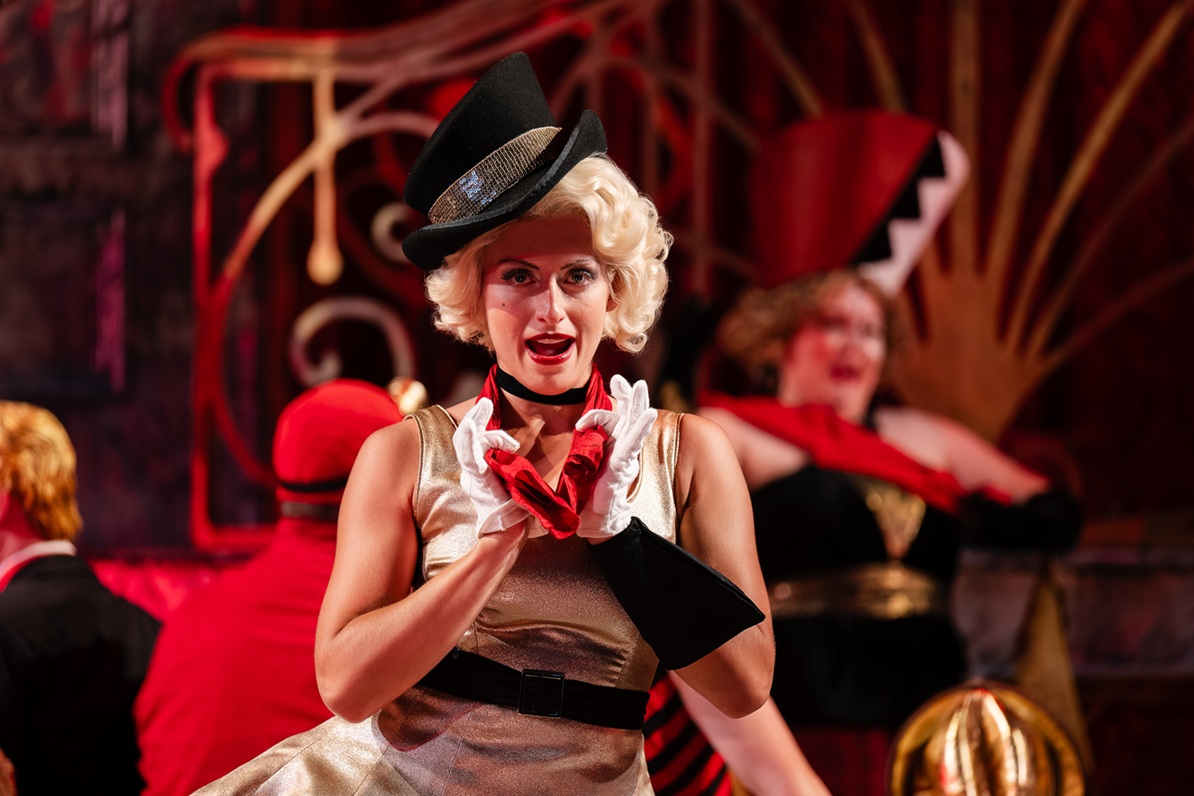
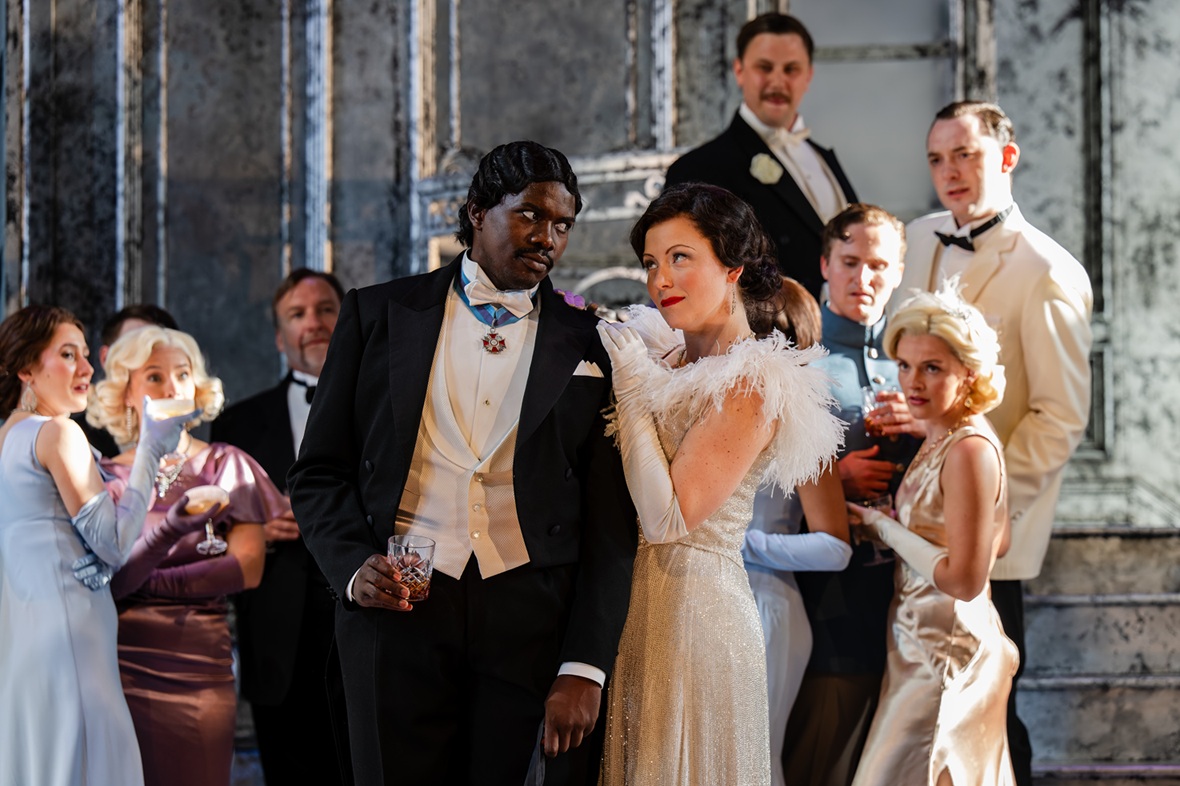
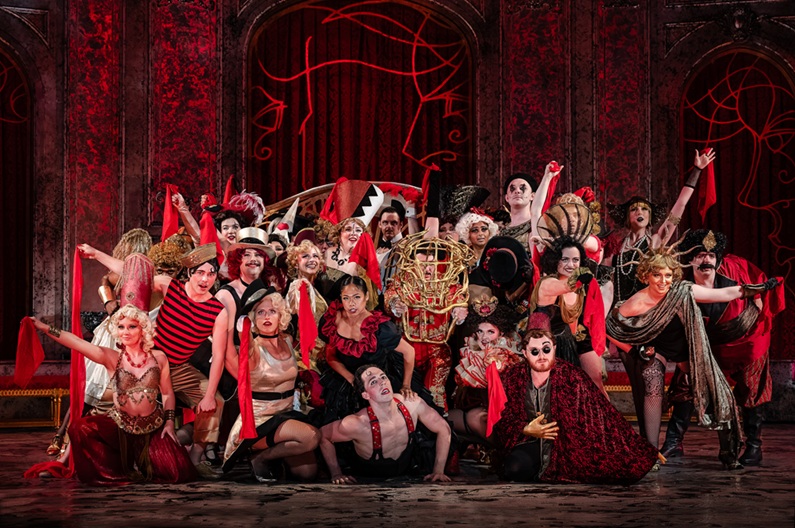
Before the opera’s 1853 première at La Fenice, objections from the Venetian censor’s office obliged Verdi to set Dumas’s contemporary story around 1700. In Louisa Muller’s production, which premiered at Santa Fe in 2024, the setting was updated to Paris in the late 1930s. Germont père’s unyielding morality is still believable rather than anachronistic, while Muller and designer Christopher Oram could indulge in an inter-war baroque silver leaf revolving set, chrome-plated accoutrements, and stylish costumes and wigs. In Act 2’s vaguely de Lempicka / Cocteau-inspired fancy dress ball, the well-disciplined Garsington chorus made brisk work of Verdi’s party goers posing as Gipsy fortune-tellers and matadors (spirited dancers Nikki Cheung and Jonathan Milton), before they synchronised to pass comment on Alfredo’s denunciation of Violetta. Smaller roles were well cast in a strong ensemble, particularly Mathilda Bryngelsson as Annina and Alexandria Moon as Flora.
Violetta and Alfredo’s love happens largely offstage. Their relationship is defined by anticipation and by its dissolution. In act one Violetta dreams of love with Alfredo before dismissing it as a fantasy and resolving to live for pleasure. Act two sees Germont père, a remorseless humbug carefully sung by Roland Wood, dapper and imposing in military uniform (was this really necessary?), browbeat Violetta into submission. Oleksiy Palchykov and Madison Leonard, as Alfredo and Violetta, had sung the (happier fated) lovers in Garsington’s L’elisir d’amore last year, and made an attractive couple with plausible chemistry. Palchykov was an eager and enthusiastic Alfredo with an easy-going, fluid line and great diction. However American soprano Leonard, who was a stand-out Sophie in Garsington’s 2021 Rosenkavalier, gave the performance of the night. Her Violetta was assertive, strong, and angry rather than the usual wet tart with a heart: a powerful view of the role. As twilight deepened outside the see-through wings of the theatre at Wormsley, Violetta did not go gentle into that good night.
Douglas Boyd conducted the Philharmonia Orchestra through the score at almost breakneck pace without sacrificing detail. There’s always something rather jarring about the country house opera principle of confronting extremely well-dined opera goers with tragedy, but the company left the audience enraptured. Do what you can to get a ticket.
La Traviata runs until 24 July 2026 – and you can find more information on the production and explore ticket options at the Garsington Opera website
Music by Ludwig van Beethoven Libretto by Joseph Sonnleithner and Georg Friedrich Treitschke, after Jean-Nicolas Bouilly Sung in German with English surtitles
Leonore, disguised as Fidelio – Sally Matthews (soprano), Florestan, her imprisoned husband – Robert Murray (tenor), Don Pizzarro, prison governor – Musa Ngqungwana (bass-baritone), Rocco, gaoler – Jonathan Lemalu (bass-baritone), Marzelline, his daughter – Isabelle Peters (soprano), Jacquino, prison warder – Oliver Johnston (tenor), Don Fernando, king’s minister – Richard Burkhard (baritone), First Prisoner – Alfred Mitchell (tenor), Second Prisoner – Wonsick Oh (bass)
John Cox (original director), Jamie Manton (revival director), Gary McCann (designer), Ben Pickersgill (lighting)
Garsington Opera Chorus, The English Concert / Douglas Boyd
Garsington Opera, Wormsley Friday 27 June 2025
review by Richard Whitehouse Photos by (c) Julian Guidera
Few operas have been subject to matters of time and place as has Fidelio. Beethoven’s sole opera, by his own admission, caused him the greatest difficulty among all his works to ‘get right’ and, even today, it can all too easily emerge as a compromise between what had been intended and what (conceptually at least) was feasible. All credit, then, to Garsington Opera for this revival which not only avoided the likely pitfalls first time around but has improved with age – in short, a production that amply conveys the essence of this flawed masterpiece.
That original staging had been directed by John Cox, whose productions are rarely less than durable and with such as his 1973 Capriccio or his 1975 The Rake’s Progress being close to definitive. For this second revival, Jamie Manton has streamlined the basic concept such that everything which takes place can be envisaged from the outset and hence ensures consistency across the production as a whole. He is abetted by Gary McCann’s designs, their monochrome stylings imparting a grim uniformity which could not be more fitting given that this drama is played out around and inside a prison. In particular, the hole front-of-stage from out of which the prisoners emerge and into which Florestan is to be committed is a device made elemental merely by its presence, while the final scene avoids the agitprop from an earlier era in favour of a straightforward tying-up of narrative loose-ends the more affecting for its understatement. Effective without being intrusive, Ben Pickersgill’s lighting enhances the changing moods of an opera which takes in domestic comedy and visceral drama prior to its heroic denouement.
Vocally the opening night was a little uneven without there any real disappointments. If Sally Matthews initially sounded a little inhibited in the title-role, this most probably reflected its ambivalent nature rather than any lack of expressive focus; certainly, her commitment in the ‘Abscheulicher…Komm Hoffnung’ aria such as defines her emotional persona was absolute, as was her seizing hold of that climactic quartet to which the entire drama has been heading. Sounding as well as looking his part, Robert Murray avoided the rhetorical overkill that too often mars portrayals of Florestan – his mingled vulnerability and fatalism maintained right through to the duet ‘O namenlose Freude’ whose eliding of elation and doubt intensified its emotive force whatever its actual length, though without pre-empting what is still to come.
As Don Pizarro, Musa Ngqungwana was imposing in presence and thoughtful in approach – his lack of histrionics preferable in a role which too often descends into caricature. That said, he was upstaged in their duet ‘Jetzt, Alter, jetzt hat es Eile!’ by Jonathan Lemalu who was in his element as Rocco; materialist aspiration outweighed by the humanity invested into a role where comedy rapidly gives way to pathos. Marzelline and Jaquino may have but little to do after the first scene, but Isabelle Peters was eloquence itself in her aria ‘O war ich schon mit dir vereint’ while Oliver Johnston veered engagingly between eagerness and consternation. Richard Burkhard made for an authoritative if never portentous Don Fernando, while Alfred Mitchell and Wonsick Oh afforded touching cameos during a memorable ‘Prisoners’ chorus’.
Nor was the Garsington Opera Chorus to be found wanting as a whole in its contribution to the finales of each act – the first as moving in its pallor, infused with radiance, as the second was in the unfettered joyousness which offset any risk of that final scene becoming merely a celebratory tableau. The English Concert sounded rarely less then characterful, even though humid conditions likely explained some occasionally approximate intonation – happily not in Rachel Chaplin’s scintillating oboe obligato which shadows Florestan’s aria ‘In des Lebens Frühlingstagen’ as if an extension of his character. Douglas Boyd directed with assurance an opera with which he has long been familiar, his tempos unexceptionally right and always at the service of the opera. The author Michael Oliver was surely correct in his observation that the Leonore original is superior in theatrical terms to the Fidelio revision, yet this latter was nothing if not cohesive through Boyd’s astute dovetailing of individual numbers, as between speech and music, so that any seeming discontinuities were made more apparent than real.
Some 211 years after the successful launch of its final version and Fidelio remains an opera acutely sensitive to political context and polemical intent. Beethoven himself was, of course, partly responsible for this but subsequent generations have sought, often recklessly, to foist their own preoccupations onto his music so as to distort or even negate its essence. There was no risk of that happening here thanks to the balanced objectivity of this production but also to its conviction that the composer’s guiding vision is, and always will be, its own justification.
Fidelio runs until 22 July 2025 – and for further information and performances, visit the Garsington Opera website
Melodramma giocoso in Two Acts – music by Giuseppe Verdi; Libretto by Felice Romani (revised by the composer)
Sung in Italian with English surtitles
Il Cavaliere di Belfiore – Joshua Hopkins (baritone), Il Barone di Kelbar – Henry Waddington (bass-baritone), La Marchesa del Poggio – Christine Rice (mezzo-soprano), Giulietta di Kelbar – Maddison Leonard (soprano), Edoardo di Sanval – Oliver Sewell (tenor), La Rocca – Grant Doyle (baritone), Il Conte Ivrea – Robert Murray (tenor), Delmonte – James Micklethwaite (tenor), Servant – Daniel Vening (bass)
Christopher Alden (director), Charles Edwards (sets), Sue Willmington (costumes), Ben Pickersgill (lighting), Illuminos (Matt and Rob Vale) (video), Tim Claydon (choreographer)
Garsington Opera Chorus, Philharmonia Orchestra / Chris Hopkins
Garsington Opera, Wormsley Monday 1 July 2024
review by Richard Whitehouse Photos by (c) Julian Guidera and Richard Hubert Smith (as marked)
Garsington Opera has a laudable track-record in presenting rarities or supposed ‘also-rans’ to best advantage, with this new production of Un giorno di regno no exception. Verdi’s second opera fell flat on its premiere at La Scala in September 1840, though the death of his wife and both of his children over the previous two years meant his heart was simply not in the writing of a comic opera: one of several extenuating circumstances that included a dearth of suitable singers for the main roles plus the demonstrably backward-looking nature of the work itself.
All credit to Christopher Alden for creating a production which, whatever its modishness of appearance, is rarely less then relevant and always entertaining. Verdi’s hurried refashioning of a 22-year-old libretto – concerning real-life impersonation of King Stanislaus prior to his briefly regaining the Polish crown in 1733 – was never likely to thrill the Milanese audience, but it does provide a lively context for this sequence of increasingly inane goings-on such as respond well to being situated in an authoritarian state swamped by ‘fake news’ and political one-upmanship. Just occasionally the deluge of video imagery threatens to overwhelm what is being enacted on stage but, overall, what can seem a needlessly involved and diffuse plot is, if not simplified, thrown into sharper focus so as to maintain the interest of those present.
In so doing, Alden is abetted by the faux-stylishness of Charles Edwards’s sets and the no less eye-catching costumes of Sue Willmington – their combined effect enhanced by the dextrous lighting of Ben Pickersgill and a video component from the Illuminos duo that adds greatly to the effect of immersive decadence. Nor is the choreography of Tim Claydon found wanting in its physicality and convincing use of all available stage-space, not least those gangways in the auditorium that function briefly if vividly as its extension for certain highpoints of the action.
Madison Leonard in Un giorno di regno Garsington Opera
opens Garsington 29.06.24
photo credit: Richard Hubert Smith
An opera production is arguably only as good as its singers, and the present cast could hardly be bettered. As the false king Belfiore, Joshua Hopkins brings style and suavity to a role that could easily become insipid – and with his ‘Freddie Mercury’ cameo carried off to perfection. Teasing out the cowardliness behind his thuggery, Henry Waddington is ideally cast as Kelbar and Grant Doyle hardly less so as the scheming La Rocca – his ‘sparring partner’ made literal during their uproarious breakfast confrontation. Oliver Sewell overcame initial unsteadiness to deliver an Edoardo of resolve and eloquence, with Robert Murray the stealthily insinuating Ivrea. Neither female role leaves anything to be desired – Madison Leonard vulnerable for all her minx-like persona; Christine Rice stealing the show as the Marchesa whose solo spots are the opera’s likely highlights. James Micklethwaite and Daniel Vening both acquit themselves ably, while Garsington Opera Chorus evidently enjoys its collective function as those ‘people in black’ who variously comment on the action then intervene often forcibly when necessary.
Stepping in at the eleventh hour (for an indisposed Tobias Ringborg), Chris Hopkins directed with verve and real sense of musical continuity – not least when Verdi (seemingly for the only time in his career) made recourse to ‘recitativo secco’ which here furthers the action without impeding its progress. Otherwise, the Philharmonia Orchestra despatches with relish a score which, for all that this lacks the sophistication and urbanity of Rossini’s or Donizetti’s mature comedies, crackles with energy along with an engaging personality for which it has not yet had its due.
Members of the Garsington Opera chorus in Un giorno di regno – opens Garsington 29.06.24
photo credit: Richard Hubert Smith
Although a lesser opera in the Verdi canon, Un giorno di regno met with modest success even in his lifetime and its later revivals were well received. Thanks to this Garsington production, his ‘King for a Day’ finds itself more than able to enjoy a timely 15 minutes in the spotlight.
The conductor talks to Ben Hogwood about his forthcoming debut at Garsington Opera, where he will conduct Rameau‘s Platée – a work in which he has also sung the title role. Agnew talks about Rameau but also Handel, considering why now is a good time for British audiences to embrace the music of the French Baroque.
On a dark, dank winter’s day there is something incredibly heartening in having a discussion about the prospect of a summer opera season. Arcana has teamed up with conductor (and former tenor) Paul Agnew to do exactly that, and he is in optimistic mood. “It will arrive quickly, with the spring and the daffodils, and then we’ll find ourselves in Garsington!” he says. It will be his first visit to Wormsley Park, and to the festival. “I’m really looking forward to it. It’s one of those very original places, and it isn’t a dark theatre. It has windows, and so each production has to take into account that you’re going to have a part of that show in the light. I’ve never done that sort of thing, and the team is very nice. We had the model showing so we’ve seen the set, and the concepts, and it looks great. It will be a lot of fun, which it should be – but with that hint of tragedy, which is always lurking in Platée.”
He is talking about Rameau’s comic-tragic opera, which he will lead with a new team of soloists and The English Concert. It is the first excursion for Garsington into the world of French Baroque opera, but Agnew is returning to a piece he knows well. Indeed, he first encountered Platée as a singer. “I didn’t sing Platée – I sang Thespis in the Prologue. I was quite a young thing, and it was a production with the Opera de Paris. It’s a really hard role, extremely high – and obviously you go on at the top of the show. It’s a bit nervy. Then almost immediately I took on the role of Platée in that same production in Japan. That was released on DVD, which had a lot of success.”
He explains why. “Laurent Pelly did a genius job – and they found just the right balance in order that when we get to the end, where the audience have been cheerleading with the rest of the chorus and these horrible characters, and they find themselves in fact implicated in this terrible humiliation. I think he just found the right click. There was a gasp from the audience when they understood quite what a terrible thing this is. I wouldn’t want to exaggerate, but there is something political about it, and within the operas of Rameau – Les Indes galantes and certainly Les Boréades. They tend to have slightly monarchical reflections, and there’s a sense – if you know the film Ridicule – about how close you can get to the king but then you know you made a mistake, you didn’t use the right wig and so on, and you get sent straight back to the back of the queue. There’s a sense of that in Platée and the ridicule, as you would expect Jupiter – who essentially is Louis XIV – to be the hero. In fact, he’s the villain! It’s not exactly dangerous, but not politic either – Louis XV by then.”
Agnew has enjoyed a close affinity with Rameau throughout his career. “The very first thing I did in France, with William Christie and Les Arts Florissants, was record the Rameau Grands Motets. They’re relatively youthful pieces compared with the operas, which he didn’t start until he was about 50 years old. I love Les Grands Motets, partly because it’s surprising to find such incredibly sensual music for the church. They just seemed to suit my voice, and in fact it was one of the very first French Baroque things I did at all. You know you have those lucky things in in a long career where you ‘meet’ a music and you think, “Oh, my goodness, I’m really made for this!” I love the sentimentality of it, in the best sense of the term, I love the melody and I love the sensuality of the harmonies. That leads you through the line and tells you where you’re going constantly, so you can make the music into such a strong experience.”
Things moved quickly. “Almost immediately we started on the operas in the Opera de Paris, so we did Hippolyte et Aricie, then various roles in Les Indes galantes, and then we did Platée, which was with Marc Minkowski and Les Musiciens du Louvre. Then we did Les Boréades, the last opera, which was never staged in his lifetime – he was 80 when he wrote it. It’s amazing to think he lived to 80, but happily he did! It’s an astonishing journey, very much like Platée but in a much more heroic way – he’s a real prince. So I did all those operas, and I’ve sung others – Castor et Pollux for instance – in concert. I’ve done a lot of the ballets, too. I’m a big fan, as you would expect! It’s the most extreme the Baroque gets, even more complicated in some ways than Bach. He was an amazing technician, and he’s stating things relatively clearly, whereas there’s a complexity of emotions in Rameau which really predate going into Gluck and then early Mozart. He didn’t die until 1764, so Mozart has already composed his first piece before Rameau dies. There is a big influence on Gluck, and everything that he says about the reform operas is what Rameau has been trying to do for years.”
Performing the operas as both a singer and a conductor has given Agnew a unique perspective. “It’s very helpful”, he agrees, “for the singers too. I’m naturally a singer’s conductor, as I want them to be able to breathe and recover and so on, because that’s the best for us. I’m not going to push them into a tempo which they can’t do, so we want to find the right tempo for the singer. If you’re a singer you understand that more clearly. It’s a good place to have been, whatever the music – I’ve sung a lot of Handel and Purcell, and now I conduct a lot of Handel and Purcell too. Having sung Platée itself, it makes me smile and I’m not in the least bit jealous about being on stage. I wouldn’t want to sing it again or go through that experience. It’s a long evening, and you’re on stage a lot. There’s a lot to sing, it’s quite hard, and it’s quite physical because it’s a comedy. There’s a lot of running around, and jumping – if you’re a frog! – and I’m happy to leave that to other people. I still absolutely love the piece, and to have that long association is very useful.”
Visitors to Platée’s page on the Garsington Opera website are presented with the image of a flamingo and a beachball (above), an immediately appealing prospect in the depths of winter. “I think it’s going to be a lot of fun. I really like the way it’s being approached. We’re quite used to women playing men – that’s been around in Handel‘s Rinaldo, for instance, but the other way round is very much rarer. The only way in which the piece works is if she’s just a woman, you just get over it. I think Rameau’s idea was to define the strangeness to that person. It’s not about sexual politics, but not a woman as the gods would know – maybe asexual thing rather than being particularly transvestite or drag. I think we’re in the right direction in this production, where we just need to forget that the singer is a man, and just accept that this is a strange woman. She’s a nymph from the marshlands – we don’t know really what she is, a creature from the blue lagoon.”
It is the first time Agnew has encountered the work of director Louisa Miller and designer Christopher Oram. “I’m not sure they’ve done much Baroque before, so I wouldn’t have encountered them as that’s more or less my world. I like them very much. It’s not a very easy piece to approach dry – just to get your head around what Rameau could possibly be thinking about is quite hard. Right from the very first meetings we were clearly on the same page, and Louisa clearly knows the piece, which is very reassuring. As a singer you often get to the first rehearsal and find out the director doesn’t really know the piece very well, and you find yourself having to subtly guide the director through towards a good solution. That’s definitely not the case here! Chris’s designs are very good, it’s funny and relevant and they work throughout the piece. Sometimes at a first rehearsal you think, “This will work great in Act One, and Act Three, but Acts Two and Four will be a disaster because it just simply won’t work in this concept. This concept will work the whole way through, so I’m really encouraged. We’ve got a lovely cast, and also decided at the beginning we would take a cast where nobody had sung it before. Nobody arrives with preconceptions about how their role is, or how they would like to play it.”
There is a sense of great excitement that this is Garsington’s first foray into Rameau’s output. “Yes, and they’ve chosen well!” he says enthusiastically. “We’ve got a great band in the English Concert. I sang with them in my 20s, with Trevor Pinnock, and what an honour it is to direct them.” He expands on the repertoire at hand. “I’ve done French Baroque music with English bands before, and it is quite tricky. They’re technically such fantastic players, but it has a tricky accent, and you can’t get it just by reading the books. Again, it’s useful to be a singer in those situations because you can sing the sensuality of the line much more easily than you can describe it. I always end up singing quite a lot of rehearsals because it’s a visceral, physical reaction to what you hear, which makes it much easier. It will be a challenge for the band to get that accent right, but they’re eminently capable, and I’m massively looking forward to working with them.”
They are complemented by a strong team of soloists, who have equivalent challenges. “Equally, the singers are all English, so we need to get that right – and that’s not just question of pronunciation. There are all sorts of things about how the phrases are constructed, and how the ornamentation helps the grammar of the music. We will have time and we have a good cast, so that doesn’t worry me. You have to go quite deep into these pieces, especially doing this repertoire for the very first time in an opera house. It’s very rare to hear Rameau at all in the UK. I think Platée is the only piece that has been properly staged in the past, and that was a long time ago with the Royal Opera House. It’s very exciting, and there is a lot of interest from the public in French baroque music, so I look forward to that encounter! It is very complicated to put on, you need a ballet, an orchestra that knows their beans, and a cast willing to take risks with the ornamentation. It’s a courageous choice, but not an impossible one.”
Is the boundless supply of great music by Handel (below) in some ways to blame for the relative lack of French baroque music in the UK? Agnew smiles. “Handel’s an interesting one, because he would say, “You do get French Baroque – because if you look at the dances in Alcina, the overtures – you’re not missing out, I’ve written it myself!” In some ways, yes – but you could never say Handel’s at fault, because a house without Handel would be a disaster. You have to think as well that if Purcell had lived longer than the whole history of English music would have been very different. He died in 1695, and then they had a few abortive attempts to create English opera. Then there was an extraordinary moment where Handel arrives, and he creates this strange bastard form of Italian opera for English people, written by a German! You think it’s never going to work but he has this immense success, at least until the early 1740s.”
He goes into more detail behind Handel’s successful formula. “He is much more straightforward, he has the advantage – and I don’t mean to be disrespectful – that what you see on the page is what you get. Twenty to thirty years earlier, the ‘affect’ is everything. Once you start an aria you stay in that in that emotion until the end of the aria, and then a recitative will tell you what kind of emotion you’re going to go to in the next one. With Rameau it’s much, much more fluid than that, because things are changing very fast, and he goes towards complications where the likes of Pergolesi go towards simplicity. You get that break that comes around the time of French Revolution, a time of an immense social and cultural change. Handel is a chancer, isn’t he?! He’s in Italy, and then he knows that George of Hanover is going to be the next king of England, so he immediately goes up and gets a job in Hanover. The first thing the Hanoverians say is go to England, as a sort of spy-come-diplomat or equerry.”
The rest – as they say – is history, and Agnew relishes recounting the events. “And then, of course, George I turns up and it’s all set up for him to have this contact with the nobility, and the prestigious arrival of the king at his operas and so on. He’s bright, and gets it sorted right at the start! The other thing is he turns up in Italy, and produces these works that are effectively for the Catholic nobility and cardinals, and he is a straight, up and up Protestant Lutheran. And yet – business is business, you do what you want! He produces something for a public that don’t know anything about anything. Rameau can produce something much more technically difficult and also psychologically complex, because he’s simply joining the train. We’ve had Lully, Charpentier, Campra, and all the rest – and Handel arrives and takes all that on board, that melange between the original French style – which wasn’t French anyway, because Lully wasn’t French – and then he puts this new Italian virtuosity in. He’s joining this great movement, and dominates England completely!”
We move on from Agnew’s fascinating dissection of Handel and Rameau to talk about one of his mentors and accomplices, conductor William Christie (above). “He’s a theatre man, he wants to pick up the music and shake it and I love that. When you’re a singer, you absolutely want that because you don’t want someone saying, “Careful with the D sharp”, you want someone saying, “Come on, tell me the story!” I always much prefer those people – and John Eliot Gardiner as well – who pick up the music and shake it, and have enough courage to say this music needs interpreters. The composer wants you to take it and make a show of it. That’s what Bill does, and absolutely what I try to do now as a conductor. You should take risks with it! These people were pragmatists, so if you’ve got someone who can sing this note but not that one, go with it. If you look at the history of Handel’s operas, or Messiah – there’s no definitive Messiah. He changed all the time, because he wanted to get the best out of who he had. It wasn’t saying, “This is my definitive work of art, have some respect and do it correctly”, it was, “Today it’s going to be like this, tomorrow it’s going to be different again, because I need to get the best that you have! I need to get great performance out of you. And that’s why it changes constantly. We don’t quite have that variance, but nonetheless you still have to have that attitude that you have to make a show. That goes straight through to Mozart – he is a show man. You want to start Cosi fan tutte with the overture thinking that you are making a show, not a homage. It’s an entertainment. You should laugh and cry and be frightened and happy, and all those things!”
Turning to Rameau again, he considers the composer’s standing. “He can be very funny, in the likes of Les indes galantes – and Platée is genuinely funny too. Rameau is always known as a surly bugger, when you read about him he is not at all a nice person – but he is really genuinely funny. To do comedy, as everyone knows, it’s much harder than just telling a joke – you have to have that special talent. He has that. It doesn’t mean that Boreades or Hippolyte aren’t amazing pieces, but when he wants to be funny he can be very funny.”
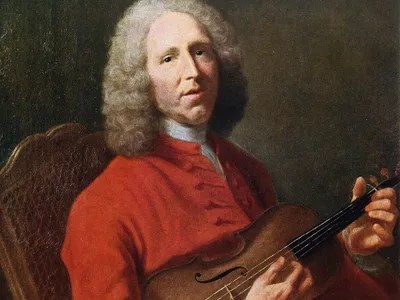
Rameau (above) is a colourful composer, too. “Everything is about colour”, agrees Agnew, “and he’s the first to really properly orchestrate, not just saying to the flutes to play the same as the violins. This is music just for flutes, just for the oboe, and then we’re just going to hear the strings coming in when when we need harmony. And then of course we’ll have a big string moment. It’s the beginning of colour in its best sense, not only harmonic colour but audible colour. The players suddenly find themselves pretty exposed in Rameau, particularly the bassoon parts. He’s a genius of the bassoon writing, and you get these incredible melodies, in Dardanus for example, with these sombre, reedy, mournful qualities. Some amazing colours.”
There is more, too. “And then he’s a great dancer! I think he has to be the best dance composer before Stravinsky. He has this incredible variety, within the ‘stock’ dances. Everyone knows straight away if it’s a Galliard or a Bourree, but they are so incredibly different. It’s a joy when the band understand it, too. I did Platée with the Dresden Staatskapelle, and a more serious orchestra you could not find – but once they got the idea that you could have fun and you could play out and take risks, they really went for it and it ended up great fun. There was a sort of trigger moment where we were doing a dance, and I kept on trying to get them to bow shorter, because they do hugely long bows, with fabulous, resonant instruments – nothing like the English Concert will play in Platée. I was trying to get them to play shorter and closer to the bridge, get a slightly sharper sound out of it. The shorter they got with the bow, the more they understood it and wanted to play out. It took off! Legato is a kind of aberration in this opera, everything else is short – so we charmed them out of certain – very good – habits.”
We bid farewell with one thing clear – Platée is in very good hands and a highly entertaining night is in prospect. “The main thing to say is that it’s a fun evening. You don’t need to worry if you don’t know much about French, or Baroque, or history. Just come and have a ball, it’s a fun evening, a fun piece with some very sharp twists!”
You can read more about the forthcoming production, and book tickets, at the Garsington Opera website