In concert – Janai Brugger, CBSO / Kazuki Yamada: Copland, Tower, Price & Adams

Janai Brugger (narrator/soprano), CBSO Chorus (Julian Wilkins, chorus-master), City of Birmingham Symphony Orchestra / Kazuki Yamada

Copland Fanfare for the Common Man (1942); Lincoln Portrait (1942)
Tower Fanfare for the Uncommon Woman (1989)
Price orch. Rosner The Heart of a Woman (c1930-50)
Adams Harmonium (1980-81)

Symphony Hall, Birmingham
Saturday 4 July 2026

Reviewed by Richard Whitehouse

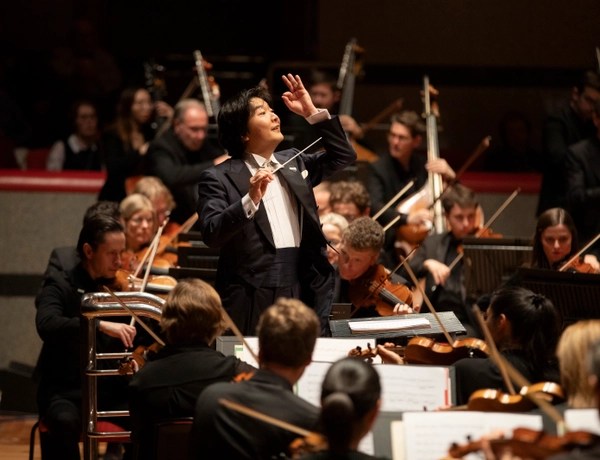
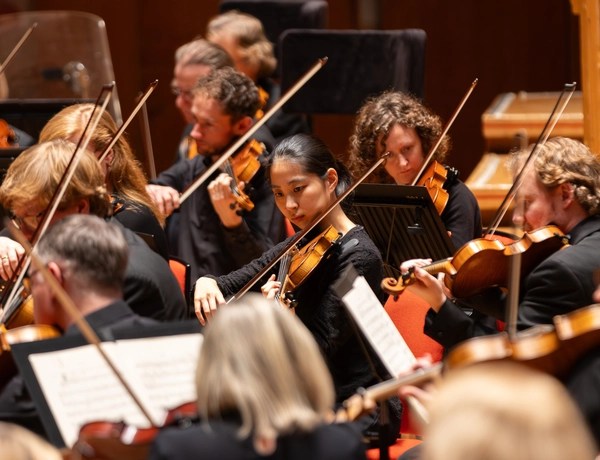
Marking the 250th anniversary of American independence, the City of Birmingham Symphony Orchestra and music director Kazuki Yamada duly pulled out the stops with a programme that placed musical achievements from the past century within an unlikely yet stimulating context.

The first half unfolded as two diptychs focussing, respectively, on male and female concerns. Thus a brazen but never brash take on Copland’s Fanfare for the Common Man preceded his Lincoln Portrait – its sentiments as apposite to World War Two as to the American Civil War, after whose Battle of Gettysburg Lincoln made his famous ‘Address’. Yamada drew nobility and fervour from its lengthy preamble, then Janai Brugger delivered its subsequent narration with enough poise and understatement to offset any risk of hubris during the climactic stages.

Initiated by a visceral reading of Joan Tower’s Fanfare for the Uncommon Woman, its brass and percussion deployed in notably combative manner, the female response continued with Florence Price’s The Heart of a Woman. Not so much a song-cycle as a ‘themed’ collection which has only recently been assembled from its composer’s extensive contribution to this genre, its 10 settings of black American authors have been orchestrated by Israeli-American composer Lior Rosner with no mean subtlety and eloquence, though on occasion softening the harmonic piquancy with which Price seeks to highlights aspects of her own experience.

Wistful and rapturous by turns, these merge into a rather generalized sequence lacking any more cumulative intensity to justify it as a whole; the exception being Don’t you say no to me which, with its vivid (if slightly self-conscious) elements of blues and ragtime, sounds like a number such as Ella Fitzgerald might have recorded in her youth. Brugger (with kit-percussionist Alex Henshaw-Van den Bos) made the most of its insouciance, with Yamada encouraging the orchestra to a warmly empathetic response elsewhere. Hardly a revelatory discovery, but attractive and affecting music such as reinforced the impression that Price is at her best freed from those formal constraints encountered in her symphonies or concertos.

After the interval came Harmonium, by which John Adams established his wider reputation almost 45 years ago. Now as then, its overall impact belies its relative concision and, while its streamlined ebb and flow arguably overrides the manifest ambivalence in John Donne’s Negative Love then emphasizes predictability over pathos in Emily Dickinson’s Because I could not stop for Death, the integration of chorus and orchestra is unfailing. To this end, coordination was not all that it might have been though the seminal passages were tellingly realized – not least that seismic build-up into a setting of Dickinson’s Wild Nights whose heady crescendos then raptly inward ending, both among its composer’s finest inspirations, were conveyed with conviction boding well for the CBSO performance at this year’s Proms.

Before that London concert, however, audiences in Birmingham can enjoy more Adams when Edward Gardner conducts his epic Harmonielehre and Edgard Varèse’s ambitious Amèriques, with the CBSO and CBSO Orchestral Residency Musicians at Symphony Hall on July 17th.

To read more about the CBSO’s 2026/27 season, visit the CBSO website. Click on the names to read more on chief conductor Kazuki Yamada, soloist Janai Brugger, the CBSO Chorus and composers Joan Tower and Florence Price

Published post no.2,939 – Monday 6 July 2026

In appreciation – Edo de Waart

by Ben Hogwood

This week the Dutch conductor Edo de Waart announced his retirement, after six decades at the top of his game. On inspection of his discography, de Waart has conducted a number of important recordings – either in San Francisco, Minnesota or the Netherlands – and a selection of these are included in the playlist below, which begins with a classic recording of Steve Reich‘s Variations for winds, strings and keyboards and ends with the landmark Harmonium, by John Adams:

Published post no.2,147 – Saturday 13 April 2024

Oppenheimer – the opera

Operan-heimer

by Ben Hogwood

With the release of Christopher Nolan’s film Oppenheimer last Friday, it is worth noting that opera also has its own high quality biopic of the scientist.

John Adams wrote Doctor Atomic in 2005 to a libretto by Peter Sellars. It is a compelling tale, bolstered by some of the composer’s best music.

The Metropolitan Opera have made their Penny Woolcock production available online, and you can view it here… it is highly recommended!

In concert – Oliver Janes, CBSO / Ryan Bancroft: Adams, Mozart & Rachmaninoff

Adams The Chairman Dances (1985)
Mozart Clarinet Concerto in A major K622 (1791)
Rachmaninoff Symphonic Dances Op.45 (1940)

Oliver Janes (clarinet), City of Birmingham Symphony Orchestra / Ryan Bancroft

Symphony Hall, Birmingham
Wednesday 2 November 2022 [2.15pm]

Reviewed by Richard Whitehouse

Back from its successful US tour (the first such in almost a quarter of a century), the City of Birmingham Symphony Orchestra this afternoon returned to Symphony Hall for what was a programme of contrasts in which an element of dance seldom lurked far beneath the surface.

Although it is often considered emblematic of his opera Nixon in China, John Adams wrote The Chairman Dances well before completing the larger work – this ‘Foxtrot for Orchestra’ encapsulating much of its atmosphere without being intrinsic to its content. Capricious while shot through with a tellingly distanced nostalgia, this remains among Adams’s most effective concert pieces and Ryan Bancroft secured a fine account whose meticulous attention to detail was not without corresponding panache – down to its percussive ‘winding down’ at the close.

It is (nearly) always welcome when an orchestra’s section leader takes the platform as soloist, as was proven with Oliver Janes in Mozart’s Clarinet Concerto – easily the most popular such piece in its repertoire yet one that can easily seem bland or even characterless in performance. There was little chance of that here – not least with a swift and purposeful take on the opening Allegro that left relatively little room for lingering over incidental detail, even if something of its underlying elegance was sacrificed with Janes’s powers of articulation pressed to the limit.

This approach paid dividends in the remaining movements, not least an Adagio whose limpid eloquence was conveyed without trace of indulgence or wanton sentiment. The final Allegro, too, had a winning buoyancy – Janes evincing a deftness and spontaneity to which the CBSO responded in kind, and with a surge of energy towards the closing chords. It set the seal on an appealing rendition which, perhaps surprisingly, Janes will not repeat at tomorrow evening’s concert from Warwick Arts Centre – when that by Gerald Finzi will be the concerto on offer.

Soon to take the reins at the Royal Stockholm Philharmonic, Bancroft is evidently a conductor on a roll as was confirmed by his take on Rachmaninoff’s Symphonic Dances. A triptych that abounds in felicitous detail (as is often belied, if not actually concealed, by the score’s lack of expression markings), it needs flexible direction for each movement to cohere, and Bancroft had their measure. The first exuded a suspenseful energy that, in its central section, took on a winsome pathos embodied by its alto saxophone melody (affectingly played by Kyle Horch).

Even more persuasive was the sardonic central dance, its waltz motion underpinning some of the composer’s most astringent harmonies as were pointedly emphasized here. If the charged outer sections of the final dance lacked the ultimate in exhilaration, the quality of the CBSO’s response was never in doubt. In the slower middle episode, moreover, Bancroft’s deliberation ideally clarified those frequently dense textures whose expressive poise is achieved, uniquely for Rachmaninoff, without recourse to an actual melody. A sign of things to come, perhaps?

Bancroft will hopefully be returning next season, but the present one continues with events to mark the 150th anniversary of Vaughan Williams’s birth – including two of his symphonies and the film Scott of the Antarctic, for which the CBSO is contributing live accompaniment.

You can read all about the 2022/23 season and book tickets at the CBSO website. For more information on the artists, click on the names of Ryan Bancroft and Oliver Janes

In concert – NEXT and Birmingham Contemporary Music Group: Past the Stars

bcmg-past-the-stars

NEXT [Joe Howson & Mikaela Livadiotis (pianos), Gavin Stewart (bass flute), Olivia Jago (violin)

Adams Hallelujah Junction (1996)
Saunders Bite (2016)
Mason When Joy Became Mixed with Grief (2007)

Patricia Auchterlonie (soprano), Ulrich Heinen (cello), Birmingham Contemporary Music Group / Geoffrey Paterson

Birtwistle Cantus Iambeus (2004)
Vir Wheeling Past the Stars (2007) – Songs 3 and 4; Hayagriva (2005) [UK premiere]

Town Hall, Birmingham
Sunday 20 June 2021

Written by Richard Whitehouse

It might have taken 15 months plus a couple of false alarms, but Birmingham Contemporary Music Group (above) finally resumed live performances en masse this afternoon and with this wide-raging concert typical of its programming across more than three decades of music-making.

Not least with its throwing the spotlight onto players of the next generation, the opening half featuring NEXT musicians as mentored by their senior colleagues. Things got underway with Hallelujah Junction, John Adams’ alternately incisive and soulful evoking of a truck-stop on the California-Nevada border; along with a tribute to orchestra manager Ernest Fleischmann, which doubtless explains its heightened peroration. Nor, despite some occasional vagaries of coordination, was there any doubting the conviction of Joe Howson and Mikaela Livadiotis.

From two pianists situated amid tables in the stalls to a bass flautist just in front of the organ console: Gavin Stewart made the most of this unlikely context with a committed reading of Rebecca SaundersBite, less a setting than paraphrase of the thirteenth from Samuel Beckett’s Texts for Nothing in which words or syllables are variously sounded in anticipation, or as consequence of the flute’s contribution. It certainly left a fragmented, even rebarbative impression compared to the seamlessness of When Joy Became Mixed with GriefChristian Mason’s contemplation of a sixth-century Jainist account over several ages of declining natural and human wonder; in which violinist Olivia Jago rendered the music’s gently enveloping pathos with unfailing poise, as well as a sure sense of where this deceptively understated music might be headed.

BCMG accordingly took to the stage for Cantus Iambeus, among the more recent of Harrison Birtwistle’s curtain-raisers for ensemble and arguably his most approachable in the unfolding of expressive contours and its frequently diaphanous textures; all underpinned by the role of iambic rhythm in promoting continuity through to an almost inviting final cadence. Nor was there a lack of that intensive interplay as has been a hallmark of this composer’s music from the outset, and to which these musicians responded with their customary precision and verve.

The other pieces (both included on a new NMC release) were by Param Vir, whose music has been a welcome if undervalued presence over four decades. Firstly, the latter two items from his song-cycle Wheeling Past the Stars after Rabindranath Tagore – the charm and vivacity of Grandfather’s Holiday then musing inwardness of New Birth, both eloquently rendered by Patricia Auchterlonie with Ulrich Heinen. Finally, to Hayagriva – the horse-headed being and mythological archetype behind a work whose headlong rhythmic energy suddenly moves, via an intricately detailed transition, to a final section whose subdued manner does not preclude music of fastidious textural variety emerging. The analogous sequence ‘red-green-blue’ was reinforced by overhead lighting, even if Vir’s musical trajectory is appreciably more subtle.

BCMG responded to Geoffrey Paterson’s direction with alacrity, not unreasonably pleased to be back performing for a live audience in an impressive indication of what can be expected from this ensemble during the 2021-22 season and barring, one hopes, no more false alarms!

You can find information on further BCMG activities here, while further information on Wheeling Past the Stars by Param Vir can be found at the NMC website