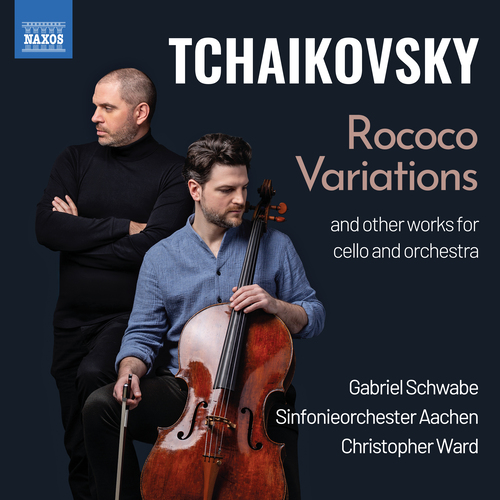
On Record: Gabriel Schwabe, Sinfonieorchester Aachen / Christopher Ward – Tchaikovsky: Rococo Variations, Romeo & Juliet etc (Naxos)

Gabriel Schwabe (cello), Sinfonieorchester Aachen / Christopher Ward

Tchaikovsky
Variations on a Rococo Theme Op. 33 (1876) – original version
Pezzo capriccioso in B minor Op.62 (1887)
Nocturne in D minor Op.19/4 (1873, arr. 1888 by composer)
Canzonetta in G minor Op.35/2 (1878, arr. 2025 by Schwabe)
Valse sentimentale Op.51/6 (1882, arr. 2019 by Schwabe)
Fantasy Overture, Romeo and Juliet (1870 version)

Naxos 8.574741 [56’45”]
Producer / Engineer Patrick Lemmens

Recorded 14 September 2018 (Romeo and Juliet) and 23-26 May 2025 at Eurogress, Aachen

Reviewed by Richard Whitehouse

What’s the story?

Naxos issues its latest recording by Gabriel Schwabe, featuring Tchaikovsky’s Variations on a Rococo Theme, alongside arrangements for cello and orchestra and a first recording of Romeo and Juliet in its second version, with the Aachen Symphony Orchestra and Christopher Ward.

What are the performances like?

Although long ago published and recorded on numerous occasions, the original version of the Rococo Variations still lags behind that made by Wilhelm Fitzhagen for whom it was written, and who shamelessly pointed up those opportunities for virtuosity at odds with the essentially Classical poise of Tchaikovsky’s own conception. Opting for the original, Schwabe makes the most of its innate formal or expressive modesty while never neglecting the element of display as surfaces in the guise of a playful humour not so often associated (though hardly unknown) with this composer. In particular the eighth variation, summarily omitted by Fitzhagen, has a genial animation that makes for a far more fitting segue into the coda – hence seeing through to its close a work whose keen lack of pretence is out of all proportion to its musical rewards.

Tchaikovsky finished one other piece for cello and orchestra, Pezzo capriccioso veering from moodiness to recalcitrance with its deftness much in evidence. Also here are his arrangement of the Nocturne from the Op. 19 piano pieces, pensive and soulful, together with Schwabe’s idiomatic takes on the Violin Concerto’s Canzonetta and wistful Valse Sentimentale from the Op. 51 piano pieces. Odd, however, that Tchaikovsky’s cello arrangement of the Andante cantabile from his First Quartet has been omitted as there was more than enough room for it; as there was for two song transcriptions – namely Legend, the fifth of his Op. 54 set, and Was I Not a Little Blade of Grass?, the seventh of his Op. 47 set – the composer also devised and which would have helped to place what is heard here in a wider, more balanced perspective.

What has been included is the second version of the fantasy overture Romeo and Juliet with (surprisingly?) its first commercial recording. Those familiar with the 1869 original will find this much closer to the third and definitive version from 1880 with the masterly introduction now in place (albeit its climax slightly underscored) then a very different lead-in (not a little akin to Balakirev) to the coda, which here seems rather over-protracted next to that of eight years later. All the right pieces are here, just in a different and ultimately less effective order.

Does it all work?

As a programme, it does. Certainly the Rococo Variations is much more effective a creative entity as Tchaikovsky conceived it, so making his reluctance to overrule Fitzhagen the more perplexing, while the other pieces with cello afford ready-made encore material Schwabe no doubt includes in his own concerts. Ward and his Aachen forces accompany sympathetically, before coming into their own with Romeo and Juliet – a fascinating intermediate version that, for all its failings, was worth making available to Tchaikovsky afficionados in this recording.

Is it recommended?

Indeed so. The performances are never less than well-attuned to the music and lack nothing in conviction, enhanced with weightily immediate sound and insightful booklet annotations. Those attracted (and why not?) to this programme should not hesitate to acquire this release.

Listen / Buy

You can listen to excerpts and explore purchase options at the Naxos website. Click on the names to read more about cellist Gabriel Schwabe, conductor Christopher Ward and the Sinfonieorchester Aachen

Published post no.2,900 – Thursday 28 May 2026
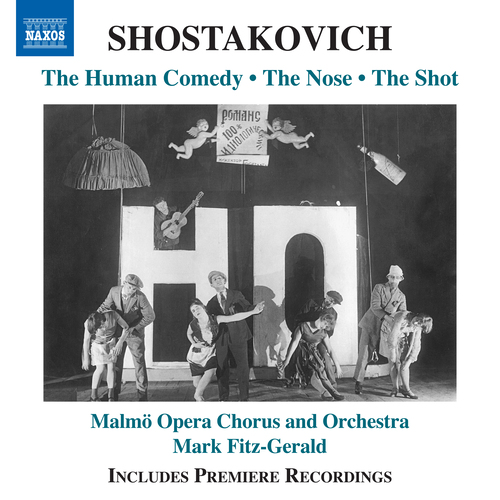
On Record – Malmö Opera Chorus and Orchestra, Mark Fitz-Gerald – Shostakovich: The Human Comedy, The Shot, The Nose (Discarded Versions) (Naxos)

Tor Lind (bass), Kenny Staškus Larsen (flute), Allan Sjølin, Jesper Sivebaek (balalaikas), Edward Stewart (guitar) (all soloists in The Shot); Lars Notto Birkeland (organ, The Nose); Christian Enarsson (piano, The Human Comedy); Malmő Opera Chorus and Orchestra / Mark Fitz-Gerald

Shostakovich
The Shot – incidental music, Op.24 (1929)
The Human Comedy – incidental music, Op. 37 (1933-4)
The Nose, Op. 15 – appendix (1927-8)
The Vyborg Side, Op. 50 – March of the Arnachists (1938)

Naxos 8.574590 [56’42’’]
Russian text & English translation included
Producer Sean Lewis

Recorded 5-7 March at Opera House, Malmő and 4 April 2024 at Fagerborg Church, Oslo (The Nose)

Reviewed by Richard Whitehouse

What’s the story?

Naxos continues its ground-breaking series devoted to Shostakovich’s film and theatre scores, given with conviction by the Malmö Opera Orchestra and authoritatively conducted by Mark Fitz-Gerald, who has edited and often reconstructed these pieces from their surviving sources.

What’s the music like?

It is all too easily overlooked that, prior to being one of the leading composers of symphonies and string quartets from the 20th century, Shostakovich became established primarily through music for the theatre and cinema; in the process, he frequently transferred musical ideas from one medium to the other. The present release features the complete incidental music from two of his most ambitious such undertakings, along with hitherto unknown passages from his first opera and an item from one of his film scores – much of this material recorded for the first time.

Shostakovich’s first assignment for Leningrad-based TRAM (Theatre of Working Youth), his incidental music for Aleksandr Bezymensky’s verse-drama The Shot had a fraught rehearsal process prior to its relatively successful first-run. Few of the mainly brief numbers survived intact but the outcome, as reconstructed from piano sketches, is a lively if not overly anarchic score – highlights being the Mussorgskian pastiche ‘Workers’ Song of Victory’ (track 1) and the poignant ‘Dun’dya’s Lament’ (16) with its guitar part deftly restored by Edward Stewart.

Some five years on and the experimental zeal of Soviet theatre had largely evaporated, hence the music for Moscow-based Vakhtangov Theatre’s production The Human Comedy. Adapted by Pavel Sukhotin from Honoré de Balzac’s epic, its essence seems one of nostalgia for things past – typified by the theme, nominally evoking Paris, which Shostakovich threads across his half-hour score. Complementing this are more animated or even uproarious numbers, several of which found their way into those Ballet Suites latterly assembled in Stalin’s twilight years.

The programme is rounded out, firstly, with three fragments from The Nose – the undoubted masterpiece of Shostakovich’s radical years. Taken from each of its acts, they pursue musical directions likely impractical in a theatrical context; though what was intended as an overture to Act Three (41) could still make its way as a scintillating encore. Finally, the ‘March of the Anarchists’ (43) from the film The Vyborg Side: reconstructed from its original soundtrack, it finds the composer remodelling music from Weill’s The Threepenny Opera in his own image.

Do the performances work?

Pretty much throughout – accepting, of course, the fragmentary nature of the two main works as determined by their function. In particular, the five-movement suite assembled – not by the composer – from The Human Comedy (and recorded by Edward Serov with the St Petersburg Chamber Orchestra for Melodiya) brings together various of those individual pieces to more cohesive overall effect. Not that the present performances are at all wanting in expertise and conviction, making for an album which is a necessary listen for all admirers of this composer.

Is it recommended?

Very much so. The booklet features detailed notes from no less than Gerard McBurney, with a brief contextual note by Fitz-Gerald. Hopefully there will be further such releases from this source, and not forgetting that several of Shostakovich’s film scores have still to be recorded.

Listen / Buy

You can hear excerpts from the album and explore purchase options at the Naxos website, or you can listen to the album on Tidal. Click to read more about Mark Fitz-Gerald’s recordings for Naxos, the Malmő Opera Orchestra and the Shostakovich Centre.

Published post no.2,792 – Sunday 8 February 2026

On Record – Matteo Generani: Martucci: Piano Works (Naxos)

Martucci
Romanza facile (1889)
Capriccio e Serenata Op.57 (1886)
Sei Pezzi Op.38 (1878)*
Notturno Op.25 ‘Souvenir de Milan’ (1875)*
Minuetto e Tempo di Gavotta Op.55 (1880/88)*
Sonata facile, Op.41 (1878)*
Scherzo in E major Op.53/2 (1880)
Nocturne in G flat major Op.70/1 (1891)
Tarantella Op. 44/5 (1880)
Prima barcarola, Op. 20 (1874)*

Matteo Generani (piano)

Naxos 8.574628 [71’51”] * World premiere recordings
Producer & Engineer Joseph Tesoro

Recorded 25-27 April 2023 at White Recital Hall, James C. Olsen Performing Center, Kansas City, USA

Reviewed by Richard Whitehouse

What’s the story?

Naxos continues its coverage of Giuseppe Martucci (1856-1909) with this selection of piano music, a medium for which the Italian composer wrote extensively but that has tended to be overshadowed by the upsurge of interest in his symphonies, concertos and chamber works.

What’s the music like?

As indicated by Tommaso Manera in his informative booklet notes, Martucci was established as a pianist when barely out of his teens and could have enjoyed an international career had it not been for his attraction to conducting and, most importantly, his determination to promote Austro-German symphonism when it was hardly established in the Italian-speaking territories. Even the piano pieces that enjoyed popularity in his lifetime often did so in transcriptions for orchestra, making the present anthology a viable overview of his achievement in this domain.

What is immediately noticeable about Martucci’s piano music is the relatively short time in which it was written – the 50 or so opus numbers over which it extends equating to 17 years of composing. Certainly, the Prima barcarola yields a melting limpidity redolent of Chopin, while the Notturno affords an evocation of Milan that wears any Lisztian antecedents lightly. More distinctive is the Sonata facile, a study in deftness and understatement which is by no means ‘easy’ and has an appealing humour. More substantial, however, the Six Pieces are not only contrasted within themselves but amount to a cohesive overall sequence (were they ever performed as such?). Highlights are its fourth and fifth pieces, an ebullient La Chasse then a beguiling Sérénade, but the whole sequence is demonstrably more than the sum of its parts.

Martucci’s piano output tended to fall away as the 1880s progressed, but what he did write is worth attention. Hence the capering Minuetto which was partnered almost a decade on by an even more engaging Tempo di Gavotta, or the Scherzo in E which is playful and resourceful by turns. A further set of six pieces is represented only by its final item, but this Tarantella is the most substantial piece here and testament to the increasing sophistication of its composer. Nor is Capriccio e Serenata other than a brace of genre-pieces unified in overall conception. Emerging either side of 1890, the Romanza facile is a compact study in unforced sentiment, whereas the Nocturne in G flat could hardly be further removed from that eponymous piece written some 16 years previously in terms of its harmonic subtlety and textural translucency.

Does it all work?

It does. As a composer for piano, Martucci may not have had the distinctive profile of Busoni (even at a comparable stage in their respective developments) or Sgambati, though the best of what he did write has no lack of character or personality. It is also music that cries out for the level of commitment evident throughout this selection, Matteo Generani audibly enjoying its technical challenges while always aware of that aspiring towards something more ambitious that was to find its outlet in the multi-movement works which crowned Martucci’s maturity.

Is it recommended?

It is. Although this does not survey the extent of Martucci’s piano music, Generani’s selection is an enticing one that will certainly appeal to those with any taste for the byways of musical Romanticism, along with those who have acquired earlier releases of this composer on Naxos.

Listen & Buy

Click on the artist names to read more on pianist Matteo Generani and composer Giuseppe Martucci

Published post no.2,513 – Wednesday 23 April 2025

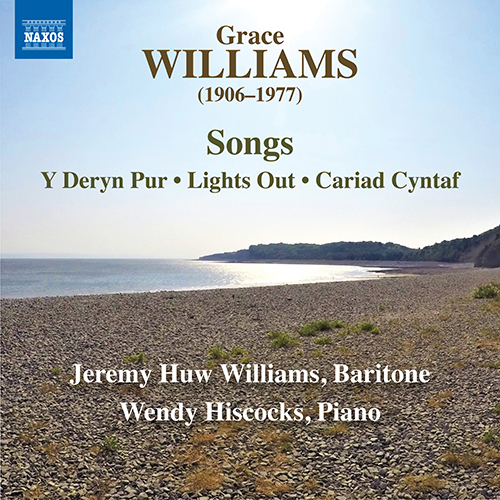
On Record – Jeremy Huw Williams & Wendy Hiscocks: Grace Williams: Songs (Naxos)

Grace Williams
Slow, slow, fresh fount (c1925); I had a little nut tree (c1930); Green Rain (1933); Stand forth, Seithenin (1935, rev; 1951); Ffarwel i langyfelach (?1920s); Llangynwyd (?1920s); The Song of Mary (1939, rev; 1945); Shepherds watched their flocks by night (1948); Fairground (1949); Flight (1949, rev; 1954); À Lauterbach (c1950); Le Chevalier du guet (1949); Four Folk Songs (1950-51); When thou dost dance (1951); Three Yugoslav Folk Songs (1952); Y Deryn Pur (1958); Y Fwyalchen (1958); Cariad Cyntaf (c1960); Ow, Ow, Tlysau (1964); Dwfn yw’r Môr (c1940); Lights Out (1965); Fear no more the heat o’ the sun (1967)

Jeremy Huw Williams (baritone), Wendy Hiscocks (piano)

Naxos 8.571384 [77’47”]
Producer Wendy Hiscocks Engineer Alastair Goolden

Recorded 28-30 September 2022 at Cooper Hall, Selwood Manner, Frome

Reviewed by Richard Whitehouse

What’s the story?

Naxos continues its long-running series of releases sponsored by the British Music Society with an album of songs by Grace Williams (1906-77), all of which are recorded here for the first time and, between them, extend chronologically over the greater part of her composing.

What’s the music like?

Even more than others of her generation, Williams has benefitted from the upsurge of interest in women composers this past decade with recordings of major works on Lyrita and Resonus. Songs may not have the primary place in her output, but they afford a viable overview of her stylistic evolution with individual instances among her most characteristic statements. Most are in English or Welsh though there also settings of French texts, while her own translations of several from the former Yugoslavia further underline the breadth of her literary concerns.

Early settings of Ben Johnson along with traditional English and Welsh poems find Williams, barely out of her teens, tackling verse with audible appreciation of this genre’s lineage within the Victorian and Edwardian eras. That of Mary Webb’s Green Rain is audibly more personal for its wistful ambivalence, while The Song of Mary brings due sensitivity to bear upon some familiar lines from St Luke. The most extended item, Fairground is a setting of Sam Harrison that captures the sights and sounds of said environment with an immediacy never descending into kitsch, while that of Flight matches the sentiments in Laurence Whistler’s poem and has a piano part testing in its intricacy. Her setting of the Jacobean-era When thou dost dance is, by comparison, slighter though no less attuned to the limpid elegance of its anonymous text.

Arrangements of traditional verse had early featured in this composer’s output, and this is not the customary text for her attractive treatment of a traditional Czech carol Shepherds watched their flocks by night. The period around 1950 saw a number of such arrangements and mainly of French texts, but with her take on the Northumbrian Bonny at Morn appreciably different from the more familiar one by Tippett. The end of that decade brought forth a trio of eloquent Welsh settings, while that of the Medieval text Oh, Oh, Treasures may be pastiche yet it has a fervency which feels not a little unsettling. The final two songs see a return to more familiar verse: that of Edward Thomas’s Lights Out evinces a subdued and even fatalistic acceptance, while that of Shakespeare’s Fear no more the heat o’ the sun captures its aura of resignation.

Does it all work?

Yes, allowing for inevitable unevenness in what is a conspectus over four decades. At least a half-dozen of these songs ranks with the best of those by British composers from this period and well warrant investigation by more inquiring singers. Jeremy Huw Williams clearly has no doubts as to their quality and, though his tone as recorded here is not always flattering, it captures his intensity of response. Nor could he have had a more committed or a perceptive accompanist than Wendy Hiscocks, who teases out myriad subtleties from the piano writing.

Is it recommended?

Indeed, and there ought to be enough remaining vocal items for a follow-up release at some stage. Graeme Cotterill pens informative notes, and while it is a pity that several texts could not be printed for copyright reasons, the clarity of Williams’s diction seems fair recompense.

Listen & Buy

Click on the artist names to read more on Jeremy Huw Williams, Wendy Hiscocks, composer Grace Williams and the British Music Society

Published post no.2,506 – Wednesday 16 April 2025

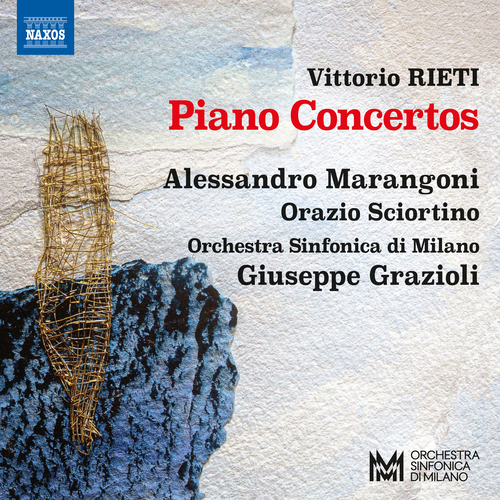
On Record – Alessandro Marangoni, Orazio Sciortino, Orchestra Sinfonica di Milano / Giuseppe Grazioli: Rieti: Piano Concertos (Naxos)

Rieti
Piano Concerto no.1 (1926)
Piano Concerto no.2 (1937)
Piano Concerto no.3 (1955)
Concerto for Two Pianos (1951)

Alessandro Marangoni, Orazio Sciortino (pianos), Orchestra Sinfonica di Milano / Giuseppe Grazioli

Naxos 8.564505 [80’27”]
Producer Stefano Barzan Engineer Cinzia Guareschi

Dates: 21-22 August 2022, 17-20 August 2023 (Piano Concerto no.3, Concerto for Two Pianos) at Auditorium di Milano

Reviewed by Richard Whitehouse

What’s the story?

Naxos continues its enterprising 20th Century Italian Classics with the concertante works for piano by Vittorio Rieti (1898-1994), the Egyptian-born Italian composer whose years in Paris then New York and Chicago afforded contact with a range of illustrious musicians and artists.

What’s the music like?

Dedicated to Poulenc and likely inspired by the success of Prokofiev’s Third Concerto earlier that decade, Rieti’s First Piano Concerto brings a deft touch to its ostensible neo-Classicism – whether in the martially-inflected playfulness of its initial Allegro, laconic but also beguiling ambivalence of its central Andantino, or the theatrical high-jinx of a final Allegro whose nod towards jazz rhythm marks this out as a piece decidedly yet always unaffectedly of its time. Seemingly forgotten following its premiere (by the composer?), its revival is well deserved.

Just over a decade on, the Second Piano Concerto emerged from material originally intended for a harpsichord concerto. On a similar scale to its predecessor, the opening Allegro has an impetus that denotes the uncertainty spreading throughout Europe at this time, and which is intensified by the central Adagio with its plangent discourse between soloist and orchestra; a quality the final Allegro (which follows with barely a pause) does not so much overcome as dismiss through an energetic repartee which brings about the nominally affirmative ending.

By the time of his Third Piano Concerto, Rieti was well established in the United States such that the present work is audibly in the lineage of American works for this medium of the post -war era. Any undue portentousness in the introductory Largo is dismissed with the vivacious Allegro that follows, then the central Andantino confirms that, while Rieti’s idiom might not have altered substantially over his career, it gained in subtlety and depth. Any more ominous expression is avoided in the final Allegro as it wends a capricious course to its decisive close.

Written in the wake of his relocation to the USA, the Two-Piano Concerto helped to establish Rieti’s reputation in a very different cultural climate. There is little moderate about either the tempo or character of the impetuous opening Allegro, then the central Allegretto comprises a set of variations’ which takes its unassuming theme through a diverse range of moods without losing focus on route to the pensive close. The final Allegro turns away from any encroaching inwardness with its energetic fugal interplay such as makes for an ending of pointed defiance.

Does it all work?

It does, provided one accepts Rieti as a product of his age rather than trailblazer or innovator. Stravinsky, Prokofiev and even Jean Françaix are prominent in the stylistic mix, with a more tensile aspect derived from Copland in the works of his American years. Not that this should offset enjoyment of music that feels never less than communicative and often engagingly so, particularly as regards the latter two pieces. Both of these were recorded way back in the LP era, but to have all four works rendered in such sympathetic readings is hardly to be gainsaid.

Is it recommended?

It is, not least when Alessandro Marangoni (alongside Orazio Sciortino) is so attuned to this music, while Giuseppe Grazioli obtains a committed response from the Milan orchestra. The succinct booklet notes are highly informative and further enhance the appeal of this release.

Listen & Buy

For purchase options, you can visit the Naxos website. For information on the performers, click on the names to read more about Alessandro Marangoni, Orazio Sciortino, Giuseppe Grazioli and the Orchestra Sinfonica Milano. An interview between Vittorio Rieti and Bruce Duffie can be read here

Published post no.2,492 – Wednesday 2 April 2025