
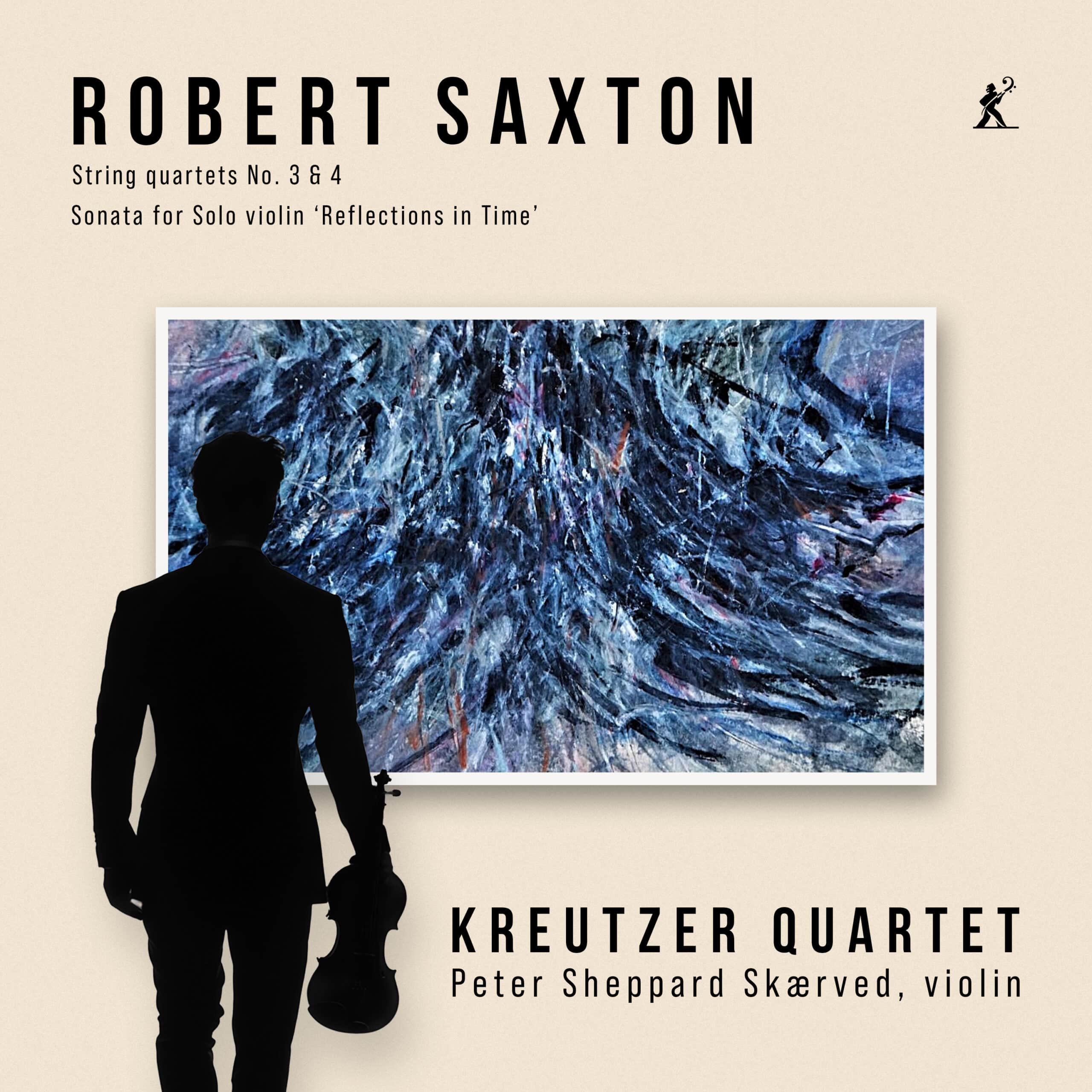
Kreutzer Quartet [Peter Sheppard Skærved and Mihailo Trandafilovsky (violins), Clifton Harrison (viola, Quartet no.3), Morgan Goff (viola, Quartet no.4), Neil Heyde (cello)]; Peter Sheppard Skærved (violin, Sonata)
Robert Saxton
String Quartet no.3 (2009)
String Quartet no.4 (2018)
Sonata for Solo Violin ‘Reflections in Time’ (2023)
Métier Records MEX77138 [73’23”]
Producer Peter Sheppard Skærved Engineer Adaq Khan
Recorded 2019 at St. George’s, Headstone, Harrow (String Quartet no.3); 2024 at Hastoe Village Hall, Tring (String Quartet no.4, Sonata for Solo Violin)
Reviewed by Richard Whitehouse
What’s the story?
The enterprising Métier Records label continues coverage of Robert Saxton on a release featuring his Third and Fourth String Quartets, with his Solo Violin Sonata, in readings by Peter Sheppard Skærved or the Kreutzer Quartet who had commissioned and premiered two of these pieces.
What’s the music like?
String quartets range across the greater part of Saxton’s composing, but that once designated his ‘First Quartet’ from 1982 was long ago withdrawn and its place taken by the Fantazia of 1993. His second quartet, 1997’s Songs, Dances and Ellipses was written for the Chilingirian Quartet’s 25th anniversary while recorded by the Kreutzer for its miscellany Northern Lights (Métier MSV28507). Subsequent quartets were written for and premiered by the Arditti and Kreutzer quartets, with which latter Saxton’s collaboration stretches back over three decades.
Comprising five movements, the Third Quartet is a telling example of the interplay between serial and tonal practices characterizing Saxton’s music these past two decades. Departure and Return traces its methodical trajectory away from and back to the note D, with Winter Light a varied intermezzo before the animated scherzo Dance; after this, Sea Ground is a passacaglia whose sustained build-up and gradual subsidence makes way for Continuing Journey – a finale such as revisits the opening movement in a spirit of purposeful renewal.
Its seven movements on a larger scale, the Fourth Quartet is described by its composer as a ‘‘Creation/Life cycle’’ as inferred by the opening Wavebreak, its motivic constituents duly intensified in the passacaglia Time Spiral while etherealized in Nightscape. Finding their respective cues in Siegfried Sassoon and T. S. Eliot, the ensuing sections are akin to scherzo and slow movement. Hymn then becomes an extended introduction to the final Daybreak, revisiting previous material though now with an unforced yet affecting sense of affirmation.
Between these pieces, Reflections in Time is a sonata for solo violin whose five (untitled) movements take inspiration from landscapes and seascapes as drawn by Sheppard Skærved, the work’s commissioner and dedicatee; his residing on the opposite side of the Thames also influencing this music as regards the eddying of its textures and the temporal (though never scenic) vistas effected by the five pitch-centres heard during its course. For all its technical intricacy, this is music as vivid or as imaginative in its evocation as any Saxton has written.
Does it all work?
It does. While it would be naive to suggest the relationship between tonal and serial facets of these pieces as equating to that age-old duality between ‘heart’ and ‘brain’, there could be no doubting the expressive spontaneity which arises out of their formal cohesion. A balance that, achieved by (surprisingly?) few composers from Saxton’s generation, makes his more recent music (at least) as appealing as it is engrossing. Sound leaves nothing to be desired, with the composer’s pithy annotations complemented by the violinist’s more discursive observations.
Is it recommended?
It is. Anyone who has enjoyed such recent pieces as the symphony Scenes from the Epic of Gilgamesh) will find these three works no less representative of Saxton’s maturity, and one looks forward to more recordings of what has become an individual and fascinating output.
Listen / Buy
You can explore purchase options at the Métier Records website. You can click on the link to read Arcana’s review of Saxton’s Scenes from the Epic of Gilgamesh & The Resurrection of the Soldiers, or click on the names for more on the Kreutzer Quartet, Peter Sheppard Skærved and composer Robert Saxton
Published post no.2,897 – Monday 25 May 2026

