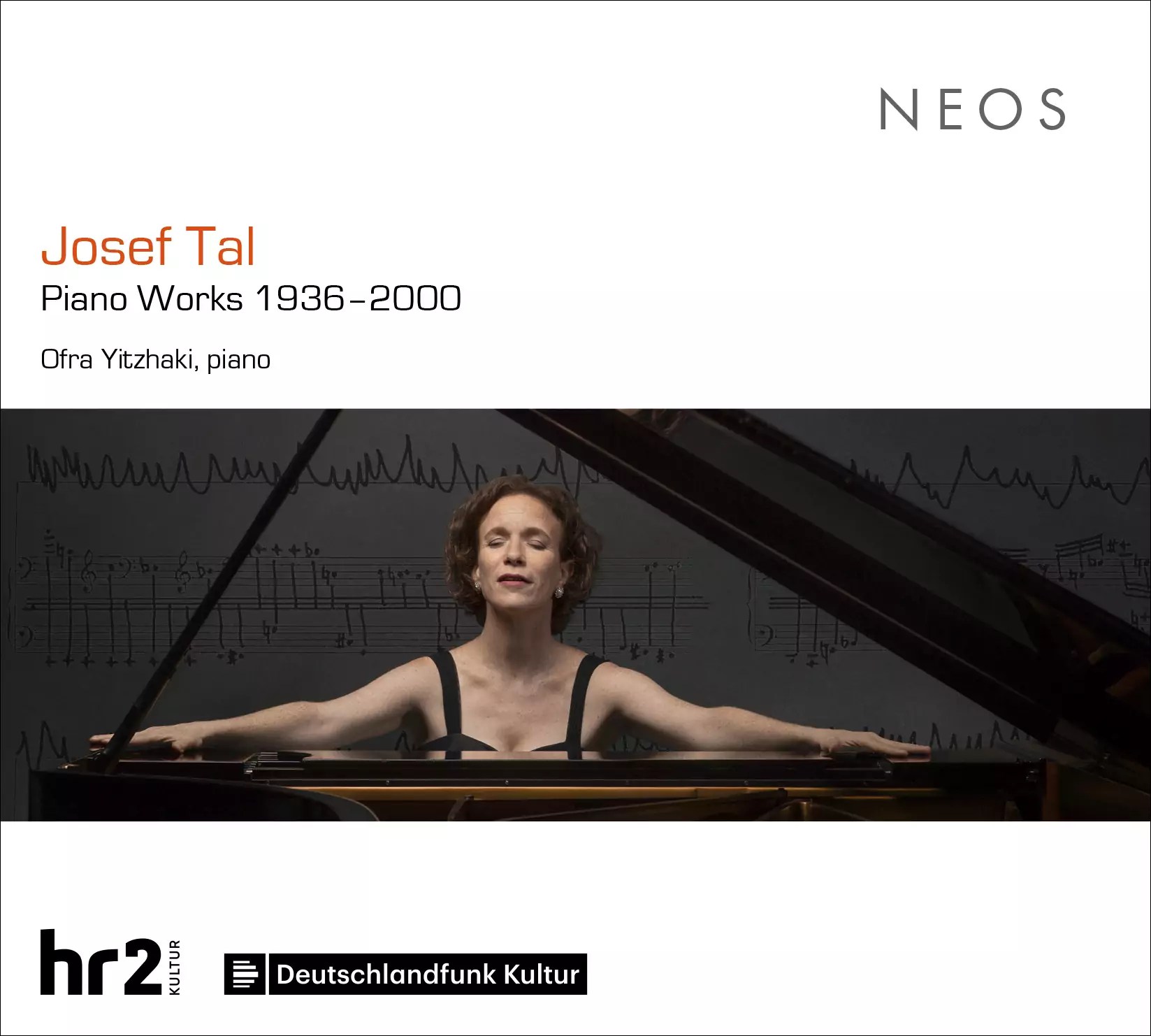
On Record: Ofra Yitzhaki – Josef Tal: Piano Works 1936–2000 (NEOS Music)

Ofra Yitzhaki (piano)

Josef Tal
Sonata for Piano (1949)
Five Densities (1975)
Three Pieces (1937)
Concerto no.5 for Piano and Magnetic Tape (1964)
By the Rivers of Babylon (1951)
Six Sonnets (1946)
Essay IV (1997)
Essay V (2000)
Chaconne (1936)

NEOS Music 12520 [82’04”]
Producers Alexander Hainz and Dominik Weinmann Engineer Robin Bös

Recorded 1-3 September 2022 at Hessian Radio Studio, Frankfurt am Main

Reviewed by Richard Whitehouse

What’s the story?

The enterprising NEOS Music label releases an anthology of piano music by Josef Tal (2010-2008), the German-born Israeli composer who did much to advance the cause of new music in Israel during the post-war era and whose varied output confirms him as a significant creative figure.

What’s the music like?

Little heard in the UK (his Third Symphony featured at the 1979 Proms and his chamber opera The Garden at South Bank Centre in 1998), Tal wrote in all the main genres. His piano music, moving from overt Expressionism to innate Atonalism, is accorded focus by its motivic rigour.

This is evident from the earliest piece here – Chaconne being a consummate study in ‘less is more’ such that its variations on an austerely rhetorical theme merge into an intensifying and cumulative whole, capped by an epiphanic calm prior to the inevitability of a final onslaught. Elements of this language are further explored by the Three Pieces which, in their respective volatility, impetuousness or introspection, denote the influence of Schoenberg’s piano pieces -albeit less those emotional extremes of his Op. 11 than that fastidious subtlety of his Op. 23.

A subtlety duly refined in the Six Sonnets, miniatures of a formal ingenuity and expressive poise out of all proportion to their brevity. From there to the Sonata is to emerge at a crucial stylistic juncture in Tal’s output: again, the modest dimensions (each of its three movements lasting around four minutes) only makes more acute that growing ominousness of its initial movement, the plangency of its central Basso Ostinato (a favoured device throughout Tal’s career) then the mounting impetus of its final Rondo toward a viscerally unequivocal close.

Arranged from a theatrical work, By the Rivers of Babylon conveys a measure of eloquence prior to what became the most radical phase of Tal’s composing. Hence the Concerto No. 5 as replaces orchestra with electronics in a substantial single movement which, whatever the timbral limitations of its magnetic tape, ensures a tense while often combative interplay of mutually opposing forces. This intensity is channelled into the Five Densities, such that its starkly contrasted first four pieces find unlikely yet convincing rapprochement in the fifth.

The remaining works form part of a sequence that extends across Tal’s final creative decades. Essay IV moves stealthily between sharply distinct ideas to an ending which does not resolve but simply cease, and Essay V is more demonstrative as it heads to its terse yet forceful close.

Does it all work?

Indeed it does. A figure nowadays admired more for what his music represents than for what it achieves, Tal left a legacy which is highly significant in or of itself (and one which, unlike almost all Israeli composers of his generation, audibly transcends the idiom of Ernest Bloch). His piano output exemplifies that technical precision, underpinning a creative spontaneity, as are hallmarks of his maturity and which help make this music as relevant to our day as to his own. It also makes for an engrossing and sometimes even entertaining listen in its own right.

Is it recommended?

Indeed it is. Only the Sonata has previously been recorded, and Ofra Yitzhaki’s empathy with this music cannot be denied. Superbly recorded and informatively annotated, this deserves an enthusiastic recommendation, with hopefully a follow-up of Tal’s other piano works to come.

Listen / Buy

You can hear excerpts from the album and explore purchase options at the NEOS Music website. Click on the names to read more about pianist Ofra Yitzhaki and composer Josef Tal

Published post no.2,918 – Monday 15 June 2026

On Record – Linda Kouvaras: Piano Music, Chamber Works and Songs, Vol. 2 (Toccata Classics)

Tiriki Onus (narrator), Coady Green (piano), Roger Alsop (sound design) – Herring Island Piano Sonata; Jane Magão (soprano), Karen Van Spall (mezzo-soprano), Georgia Lewis (piano) – Winter Came Early

Linda Kouvaras
Herring Island Piano Sonata
Winter Came Early

Toccata Classics TOCC0734 [78’33”] English text included
Producer / Engineer Haig Burnell

Recorded 16 & 24 November 2023 (Herring Island Piano Sonata), February 2024 (Winter Came Early)

Reviewed by Richard Whitehouse

What’s the story?

Toccata Classics issues the second volume in its ongoing survey of chamber and vocal works by Linda Kouvaras (b.1960), comprising two sizable pieces that examine those genres of the piano sonata and the song-cycle from unlikely while always thought-provoking perspectives.

What’s the music like?

A veteran of the New Wave scene from the early 1980s, Kouvaras studied in London and her native Melbourne where she has pursued her career as an academic and composer. Especially notable is her output for ensemble, with or without voices, which is currently being recorded by Toccata. Its second instalment demonstrates a keen sense of how to broaden and diversify genres that could all too easily be taken for granted as regards precedent then, in the process, making these relevant to the artistic and the cultural concerns of those having inspired them.

Inspired then dedicated to the physical and historical facets of an artificial islet in Melbourne, Herring Island Piano Sonata amalgamates an abstract entity with a text by N’arweet Carolyn Briggs and spoken by Tiriki Onus in the context of an environmental soundscape from Roger Alsop – though the piano component can also be performed independently (and can be heard here by selecting tracks 2, 3, 5 and 7). Musically it typifies Kouvaras’ predilection for modal harmonies and vibrant textures, allied to a determined if never excessive virtuosity. Just how far this three-way interplay comes together is for each listener to decide, though there can be no doubt as to the ambition of the whole. To which end, a visual (not necessarily illustrative) component might have helped with integrating these already interrelated aspects further still.

Written immediately before, Winter Came Early is a song-cycle to poems by Melbourne poet Catherine Lewis whose untimely death and her posthumous legacy is directly commemorated. The presence, indeed frequent concurrence, of two female voices represents a mother and her daughter – the latter being pianist Georgina Lewis who also contributes the central poem that gives the work its title – heard alternately and in dialogue, though this could be considered too much of a good thing given the overlap in vocal lines and consequent blurring of words such as makes it difficult (if not impossible) to discern what is being sung. Musically, the sequence alternates between knowledge of encroaching death and recollection of earlier but not always happier times, rounded off by an ‘Epilogue’ that sets the poet’s final love-note to her husband.

Does it all work?

For the most part. Kouvaras is evidently a composer with an inquiring mind and the means to realize her intentions, though the element of mixed media sometimes works to the detriment of her music by drawing attention away from its intrinsic content. All the performers provide contributions of unfailing sincerity, but there remains a feeling of sensory overload or merely reluctance to let this music speak on its own terms. Try those sonata tracks detailed above, or the final four tracks (11-14) of the song-cycle, to hear her music at its most communicative.

Is it recommended?

Yes, with these reservations in mind. Those who are unfamiliar with this composer would be best advised to start with the first volume in this survey (TOCC0729) with its works for solo piano or saxophone and piano that, in their different ways, find her music at its most potent.

Listen / Buy

You can hear excerpts from the album and explore purchase options at the Toccata Classics website. Click on the names to read more about performers Jane Magão, Karen Van Spall, Tiriki Onus, Coady Green, Georgina Lewis and Roger Alsop, and composer Linda Kouvaras

Published post no.2,916 – Saturday 12 June 2026

On Record: Lesley-Jane Rogers – Hommage: Tributes to Handel & Purcell (Heritage Records)

Lesley-Jane Rogers (soprano), John Turner (recorder), Jonathan Price (cello), Jonathan Bielby (harpsichord)

Ruth Zechlin Hommage á Henry Purcell (1997); Hommage á Handel (2004)
Robin Walker Handel to his Soul (2006)
Pepusch When Love’s Soft Passion (pub. 1720)
Purcell The Blessed Virgin’s Expostulation, Z196; Oedipus, Z583 (1678) – Music for a while; The Indian Queen, Z630 (1695) – I attempt from love’s sickness to fly
Telemann Cello Sonata in D major TWV41: D6 (pub. 1728-9)
Handel Nel Dolce del’Oblio, HWV134 (1709)

Heritage Records HTGCD118 [73’06”] Texts and translations included
Remastering Engineer Paul Arden-Taylor

Live performance on 14 June 2006 at Händel-Haus, Halle an der Saale

Reviewed by Richard Whitehouse

What’s the story?

Heritage releases what was actually a live performance, given at the original ‘Handel House’ in the composer’s hometown of Halle while featuring an imaginative miscellany of Baroque and Contemporary works, all expertly realized by soprano, recorder, cello and harpsichord.

What’s the music like?

The sub-title says it all – tributes to Handel and Purcell that range from pieces by both these composers to works which wear their ‘hommage’ credentials not a little obliquely. Purcell is heard in evergreen extracts from his incidental music to Oedipus and semi-opera The Indian Queen elegantly sung by Lesley-Jane Rogers, who renders the interplay of recitative and aria in The Blessed Virgin’s Expostulation with real eloquence. Handel rounds off this programme with Nel Dolce del’Oblio (In the Sweetness of Oblivion), one of several Italian cantatas that helped establish his reputation prior to his arrival in England. Again, a fine performance that respects this music’s expressive deftness and understatement though without making it seem trite or lightweight; failings which are not so uncommon in latter-day accounts of this music.

Also featured is a cello sonata drawn from Telemann’s collection Der Getreue Musikmeister (The Faithful Music-Master), its simple alternation of Largo and Allegro movements belying the piece’s overall motivic subtlety. Interest naturally attaches to the cantata When Love’s Soft Passion by Johann Pepusch, remembered for his musical contribution to The Beggar’s Opera by John Gay (and lesser-known sequel Polly) but who wrote extensively for various genres – among them the secular cantata, hence the poise and sensuous appeal of the present example.

Two of the contemporary works are by Ruth Zechlin (1926-2007), among the most prominent composers in what was East Germany, whose expertise as harpsichordist or organist informed her own works. Hommage á Henry Purcell juxtaposes recorder and harpsichord with pointed humour redolent of Mauricio Kagel, whereas Hommage á Handel comprises settings of three Shakespeare sonnets (Nos. 36, 78 and 46) with their music derived from three Handel arias to verses by Barthold Brockes. Even more engrossing is Handel to his Soul, a cantata setting his own text by Robin Walker (b.1953) who, known primarily for some seismic orchestral works (Toccata Classics TOCC0283), brings comparable insight to this thought-provoking trialogue between the composer, his soul and the goddess Proserpina – its music being witty and ironic.

Does it all work?

Yes, not least as collated into a programme which elides nimbly if meaningfully between the musical past and present. All credit to the musicians that these performances are so idiomatic across the board, thereby bringing works separated by over three centuries into enlightening accord. Whether the present release is taken from a radio broadcast or an archive recording, its sound lacks nothing in spaciousness or focus; enabling Rogers’s excellent annunciation to come through unimpeded. An occasion which was decidedly making available commercially.

Is it recommended?

It is. The booklet has decent notes and full texts (if not all English translations) – making for a worthy tribute to Percy M. Young (1912-2004), renowned music scholar and soccer historian, in whose memory this concert was sponsored by the British Professional Football Association.

Listen / Buy

You can explore purchase options at the Heritage Records website. Click on the names for more information on Lesley-Jane Rogers, John Turner, Jonathan Price, Jonathan Bielby, Ruth Zechlin, Robin Walker and the Händel-Haus

Published post no.2,914 – Thursday 11 June 2026

On Record – Philharmonia Orchestra / Martyn Brabbins – William Mival Orchestral Works (Signum Classics)

Philharmonia Orchestra / Martyn Brabbins

William Mival
Vale – a pastoral symphony (2022-23)
Tristan – still (2003)
Pluen (feather) (2018)

Signum Classics SIGCD977 [57’13”]
Producer Stephen Johns Engineer Mike Hatch

Recorded 21 & 22 May 2024 at St Jude on the Hill, Hampstead, London

Reviewed by Richard Whitehouse

What’s the story?

Signum Classics issues the first album devoted to William Mival (b.1959), featuring his three most significant orchestral works which also amounts to a representative overview of his output, all being heard in persuasive readings by the Philharmonia Orchestra and Martyn Brabbins.

What’s the music like?

Best known for almost two decades as Head of Composition at the Royal College of Music, as for his frequent broadcasts on Radio 3, Mival has created an output of a quality out of all proportion to its quantity. Many will first have encountered his music through the orchestral piece On the Ringstreet (1996), its lively traversal of Vienna’s Ringtrasse and acute punning on familiar passages from 19th century opera leaving a very different impression from these pieces and not least because of their preoccupation with interiorized emotional ‘landscapes’.

Premiered prior to a concert presentation of the third act from Tristan und Isolde, and what might be termed a ‘symphonic adagio’, Tristan – still finds Mival integrating elements from that opera in the context of a string quartet Wagner left unrealized in the mid-1860s and the speculative orchestral piece Stille und Umkehr by Bernd Alois Zimmermann. This is music which unfolds inferentially as it variously touches on without needing to embrace a musical Romanticism that, of necessity, remains tantalizingly and unself-consciously beyond reach.

Over a decade had elapsed before Mival returned to composition in earnest – his subsequent orchestral piece being Pluen. Its Welsh title refers to the three heraldic feathers in the Prince of Wales’s coat of arms, duly translated into three variations on the folksong Y Glomen (The Dove) with a brief introduction then a more extended conclusion. Here the composer places himself in a lineage of British musical landscapes, for all that his metamorphic thinking feels more audibly aligned with that of Austro-German composers at the start of the 20th century.

From here to Vale is to find Mival reinforcing his overt while never inhibited take on tonality in what he calls a ‘pastoral symphony’; one whose six continuous sections imply a Classical structure in outline as they draw inspiration from the region of Clywd, adjacent to where the composer was born. Here again, however, the music admits a distinctly European sensibility with its methodical progress toward an ecstatic culmination before concluding in the deftest transcendence. Suffice to add its first section’s ‘Senza ironia’ marking holds good throughout.

Does it all work?

Yes, assuming one responds to Mival’s often oblique yet always sincere response to musical Romanticism. Certainly, those who appreciate such as David Matthews, Philip Sawyers and the more recent works of Robert Saxton should find themselves readily engrossed with what is on offer. It helps that the Philharmonia is so attuned in its playing, and Martyn Brabbins’s direction so unobtrusive in its authority. A pity that earlier piece was not included, but it can be heard on the Royal College of Music YouTube channel

Is it recommended?

Indeed, not least as the sound serves the music ideally and the annotations are so informative. It is to be hoped the release of this album will encourage greater interest in Mival’s output as a whole, with maybe a collection of his various chamber and ensemble works as a follow-up.

Listen / Buy

You can explore purchase options at the Signum Records website, and listen to excerpts from the album at Presto Music. Click on the names to read more about composer William Mival, conductor Martyn Brabbins and the Philharmonia Orchestra

Published post no.2,913 – Wednesday 10 June 2026

On Record – Valerie Fritz & Nina Gurol: Pas de deux (NEOS Music)

Valerie Fritz (cello), Nina Gurol (piano)

Clarke Viola Sonata (1919, arr. composer)
Debussy Cello Sonata in D minor, L135 (1915)
Höller Mouvements (2010); Piano Sonata no.3 (2010-11); Signe ascendant (2024)

NEOS Music 12526 [74’02”]
Producers Dominik Weinmann, Marie-Josefin Melchior Engineer Klemens Kamp

Recorded 14-16 April 2025 at Studio 2, Bavarian Radio, Munich

Reviewed by Richard Whitehouse

What’s the story?

NEOS issues an album such as places three contrasted works by York Höller (b.1944) within the context of two sonatas from the earlier 20th century, which all adds up to an illuminating programme when realized with the artistry and perception of those musicians featured here.

What’s the music like?

His most recent piece for an instrument prominent in his output, Signe ascendant has Höller paying tribute to Pierre Boulez on what would have been his 100th birthday via a miniature whose motivic content is derived from the latter’s surname – its lucid and eventful unfolding typical of this composer. Written for a competition organized by Kulturkreis der Deutschen Industrie, the Third Piano Sonata comprises a single movement which is in almost constant evolution; its improvisatory opening phase setting out motifs to be developed in alternately incisive and lyrical episodes towards a conclusion the more powerful in expression through being so methodically attained. Coming respectively 42 and 24 years after his earlier such works, the present piece is no less summatory of Höller’s music at its time of composition.

Its being an ‘abstract’ or ‘imaginary’ ballet makes clear the link between Mouvements and similarly designated works by Höller’s teacher Bernd Alois Zimmermann. Not that it could be mistaken for any other composer – witness the sardonic playfulness of its Entrée, duly intensified in the Pas de deux; the Interlude affords a measure of ruminative while by no means uneventful calm, before the Finale ties up any thematic and conceptual loose-ends via a purposefulness as makes this work more than the sum of its already impressive parts.

The first of a projected six sonatas (only three of which were realized) intended to reinforce his innately French aesthetic, Debussy’s Cello Sonata gets a restrained yet insightful reading – its ‘Prologue’ exuding a fugitive uncertainty brusquely countered by the Sérénade, whose disjunctive gestures are duly channelled into the tensile energy of the Finale.

Even finer as an interpretation is that of the Viola Sonata by Rebecca Clarke, in its highly idiomatic cello transcription. Whether in the restless though precisely gauged musings of its Impetuoso, the speculative dialogue of its central Vivace then rapt serenity of its final Adagio which builds unerringly to the bracing and affirmative close, this is a superb rendering of a work that has (rightly) come into its own during the past quarter-century as a cornerstone of its repertoire.

Does it all work?

Undoubtedly – even if, as a sequence, it might have been preferable to have commenced with the Debussy then continue with the three Höller works and ended with the Clarke. That said, it is easy enough to re-programme the order and this hardly detracts from the persuasiveness of what is heard here; Valerie Fritz and Nina Gurol conveying the specific qualities of the duo works while pointing up stylistic connections between them. Those who know Höller’s Third Sonata through Fabio Martino’s account (Oehms) will likely find Gurol even more insightful.

Is it recommended?

Very much so. Spacious but not lacking definition, the sound is well up to NEOS’s customary high standards and there are succinct if informative booklet notes by the musicians. Hopefully there will be further such combinations of modern and contemporary music from this source.

Listen / Buy

You can explore purchase options on the NEOS website. Click on the names to read more about cellist Valerie Fritz, pianist Nina Gurol and composer York Höller

Published post no.2,912 – Tuesday 9 June 2026