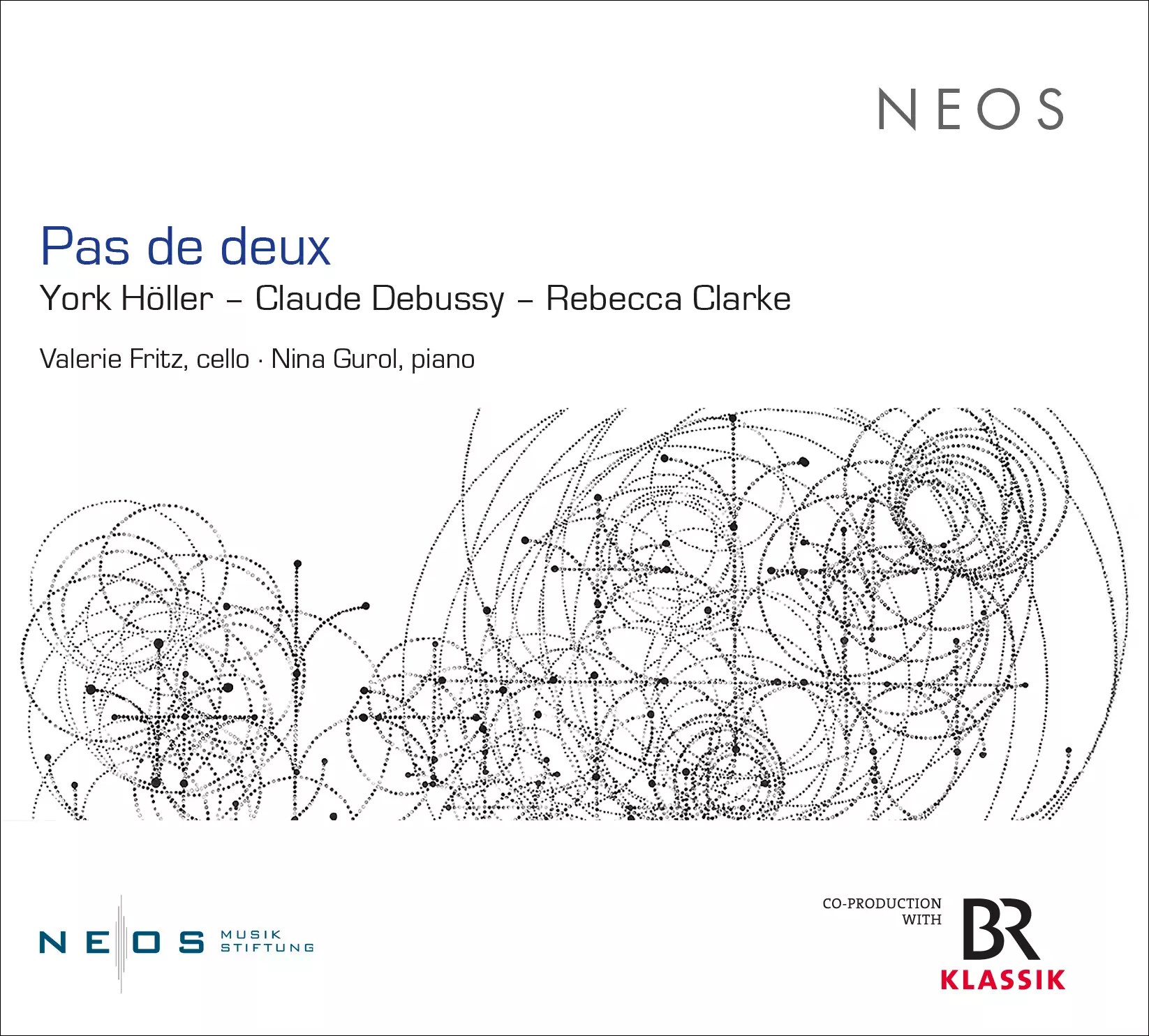
On Record – Valerie Fritz & Nina Gurol: Pas de deux (NEOS Music)

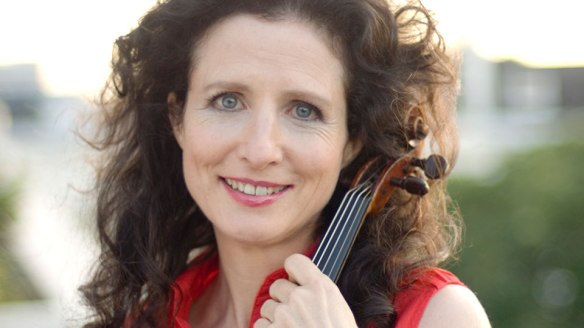
Valerie Fritz (cello), Nina Gurol (piano)

Clarke Viola Sonata (1919, arr. composer)
Debussy Cello Sonata in D minor, L135 (1915)
Höller Mouvements (2010); Piano Sonata no.3 (2010-11); Signe ascendant (2024)

NEOS Music 12526 [74’02”]
Producers Dominik Weinmann, Marie-Josefin Melchior Engineer Klemens Kamp

Recorded 14-16 April 2025 at Studio 2, Bavarian Radio, Munich

Reviewed by Richard Whitehouse

What’s the story?

NEOS issues an album such as places three contrasted works by York Höller (b.1944) within the context of two sonatas from the earlier 20th century, which all adds up to an illuminating programme when realized with the artistry and perception of those musicians featured here.

What’s the music like?

His most recent piece for an instrument prominent in his output, Signe ascendant has Höller paying tribute to Pierre Boulez on what would have been his 100th birthday via a miniature whose motivic content is derived from the latter’s surname – its lucid and eventful unfolding typical of this composer. Written for a competition organized by Kulturkreis der Deutschen Industrie, the Third Piano Sonata comprises a single movement which is in almost constant evolution; its improvisatory opening phase setting out motifs to be developed in alternately incisive and lyrical episodes towards a conclusion the more powerful in expression through being so methodically attained. Coming respectively 42 and 24 years after his earlier such works, the present piece is no less summatory of Höller’s music at its time of composition.

Its being an ‘abstract’ or ‘imaginary’ ballet makes clear the link between Mouvements and similarly designated works by Höller’s teacher Bernd Alois Zimmermann. Not that it could be mistaken for any other composer – witness the sardonic playfulness of its Entrée, duly intensified in the Pas de deux; the Interlude affords a measure of ruminative while by no means uneventful calm, before the Finale ties up any thematic and conceptual loose-ends via a purposefulness as makes this work more than the sum of its already impressive parts.

The first of a projected six sonatas (only three of which were realized) intended to reinforce his innately French aesthetic, Debussy’s Cello Sonata gets a restrained yet insightful reading – its ‘Prologue’ exuding a fugitive uncertainty brusquely countered by the Sérénade, whose disjunctive gestures are duly channelled into the tensile energy of the Finale.

Even finer as an interpretation is that of the Viola Sonata by Rebecca Clarke, in its highly idiomatic cello transcription. Whether in the restless though precisely gauged musings of its Impetuoso, the speculative dialogue of its central Vivace then rapt serenity of its final Adagio which builds unerringly to the bracing and affirmative close, this is a superb rendering of a work that has (rightly) come into its own during the past quarter-century as a cornerstone of its repertoire.

Does it all work?

Undoubtedly – even if, as a sequence, it might have been preferable to have commenced with the Debussy then continue with the three Höller works and ended with the Clarke. That said, it is easy enough to re-programme the order and this hardly detracts from the persuasiveness of what is heard here; Valerie Fritz and Nina Gurol conveying the specific qualities of the duo works while pointing up stylistic connections between them. Those who know Höller’s Third Sonata through Fabio Martino’s account (Oehms) will likely find Gurol even more insightful.

Is it recommended?

Very much so. Spacious but not lacking definition, the sound is well up to NEOS’s customary high standards and there are succinct if informative booklet notes by the musicians. Hopefully there will be further such combinations of modern and contemporary music from this source.

Listen / Buy

You can explore purchase options on the NEOS website. Click on the names to read more about cellist Valerie Fritz, pianist Nina Gurol and composer York Höller

Published post no.2,912 – Tuesday 9 June 2026
BBC Proms at Birmingham – Claire Barnett-Jones & Simon Lepper in songs by Horovitz, Smyth, Clarke, Vaughan Williams & Wallen

BBC Proms at Birmingham – Claire Barnett-Jones (mezzo-soprano), Simon Lepper (piano)

Horovitz Lady Macbeth – a scena (1970) [Proms premiere]
Smyth Fünf Lieder, Op. 4 (c1877) [Proms premiere]
Clarke The Seal Man (1921-2) [Proms premiere]
Vaughan Williams Four Last Songs (1954-8) [Proms premiere of original version]
Wallen Lady Super Spy Adventurer (2022) [BBC commission: World premiere]

Bradshaw Hall, Royal Birmingham Conservatoire

Monday 29 August 2022, 1pm

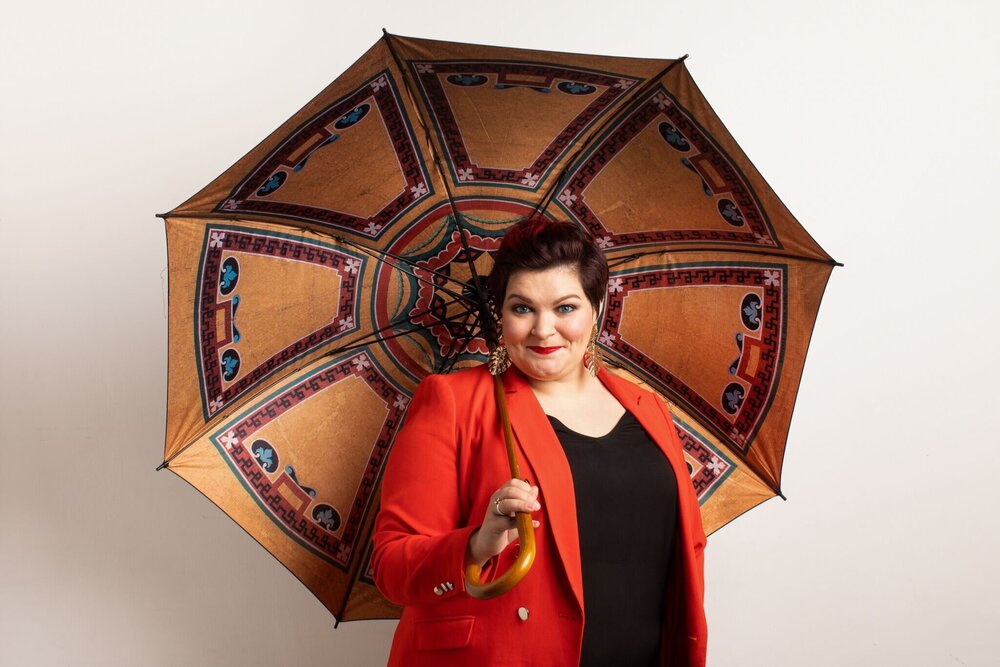
Reviewed by Richard Whitehouse Photo (Claire Barnett-Jones) (c) Benjamin Ealovega

The series of regional lunchtime Proms this afternoon reached Birmingham for a song recital by Claire Barnett-Jones, whose success at last year’s Cardiff Singer of the World and having studied at Royal Birmingham Conservatoire made her appearance doubly apposite. Equally so the initial item by Joseph Horovitz, after his death in February at 96. Lady Macbeth – a scena revealed his more serious side – with monologues from the first, second and fifth acts of ‘The Scottish Play’ charting the anti-heroine’s journey from aspiration via ambition to desperation.

The music of Ethel Smyth has been a recurrent feature this season – the present set of Lieder a reminder that, before she achieved fame with The Wreckers and notoriety as a suffragette, she had received a thoroughly Teutonic musical education in Leipzig. Fluent and idiomatic, these five settings are fluent and idiomatic: the enervation of Büchner’s Tanzlied followed by the wistfulness of Wildenbruch’s Schlummerlied and eloquence of Eichendorff’s Mittagsrum, then the assertiveness of Groth’s Nachtreiter and transcendence of Heyse’s Nachtgedanken.

Barnett-James rendered them with sensitivity and insight, with Simon Lepper (above) no less attuned to those most often intricate accompaniments. Qualities equally evident in Rebecca Clarke’s luminous setting of Masefield’s evocative if rather prolix The Seal Man as well as Four Last Songs that Vaughan Williams set to texts by his second wife, the poet Ursula Wood. From the fatalism of The Death of Procris, via the acceptance of Tired and the poise of Hands, Eyes and Heart, to the fulfilment of Menelaus – these are songs which speak of a life well-lived.

A very different take on the journey from innocence to experience is proffered by Lady Super Spy Adventurer, written by Errollyn Wallen for this recital and which might be described as a ‘concert aria’ in that its highly visual – and often visceral – rendering of the composer’s own text is balanced by a sure formal sense as to where these deceptively superficial observations are headed. Barnett-James despatched them with suitable aplomb such that Wallen, listening from home, must have been well satisfied.

Vaughan Williams’ Silent Noon, the second song from his cycle of Rossetti poems House of Life, made for an affecting encore.

Click on the artist names for more information on Claire Barnett-Jones and Simon Lepper. For more information on this year’s BBC Proms, head to the festival website

In concert – London Chamber Ensemble & Madeleine Mitchell: A Century of Music by British Women (1921-2021)

London Chamber Ensemble [Madeleine Mitchell (violin, director), Joseph Spooner (cello), Sophia Rahman (piano), David Aspin (viola), Gordon Mackay (violin), Lynda Houghton (double bass), Peter Cigleris (clarinet, bass clarinet), Nancy Ruffer (flute), Alec Harmon (oboe), Bruce Nockles (trumpet), Ian Pace (piano)

Rebecca Clarke Piano Trio (1921)
Judith Weir Atlantic Drift: Sleep Sound ida Mornin’ (1995), Atlantic Drift (2006), Rain and Mist are on the Mountain, I’d Better Buy Some Shoes (Movements I-IV, 2005)
Helen Grime Miniatures (2005)
Judith Weir The Bagpiper’s String Trio (1985)
Cheryl Frances-Hoad Invocation for cello & piano (1999)
Thea Musgrave Colloquy (1960)
Ruth Gipps Prelude for bass clarinet (1958)
Errollyn Wallen Sojourner Truth (2021, world premiere)
Grace Williams Suite for Nine Instruments (1934)

St John’s Smith Square, London
Monday 9 March (review of the online broadcast)

Written by Ben Hogwood

Classical music still has an awfully long way to go before female composers are an integral part of its make-up, but the celebration of International Women’s Day is helping the cause considerably, gaining more traction with each passing year.

One of the highlights of the 2021 celebrations was this concert from St John’s Smith Square, masterminded by Madeleine Mitchell, who led the London Chamber Ensemble in a very satisfying hour-and-a-half of music.

In a concert celebrating eight women composers, the common threads of America and the Royal College of Music were also explored. The latter organisation is where Rebecca Clarke, Grace Williams and Helen Grime all studied, and where Errollyn Wallen and Mitchell herself are now professors. Wallen wrote a new piece, Sojourner Truth, for the occasion.

The concert began however with a terrific performance of Rebecca Clarke’s Piano Trio. Completed in 1921, this substantial piece begins with a passionate outpouring, but it also has its elusive, mysterious moments. The trio of Mitchell, cellist Joseph Spooner and pianist Sophia Rahman caught these elements, getting off to a terrific start but pulling back to allow the enchanting slow movement room to breathe. At times Clarke’s music hints at influences from France – particularly Ravel but also Franck – which Spooner caught in his high intonation in the second movement. The spirit of the dance inhabited the finale, a more obviously English statement, but there was still room for more fervent thoughts when the trio united.

There was a sudden transition on the broadcast to the refreshing open air of Judith Weir’s Atlantic Drift, a compilation of three pieces for two violins proving an invigorating contrast to the denser textures of the Clarke. Weir’s incorporation of folk material into her music is enchanting, especially in the four-part last piece, Rain and mist are on the Moutain, I’d Better Buy Some Shoes. Using a Gaelic song as its inspiration, Weir’s adaptation worked really well in these open air accounts from Mitchell and Gordon Mackay, the empty St John’s providing the ideal acoustic. Weir appeared later with The Bagpiper’s String Trio, a similarly folk-powered work from 1985. Based on a Scottish pipe tune this too lifted the listener away to the great outdoors, with excellent teamwork from Mitchell, Spooner and viola player David Aspin.

Helen Grime’s trio of Miniatures for oboe and piano were next, studies in compressed expression from the pale harmonics of the first to the jagged edges of the second. The third was an effective summation of Grime’s thoughts, panning out for a wider perspective from the piano. Alec Harmon and Sophia Rahman were fully responsive to the virtuoso demands.

Cheryl Frances-Hoad’s Invocation for cello and piano followed, a late teenage piece offering an immediate chance to appreciate the probing line given to Joseph Spooner’s fulsome cello. As the composer’s response to Edvard Munch’s painting Melanchola reached its apex there were clangorous chords from Rahman, capping a compact but powerful utterance.

Thea Musgrave’s Colloquy was next, another model of economy – four short pieces for violin and piano packed with sharp, expressive statements. There were some challenges to performance here – such as the quick interchange between pizzicato and bowing in the second movement – which Mitchell took in her stride. The third piece was a touch more playful but still assertive, but the fourth was the most effective, a private train of thought gracefully prompted by Ian Pace’s piano.

The most striking piece of the evening – for its sound, its soul and its warmth – was Ruth GippsPrelude for bass clarinet. Gipps’ centenary falls this year, and her slightly baleful writing for the instrument was beautifully captured by Peter Cigleris, a model of control. After watching this I was struck by two questions – why do we not hear the music of Gipps more, and why are there not more pieces for solo bass clarinet?

Errollyn Wallen’s Sojourner Truth followed, written not just for Madeline Mitchell but for International Women’s Day – and taking us back to violin and piano. Based on a spiritual, O’er the crossing, it features intense dialogue between the two instruments, but when the melody is heard unaccompanied on the violin the ear is pulled firmly towards the centre of the music, a striking feature of another piece with more traditional inspirations.

To finish, we heard the 75-year-old Suite for Nine Instruments by Grace Williams. Scored for piano quintet, double bass, flute, clarinet and trumpet, it is a vivacious piece, quite modal and with hints of Stravinsky’s Septet for a similar instrumental combination – and equally driven in the outer movements, bringing the interval of a tritone right to the front. The London Chamber Ensemble played with flair, commitment and virtuosity, bringing a very impressive program to a close.

The concert is available to watch until 8 April on the link below – with some spoken introductions by Mitchell herself. On occasion the gaps between pieces are very short, but there are helpful markers to make viewing easier. Do make sure you watch, as some of the best chamber music from British women composers in the last 100 years is right here.

A Century of Music by British Women (1921-2021) on International Women’s Day, directed by Madeleine Mitchell from St John’s Smith Square on Vimeo.

Meanwhile, Madeleine and the London Chamber Ensemble’s album of works by Grace Williams can be heard here:

In concert – Gould Piano Trio @ Wigmore Hall

Gould Piano Trio [Lucy Gould (violin), Richard Lester (cello), Benjamin Frith (piano)]

Mozart Piano Trio in G major K564 (1788)
Clarke Piano Trio in E flat minor (1921)
Ravel Piano Trio in A minor (1914)

Wigmore Hall, London, 29 October 2020

Reviewed by Richard Whitehouse

This latest event in the Wigmore Hall season saw a welcome recital by the Gould Trio, now well into its third decade and whose frequent appearances at this venue have always featured music from right across the medium of the piano trio; with tonight’s programme no exception.

A medium to which Mozart came relatively late in his career, producing five such works in little more than two years. Last in this sequence, K564 has rather remained in the shadow of its predecessors; unfairly so, as motivic interplay across and between its three movements is comparable to any of his more imposing pieces of this time. Such was affirmed in a reading which brought out the muscular interplay of its Allegro, the wistful elegance of its Andante then the relaxed nonchalance of a final Allegretto as ranks among Mozart’s most endearing.

Would that Rebecca Clarke had followed up her solitary contribution; the Piano Trio belonging to a clutch of pieces that should have laid the basis for a composing career but were destined to remain the peak of her achievement. The influence of Debussy and Ravel is often cited, but the vehemence of Bartók’s music from this period is equally evident – witness the emotional volatility of the first movement (which predates the similarly conceived opening movement of the Hungarian composer’s First Violin Sonata), fraught eloquence of the central Andante then driving impetus of the final Allegro; its powerful culmination subsiding into a resigned coda whose defiant ending feels almost in spite of itself. A fine performance by an ensemble which was championing this piece well before it attained the recognition it now justly enjoys.

If Ravel’s Piano Trio has never lacked for advocacy over the century and more since it was first performed, it remains a tough challenge both technically and interpretively. The present account was perhaps a shade under-characterized in the simmering dance rhythms of the first movement, with the Scherzo’s deft syncopations similarly downplayed at least until the sheer effervescence of its closing bars. No doubts, though, as to the ensuing Passacaglia – building methodically yet irresistibly to its baleful climax before winding down into the depths of the piano, from whence the finale steals in. The latter movement has been criticized for exuding near-orchestral sonorities, but Ravel’s handling of this is astutely judged – not least in a coda whose hard-won triumph in the face of encroaching adversity was powerfully conveyed here.

It certainly made for an impressive conclusion to this recital, just the sort of programme that feels necessary at such a time as this. Hopefully, these next few weeks will bring no cessation on the part of Wigmore Hall or the Gould Trio – their activities necessary now more than ever.

This concert can be streamed again until 29 November via the YouTube link above, or through the Wigmore Hall website here

These Wigmore Hall concerts are free to view but the venue is relying on the generosity of its audience to make them possible. If you do watch the concert, please consider making a donation, either at the Wigmore Hall website or via PayPal

Wigmore Mondays – Kitty Whately & Simon Lepper: From the Pens of Women

Kitty Whately (mezzo-soprano, above), Simon Lepper (piano, below)

Jonathan Dove All the Future Days (Autobiography; Penelope; The Siren) (2004) (2:11-13:27 on the broadcast link below)
Vaughan Williams 4 Last Songs (1954-8) (13:58-23:27)
Judith Cloud Night Dreams (Variations on the Word Sleep) (2006) (24:58-28:12)
Lori Laitman Orange Afternoon Lover (I Was Reading a Scientific Article) (2006) (28:15-32:24)
Argento From the Diary of Virginia Woolf (Anxiety) (1974) (32:27-34:25)
Rebecca Clarke Lethe (1941) (35:58-39:00)
Juliana Hall Letters from Edna (To Harriet Monroe; To Mother) (1993) (39:05-43:15)
Jonathan Dove Nights Not Spent Alone (2015) (43:34-52:42)

Wigmore Hall, London
Monday 18 February 2019

To hear the BBC broadcast through BBC Sounds, please follow this link

Commentary and Review by Ben Hogwood

What a refreshing hour of music.

With no criticism intended, Mondays at the Wigmore Hall, where BBC Radio 3 hold a lunchtime concert every week, are a reliable way in which to start the week with quality music. They show off some of the very best in chamber, piano and vocal music, often in imaginative programs, but understandably catering for the audience with relatively well-thumbed pieces of music often included.

Not so on this occasion. Mezzo-soprano Kitty Whately always ensures she has an equal balance of male and female composers in her programs, and likes to sing about the stories of both sexes. From the Pens of Women, then, presented an opportunity to sing songs written by women – which in classical music is still not much as a proportion of the whole. She was joined by her regular recital partner Simon Lepper.

Autobiography (2:11 on the broadcast link) was a brave start, Whately straight into the high notes as she flew like the eagle in the text above the rapidly circling figurations of Lepper’s piano. Jonathan Dove’s sound world is fascinating here, clearly on the wing – and then coming down to earth a little for Penelope (4:46), which has a right hand piano figure not dissimilar to Britten, calling out in the right hand before the vocalist brings softer thoughts, then rising to soar with great feeling.

Then, from 8:04, another striking setting – this time The Siren, where Lepper worked overtime to bring a distinctive, treble-rich piano part that dives from the heights as though into a pool of water before cutting off quite suddenly at 13:27 on the broadcast.

Ursula Vaughan Williams‘ text, as set by her husband Ralph, is a very different story. One of her husband’s last works, the Four Last Songs would inevitably invite comparisons with the more famous works of the same name by Richard Strauss, but they are totally different. Vaughan Williams was less obviously heart-on-sleeve with his feelings, but look deeper and they are still there.

The first, Procris (13:58) is a little restless and decides against following the black humour of the story, while Tired (16:32) is a wonderful song, softly rocking its listener as a lullaby. Whately gave an appropriately understated reading here. Hands, Eyes and Heart (18:32) is a short song but then Menelaus (19:42), the most substantial of the four, finishes the brief cycle in a poignant mood.

Three settings of Margaret Attwood follow, with Judith Cloud’s Night Dreams (24:58) a beautifully observed setting of how the author ‘would like to watch you sleeping’. The song is dappled in half light and is shot through with the intimacy of the sleeping hours, while Lori Laitman’s Orange Afternoon Lover (I Was Reading A Scientific Article) (28:15) is similarly personal, set to a flowing accompaniment. Dominick Argento’s setting of Anxiety from From the Diary of Virginia Woolf (32:27) is propelled by the urgent piano part and keeps a high level of agitation throughout.

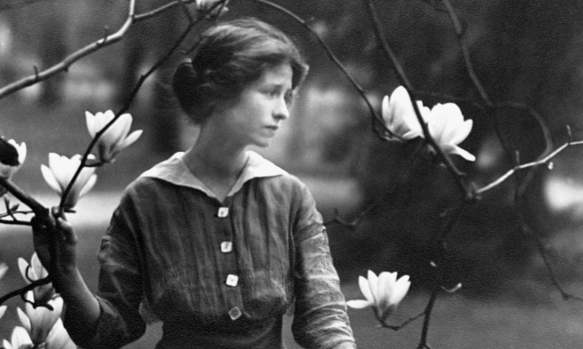
The text of Edna St Vincent Millay (above) provided the inspiration for the last third of the concert, a remarkable group of song settings. Rebecca Clarke’s Lethe is the very definition of bleakness, the underworld river supplying no comfort but only sorrow and menace (35:58), particularly in its ominous piano part at the end.

Juliana Hall’s settings of Letters from Edna provide some much-needed light relief, Millay asking humorously for payment from her publisher (39:05-40:22), declaring herself ‘awfully broke’, before passionately declaring her love and admiration To Mother (40:25).

Three settings make up Jonathan Dove’s mini-cycle Nights Not Spent Alone – the down to earth text of Recuerdo (43:34), with a quasi-orchestral piano part brilliantly managed by Lepper, the heady What lips my lips have kissed (47:41) and the passionate I too beneath your moon (50:18).

As an encore Whately and Lepper gave another Dove song, All These Dismal Looks (54:13-56:00), the fourth of five songs making up his Five Am’rous Sighs. The humourous song put the seal on an outstanding hour of music making, full of new discoveries and surprises and passionately delivered. The music and verse will I’m sure provide a springboard for listeners to the broadcast to look further afield. Talking of which…

Further listening

Kitty Whately has recorded the Jonathan Dove songs as part of a disc devoted to the composer’s music, including All The Future Days in its entirety, as well as Nights Not Spent Alone:

The below playlist contains all the music heard in this concert in available versions:

https://open.spotify.com/user/arcana.fm/playlist/6ctQO8z0d77IAARv24UoCR?si=JMBLzE4GQ9S7_Ay03k3iTg

Meanwhile you can hear all the songs of Rebecca Clarke on this disc from Patricia Wright, Jonathan Rees and Kathron Sturrock: