
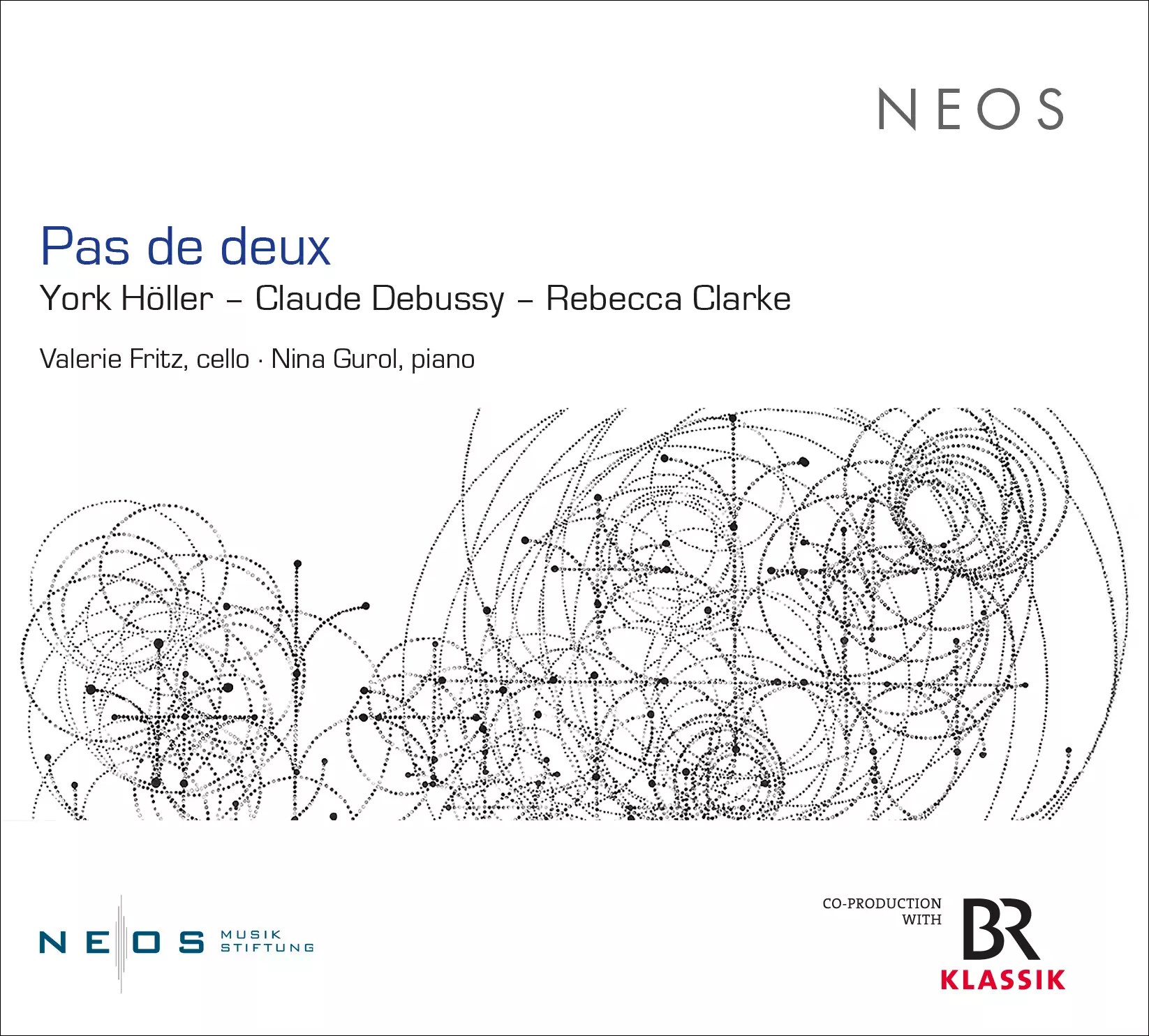
Valerie Fritz (cello), Nina Gurol (piano)
Clarke Viola Sonata (1919, arr. composer)
Debussy Cello Sonata in D minor, L135 (1915)
Höller Mouvements (2010); Piano Sonata no.3 (2010-11); Signe ascendant (2024)
NEOS Music 12526 [74’02”]
Producers Dominik Weinmann, Marie-Josefin Melchior Engineer Klemens Kamp
Recorded 14-16 April 2025 at Studio 2, Bavarian Radio, Munich
Reviewed by Richard Whitehouse
What’s the story?
NEOS issues an album such as places three contrasted works by York Höller (b.1944) within the context of two sonatas from the earlier 20th century, which all adds up to an illuminating programme when realized with the artistry and perception of those musicians featured here.
What’s the music like?
His most recent piece for an instrument prominent in his output, Signe ascendant has Höller paying tribute to Pierre Boulez on what would have been his 100th birthday via a miniature whose motivic content is derived from the latter’s surname – its lucid and eventful unfolding typical of this composer. Written for a competition organized by Kulturkreis der Deutschen Industrie, the Third Piano Sonata comprises a single movement which is in almost constant evolution; its improvisatory opening phase setting out motifs to be developed in alternately incisive and lyrical episodes towards a conclusion the more powerful in expression through being so methodically attained. Coming respectively 42 and 24 years after his earlier such works, the present piece is no less summatory of Höller’s music at its time of composition.
Its being an ‘abstract’ or ‘imaginary’ ballet makes clear the link between Mouvements and similarly designated works by Höller’s teacher Bernd Alois Zimmermann. Not that it could be mistaken for any other composer – witness the sardonic playfulness of its Entrée, duly intensified in the Pas de deux; the Interlude affords a measure of ruminative while by no means uneventful calm, before the Finale ties up any thematic and conceptual loose-ends via a purposefulness as makes this work more than the sum of its already impressive parts.
The first of a projected six sonatas (only three of which were realized) intended to reinforce his innately French aesthetic, Debussy’s Cello Sonata gets a restrained yet insightful reading – its ‘Prologue’ exuding a fugitive uncertainty brusquely countered by the Sérénade, whose disjunctive gestures are duly channelled into the tensile energy of the Finale.
Even finer as an interpretation is that of the Viola Sonata by Rebecca Clarke, in its highly idiomatic cello transcription. Whether in the restless though precisely gauged musings of its Impetuoso, the speculative dialogue of its central Vivace then rapt serenity of its final Adagio which builds unerringly to the bracing and affirmative close, this is a superb rendering of a work that has (rightly) come into its own during the past quarter-century as a cornerstone of its repertoire.
Does it all work?
Undoubtedly – even if, as a sequence, it might have been preferable to have commenced with the Debussy then continue with the three Höller works and ended with the Clarke. That said, it is easy enough to re-programme the order and this hardly detracts from the persuasiveness of what is heard here; Valerie Fritz and Nina Gurol conveying the specific qualities of the duo works while pointing up stylistic connections between them. Those who know Höller’s Third Sonata through Fabio Martino’s account (Oehms) will likely find Gurol even more insightful.
Is it recommended?
Very much so. Spacious but not lacking definition, the sound is well up to NEOS’s customary high standards and there are succinct if informative booklet notes by the musicians. Hopefully there will be further such combinations of modern and contemporary music from this source.
Listen / Buy
You can explore purchase options on the NEOS website. Click on the names to read more about cellist Valerie Fritz, pianist Nina Gurol and composer York Höller
Published post no.2,912 – Tuesday 9 June 2026

