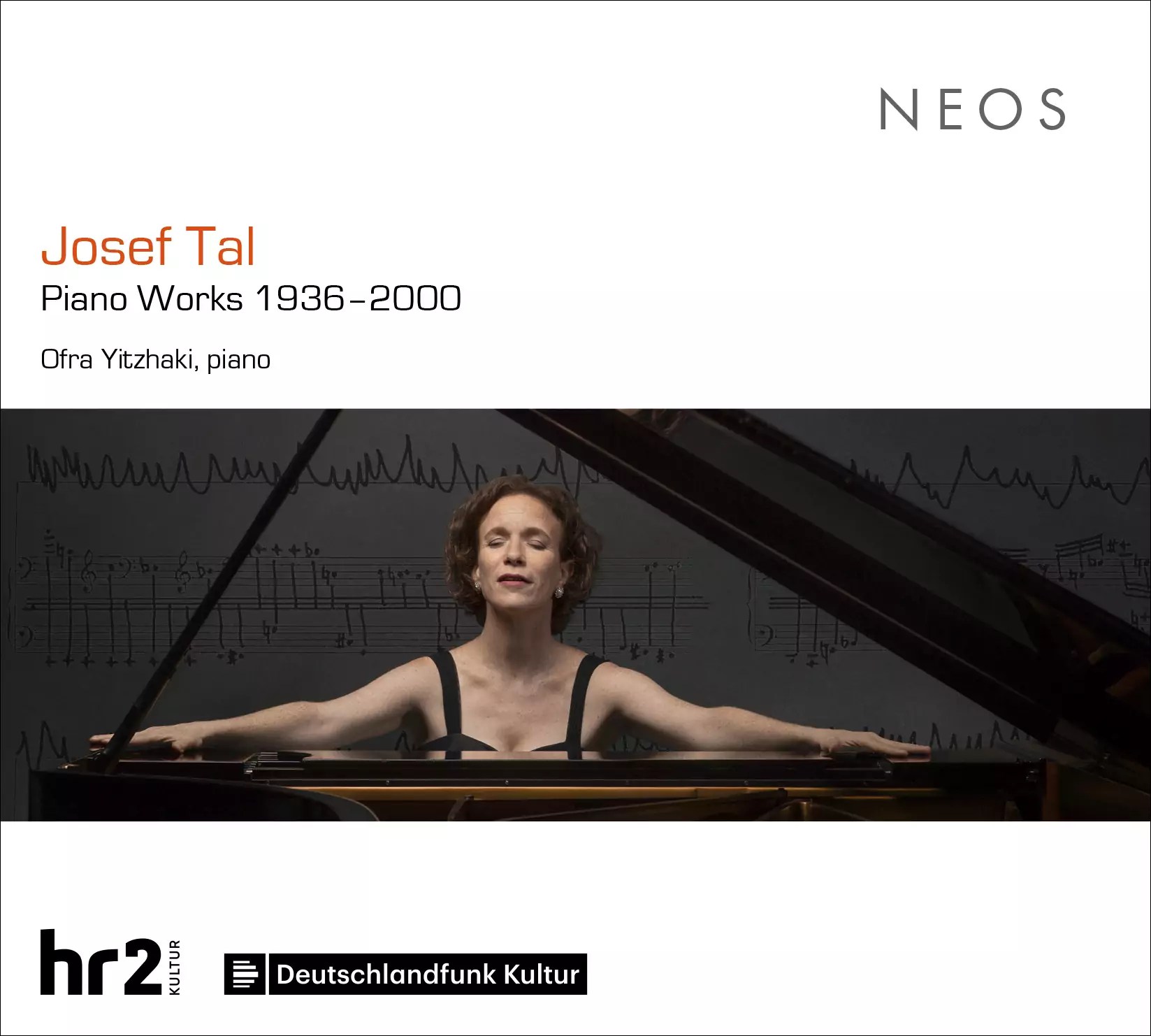
On Record: Ofra Yitzhaki – Josef Tal: Piano Works 1936–2000 (NEOS Music)

Ofra Yitzhaki (piano)

Josef Tal
Sonata for Piano (1949)
Five Densities (1975)
Three Pieces (1937)
Concerto no.5 for Piano and Magnetic Tape (1964)
By the Rivers of Babylon (1951)
Six Sonnets (1946)
Essay IV (1997)
Essay V (2000)
Chaconne (1936)

NEOS Music 12520 [82’04”]
Producers Alexander Hainz and Dominik Weinmann Engineer Robin Bös

Recorded 1-3 September 2022 at Hessian Radio Studio, Frankfurt am Main

Reviewed by Richard Whitehouse

What’s the story?

The enterprising NEOS Music label releases an anthology of piano music by Josef Tal (2010-2008), the German-born Israeli composer who did much to advance the cause of new music in Israel during the post-war era and whose varied output confirms him as a significant creative figure.

What’s the music like?

Little heard in the UK (his Third Symphony featured at the 1979 Proms and his chamber opera The Garden at South Bank Centre in 1998), Tal wrote in all the main genres. His piano music, moving from overt Expressionism to innate Atonalism, is accorded focus by its motivic rigour.

This is evident from the earliest piece here – Chaconne being a consummate study in ‘less is more’ such that its variations on an austerely rhetorical theme merge into an intensifying and cumulative whole, capped by an epiphanic calm prior to the inevitability of a final onslaught. Elements of this language are further explored by the Three Pieces which, in their respective volatility, impetuousness or introspection, denote the influence of Schoenberg’s piano pieces -albeit less those emotional extremes of his Op. 11 than that fastidious subtlety of his Op. 23.

A subtlety duly refined in the Six Sonnets, miniatures of a formal ingenuity and expressive poise out of all proportion to their brevity. From there to the Sonata is to emerge at a crucial stylistic juncture in Tal’s output: again, the modest dimensions (each of its three movements lasting around four minutes) only makes more acute that growing ominousness of its initial movement, the plangency of its central Basso Ostinato (a favoured device throughout Tal’s career) then the mounting impetus of its final Rondo toward a viscerally unequivocal close.

Arranged from a theatrical work, By the Rivers of Babylon conveys a measure of eloquence prior to what became the most radical phase of Tal’s composing. Hence the Concerto No. 5 as replaces orchestra with electronics in a substantial single movement which, whatever the timbral limitations of its magnetic tape, ensures a tense while often combative interplay of mutually opposing forces. This intensity is channelled into the Five Densities, such that its starkly contrasted first four pieces find unlikely yet convincing rapprochement in the fifth.

The remaining works form part of a sequence that extends across Tal’s final creative decades. Essay IV moves stealthily between sharply distinct ideas to an ending which does not resolve but simply cease, and Essay V is more demonstrative as it heads to its terse yet forceful close.

Does it all work?

Indeed it does. A figure nowadays admired more for what his music represents than for what it achieves, Tal left a legacy which is highly significant in or of itself (and one which, unlike almost all Israeli composers of his generation, audibly transcends the idiom of Ernest Bloch). His piano output exemplifies that technical precision, underpinning a creative spontaneity, as are hallmarks of his maturity and which help make this music as relevant to our day as to his own. It also makes for an engrossing and sometimes even entertaining listen in its own right.

Is it recommended?

Indeed it is. Only the Sonata has previously been recorded, and Ofra Yitzhaki’s empathy with this music cannot be denied. Superbly recorded and informatively annotated, this deserves an enthusiastic recommendation, with hopefully a follow-up of Tal’s other piano works to come.

Listen / Buy

You can hear excerpts from the album and explore purchase options at the NEOS Music website. Click on the names to read more about pianist Ofra Yitzhaki and composer Josef Tal

Published post no.2,918 – Monday 15 June 2026
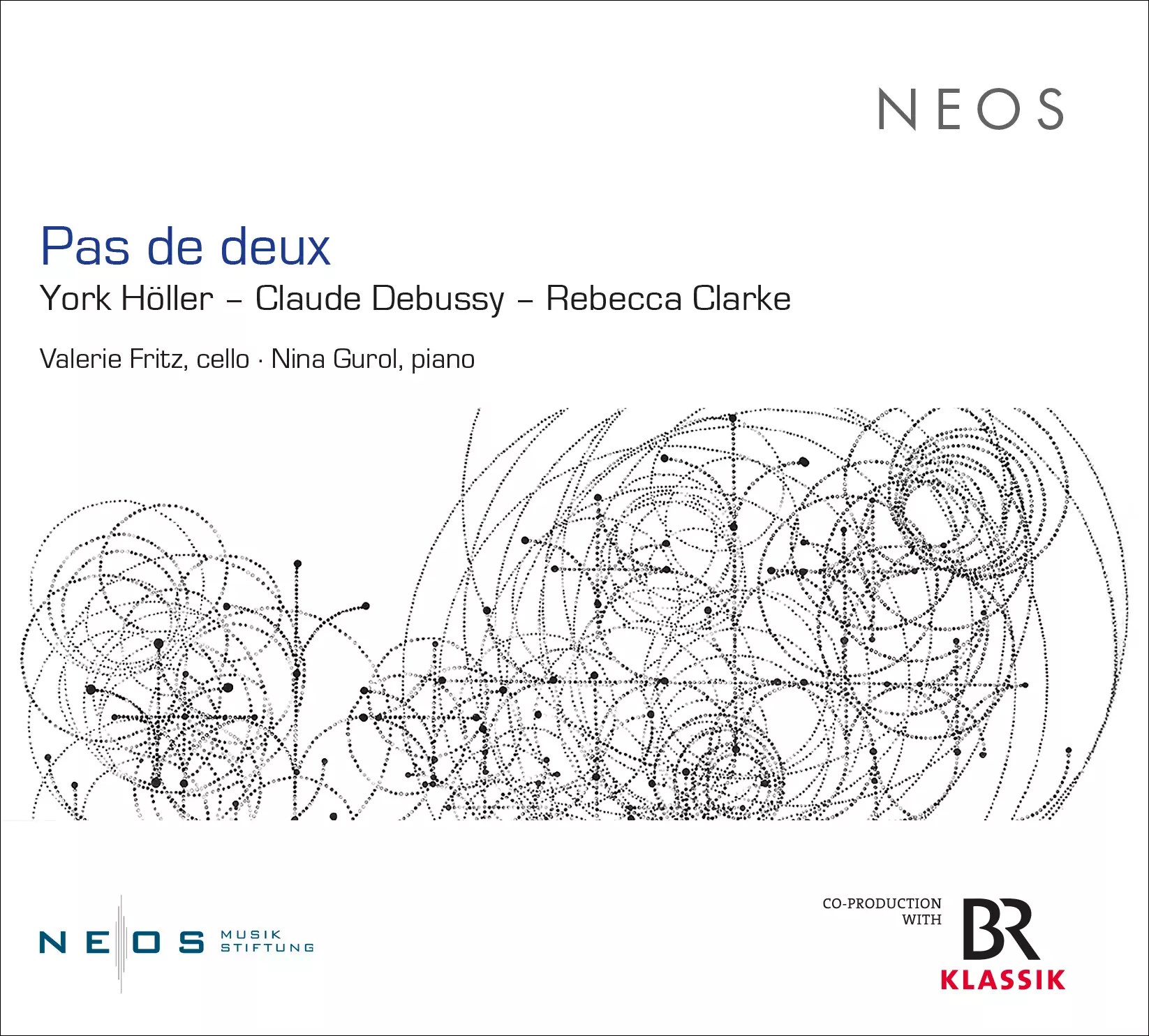
On Record – Valerie Fritz & Nina Gurol: Pas de deux (NEOS Music)

Valerie Fritz (cello), Nina Gurol (piano)

Clarke Viola Sonata (1919, arr. composer)
Debussy Cello Sonata in D minor, L135 (1915)
Höller Mouvements (2010); Piano Sonata no.3 (2010-11); Signe ascendant (2024)

NEOS Music 12526 [74’02”]
Producers Dominik Weinmann, Marie-Josefin Melchior Engineer Klemens Kamp

Recorded 14-16 April 2025 at Studio 2, Bavarian Radio, Munich

Reviewed by Richard Whitehouse

What’s the story?

NEOS issues an album such as places three contrasted works by York Höller (b.1944) within the context of two sonatas from the earlier 20th century, which all adds up to an illuminating programme when realized with the artistry and perception of those musicians featured here.

What’s the music like?

His most recent piece for an instrument prominent in his output, Signe ascendant has Höller paying tribute to Pierre Boulez on what would have been his 100th birthday via a miniature whose motivic content is derived from the latter’s surname – its lucid and eventful unfolding typical of this composer. Written for a competition organized by Kulturkreis der Deutschen Industrie, the Third Piano Sonata comprises a single movement which is in almost constant evolution; its improvisatory opening phase setting out motifs to be developed in alternately incisive and lyrical episodes towards a conclusion the more powerful in expression through being so methodically attained. Coming respectively 42 and 24 years after his earlier such works, the present piece is no less summatory of Höller’s music at its time of composition.

Its being an ‘abstract’ or ‘imaginary’ ballet makes clear the link between Mouvements and similarly designated works by Höller’s teacher Bernd Alois Zimmermann. Not that it could be mistaken for any other composer – witness the sardonic playfulness of its Entrée, duly intensified in the Pas de deux; the Interlude affords a measure of ruminative while by no means uneventful calm, before the Finale ties up any thematic and conceptual loose-ends via a purposefulness as makes this work more than the sum of its already impressive parts.

The first of a projected six sonatas (only three of which were realized) intended to reinforce his innately French aesthetic, Debussy’s Cello Sonata gets a restrained yet insightful reading – its ‘Prologue’ exuding a fugitive uncertainty brusquely countered by the Sérénade, whose disjunctive gestures are duly channelled into the tensile energy of the Finale.

Even finer as an interpretation is that of the Viola Sonata by Rebecca Clarke, in its highly idiomatic cello transcription. Whether in the restless though precisely gauged musings of its Impetuoso, the speculative dialogue of its central Vivace then rapt serenity of its final Adagio which builds unerringly to the bracing and affirmative close, this is a superb rendering of a work that has (rightly) come into its own during the past quarter-century as a cornerstone of its repertoire.

Does it all work?

Undoubtedly – even if, as a sequence, it might have been preferable to have commenced with the Debussy then continue with the three Höller works and ended with the Clarke. That said, it is easy enough to re-programme the order and this hardly detracts from the persuasiveness of what is heard here; Valerie Fritz and Nina Gurol conveying the specific qualities of the duo works while pointing up stylistic connections between them. Those who know Höller’s Third Sonata through Fabio Martino’s account (Oehms) will likely find Gurol even more insightful.

Is it recommended?

Very much so. Spacious but not lacking definition, the sound is well up to NEOS’s customary high standards and there are succinct if informative booklet notes by the musicians. Hopefully there will be further such combinations of modern and contemporary music from this source.

Listen / Buy

You can explore purchase options on the NEOS website. Click on the names to read more about cellist Valerie Fritz, pianist Nina Gurol and composer York Höller

Published post no.2,912 – Tuesday 9 June 2026

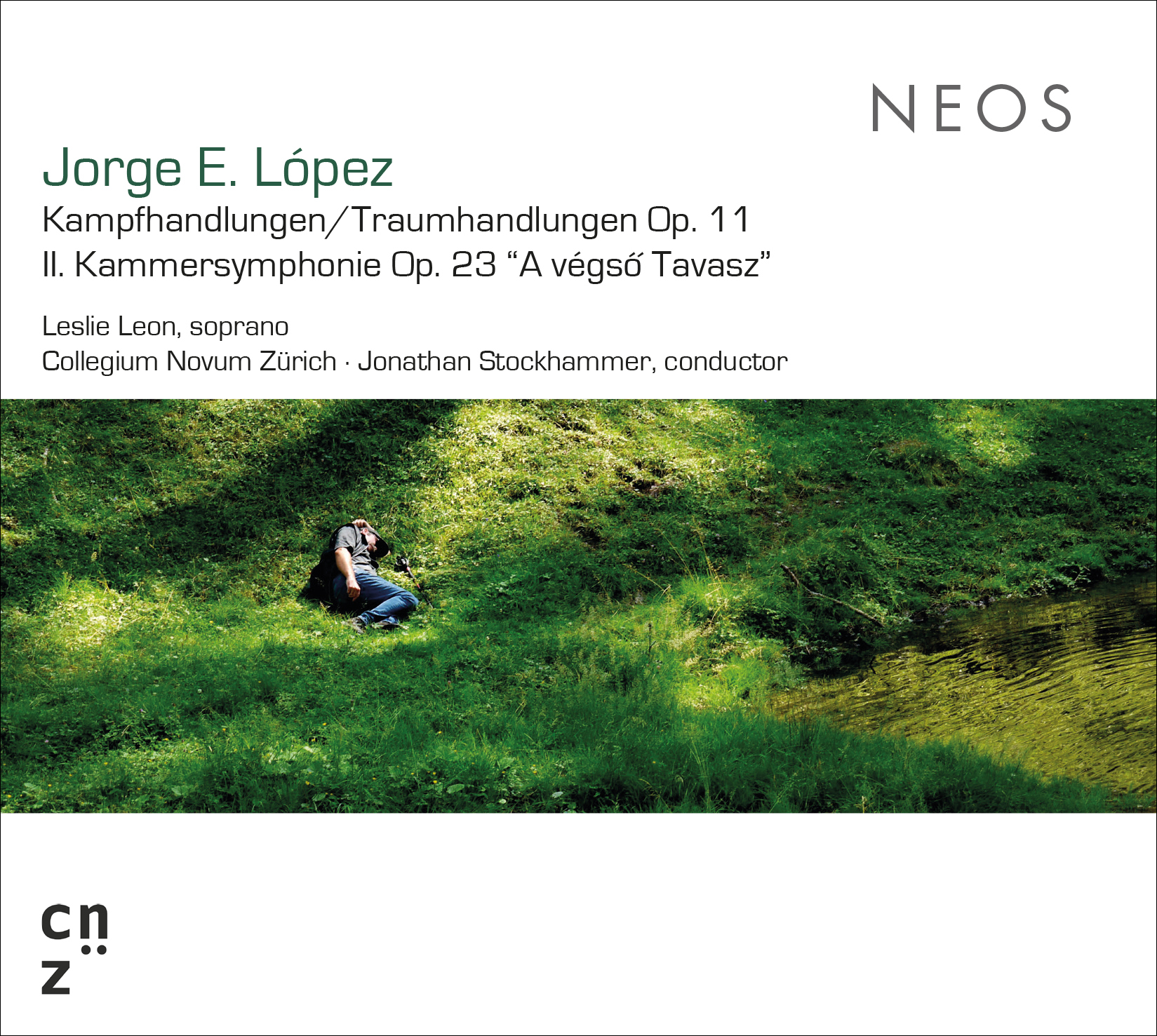
On record – Jorge E. López: Kampfhandlungen/Traumhandlungen & Kammersymphonie II (NEOS Music)

López
Kampfhandlungen/Traumhandlungen Op.11 (1995, rev. 1998)
Chamber Symphony no.2 Op.23, ‘A végsö Tavasz’ (2009-11)*

*Leslie Leon (soprano); Collegium Novum Zürich / Jonathan Stockhammer

NEOS 11912 [74’43”]

Producer Wulf Weinmann
Engineers Leandro Gianini, *Ueli Würth

Recorded 12 April 2018, TOnhalle Maag, *11-15 February 2019 at Radiostudio, Zurich

Written by Richard Whitehouse

What’s the story?

The always enterprising NEOS label releases a second disc devoted to the music of Jorge E. López (b1955) – a composer who has pointedly reassessed that dislocated juncture between late Romanticism and early Modernism, with little concern for any eventual accommodation.

What’s the music like?

Little heard (if at all) in the UK, López was born in Havana then spent his formative years in New York and Chicago, latterly moving to Austria and residing in Vienna since 2008. Largely self-taught as a composer, he was unknown until Michael Gielen championed his Landscape with Martyrdom (Intercord – hopefully to appear as part of SWR Music’s Gielen Edition), as singular an Op. 1 as any in musical history. Since then he has gradually built up a catalogue of 30 predominantly large-scale works, with increasing emphasis on the symphonic genre.

López has frequently spoken of the importance to his thinking of Surrealism, albeit not as an aesthetic but rather a method of musical construction as intuitive as it is flexible. This is made plain in Kampfhandlungen/Traumhandlungen – a visceral workout for large ensemble which emerges in stages from those elemental, Xenakis-like beginnings toward a more individuated discourse with prominent roles for cor anglais and bass trumpet; the whole piece adhering to that ‘Scenes of Combat/Tissue of Dreams’ interplay as posited by its title. Despite an aura of primal metamorphosis as might recall Birtwistle, López’s expressive range is informed more by evocation of human activity in the way his music proceeds in an often erratic while always fascinating trajectory; one whose denouement is the more conclusive for its unexpectedness.

Hardly the first composer to have embraced symphonic writing belatedly, López has focussed increasingly on the genre (he is currently completing his Fifth). The first two are for chamber forces, the Second taking its subtitle – which translates as The Final Spring – from the late 19th-century Hungarian poet Endre Ady. Should this bring to mind an exercise in ruminative introspection, the music confirms otherwise – its 52 minutes unfolding over five movements that consist of a compressed sonata design, further skewed by cadenzas for piano and horn; a sizeable and disruptive scherzo at length waylaid by (surreal) intimation of children’s songs; a halting and edgy intermezzo periodically arraigned by percussive fusillades; another scherzo that rapidly assumes a Mahlerian façade, where the soprano functions as a constituent of the ensemble in that her singing makes phonetic rather than semantic sense; then a finale whose martial undertow affords recollections of earlier movements (notably the first) as it heads to a conclusion of an inevitability which, not for the first time with López, arises out of nothing.

Does it all work?

It does, once one accepts López is not so much breaking the rules of formal and expressive continuity as refashioning them according to his needs; something Jonathan Stockhammer conveys in gratifying measure through these assured readings by Collegium Novum Zürich.

Is it recommended?

Very much so. The sound could hardly be improved on for clarity or perspective, and there is an informative overview by Jens Schubbe with a more subjective appreciation by Láng Zsolt. NEOS will hopefully be issuing further releases by this fascinating and absorbing composer.

Listen

Buy

You can listen to clips from the recording and buy this release at the Presto website

Read

You can read more about this release on the NEOS website, while for more information on Jorge E. López head to the Musica Austria website