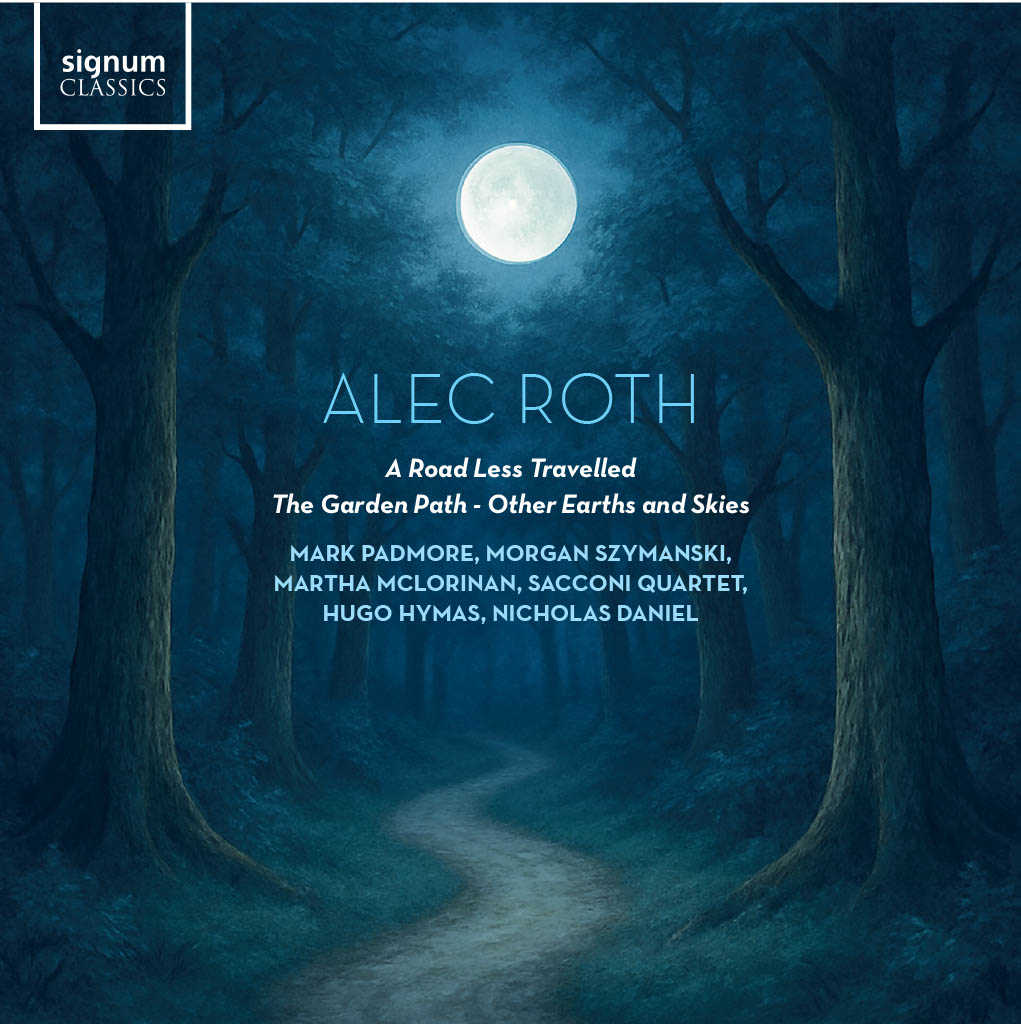
On Record – Mark Padmore, Martha McLorinan, Hugo Hynas, Morgan Szymanski, Nicholas Daniel, Sacconi Quartet: Alec Roth: Chamber Music with Voice (Signum Classics)

Mark Padmore (tenor), Morgan Szymanski (guitar) (A Road Less Travelled); Martha McLorinan (mezzo-soprano), Sacconi Quartet [Ben Hancox and Hannah Dawson (violins), Robin Ashwell (viola), Cara Berridge (cello)] (The Garden Path), Hugo Hymas (tenor) with Nicholas Daniel (oboe) (Other Earths and Skies)

Alec Roth
A Road Less Travelled (2017)
The Garden Path (2013, rev. 2022)
Other Earths and Skies (2010, rev. 2022)

Signum Classics SIGCD971 [61’12”] English texts included
Producer Adrian Peacock Engineer David Hinnitt

Recorded 6,8 & 10 October 2025 at Church of St Anne and St Agnes, Gresham Street, City of London

Reviewed by Richard Whitehouse

What’s the story?

Signum Classics resumes its coverage of Alec Roth (b.1948) with this album of song-cycles, their scoring with guitar, string quartet or oboe confirming the versatility of the composer’s idiom and enabling each to be enjoyed on its own terms or as part of the overall programme.

What’s the music like?

Best known for larger-scale choral works (though his string quartets – recorded by the Allegri Quartet on RTF Classical NI6321 – are well worth anyone’s investigation), Roth has produced a number of song-cycles whose accompaniment can be as crucial as the words in determining the overall expressive trajectory. Each of these works has notable British precedents – Britten or Walton with guitar, Gurney or Vaughan Williams with string quartet, then VW again with oboe – though, in terms of his fashioning a personal response, Roth is definitely his own man.

Performable with guitar and/or string quartet (the former chosen here), A Road Less Travelled sets (whole or in part) 12 poems by Edward Thomas – though the title is actually the title of a poem by Robert Frost, the American poet who had encouraged Thomas to develop his poetic muse. Pivoting around an instrumental Interlude, the settings in this ‘solo cantata’ are mainly brief while strongly evocative of a mood shared by all these texts; namely, the journey itself as more lastingly significant than the destination indicated, or at least implied, over its course.

The ‘song-cycle’ that is The Garden Path utilizes four poems by Amy Lowell and started out with piano accompaniment before being revised with string quartet. Here it is those parallels between her garden, which the poet describes in its myriad states and variety, and the human condition which come to the fore in these four relatively lengthy settings; alongside a feeling of what may lie beyond such luxuriance and abundance for the protagonist, as for the reader. That such ambiguity emerges so candidly yet obliquely is integral to this cycle’s fascination.

Finally to Other Earth and Skies – these ‘five miniatures’ after eighth-century Chinese poet Li Bai (once known as Li Tai-po) having been translated by Vikram Seeth, an author with whom Roth has collaborated on numerous occasions. It is the haiku-like brevity and concentration of the texts as sets the tone for this sequence, with its interplay between all-too-human emotions and metaphysical longing in which any vestige of ego has been subsumed into the numinous. Quite likely the deepest such cycle featured on this album, and certainly the most intriguing.

Does it all work?

Pretty much throughout. As an adherent of the ‘less is more’ ethos, Roth’s settings are almost consistently spare in texture and restrained in manner; their meaning arising out of the actual words as much as from any poetic gloss. Demonstrably yet never stereotypically tonal, while often teasing as to their emotional remit, this is song-writing of a high order and as pleasurable for the listeners as they are manifestly are for the singers and instrumentalists featured herein. All the texts are included, though there is never any problem with hearing what is being sung.

Is it recommended?

Indeed it is. The church acoustic is evidently an ideal ambience for recording such music, and those who respond to it should investigate earlier releases of Roth on this label – most notably the vocal miscellanies Songs in Time of War (SIGCD124) or Sometime I Sing (SIGCD332).

Listen / Buy

You can listen to excerpts and explore purchase options at the Signum Records website. Click on the names to read more about composer Alec Roth, and the performers Mark Padmore, Martha McLorinan, Hugo Hymas, Morgan Szymanski, Nicholas Daniel and the Sacconi Quartet

Published post no.2,893 – Wednesday 20 May 2026

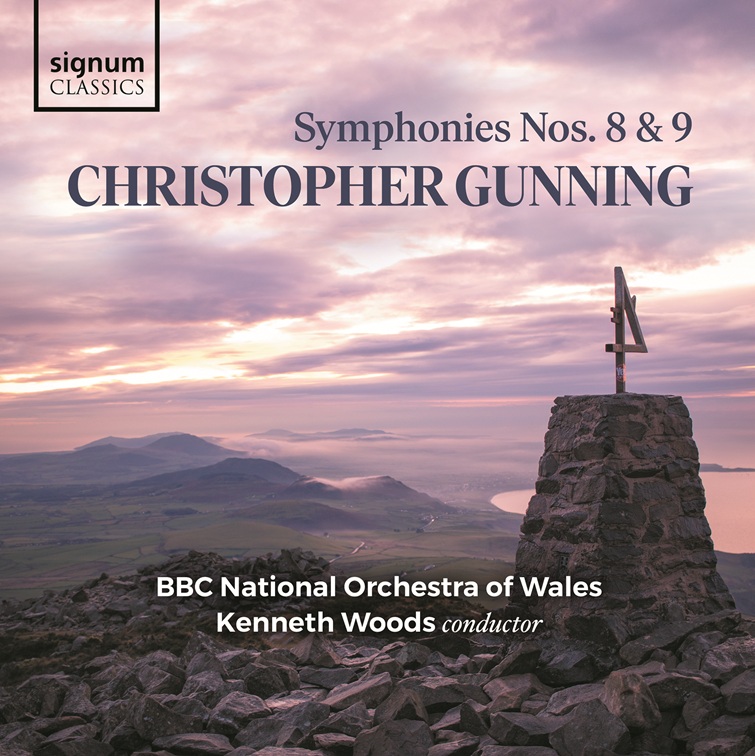
On Record – BBC National Orchestra of Wales / Kenneth Woods – Christopher Gunning: Symphonies nos. 8 & 9 (Signum Classics)

BBC National Orchestra of Wales / Kenneth Woods

Christopher Gunning
Symphony no.8 (2015)
Symphony no.9 (2016)

Signum Classics SIGCD949 [67’33”]
Producer Phil Rowlands Engineer Mike Hatch

Recorded 11-13 March 2024, Hoddinott Hall, Wales Millennium Centre, Cardiff

Reviewed by Richard Whitehouse

What’s the story?

Signum Classics continues its coverage of the late Christopher Gunning with this coupling of two symphonies, a genre that dominated the composer’s thinking in later years, and which get the advocacy they deserve from the BBC National Orchestra of Wales with Kenneth Woods.

What’s the music like?

Although he studied at London’s Guildhall School of Music and Drama with early ambitions as a symphonist, Gunning’s subsequent career was centred on scores for film and television with successful excursions into popular music. Not until 2001, when he was nearing 58, did he complete his First Symphony that was followed by a further 12 over the next two decades, along with several concertos and other orchestral pieces, in what is among the more notable instances of a composer moving between very different disciplines with comparable success.

Written for modest and what might be called ‘late-Classical’ forces, both symphonies are as integrated formally as they are resourceful motivically while, in both instances, movements are merely numbered rather than designated by tempo or expression. The Eighth Symphony consists of three movements unfolding from a sonata design of deft formal proportions with a slower introduction, via a slow movement whose ruminative cast is enhanced by plaintive contributions from flute and cor anglais, to a finale whose scherzo inclinations afford it an impetus and lightness maintained through to the decisive close. An earlier era of American symphonism (ostensibly that of Walter Piston or Randall Thompson) can be detected in its harmonic colouring and melodic contours, but Gunning’s personality is audible throughout.

Scored for slightly larger forces and with four movements, the Ninth Symphony feels no less focussed formally while admitting a wider range of or, at least, of more ambivalent emotions. Thus the opening movement again adheres to sonata design, with a more discursive (though never rhapsodic) take on its primary ideas. This is followed by a speculative or even fugitive scherzo, then a slow movement whose sustained eloquence arguably makes for the highlight of either symphony. It only remains for the finale, its progress as purposeful as it is eventful, to afford a conclusiveness that feels not at all premeditated, let alone predictable. If, in both these works, there is a tangible inner drama which is being played out, Gunning is first and foremost a symphonist for whom abstract concerns override any more subjective tendencies.

Does it all work?

It does indeed – thanks, above all, to Gunning’s unstinting focus on what symphonic form is and can be. Those familiar with any of his other symphonies will know that there is nothing anecdotal or half-baked about his handling of the genre, which emerges as the self-sufficient concept it ideally should be. It helps, of course, that Woods renders both these works with the insight expected from a conductor whose 21st Century Symphony Project has been crucial in rehabilitating the symphony in the UK, and who secures committed playing from BBCNOW.

Is it recommended?

Very much so. Recorded with all the necessary definition, and informatively annotated, this is well worth acquiring by those who are not yet acquainted with Gunning’s symphonic odyssey. Only recordings of the 11th, 13th and the revised First remain to complete an important cycle.

Listen / Buy

You can hear excerpts from the album and explore purchase options at the Signum Classics website, or you can listen to the symphonies on Tidal. Click on the names to read more about composer Christopher Gunning, the BBC National Orchestra of Wales and conductor Kenneth Woods

Published post no.2,782 – Thursday 29 January 2026

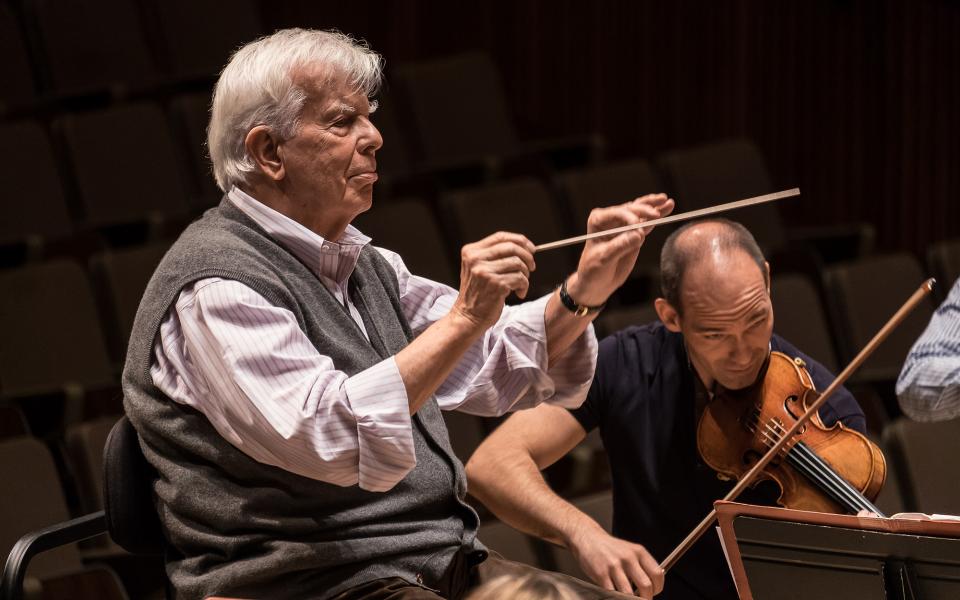
In Appreciation – Christoph von Dohnányi

by Ben Hogwood Picture by Clive Barda

In the last week we learned of the sad news of the death of conductor Christoph von Dohnányi, at the age of 95.

You can read an obituary for him on the Guardian website, and tributes from each of the orchestras with which he had a special relationship – the Cleveland Orchestra, where he was chief conductor from 1984 until 2002, the Philharmonia Orchestra, where he was principal guest conductor, then principal conductor from 1997 to 2008, then honorary conductor for life – and the Vienna Philharmonic Orchestra, with whom he worked from 1966 to 2019.

Dohnányi’s prodigious discography, mostly recorded on the Decca Classics, Telarc and Signum Classics labels, is rich in opera and symphonic repertoire, but he also had a reputation for fine recordings of modern music, including colourful examinations of the worlds of Webern, Carl Ruggles and Lutosławski. These recordings, together with a special Cleveland account of Dvořák’s Symphony no.6, make up the playlist below:

https://tidal.com/playlist/ae221923-6f02-4402-8d59-932b6a79c265

Published post no.2,656 – Saturday 13 September 2025

On Record – Parry Karp, BBC National Orchestra of Wales – Bloch: Schelomo & Suite (Signum Classics)

Ernest Bloch
Schelomo (1918)
Suite for Viola and Orchestra (1919; arr. Rejtő/Baller, 1969)

Parry Karp (cello), BBC National Orchestra of Wales / Kenneth Woods

Signum Classics SIGCD932 [60’58”]
Producer Phil Rowlands Engineer Andrew Smilie

Recorded 29-30 July 2024 at BBC Hoddinott Hall, Wales Millennium Centre, Cardiff

Reviewed by Richard Whitehouse

What’s the story?

Signum Classics issues its first release devoted to Ernest Bloch (1880-1959), comprising what is his best-known work alongside a piece that receives its first recording in a version for cello and orchestra – making for a representative introduction to this now under-appreciated figure.

What’s the music like?

Considered in his lifetime to be on a par with such contemporaries as Bartók and Stravinsky, Bloch duly suffered that almost inevitable falling off of reputation from which his music has never quite recovered, but almost all his major works have now been recorded and often on several occasions. Among his sizable output, those with a concertante element are especially notable for their redefining the relationship between soloist and orchestra as holds good for the present works, written as they were either side of the composer’s emigration to the USA.

Its title might translate as Solomon, but Schelomo is by no means a portrait of the Biblical monarch nor is the solo part merely a ‘translation’ of lines from Ecclesiastes such as Bloch had initially intended to set. This ‘Hebraic Rhapsody’ is the last and most representative, if not necessarily the finest, of his Jewish Cycle, its three contrasting sections amounting to a concerto (or maybe a Konzertstück) in terms of their encompassing a gradually cumulative ‘exposition’, then an impulsively tense ‘development’ whose impassioned climax subsides into a ‘reprise’ which takes in a musing accompanied cadenza prior to the starkly fatalistic close. Parry Karp is a perceptive interpreter – one who never over-emphasizes its eloquence or rhetorical overkill, while rendering the piece as a cohesive and an audibly unified whole.

Conceived for viola and piano, the Suite was orchestrated soon afterward then arranged for cello a half-century on by cellist Gábor Rejtő and pianist Adolph Baller. The layout, though not so integrated as to make it a concerto, is none the less striking. Its lengthy initial Lento (originally entitled ‘In the Jungle’) pits soloist against orchestra in a fantasia-like evolution that finds effective contrast in an alternately capricious and ruminative Allegro ironico, then the songfulness of an equally compact Lento; its searching inwardness pointedly dispelled by the lively and playful Molto vivo which brings about an affirmative conclusion. Karp is fully attuned to its understated charm and Kenneth Woods, who directed the likely premiere of this version in 2008, secures playing of sensitivity and imagination from the BBC NOW.

Does it all work?

Almost always. As his introductory note makes plain, Karp has been an enthusiastic advocate for this music throughout his career and there is no doubting the extent of his commitment in either piece. Schelomo remains Bloch’s most recorded work such that those who have any one of Gregor Piatigorsky (Testament), Pierre Fournier (DG), Mstislav Rostropovich (Warner) or, more recently, Sol Gabetta (Sony) can rest content; yet this newcomer is worth a place on any shortlist and a first recording of the Suite in this guise makes the release self-recommending.

Is it recommended?

It is. Balance between cello and orchestra could not be bettered in the spacious yet analytical ambience of Hoddinott Hall, while Woods contributes his customary insightful observations. Aficionados and newcomers alike will find much to delight and absorb them on this release.

Listen / Buy

You can read more about this release and explore purchase options at the Signum Records website. Click on the names to read more about cellist Perry Karp, the BBC National Orchestra of Wales and conductor Kenneth Woods, and for the Ernest Bloch Society

Published post no.2,585 – Friday 4 July 2025

On Record – Anna Huntley, Gwilym Bowen, Thomas Mole, BBC Women’s Chorus of Wales, ESO / Kenneth Woods – Walter Arlen: The Song of Songs, The Poet In Exile (Signum Classics)

Arlen arr. Bekmambetov / ed. Woods The Song of Songs (1953)
Arlen ed. Woods The Poet in Exile (1988, rev. 1994)

Anna Huntley (mezzo-soprano), Gwilym Bowen (tenor), Thomas Mole (baritone), BBC Women’s Chorus of Wales, English Symphony Orchestra / Kenneth Woods

Signum Classics SIGCD879 [52’21’’]
Producer / Engineer Phil Rowlands, Engineer Andrew Smilie

Recorded 17-20 February 2022 at BBC Hoddinott Hall, Cardiff

Reviewed by Richard Whitehouse

What’s the story?

Kenneth Woods and the English Symphony Orchestra continue their exploration of music by composers murdered or forced into exile during the Third Reich with this release of Walter Arlen, whose recent death at 103 enabled him to experience a renewed interest in his music.

What’s the music like?

Although he remains best known through his trenchant music criticism for the Los Angeles Times, the Vienna-born Walter Arlen (Aptowitzer) also made a distinguished contribution to music administration and left a not inconsiderable output. Several albums featuring his songs and piano music can be heard on the Gramola label, while this latest ESO release provides a welcome introduction to two of his works that involve larger forces – the one drawing on an ancient Jewish source and the other upon poems by a seminal author from the post-war era.

Whether or not The Song of Songs is the harbinger of monogamy in the Judeo-Christian moral code, it contains some of the eloquent expression found in either Biblical testament. In just 30 minutes, Arlen’s ‘dramatic poem’ takes in the main narrative, its lively initial chorus featuring intricate polyphony for female voices and incisive orchestral textures. As the piece unfolds, its emotional emphasis is placed on the solo contributions – whether those of Solomon sung with burnished warmth by Thomas Mole, those of the Shepherdess with poise and insouciance by Anna Huntley, or those of the Shepherd given with virility and tenderness by Gwilym Bowen. Nor is the BBC Women’s Chorus of Wales wanting in intonational accuracy. If the resolution does not bring expected closure, this direct and unaffected setting certainly warrants revival.

The real discovery is The Poet in Exile, a song-cycle to texts by Polish-born American author Czesław Miłosz. These profound poems are not easily rendered in musical terms, and it is to Arlen’s credit that he goes a considerable way to achieving this. As the composer states, they ‘‘dealt with situations echoing my own remembrance of things past’’ – as holds good from the trenchant rhetoric of ‘Incantation’, via the sombre rumination of ‘Island’ then wistful elegance of ‘In Music’ or controlled fervour of ‘For J.L.’ (with its striking harpsichord obligato), to the confiding intimacy of ‘Recovery’. Some may have heard these songs with Christian Immler and Danny Driver (GRAM98946) but this orchestration by Woods, after the arrangement by Eskender Bekmambatov, offers a wider-ranging context for assured singing by Thomas Mole.

Does it all work?

Pretty much, and not least because the ESO is heard to advantage in the spacious acoustic of Hoddinott Hall while directed by Woods with unerring sense of where to place the emotional emphasis – especially important in conveying the meaning of the songs. A pity, however, that neither texts nor translations could be included here – not least as that by Leroy Waterman of The Song of Songs is appreciably different from those which have been previously set, while the Miłoz poems are worth savouring on their own terms and need to be approached as such.

Is it recommended?

It is. If not a major voice, Arlen’s music is always approachable and often thought-provoking. Initiates and newcomers alike will enjoy getting to know these works and hearing them given so persuasively – a worthy present, indeed, for this composer as he neared his 102nd birthday.

Listen & Buy

Click on the names to read more about performers Anna Huntley, Gwilym Bowen, Thomas Mole, the English Symphony Orchestra and conductor Kenneth Woods. Click on the name for more on Walter Arlen

Published post no.2,515 – Saturday 26 April 2025