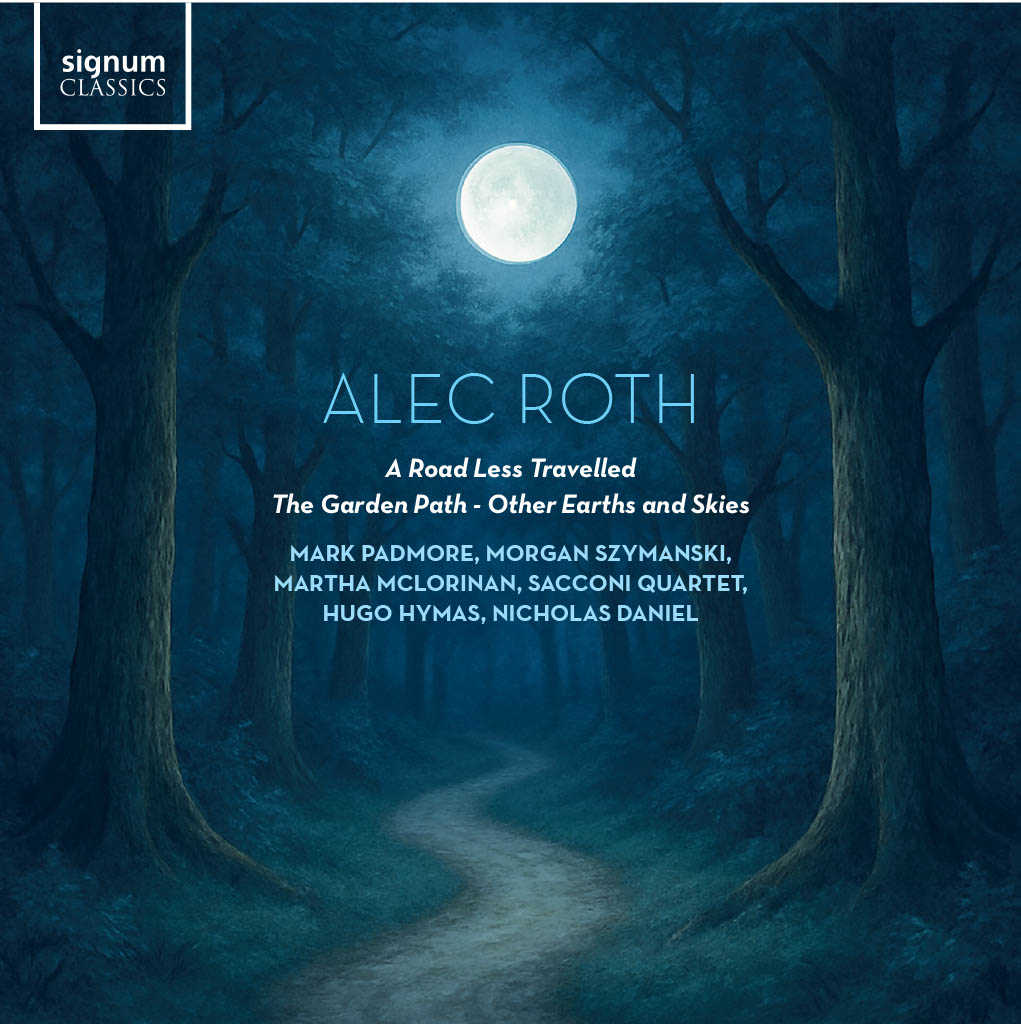
On Record – Mark Padmore, Martha McLorinan, Hugo Hynas, Morgan Szymanski, Nicholas Daniel, Sacconi Quartet: Alec Roth: Chamber Music with Voice (Signum Classics)

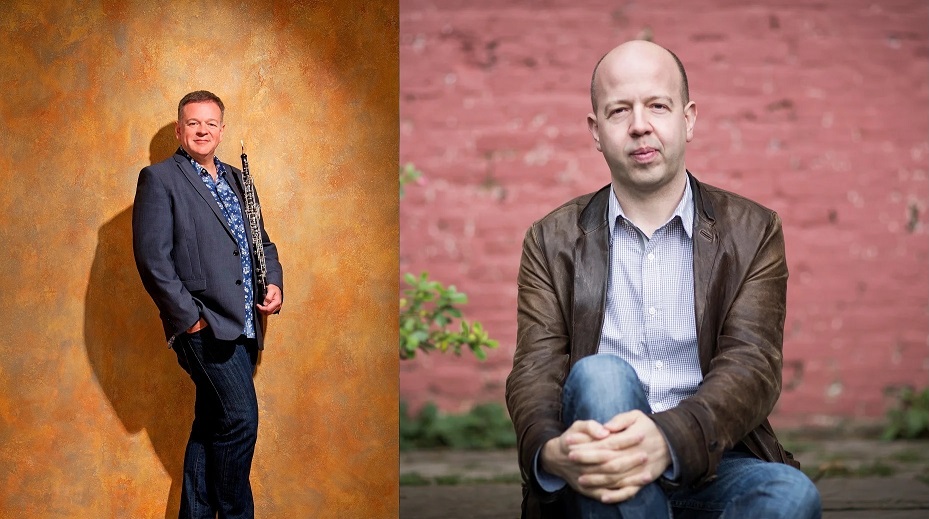
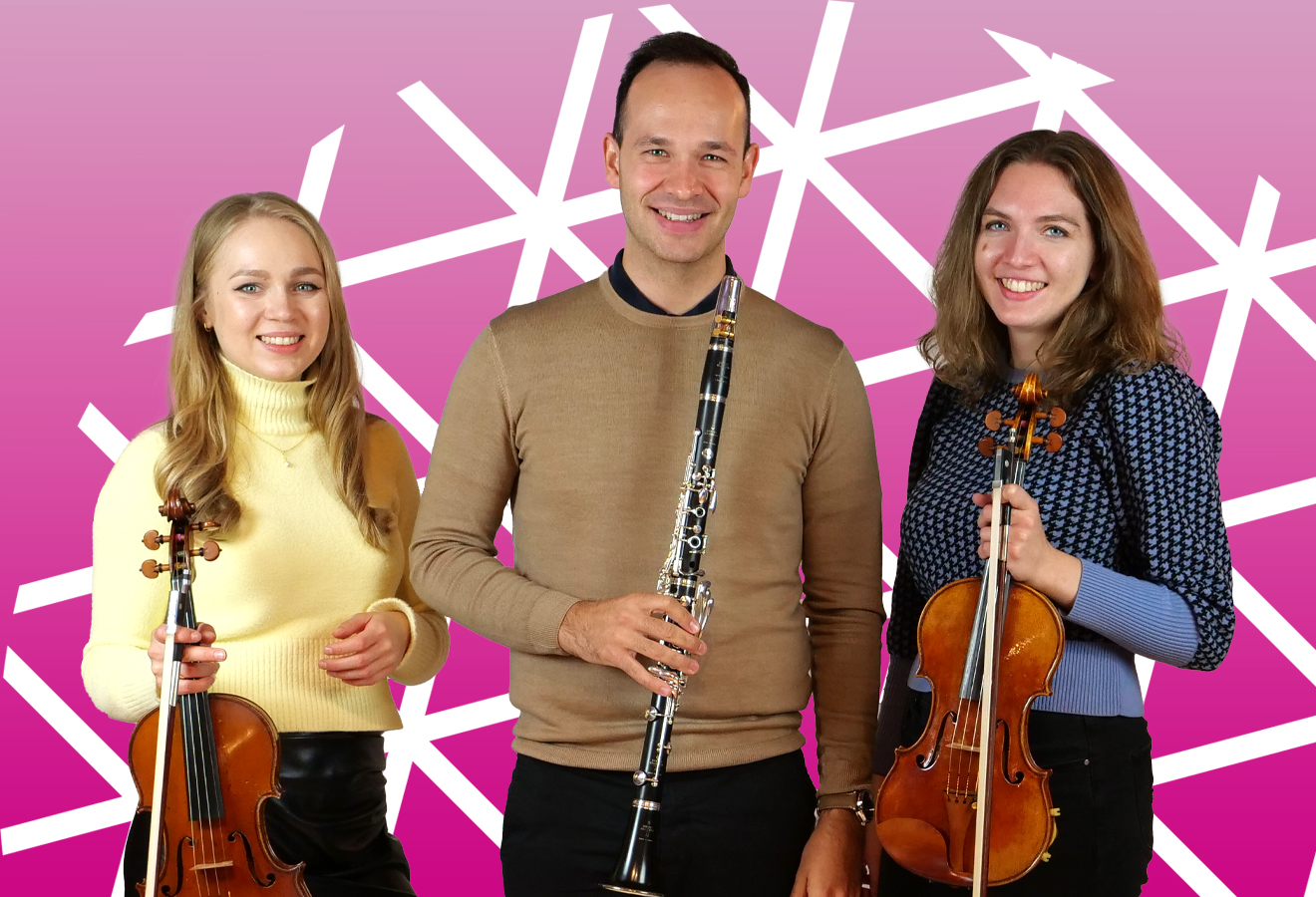
Mark Padmore (tenor), Morgan Szymanski (guitar) (A Road Less Travelled); Martha McLorinan (mezzo-soprano), Sacconi Quartet [Ben Hancox and Hannah Dawson (violins), Robin Ashwell (viola), Cara Berridge (cello)] (The Garden Path), Hugo Hymas (tenor) with Nicholas Daniel (oboe) (Other Earths and Skies)

Alec Roth
A Road Less Travelled (2017)
The Garden Path (2013, rev. 2022)
Other Earths and Skies (2010, rev. 2022)

Signum Classics SIGCD971 [61’12”] English texts included
Producer Adrian Peacock Engineer David Hinnitt

Recorded 6,8 & 10 October 2025 at Church of St Anne and St Agnes, Gresham Street, City of London

Reviewed by Richard Whitehouse

What’s the story?

Signum Classics resumes its coverage of Alec Roth (b.1948) with this album of song-cycles, their scoring with guitar, string quartet or oboe confirming the versatility of the composer’s idiom and enabling each to be enjoyed on its own terms or as part of the overall programme.

What’s the music like?

Best known for larger-scale choral works (though his string quartets – recorded by the Allegri Quartet on RTF Classical NI6321 – are well worth anyone’s investigation), Roth has produced a number of song-cycles whose accompaniment can be as crucial as the words in determining the overall expressive trajectory. Each of these works has notable British precedents – Britten or Walton with guitar, Gurney or Vaughan Williams with string quartet, then VW again with oboe – though, in terms of his fashioning a personal response, Roth is definitely his own man.

Performable with guitar and/or string quartet (the former chosen here), A Road Less Travelled sets (whole or in part) 12 poems by Edward Thomas – though the title is actually the title of a poem by Robert Frost, the American poet who had encouraged Thomas to develop his poetic muse. Pivoting around an instrumental Interlude, the settings in this ‘solo cantata’ are mainly brief while strongly evocative of a mood shared by all these texts; namely, the journey itself as more lastingly significant than the destination indicated, or at least implied, over its course.

The ‘song-cycle’ that is The Garden Path utilizes four poems by Amy Lowell and started out with piano accompaniment before being revised with string quartet. Here it is those parallels between her garden, which the poet describes in its myriad states and variety, and the human condition which come to the fore in these four relatively lengthy settings; alongside a feeling of what may lie beyond such luxuriance and abundance for the protagonist, as for the reader. That such ambiguity emerges so candidly yet obliquely is integral to this cycle’s fascination.

Finally to Other Earth and Skies – these ‘five miniatures’ after eighth-century Chinese poet Li Bai (once known as Li Tai-po) having been translated by Vikram Seeth, an author with whom Roth has collaborated on numerous occasions. It is the haiku-like brevity and concentration of the texts as sets the tone for this sequence, with its interplay between all-too-human emotions and metaphysical longing in which any vestige of ego has been subsumed into the numinous. Quite likely the deepest such cycle featured on this album, and certainly the most intriguing.

Does it all work?

Pretty much throughout. As an adherent of the ‘less is more’ ethos, Roth’s settings are almost consistently spare in texture and restrained in manner; their meaning arising out of the actual words as much as from any poetic gloss. Demonstrably yet never stereotypically tonal, while often teasing as to their emotional remit, this is song-writing of a high order and as pleasurable for the listeners as they are manifestly are for the singers and instrumentalists featured herein. All the texts are included, though there is never any problem with hearing what is being sung.

Is it recommended?

Indeed it is. The church acoustic is evidently an ideal ambience for recording such music, and those who respond to it should investigate earlier releases of Roth on this label – most notably the vocal miscellanies Songs in Time of War (SIGCD124) or Sometime I Sing (SIGCD332).

Listen / Buy

You can listen to excerpts and explore purchase options at the Signum Records website. Click on the names to read more about composer Alec Roth, and the performers Mark Padmore, Martha McLorinan, Hugo Hymas, Morgan Szymanski, Nicholas Daniel and the Sacconi Quartet

Published post no.2,893 – Wednesday 20 May 2026

In concert – CBSO Winds / Nicholas Daniel: Anna Clyne ‘Overflow’ & Mozart ‘Gran Partita’

CBSO Winds / Nicholas Daniel (oboe, above)

Clyne Overflow (2020)
Mozart Serenade no.10 in B flat major K361 ‘Gran Partita’ (1781)

Town Hall, Birmingham
Sunday 26 January 2025 (3pm)

Reviewed by Richard Whitehouse

An interesting and worthwhile strand in the City of Birmingham Symphony Orchestra’s current season is the series of Sunday afternoon programmes focussing on each of the orchestra’s sections. Last November brought the strings for a perceptive account of Bach’s Goldberg Variations, as arranged by Dmitry Sitkovetsky and the present recital duly centred upon the woodwind in what was dominated – not unreasonably so – by a performance of Mozart’s epic Gran Partita.

Still the finest and probably longest work ever composed for wind ensemble, it also remains the canniest example of ‘functional’ music raised to a level such as transcends its immediate purpose. Not the least of its virtues is the way in which its orchestration – comprising pairs of oboes, clarinets, basset horns and bassoons along with four horns and double-bass – suggests timbral and textural possibilities as profound as they are far-reaching. Put another way, this is ‘Harmoniemusik’ which makes of a localized and even provincial genre something universal.

Such a quality was rarely less than present in this performance. Right from its trenchant yet never portentous introduction, the opening Allegro found an enticing balance between poise and impulsiveness matched by that between tutti and ensemble passages. The first Menuetto was notable for the winsome elegance of its second trio, then the ensuing Adagio yielded no mean pathos without risk of sentimentality at a flowing tempo abetted by that effortlessness of dialogue which proved a hallmark of this movement as of the performance taken overall.

Although less overtly characterful than its predecessor, the second Menuetto did not lack for personality and while the Romanze feels the least essential part of the overall conception, it still made for a pertinent entrée into the Tema con variazioni. This longest and most varied movement also encapsulates the work overall in its expressive contrasts which were to the fore here – the last variation preparing unerringly for a final Allegro whose relative brevity was belied by a drive, even forcefulness that propelled the whole work to its decisive close.

It was a testament to the excellence of these musicians that one never suspected the absence of any guiding hand, for all that guest first oboist Nicholas Daniel could be seen encouraging the players whenever his part permitted. Neither was there any sense of the latter being other than integral to the overall ensemble, such was the underlying felicity and finesse with which it conveyed the depths of what must surely rank among its composer’s greatest achievements. Not a bad way, moreover, for the CBSO’s woodwind to savour its occasion ‘in the spotlight’.

The programme had commenced just over an hour earlier with Overflow, a short but eventful piece where Anna Clyne draws inspiration from Emily Dickinson’s poetry (and, in turn, that by Jelaluddin Rumi) in music which treads an audibly viable balance between the ruminative and capricious. It made an understated showcase for the CBSO woodwind, whose brass and percussion colleagues are heard in the next of these recitals when Alpesh Chauhan directs a varied programme climaxing in Pictures at an Exhibition arranged by the late Elgar Howarth.

List of players: Marie-Christine Zupancic and Veronika Klirova (flutes), Nicholas Daniel and Emmet Byrne (oboes), Oliver Janes and Joanna Paton (clarinets), Anthony Pike and Steve Morris (basset horns), Nikolaj Henriques and Tony Liu (bassoons), Elspeth Dutch and Neil Shewan (horns), Julian Atkinson (double bass)

For details on the upcoming CBSO Brass & Percussion concert, heard to the City of Birmingham Symphony Orchestra website. Click on the names for more on Nicholas Daniel and composer Anna Clyne

Published post no.2,426 – Wednesday 29 January 2025

Online Concert recommendation: Nicholas Daniel & Huw Watkins @ Wigmore Hall

Nicholas Daniel (oboe, picture (c) Eric Richmond), Huw Watkins (piano, picture (c) Benjamin Ealovega

by Ben Hogwood

Here is a nudge in the direction of a very fine concert given at the Wigmore Hall yesterday by oboist Nicholas Daniel and pianist Huw Watkins.

They were in the company of three fine living composers – Althea Talbot-Howard, Michael Berkeley and David Matthews – whose music features in the concert, alongside works by Clara and Robert Schumann, and an arrangement for oboe and piano of a Mozart violin sonata.

Talbot-Howard’s contribution is to rework an attractive sonata for flute and harp by Joseph Bologne, Chevalier de Saint-Georges, for oboe and piano, another stage in the concert rehabilitation of this remarkable 18th century composer.

You can watch a lovely, affirmative hour of music on YouTube below:

For more livestreamed concerts from the Wigmore Hall, click here

Published post no.1,995 – Tuesday 31 October 2023

In concert – Southbank Sinfonia – Journeys Through Worlds (Álvarez, Woolrich, Burell and Glass); Eruptions of Sound and Colour (Simpson and Mozart)

Journeys Through Worlds
Álvarez Metro Chabacano (1986, rev. 1991)
Woolrich Ulysses Awakes (1989)
Burrell Das Meer, das so gross und weit ist, da wimmelt’s ohne zahl, grosse und kleine Tiere (1992)
Glass Symphony no.3 (1995)
Southbank Sinfonia / Owain Park

Eruptions of Sound and Colour
Mark Simpson Geysir (2014)
Mozart Serenade no.10 in B flat major K361 ‘Gran Partita’ (1781-2)
Southbank Sinfonia / Nicholas Daniel

St John’s, Smith Square, London
Thursday 19 January 2023 @ 7pm and 9pm

Reviewed by Richard Whitehouse

A typically diverse programme by Southbank Sinfonia; actually two programmes, each of which lasted just over and hour and offered respective showcases for the strings then woodwind of this enterprising outfit – now into the second season of its St John’s residency.

Journeys Through Worlds featured four works by contemporary composers, opening with the energetic and purposeful intricacy of Javier Álvarez’s Metro Chabacano. Inspired by Mexico City’s busiest subway station, it made for an engaging concert opener and a telling foil to the restraint of John Woolrich’s Ulysses Awakes. Obliquely reworking an aria from the opera by Monteverdi, this brought viola and strings into ruminative if at times sombre accord – Peter Fenech drawing no mean eloquence from the solo writing. It may have one of the longest-ever titles, but Diana Burrell’s piece (translating as The vast and wide sea, wherein are things swarming innumerable, both great and small animals) brought the most dissonant music – its densely wrought textures needing scrupulous balance for their inner intensity fully to register.

This it received in part owing to attentive conducting from Owain Park, who went on to direct an impressive account of Philip Glass’s Third Symphony. Free from extra- or, for that matter, ‘other’ musical references, this modest work affords something of a neo-classical conception across its four movements – a moderately paced opener duly making way for a scherzo-like interplay of harmonic and pizzicato writing, then the soloistic writing of a fatalistic chaconne finding real contrast with the vigorous ensemble of a short while pointedly conclusive finale.

Eruptions of Sound and Colour, following a suitable interval, featured Southbank Sinfonia’s woodwind in two decidedly contrasted items. Established both as clarinettist and composer, Mark Simpson packed no mean activity into Geysir – its irresistibly upwards progress aptly evoking those Icelandic hot-springs of its title (which was evidently suggested by composer Simon Holt). These emerge out of an anticipatory calm to which the music at length returns, though the closing bars seem anything but tranquil given the activity that went before them.

Nicholas Daniel directed an assured account of this piece, then had prepared that of Mozart’s Gran Partita which followed (the Simpson having been commissioned for such a purpose). Still the finest and most likely longest work for wind ensemble, it also remains the canniest example of ‘functional’ music raised to a level transcending its ostensible purpose. Not least in the way that its orchestration – pairs of oboes, clarinets, basset horns and bassoons joined by four horns and double-bass – suggests possibilities both profound and far-reaching. It was a testament to the excellence of these musicians one never suspected (or would have noticed has this been a radio broadcast) the absence of any ‘guiding hand’ – such was their unanimity in pursuing the felicity and finesse of what ranks among its composer’s greatest achievements.

It proved a memorable way to close an evening of varied and consistently fine music-making. Southbank Sinfonia is returning to its home venue later this month in a Beethoven double-bill then over the coming months for repertoire established and unfamiliar but always worthwhile.

You can read more about the Southbank Sinfonia at their website. Click on the artist names for more on conductors Owain Park and Nicholas Daniel, while for more on the composers click on the names Javier Álvarez, John Woolrich, Diana Burrell, Philip Glass and Mark Simpson

Talking Heads – Alison Balsom

interview by Ben Hogwood

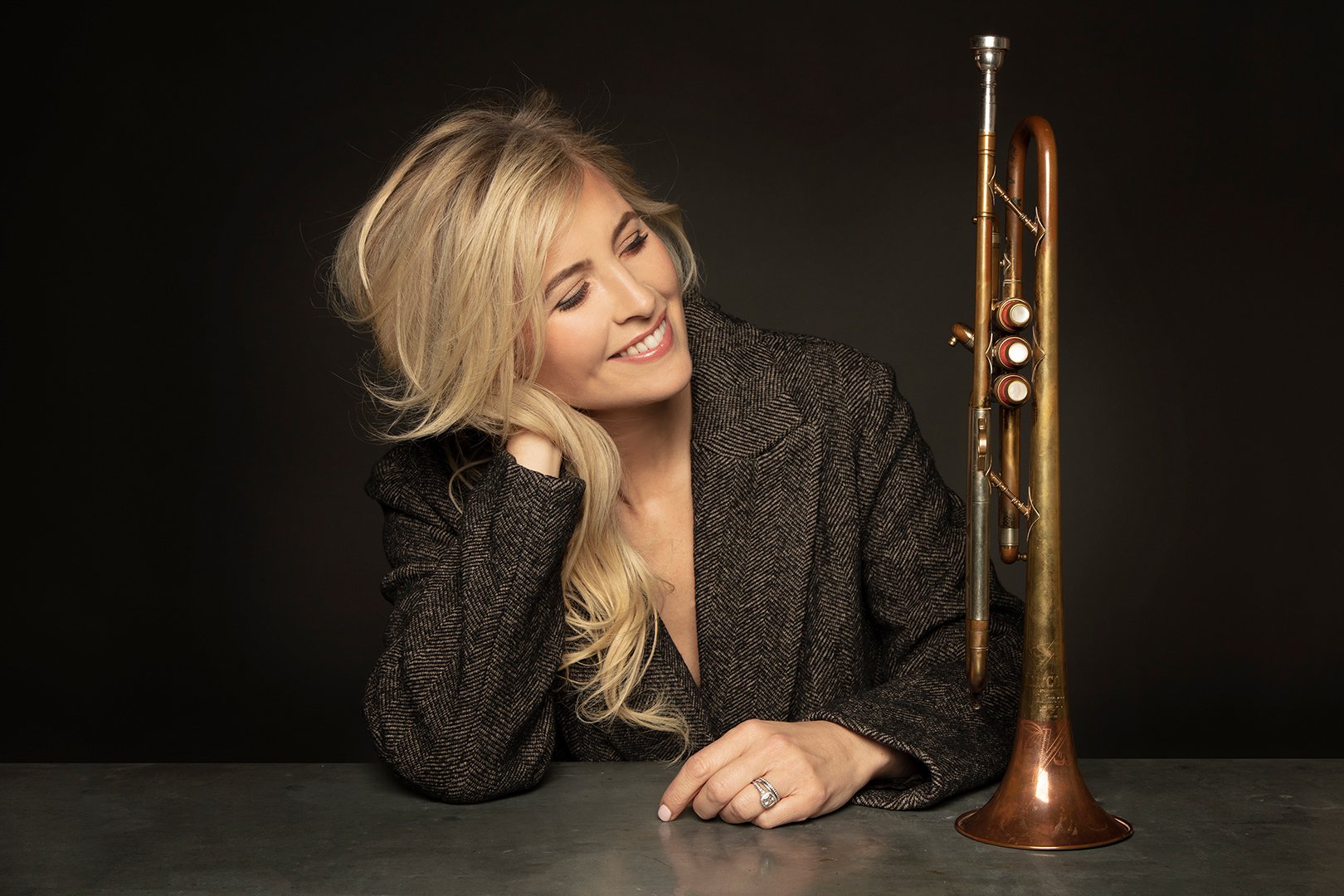
We still think of Alison Balsom as a new artist, a breath of fresh air for the trumpet in and around classical music. Yet all of a sudden it is nearly 25 years since she burst onto the scene, winning the Brass Final of the BBC’s Young Musician competition in 1998. Since then her recording career has yielded no fewer than 15 albums, for EMI Classics and latterly Warner Classics.

Quiet City will be her 16th – and in many ways it is her most personal album yet, as Arcana found when we sat down for a chat with the trumpeter. Balsom has poured herself a cup of tea, and the chat is punctuated with comfortable silences as she sips tea and I write. An extremely affable presence, she clearly has as much enthusiasm for the music now as she did in 1998, if not more.

Quiet City, as you may have guessed, is named after the Copland composition for trumpet, cor anglais and string orchestra of 1939. A forward-looking piece, it became a popular pick for online concerts during lockdown, its scoring favouring smaller orchestras and its mood wholly redolent of the times. It has held a very significant place in Balsom’s life, too. “I didn’t know I was going to make an album like this”, she confesses. “Quiet City is one of the very first pieces that I fell in love with to a deeper level when playing the trumpet. Copland understands the trumpet’s qualities, the melancholy aspects of the instrument and how it could sing. It is a relatively short work, so it was interesting to think about what it should be programmed with. I don’t think of myself as a jazz trumpeter, yet there is a really interesting point where in America composers were writing ‘in the gap’, letting themselves experiment. It didn’t matter that it was classical or jazz, they were taking from both realms. I found that this made a coherent journey, and found the nuggets growing to album ideas.”

She recognises the relevance of Quiet City to the pandemic. “Copland was a visionary with what we needed.  We made this recording in November 2021, when we were just coming out of lockdown. We all had an intense feeling of gratitude to be able to play this music live with a feeling of stillness in the concert hall, a voice that said, “Aren’t we lucky to be here?!” It is such a powerful vision, evoking the atmosphere from the first section, looking between building in New York like an Edward Hopper painting. Even working with a piano reduction I was in a melancholy mood. With this music I think of a film like Lost In Translation, and of two people with a luxury life, going to very different places. There is an isolated melancholy but beauty too, like a friend. As a piece, though, it is technically and physically challenging to play.”

She elaborates further. “Sustaining the notes can be a physical struggle, but you need command of the sound, the articulated notes – and you somehow need to make them tentative and nervous. You want to convey someone practising in an apartment block or something, being wonderfully balanced with the cor anglais and communicating with your audience or listeners.”

The cor anglais part on this recording is taken by Nicholas Daniel, who Balsom professes undying admiration for. “He is such a great musician, and has such a strong feeling about that piece. It was inspiring working with him and getting his insight and thoughts. It was incredible working with the Britten Sinfonia as well, they have great integrity and are always minded for collaboration. I worked with them in 2017, when we did the Barbican’s Sound Unbound festival. We did Miles Davis and Gil EvansSketches Of Spain, using transcriptions from the original studio recordings. I didn’t realise about the manuscripts, and there was a trumpet part revealed to me. He knew exactly what he wanted! I felt privileged to hear the players as at home playing jazz as they do classical.”

Also featured in the Sound Unbound concert was Gershwin’s Rhapsody In Blue, which appears on Balsom’s album in a very different guise – tastefully rejigged to bring the trumpet forward as a second soloist, alongside childhood friend Tom Poster on the piano. “I had a different hat on for this one!” she confesses. “I respect Tom so much, I think he’s the greatest pianist to play with. We met when I was ten, so we know each other really well. With the arrangement I phoned him up and suggested it, and he thought it was nuts but a good idea. We found that Rhapsody in Blue was out of copyright, but not in the Grofé arrangement. This made the job an enormous one for Simon Wright, who orchestrated it from scratch.  Any coincidences in the new version are Simon coming to the same conclusion as Grofé, and I think it is an amazing achievement. The piano part didn’t have to be set in stone, which gave Tom the opportunity to express himself even more. We did a concert in Norwich, when everything was closed, and we only had to get it right once to get it in the can.”

She may be 15 albums in, but Alison is keenly aware of how much the format has changed in that time, and how consumption habits are so different with streaming. “The greatest challenge has been finding my muse, making something that the world might want to hear”, she says, “and yet there is an amazing opportunity to pioneer. We put Quiet City with some things that we’re OK with, and some things that are more challenging, such as the Charles Ives piece The Unanswered Question, which I love, but Warner let me go for it. It’s a lucky situation to be in.”

Asking Balsom to cast her thoughts back, I ask who has been an influence on her career to date? “In terms of my teachers, I would say John Miller – an amazing teacher and trumpet guru. With him we focussed on sound, as the trumpet is all about the production of technique. I would compare him to Mr. Miyagi from Karate Kid, he wouldn’t let me do the cool stuff but I’m so glad he did that! I then went on to work with Håkan Hardenberger, who taught me how to teach myself. Physically the trumpet is so challenging, but that’s not how you master it. Getting to Grade 8 is just the start! It has this incredible, multifaceted personality, it reflects who you are. We play our personalities through our instruments!”

Balsom’s husband, film director Sam Mendes, had a small hand in the album’s running order. “He suggested the use of Leonard Bernstein‘s Lonely Town”, she says, and was a good soundboard for how the album was fitting together.” Has she returned the compliment on any of his film scoring? “I have made a few suggestions!” – she smiles – “and of course he has got to know a lot of trumpet repertoire through me.”

She recognises a change of focus in the musical landscape since the pandemic, with much more emphasis on recorded music. In spite of that there are a couple of concerts planned for the rest of the year. “There was the launch concert at Snape, with full bells and whistles, which is quite a complicated affair but the only live version of the album we will be doing. After that it gets quite random, but on October I’ll be doing a recital with Anna Lapwood, the organist, and a lighting designer, at a school in Tonbridge. It’s going to be an immersive trumpet and organ recital. We know the music is amazing but how can we present it and immerse people in the music? I’m really looking forward to doing that, she’s a real force for good! I wanted an amazing acoustic and organ, and there will be a few new pieces for that one.”

Plans are afoot for a seventeenth album, too. “I have had a good chat with Trevor Pinnock about my next project. Over the pandemic we had to re-evaluate travelling and what we have a desire to do – and there are some exciting plans on the horizon!”

You can discover more on Alison Balsom by visiting her website – and you can hear more of Quiet City and purchase the album on the Presto website. Meanwhile for more information on her recital with Anna Lapwood, and to buy tickets, go to the Tonbridge Music Club website