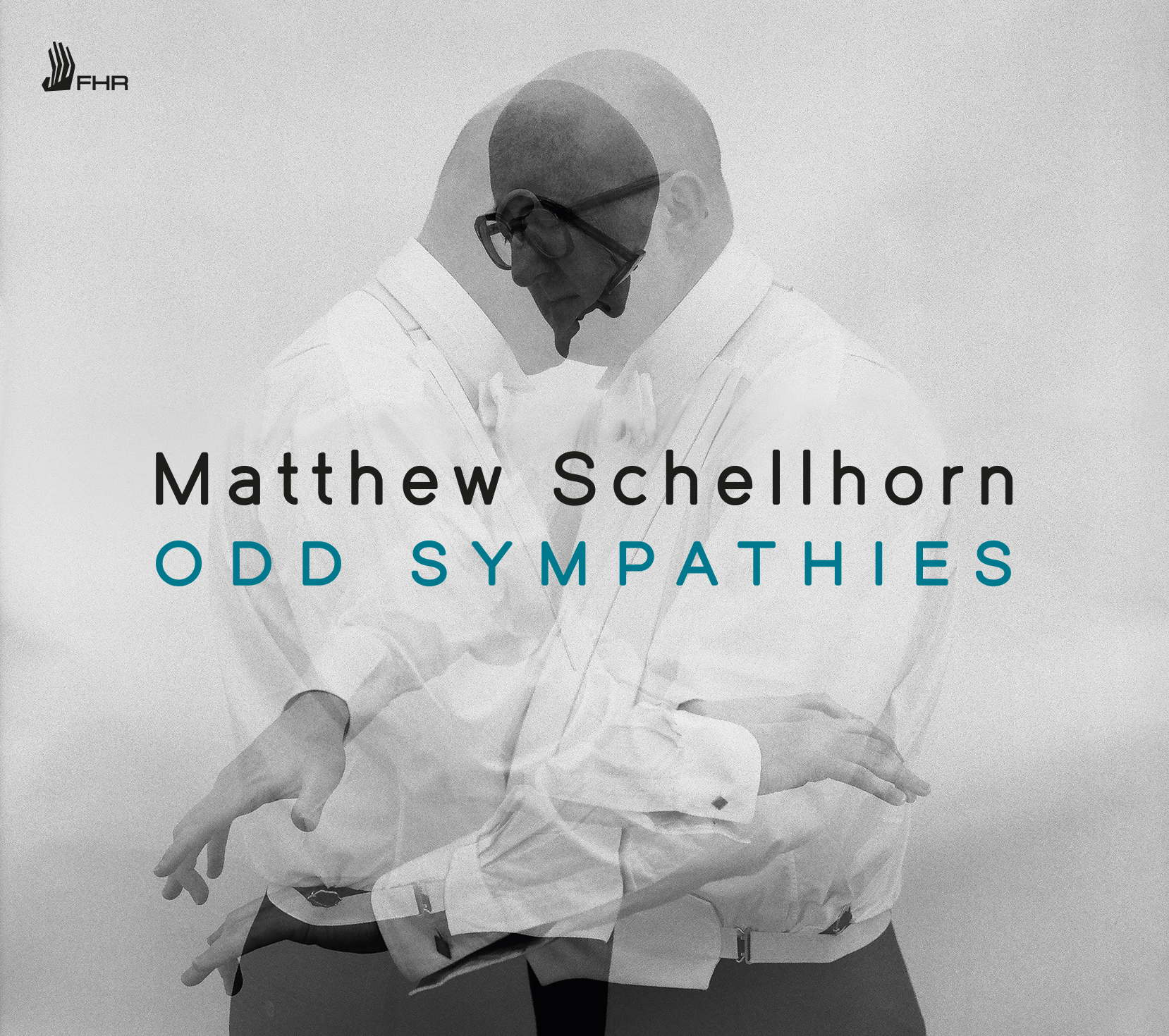
On Record – Matthew Schellhorn – Odd Sympathies (First Hand Records)

Matthew Schellhorn (piano)

Thurlow The Will of the Tones (2004)
Bussey Floreat Coll. Reg. (2021)
Burrell Pentecost (2017)
Homage to Haydn (2009) by Tim Watts, Colin Riley, Cecilia McDowall, Cheryl Frances-Hoad, Michael Zev Gordon and Jeremy Thurlow
Riley Joplin Jigsaws (2018)
Percy Chop and Change (2018)
Spicer Two Pieces for James (2010)
Briggs Willows and Jitterbug (2014)

First Hand Records FHR181 [83’03”]
Producer Simon Weir Engineer Ben Connellan

Recorded 2-4 December 2022 at Menuhin Hall, Stoke d’Abernon, Surrey

Reviewed by Richard Whitehouse

What’s the story?

First Hand Records issues this latest recital from Matthew Schellhorn, a collection of pieces by present-day composers with whom he has collaborated (often extensively) that amounts to an inclusive overview of his musical preoccupations and sympathies – odd or otherwise.

What’s the music like?

This album opens at the beginning with Schellhorn’s first large-scale commission – a scintillating while demanding workout by Jeremy Thurlow that wrests musical cohesion out of pianistic fragmentation prior to its subtly conclusive coda. By contrast, Martin Bussey contributes a brace of pieces drawing repose from a tribute to author Philip Radcliffe and a lively coranto with that to conductor Philip Ledger. Diana Burrell’s work is the most substantial, utilizing the plainchant Veni Sancte Spiritus as cantus firmus for this three-movement sequence – the opening one a little too discursive in its unfolding, but the central panel distilling meditative calm then the finale building to a powerful apotheosis before subsiding into limpid serenity. Very different in every sense is Homage to Haydn, a six-piece sequence – intended to be played in the order here – that was written to commemorate the bicentenary of Haydn’s death in 2009. The constituent pieces are however no less revealing of the personas of their respective writers; an anthology saying much about how this totemic figure is regarded by a representative sextet of British composers with notably different idioms and aesthetics.

One of these pieces being by Colin Riley duly leads into his own commission – six brief yet resourceful pieces taking their cue from four distinct rags by Scott Joplin: suffice to add that these latter can feel more oblique in their allusions than their anagrams. The work by Robert Percy started out very differently from that heard here – Schellhorn and its composer having refashioned it into a sequence of mobiles (eight out of a potential 10 included) fastidious of texture and elusive in content: there being evidently more than 40,000 possible permutations at least means it need never sound the same way twice. There could be nothing less arbitrary than birthday-tributes to the Reverend James Potts by Paul Spicer, a lively jaunt followed by a pensive pavane that underlines the love of both composer and recipient for the clavichord miniatures by Herbert Howells. Finally to Roger Briggs, the American composer whose harmonic eloquence then rhythmic energy are gratefully seized on for what is a wholly apposite conclusion to this programme.

Does it all work?

Pretty much throughout. Listeners will inevitably prefer one or other composer to another, but there is no doubting the respect in which they hold Schellhorn, nor of the conviction which he brings to all this music. It helps that his instrument (not specified in the booklet) has been so faithfully captured, its tonal definition enhanced with the spacious surround-sound mix made possible by Dolby Atmos. As these pieces are either world premiere recordings or first commercial recordings, a substantial amount of new piano repertoire is made available herein.

Is it recommended?

Indeed it is. Schellhorn contributes detailed and highly personable annotations, and one looks forward to more such anthologies from this source. No doubt he includes many of these pieces in his recitals, though there is no reason why other enterprising pianists should not follow suit.

Listen / Buy

You can explore purchase options at the First Hand Records website. Click on the name to read more about pianist Matthew Schellhorn

Published post no.2,896 – Sunday 24 May 2026

In appreciation – BBC Singers

by Ben Hogwood

Yesterday we learned of the almost incomprehensible decision by the BBC that they were planning to close the BBC Singers. The choir is one of the leading ensembles of its type in the UK – if not the leading example – and have been responsible for many important premieres and landmark concerts over their 99-year existence.

Only in 2020 they were on stage as the Proms concerts returned, with a memorable performance of Eric Whitacre‘s Sleep, while if you want proof of their versatility from this year, watch this video of an arrangement of ABBA‘s Little Things:

The Spotify playlist below celebrates just some of the recordings made by the BBC Singers, in the hope that they will somehow be able to continue their invaluable service to British music. Included are shorter works by John McCabe, Sir Michael Tippett, Elizabeth Maconchy and Diana Burrell, alongside excerpts from Mozart’s Requiem, under Jane Glover, Janáček’s The Excursions Of Mr. Brouček, in a Proms performance under Jiří Bělohlávek, and the same forces at work in Smetana’s large scale opera Dalibor.

Finally the Singers can be heard in the striking Moth Requiem by Sir Harrison Birtwistle, which they premiered at the Proms in 2013.

If you do listen, please also make sure you sign the petition calling for the BBC to reconsider their decision,

In concert – Southbank Sinfonia – Journeys Through Worlds (Álvarez, Woolrich, Burell and Glass); Eruptions of Sound and Colour (Simpson and Mozart)

Journeys Through Worlds
Álvarez Metro Chabacano (1986, rev. 1991)
Woolrich Ulysses Awakes (1989)
Burrell Das Meer, das so gross und weit ist, da wimmelt’s ohne zahl, grosse und kleine Tiere (1992)
Glass Symphony no.3 (1995)
Southbank Sinfonia / Owain Park

Eruptions of Sound and Colour
Mark Simpson Geysir (2014)
Mozart Serenade no.10 in B flat major K361 ‘Gran Partita’ (1781-2)
Southbank Sinfonia / Nicholas Daniel

St John’s, Smith Square, London
Thursday 19 January 2023 @ 7pm and 9pm

Reviewed by Richard Whitehouse

A typically diverse programme by Southbank Sinfonia; actually two programmes, each of which lasted just over and hour and offered respective showcases for the strings then woodwind of this enterprising outfit – now into the second season of its St John’s residency.

Journeys Through Worlds featured four works by contemporary composers, opening with the energetic and purposeful intricacy of Javier Álvarez’s Metro Chabacano. Inspired by Mexico City’s busiest subway station, it made for an engaging concert opener and a telling foil to the restraint of John Woolrich’s Ulysses Awakes. Obliquely reworking an aria from the opera by Monteverdi, this brought viola and strings into ruminative if at times sombre accord – Peter Fenech drawing no mean eloquence from the solo writing. It may have one of the longest-ever titles, but Diana Burrell’s piece (translating as The vast and wide sea, wherein are things swarming innumerable, both great and small animals) brought the most dissonant music – its densely wrought textures needing scrupulous balance for their inner intensity fully to register.

This it received in part owing to attentive conducting from Owain Park, who went on to direct an impressive account of Philip Glass’s Third Symphony. Free from extra- or, for that matter, ‘other’ musical references, this modest work affords something of a neo-classical conception across its four movements – a moderately paced opener duly making way for a scherzo-like interplay of harmonic and pizzicato writing, then the soloistic writing of a fatalistic chaconne finding real contrast with the vigorous ensemble of a short while pointedly conclusive finale.

Eruptions of Sound and Colour, following a suitable interval, featured Southbank Sinfonia’s woodwind in two decidedly contrasted items. Established both as clarinettist and composer, Mark Simpson packed no mean activity into Geysir – its irresistibly upwards progress aptly evoking those Icelandic hot-springs of its title (which was evidently suggested by composer Simon Holt). These emerge out of an anticipatory calm to which the music at length returns, though the closing bars seem anything but tranquil given the activity that went before them.

Nicholas Daniel directed an assured account of this piece, then had prepared that of Mozart’s Gran Partita which followed (the Simpson having been commissioned for such a purpose). Still the finest and most likely longest work for wind ensemble, it also remains the canniest example of ‘functional’ music raised to a level transcending its ostensible purpose. Not least in the way that its orchestration – pairs of oboes, clarinets, basset horns and bassoons joined by four horns and double-bass – suggests possibilities both profound and far-reaching. It was a testament to the excellence of these musicians one never suspected (or would have noticed has this been a radio broadcast) the absence of any ‘guiding hand’ – such was their unanimity in pursuing the felicity and finesse of what ranks among its composer’s greatest achievements.

It proved a memorable way to close an evening of varied and consistently fine music-making. Southbank Sinfonia is returning to its home venue later this month in a Beethoven double-bill then over the coming months for repertoire established and unfamiliar but always worthwhile.

You can read more about the Southbank Sinfonia at their website. Click on the artist names for more on conductors Owain Park and Nicholas Daniel, while for more on the composers click on the names Javier Álvarez, John Woolrich, Diana Burrell, Philip Glass and Mark Simpson