
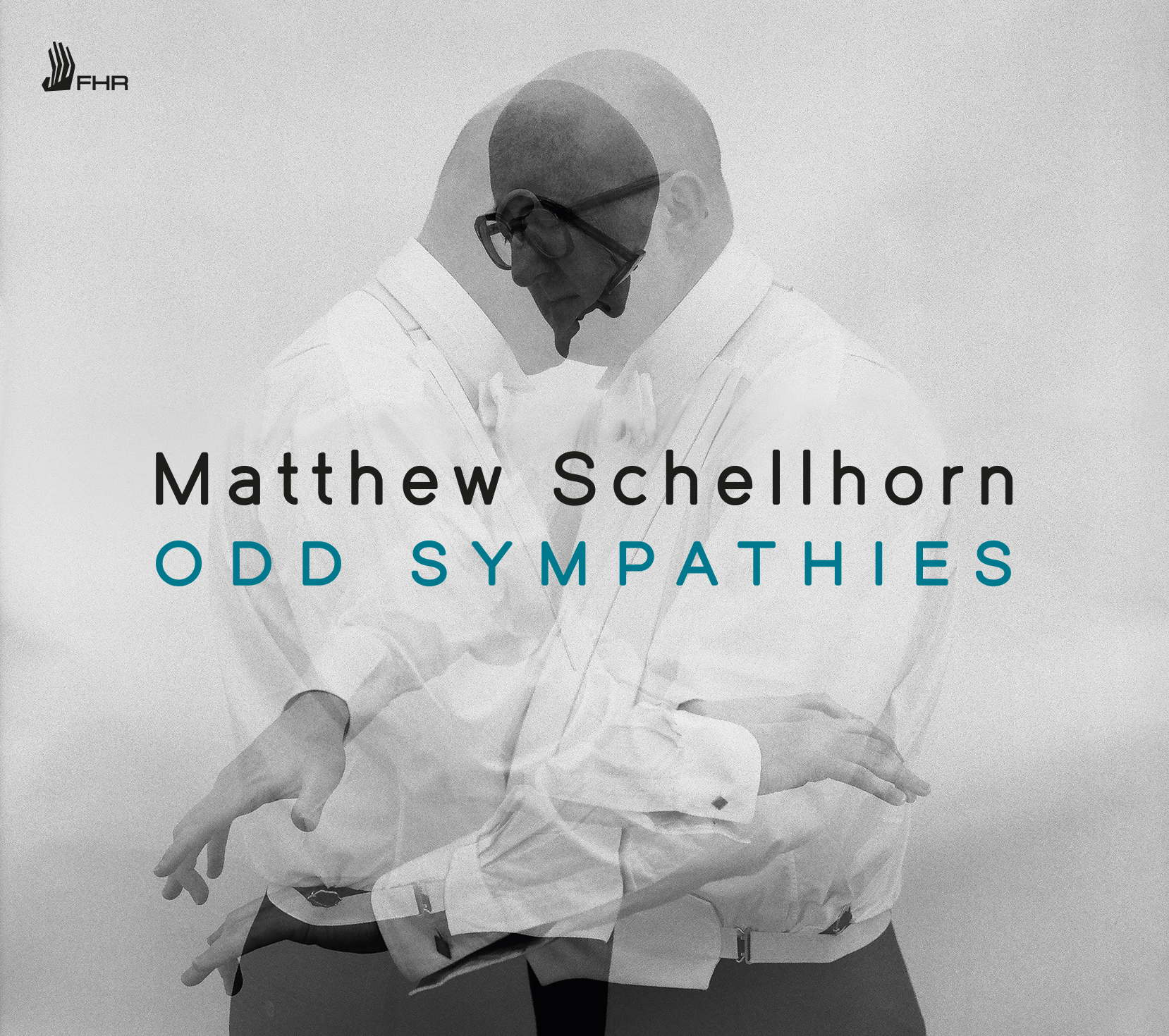
On Record – Matthew Schellhorn – Odd Sympathies (First Hand Records)

Matthew Schellhorn (piano)

Thurlow The Will of the Tones (2004)
Bussey Floreat Coll. Reg. (2021)
Burrell Pentecost (2017)
Homage to Haydn (2009) by Tim Watts, Colin Riley, Cecilia McDowall, Cheryl Frances-Hoad, Michael Zev Gordon and Jeremy Thurlow
Riley Joplin Jigsaws (2018)
Percy Chop and Change (2018)
Spicer Two Pieces for James (2010)
Briggs Willows and Jitterbug (2014)

First Hand Records FHR181 [83’03”]
Producer Simon Weir Engineer Ben Connellan

Recorded 2-4 December 2022 at Menuhin Hall, Stoke d’Abernon, Surrey

Reviewed by Richard Whitehouse

What’s the story?

First Hand Records issues this latest recital from Matthew Schellhorn, a collection of pieces by present-day composers with whom he has collaborated (often extensively) that amounts to an inclusive overview of his musical preoccupations and sympathies – odd or otherwise.

What’s the music like?

This album opens at the beginning with Schellhorn’s first large-scale commission – a scintillating while demanding workout by Jeremy Thurlow that wrests musical cohesion out of pianistic fragmentation prior to its subtly conclusive coda. By contrast, Martin Bussey contributes a brace of pieces drawing repose from a tribute to author Philip Radcliffe and a lively coranto with that to conductor Philip Ledger. Diana Burrell’s work is the most substantial, utilizing the plainchant Veni Sancte Spiritus as cantus firmus for this three-movement sequence – the opening one a little too discursive in its unfolding, but the central panel distilling meditative calm then the finale building to a powerful apotheosis before subsiding into limpid serenity. Very different in every sense is Homage to Haydn, a six-piece sequence – intended to be played in the order here – that was written to commemorate the bicentenary of Haydn’s death in 2009. The constituent pieces are however no less revealing of the personas of their respective writers; an anthology saying much about how this totemic figure is regarded by a representative sextet of British composers with notably different idioms and aesthetics.

One of these pieces being by Colin Riley duly leads into his own commission – six brief yet resourceful pieces taking their cue from four distinct rags by Scott Joplin: suffice to add that these latter can feel more oblique in their allusions than their anagrams. The work by Robert Percy started out very differently from that heard here – Schellhorn and its composer having refashioned it into a sequence of mobiles (eight out of a potential 10 included) fastidious of texture and elusive in content: there being evidently more than 40,000 possible permutations at least means it need never sound the same way twice. There could be nothing less arbitrary than birthday-tributes to the Reverend James Potts by Paul Spicer, a lively jaunt followed by a pensive pavane that underlines the love of both composer and recipient for the clavichord miniatures by Herbert Howells. Finally to Roger Briggs, the American composer whose harmonic eloquence then rhythmic energy are gratefully seized on for what is a wholly apposite conclusion to this programme.

Does it all work?

Pretty much throughout. Listeners will inevitably prefer one or other composer to another, but there is no doubting the respect in which they hold Schellhorn, nor of the conviction which he brings to all this music. It helps that his instrument (not specified in the booklet) has been so faithfully captured, its tonal definition enhanced with the spacious surround-sound mix made possible by Dolby Atmos. As these pieces are either world premiere recordings or first commercial recordings, a substantial amount of new piano repertoire is made available herein.

Is it recommended?

Indeed it is. Schellhorn contributes detailed and highly personable annotations, and one looks forward to more such anthologies from this source. No doubt he includes many of these pieces in his recitals, though there is no reason why other enterprising pianists should not follow suit.

Listen / Buy

You can explore purchase options at the First Hand Records website. Click on the name to read more about pianist Matthew Schellhorn

Published post no.2,896 – Sunday 24 May 2026
On Record – Peter Jacobs: The Silent Pool: British Piano Music by Women Composers (Heritage Records)

Peter Jacobs (piano)

Smyth Piano Sonata no.3 (1877); Piano Sonata no.2 (Andante) (1877)
Maconchy A Country Town (nos. 1, 3, 4, 5 & 7) (1945)
Williams The Silent Pool (1932)
Grime The Silver Moon (2025)
Dring Colour Suite (1963)
Bingham The Moon Over Westminster Cathedral (2003)
Woodforde-Finden Indian Love Lyrics (nos.2 & 1) (1903)
McDowall Vespers in Venice (2002)
Bingham Christmas Past, Christmas Present (1991)
Roe A Mystery of Cats (nos. 1, 4 & 5) (1994)
Beamish Lullaby for Owain (2016)
Da Costa Gigue; Moods (both 1930)
Lehmann Cobweb Castle (nos. 2 & 5) (1908)

Heritage Records HTGCD126 [75’40”]
Producer / Engineer Paul Arden-Taylor

Recorded 16 September 2024 & 26 January 2025 at Wyastone Concert Hall, Wyastone Leys, Monmouth

Reviewed by Richard Whitehouse

What’s the story?

Peter Jacobs continues his productive association with the Heritage label with this anthology that takes in a well-planned overview of piano music by female British composers, ranging across over more than 130 years of creativity in an impressive variety of idioms and genres.

What’s the music like?

Although female composers had been active in the UK from the outset of the English Musical Renaissance and before, relatively few came to prominence during their lifetime, with many others destined to be rediscovered only years and sometimes decades after their death. While hardly the first of its kind, the present collection is among the most representative in terms of its stylistic coverage which, in turn, underlines they should not be pigeon-holed any more than their male counterparts. Moreover, what was the loss to earlier generations is our gain today.

This recital opens with the redoubtable Ethel Smyth – her Third Piano Sonata contrasting the equable motion of its initial Allegro with the impetuous manner of its closing Allegro vivace. From its larger scale predecessor, the central Song Without Words affords ruminative space between the dynamism and tensions of those movements either side. Of the five (out of nine) pieces in Elizabeth Maconchy’s suite, the eloquent Lament and limpid Bells are especially appealing. Grace Williams is at her most haunting in the piece as gives this collection its title, and Helen Grime pens a miniature stark yet pellucid. Among the most versatile composers of her generation, Madeleine Dring is represented here by a five-movement themed suite which includes such delights as the quizzical Pink Mirror or the appropriately sensuous Blue Air. Judith Bingham may be best known for her choral and brass band music, but there is nothing unpianistic about so translucently textured a nocturne.

Two of Amy Woodforde-Finden’s four-piece suite include the elegant poise of Less than the Dust, while Cecilia McDowall sounds a note of spatial immensity in her Venetian evocation. The four pieces of her Christmas suite find Bingham pursuing an altogether more winsome vein of expression – duly complemented by three out of five whimsical feline homages by Betty Roe, happily still going strong in her 96th year. Sally Beamish contributes a (surprisingly?) capricious lullaby, with two pieces by the short-lived Raie da Costa typifying her witty and sassy manner. The wistful charm of Liza Lehmann, two of six pieces from her only piano suite, affords an elegant then touching envoi.

Does it all work?

As an overall sequence, absolutely. At around 75 minutes, this concert-length recital can be enjoyed as a continuous sequence or in any number of selections. It helps when Jacobs is so persuasive an exponent of this music, much of it remaining little known other than to pianists with his breadth of sympathies but which ought to find an audience given exposure in a live context. As he himself notes, this “random selection [is] united by being rewarding to play, beautifully written for the instrument, varied in style and intellectual depth”. Enough said.

Is it recommended?

It is. Piano sound is as full and spacious as expected given its Wyastone source, while Jacobs contributes laconically insightful notes on the recital overall. Most enjoyable, with hopefully enough material in this pianist’s “library of over 60 years collecting” to warrant a follow-up.

Listen / Buy

You can read more about this release and explore purchase options at the Heritage Records website

Published post no.2,682 – Thursday 9 October 2025

Playlist – celebrating Mother’s Day

Today is Mothering Sunday in the UK – and here is a playlist celebrating mothers.

We begin with a touching suite for piano by Josef Suk. About Mother is dedicated not to his own mother but for his children about their mother, his wife Otilie Dvořák. Then we continue with a famous song from Suk’s father-in-law, Antonin Dvořák, Songs My Mother Taught Me.

Taking the theme a little loosely we move on to Ravel, and his delectable ballet Ma mère l’oye (Mother Goose) – evidence of the French composer’s beautiful writing for orchestra.

Finally something of an English rarity, Cecilia McDowall setting the Magnificat (the song of Mary, Mother of God) for chorus and orchestra. It is a striking piece with which to end.

I hope you enjoy!

This playlist is dedicated to the memory of my aunt, Angela – who passed away on Thursday. It is also posted in mind of her sister – my own mother Coralie (above), whose musical influence on my own life I celebrated on Arcana here.