
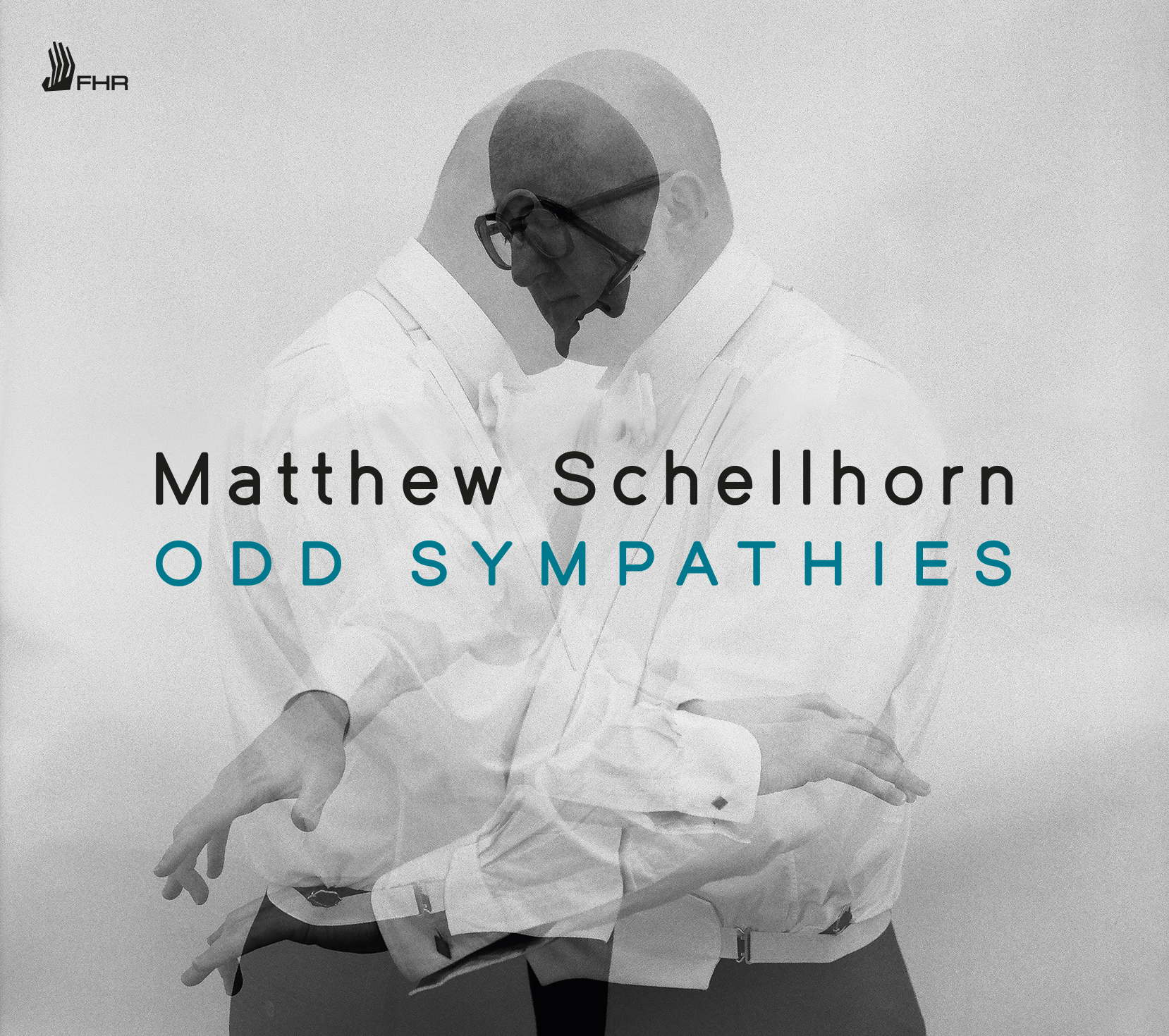
Matthew Schellhorn (piano)
Thurlow The Will of the Tones (2004)
Bussey Floreat Coll. Reg. (2021)
Burrell Pentecost (2017)
Homage to Haydn (2009) by Tim Watts, Colin Riley, Cecilia McDowall, Cheryl Frances-Hoad, Michael Zev Gordon and Jeremy Thurlow
Riley Joplin Jigsaws (2018)
Percy Chop and Change (2018)
Spicer Two Pieces for James (2010)
Briggs Willows and Jitterbug (2014)
First Hand Records FHR181 [83’03”]
Producer Simon Weir Engineer Ben Connellan
Recorded 2-4 December 2022 at Menuhin Hall, Stoke d’Abernon, Surrey
Reviewed by Richard Whitehouse
What’s the story?
First Hand Records issues this latest recital from Matthew Schellhorn, a collection of pieces by present-day composers with whom he has collaborated (often extensively) that amounts to an inclusive overview of his musical preoccupations and sympathies – odd or otherwise.
What’s the music like?
This album opens at the beginning with Schellhorn’s first large-scale commission – a scintillating while demanding workout by Jeremy Thurlow that wrests musical cohesion out of pianistic fragmentation prior to its subtly conclusive coda. By contrast, Martin Bussey contributes a brace of pieces drawing repose from a tribute to author Philip Radcliffe and a lively coranto with that to conductor Philip Ledger. Diana Burrell’s work is the most substantial, utilizing the plainchant Veni Sancte Spiritus as cantus firmus for this three-movement sequence – the opening one a little too discursive in its unfolding, but the central panel distilling meditative calm then the finale building to a powerful apotheosis before subsiding into limpid serenity. Very different in every sense is Homage to Haydn, a six-piece sequence – intended to be played in the order here – that was written to commemorate the bicentenary of Haydn’s death in 2009. The constituent pieces are however no less revealing of the personas of their respective writers; an anthology saying much about how this totemic figure is regarded by a representative sextet of British composers with notably different idioms and aesthetics.
One of these pieces being by Colin Riley duly leads into his own commission – six brief yet resourceful pieces taking their cue from four distinct rags by Scott Joplin: suffice to add that these latter can feel more oblique in their allusions than their anagrams. The work by Robert Percy started out very differently from that heard here – Schellhorn and its composer having refashioned it into a sequence of mobiles (eight out of a potential 10 included) fastidious of texture and elusive in content: there being evidently more than 40,000 possible permutations at least means it need never sound the same way twice. There could be nothing less arbitrary than birthday-tributes to the Reverend James Potts by Paul Spicer, a lively jaunt followed by a pensive pavane that underlines the love of both composer and recipient for the clavichord miniatures by Herbert Howells. Finally to Roger Briggs, the American composer whose harmonic eloquence then rhythmic energy are gratefully seized on for what is a wholly apposite conclusion to this programme.
Does it all work?
Pretty much throughout. Listeners will inevitably prefer one or other composer to another, but there is no doubting the respect in which they hold Schellhorn, nor of the conviction which he brings to all this music. It helps that his instrument (not specified in the booklet) has been so faithfully captured, its tonal definition enhanced with the spacious surround-sound mix made possible by Dolby Atmos. As these pieces are either world premiere recordings or first commercial recordings, a substantial amount of new piano repertoire is made available herein.
Is it recommended?
Indeed it is. Schellhorn contributes detailed and highly personable annotations, and one looks forward to more such anthologies from this source. No doubt he includes many of these pieces in his recitals, though there is no reason why other enterprising pianists should not follow suit.
Listen / Buy
You can explore purchase options at the First Hand Records website. Click on the name to read more about pianist Matthew Schellhorn
Published post no.2,896 – Sunday 24 May 2026
 Matthew Schellhorn (piano)
Herbert Howells
Phantasy (1917)
Harlequin Dancing (1918)
My Lord Harewood’s Galliard (1949)
Finzi: His Rest (1956)
Summer Idyls (1911)
Siciliana (1958)
Pavane and Galliard (1964)
Petrus Suite (1967-73)
Naxos 8.571382 [65’52”]
Producers Rachel Smith<
Engineer Ben Connellan
Recorded 19-21 August 2019 at The Menuhin Hall, Stoke D’Abernon
Written by Richard Whitehouse
What’s the story?
Naxos continues its coverage of Herbert Howells with this initial instalment (presumably one more to follow) of his piano music, all pieces being previously unrecorded and authoritatively rendered by Matthew Schellhorn in what is a notable addition to the composer’s discography.
What’s the music like?
Long before his death (at the age of 90), Howells’s reputation rested firmly on his output of choral and organ works. Only quite recently has his considerable earlier output of orchestral and chamber music received serious re-evaluation, so revealing one whose distinct change of outlook in his early forties came about as much through cultural as personal reasons. Modest in scope and dimension, his piano music features no extended or career-defining works, yet its technical poise and always idiomatic feel for this instrument makes for a rewarding listen.
The present selection interleaves miniatures and cyclical works in chronological order. As to the former, Phantasy finds the recently graduated composer assured in his handling of those impressionist aspects derived from Debussy and Ravel, while Harlequin Dreaming inhabits a world of Satie-esque whimsy and nonchalance as a reminder that Howells was then close friends with Bliss. Moving on to the Renaissance-inspired piano pieces of his later years, My Lord Harewood’s Galliard fuses its recherche manner with engaging harmonic astringency, whereas Finzi: His Rest is a pensively ambivalent in-memoriam to a younger colleague. The Siciliana is a languorous if non-indulgent take on the characteristic dance rhythm, while the Pavane and Galliard juxtaposes the confessional and combative with stark emotional acuity.
The suites come from either end of Howells’s career, with all that implies for a half-century timespan. Summer Idyls [sic] formed a part of his portfolio for the Royal College of Music; its stylistic indebtedness to the mid- and late Romantics – not least Rachmaninov – would soon be left behind, but the appeal in these evocations of rural environs no doubt familiar from his childhood endures. Pick of the seven is the wistful rumination of ‘Near Midnight’, with the central ‘Minuet Sine Nomine’ similarly dominating the Petrus Suite in its limpid refinement. Otherwise, the seven pieces evince a sinewy counterpoint and tensile linearity as are audibly a product of Howells’s late style, yet the origin of several in sketches made decades before confirms an overriding consistency of approach heightened by experience.
Does it all work?
Yes, allowing that Howells never sought to suffuse this music with the degree of emotional intensity reserved, at least in his maturity, for the larger choral works. Yet his quintessential expression is arguably to be found in those many shorter choral or organ pieces intended for liturgical purpose; in which case, the expressive focus and restraint of what is recorded here is its own justification. It could hardly have a more persuasive advocate than Schellhorn, who credits the late Stephen Cleobury for introducing him to the extent of Howells’s piano music.
Is it recommended?
Indeed. The closely unduly defined sound is ideal for piano music of this kind, and Jonathan Clinch’s annotations (along with a reminiscence by the pianist) are succinct and informative. The follow-up volume, mainly of better-known music, will doubtless prove just as rewarding.
Listen & Buy
You can listen to clips from the recording and purchase, either in physical or digital form, at the
Matthew Schellhorn (piano)
Herbert Howells
Phantasy (1917)
Harlequin Dancing (1918)
My Lord Harewood’s Galliard (1949)
Finzi: His Rest (1956)
Summer Idyls (1911)
Siciliana (1958)
Pavane and Galliard (1964)
Petrus Suite (1967-73)
Naxos 8.571382 [65’52”]
Producers Rachel Smith<
Engineer Ben Connellan
Recorded 19-21 August 2019 at The Menuhin Hall, Stoke D’Abernon
Written by Richard Whitehouse
What’s the story?
Naxos continues its coverage of Herbert Howells with this initial instalment (presumably one more to follow) of his piano music, all pieces being previously unrecorded and authoritatively rendered by Matthew Schellhorn in what is a notable addition to the composer’s discography.
What’s the music like?
Long before his death (at the age of 90), Howells’s reputation rested firmly on his output of choral and organ works. Only quite recently has his considerable earlier output of orchestral and chamber music received serious re-evaluation, so revealing one whose distinct change of outlook in his early forties came about as much through cultural as personal reasons. Modest in scope and dimension, his piano music features no extended or career-defining works, yet its technical poise and always idiomatic feel for this instrument makes for a rewarding listen.
The present selection interleaves miniatures and cyclical works in chronological order. As to the former, Phantasy finds the recently graduated composer assured in his handling of those impressionist aspects derived from Debussy and Ravel, while Harlequin Dreaming inhabits a world of Satie-esque whimsy and nonchalance as a reminder that Howells was then close friends with Bliss. Moving on to the Renaissance-inspired piano pieces of his later years, My Lord Harewood’s Galliard fuses its recherche manner with engaging harmonic astringency, whereas Finzi: His Rest is a pensively ambivalent in-memoriam to a younger colleague. The Siciliana is a languorous if non-indulgent take on the characteristic dance rhythm, while the Pavane and Galliard juxtaposes the confessional and combative with stark emotional acuity.
The suites come from either end of Howells’s career, with all that implies for a half-century timespan. Summer Idyls [sic] formed a part of his portfolio for the Royal College of Music; its stylistic indebtedness to the mid- and late Romantics – not least Rachmaninov – would soon be left behind, but the appeal in these evocations of rural environs no doubt familiar from his childhood endures. Pick of the seven is the wistful rumination of ‘Near Midnight’, with the central ‘Minuet Sine Nomine’ similarly dominating the Petrus Suite in its limpid refinement. Otherwise, the seven pieces evince a sinewy counterpoint and tensile linearity as are audibly a product of Howells’s late style, yet the origin of several in sketches made decades before confirms an overriding consistency of approach heightened by experience.
Does it all work?
Yes, allowing that Howells never sought to suffuse this music with the degree of emotional intensity reserved, at least in his maturity, for the larger choral works. Yet his quintessential expression is arguably to be found in those many shorter choral or organ pieces intended for liturgical purpose; in which case, the expressive focus and restraint of what is recorded here is its own justification. It could hardly have a more persuasive advocate than Schellhorn, who credits the late Stephen Cleobury for introducing him to the extent of Howells’s piano music.
Is it recommended?
Indeed. The closely unduly defined sound is ideal for piano music of this kind, and Jonathan Clinch’s annotations (along with a reminiscence by the pianist) are succinct and informative. The follow-up volume, mainly of better-known music, will doubtless prove just as rewarding.
Listen & Buy
You can listen to clips from the recording and purchase, either in physical or digital form, at the 
