

On Record – The Peter Jacobs Anthology: Twentieth Century British Piano Music (Heritage Records)

Peter Jacobs (piano)

Bax Winter Waters (1915)
Baines Preludes nos.1,3 & 6 (1919)
Benjamin Scherzino (1936)
Bliss Suite: Polonaise (1926)
Britten Sonatina Romantica: Moderato (1940)
Hold Tango (1975)
Howells Procession (1920)
Leigh Eclogue (1940)
Mayer Three Pieces from Calcutta-Nagar (1993)
Parry Scherzo in F major (pub 1922)
Quilter Summer Evening (1916)
Scott Egyptian Boat Song (1913)
Searle Vigil: France 1940-1944 (1944)
Seiber Scherzando Capriccioso (1953)
Shaw Roundabouts (1925)
Sterndale Bennett Presto agitato in F# minor Op.24/5
Stevenson A Wheen Tunes for Bairns Tae Spiel (1967)
Warren Second Sonata: Monody (1977)
Woodferne-Finden Kashmiri Song (1903)

Heritage Records HTGCD159 [76’40”]
Producer / Engineer Paul Arden-Taylor

Recorded 25 May 2021 at Wyastone Concert Hall, Wyastone Leys, Monmouth

Reviewed by Richard Whitehouse

What’s the story?

Besides reissuing his already extensive catalogue for other labels, Heritage has also made a number of new recordings by Peter Jacobs, with this album the first in what so far amounts to three volumes of miniatures and standalone pieces as drawn from his extensive repertoire.

Regular readers of Arcana will have come across reviews of the second and third volumes in this series, to which is now added this first instalment that ranges across the extent of Jacobs’ interest in and inclination towards unfamiliar though rewarding music by British composers.

What’s the music like?

Launched by Martin Shaw’s ebullient encore alighting on all two-dozen keys, this anthology continues with the harmonically acerbic second movement (of four) from Arthur Bliss’ early Suite, followed by music of elegant poignancy by Walter Leigh. John Mayer is heard in three from his 18 vignettes evoking sights and sounds of Calcutta (sic), with that by Roger Quilter a minor masterpiece of serenity infused with regret.

Màtyás Seiber contributes music whose liveliness and recalcitrance are entirely characteristic, with something ‘completely different’ in Amy Woodforde-Finden’s appealingly descriptive and once-ubiquitous number. Few are likely to recognize Herbert Howells as composer of a rhythmically combative piece that is (relatively) better known in its orchestral guise, while that from Arthur Benjamin could be no-one else given its playful insouciance. Dedicated ‘‘To my friends of the Fighting French Forces’’, Humphrey Searle’s evocation of war is the more powerful for its overall restraint and could well be considered the single-most impressive piece featured on this collection.

Hubert Parry is heard at his most vivacious and uninhibited; an ideal foil to Cyril Scott who, though he associated Egypt with (his own) past existences, focusses on melody of the most poetic. Much the earliest piece here, that by William Sterndale Bennett is the fifth in a six-movement suite – its deftness and agility in telling contrast to the incremental display of the opening movement from Raymond Warren’s Second Sonata. Three out of a larger sequence of preludes by William Baines constitute an object-lesson in making more out of less, while the first movement of Benjamin Britten’s never-quite-completed Sonata Romantica evinces ingenuity and didacticism in equal measure. Ronald Stevenson often aspired to the lofty or profound in his music, but the four pieces in the suite recorded here are epigrams as laconic as they are engaging. The longest single item here, Arnold Bax’s piece is at once a visceral seascape, revealing psychological study or resourceful passacaglia – the climax of an album that ends in a disarming item by Trevor Hold such as ought to win its composer new friends.

Does it all work?

As an overall sequence, undoubtedly. Jacobs is as inclusive in his interpretative acumen as   in the breadth of his musical sympathies – thereby making for a collection that plays to his strengths as convincingly as it does to those of the 19 composers who are featured herein.

Is it recommended?

Very much so, not least in the knowledge this release was merely the first in an ongoing and most valuable series bringing unfamiliar music to the attention of inquiring listeners. Sound of clarity and definition, along with Jacobs’ detailed booklet notes, are further enhancements.

Listen / Buy

You can explore purchase options at the Heritage Records website. Click on the name to read more about pianist Peter Jacobs

Published post no.2,889 – Saturday 16 May 2026
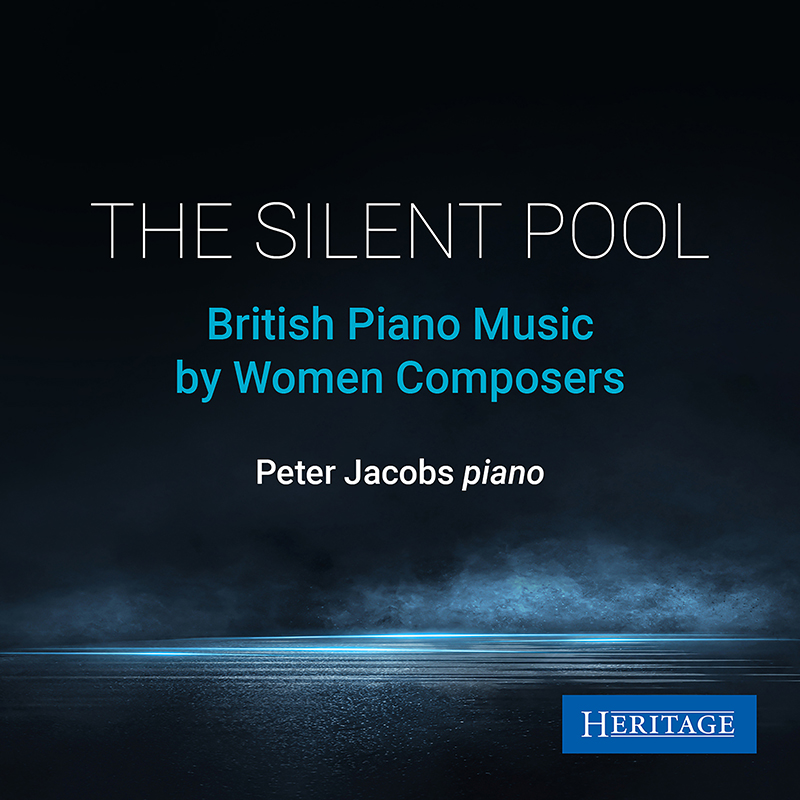
On Record – Peter Jacobs: The Silent Pool: British Piano Music by Women Composers (Heritage Records)

Peter Jacobs (piano)

Smyth Piano Sonata no.3 (1877); Piano Sonata no.2 (Andante) (1877)
Maconchy A Country Town (nos. 1, 3, 4, 5 & 7) (1945)
Williams The Silent Pool (1932)
Grime The Silver Moon (2025)
Dring Colour Suite (1963)
Bingham The Moon Over Westminster Cathedral (2003)
Woodforde-Finden Indian Love Lyrics (nos.2 & 1) (1903)
McDowall Vespers in Venice (2002)
Bingham Christmas Past, Christmas Present (1991)
Roe A Mystery of Cats (nos. 1, 4 & 5) (1994)
Beamish Lullaby for Owain (2016)
Da Costa Gigue; Moods (both 1930)
Lehmann Cobweb Castle (nos. 2 & 5) (1908)

Heritage Records HTGCD126 [75’40”]
Producer / Engineer Paul Arden-Taylor

Recorded 16 September 2024 & 26 January 2025 at Wyastone Concert Hall, Wyastone Leys, Monmouth

Reviewed by Richard Whitehouse

What’s the story?

Peter Jacobs continues his productive association with the Heritage label with this anthology that takes in a well-planned overview of piano music by female British composers, ranging across over more than 130 years of creativity in an impressive variety of idioms and genres.

What’s the music like?

Although female composers had been active in the UK from the outset of the English Musical Renaissance and before, relatively few came to prominence during their lifetime, with many others destined to be rediscovered only years and sometimes decades after their death. While hardly the first of its kind, the present collection is among the most representative in terms of its stylistic coverage which, in turn, underlines they should not be pigeon-holed any more than their male counterparts. Moreover, what was the loss to earlier generations is our gain today.

This recital opens with the redoubtable Ethel Smyth – her Third Piano Sonata contrasting the equable motion of its initial Allegro with the impetuous manner of its closing Allegro vivace. From its larger scale predecessor, the central Song Without Words affords ruminative space between the dynamism and tensions of those movements either side. Of the five (out of nine) pieces in Elizabeth Maconchy’s suite, the eloquent Lament and limpid Bells are especially appealing. Grace Williams is at her most haunting in the piece as gives this collection its title, and Helen Grime pens a miniature stark yet pellucid. Among the most versatile composers of her generation, Madeleine Dring is represented here by a five-movement themed suite which includes such delights as the quizzical Pink Mirror or the appropriately sensuous Blue Air. Judith Bingham may be best known for her choral and brass band music, but there is nothing unpianistic about so translucently textured a nocturne.

Two of Amy Woodforde-Finden’s four-piece suite include the elegant poise of Less than the Dust, while Cecilia McDowall sounds a note of spatial immensity in her Venetian evocation. The four pieces of her Christmas suite find Bingham pursuing an altogether more winsome vein of expression – duly complemented by three out of five whimsical feline homages by Betty Roe, happily still going strong in her 96th year. Sally Beamish contributes a (surprisingly?) capricious lullaby, with two pieces by the short-lived Raie da Costa typifying her witty and sassy manner. The wistful charm of Liza Lehmann, two of six pieces from her only piano suite, affords an elegant then touching envoi.

Does it all work?

As an overall sequence, absolutely. At around 75 minutes, this concert-length recital can be enjoyed as a continuous sequence or in any number of selections. It helps when Jacobs is so persuasive an exponent of this music, much of it remaining little known other than to pianists with his breadth of sympathies but which ought to find an audience given exposure in a live context. As he himself notes, this “random selection [is] united by being rewarding to play, beautifully written for the instrument, varied in style and intellectual depth”. Enough said.

Is it recommended?

It is. Piano sound is as full and spacious as expected given its Wyastone source, while Jacobs contributes laconically insightful notes on the recital overall. Most enjoyable, with hopefully enough material in this pianist’s “library of over 60 years collecting” to warrant a follow-up.

Listen / Buy

You can read more about this release and explore purchase options at the Heritage Records website

Published post no.2,682 – Thursday 9 October 2025