

On Record – The Peter Jacobs Anthology: Twentieth Century British Piano Music (Heritage Records)

Peter Jacobs (piano)

Bax Winter Waters (1915)
Baines Preludes nos.1,3 & 6 (1919)
Benjamin Scherzino (1936)
Bliss Suite: Polonaise (1926)
Britten Sonatina Romantica: Moderato (1940)
Hold Tango (1975)
Howells Procession (1920)
Leigh Eclogue (1940)
Mayer Three Pieces from Calcutta-Nagar (1993)
Parry Scherzo in F major (pub 1922)
Quilter Summer Evening (1916)
Scott Egyptian Boat Song (1913)
Searle Vigil: France 1940-1944 (1944)
Seiber Scherzando Capriccioso (1953)
Shaw Roundabouts (1925)
Sterndale Bennett Presto agitato in F# minor Op.24/5
Stevenson A Wheen Tunes for Bairns Tae Spiel (1967)
Warren Second Sonata: Monody (1977)
Woodferne-Finden Kashmiri Song (1903)

Heritage Records HTGCD159 [76’40”]
Producer / Engineer Paul Arden-Taylor

Recorded 25 May 2021 at Wyastone Concert Hall, Wyastone Leys, Monmouth

Reviewed by Richard Whitehouse

What’s the story?

Besides reissuing his already extensive catalogue for other labels, Heritage has also made a number of new recordings by Peter Jacobs, with this album the first in what so far amounts to three volumes of miniatures and standalone pieces as drawn from his extensive repertoire.

Regular readers of Arcana will have come across reviews of the second and third volumes in this series, to which is now added this first instalment that ranges across the extent of Jacobs’ interest in and inclination towards unfamiliar though rewarding music by British composers.

What’s the music like?

Launched by Martin Shaw’s ebullient encore alighting on all two-dozen keys, this anthology continues with the harmonically acerbic second movement (of four) from Arthur Bliss’ early Suite, followed by music of elegant poignancy by Walter Leigh. John Mayer is heard in three from his 18 vignettes evoking sights and sounds of Calcutta (sic), with that by Roger Quilter a minor masterpiece of serenity infused with regret.

Màtyás Seiber contributes music whose liveliness and recalcitrance are entirely characteristic, with something ‘completely different’ in Amy Woodforde-Finden’s appealingly descriptive and once-ubiquitous number. Few are likely to recognize Herbert Howells as composer of a rhythmically combative piece that is (relatively) better known in its orchestral guise, while that from Arthur Benjamin could be no-one else given its playful insouciance. Dedicated ‘‘To my friends of the Fighting French Forces’’, Humphrey Searle’s evocation of war is the more powerful for its overall restraint and could well be considered the single-most impressive piece featured on this collection.

Hubert Parry is heard at his most vivacious and uninhibited; an ideal foil to Cyril Scott who, though he associated Egypt with (his own) past existences, focusses on melody of the most poetic. Much the earliest piece here, that by William Sterndale Bennett is the fifth in a six-movement suite – its deftness and agility in telling contrast to the incremental display of the opening movement from Raymond Warren’s Second Sonata. Three out of a larger sequence of preludes by William Baines constitute an object-lesson in making more out of less, while the first movement of Benjamin Britten’s never-quite-completed Sonata Romantica evinces ingenuity and didacticism in equal measure. Ronald Stevenson often aspired to the lofty or profound in his music, but the four pieces in the suite recorded here are epigrams as laconic as they are engaging. The longest single item here, Arnold Bax’s piece is at once a visceral seascape, revealing psychological study or resourceful passacaglia – the climax of an album that ends in a disarming item by Trevor Hold such as ought to win its composer new friends.

Does it all work?

As an overall sequence, undoubtedly. Jacobs is as inclusive in his interpretative acumen as   in the breadth of his musical sympathies – thereby making for a collection that plays to his strengths as convincingly as it does to those of the 19 composers who are featured herein.

Is it recommended?

Very much so, not least in the knowledge this release was merely the first in an ongoing and most valuable series bringing unfamiliar music to the attention of inquiring listeners. Sound of clarity and definition, along with Jacobs’ detailed booklet notes, are further enhancements.

Listen / Buy

You can explore purchase options at the Heritage Records website. Click on the name to read more about pianist Peter Jacobs

Published post no.2,889 – Saturday 16 May 2026
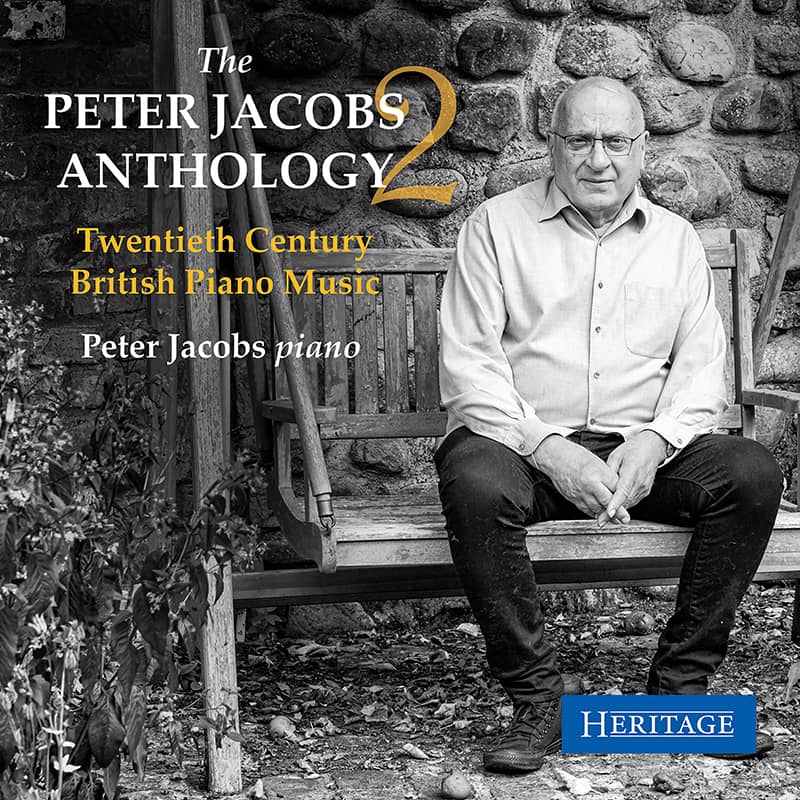
On Record – The Peter Jacobs Anthology Vol. 2 – Twentieth Century British Piano Music (Heritage)

Coleridge-Taylor Petite Suite de Concert Op.77 (1911)
Cooke High Marley Rest (1933)
Delius Mazurka and Waltz for a Little Girl RTIX/7, 1 & 2 (1922-3)
Headington Toccata (1963)
Rubbra Eight Preludes Op.131 (1967)
Scott Lotus Land Op.47/1 (1905)
Armstrong Gibbs Lakeland Pictures Op.98 (1940) – no.2, After Rain (Rydal Beck); no.8, Quiet Water (Tarn Howe)
Baumer Idyll (1935)
Mayer Calcutta-Nagar (1993)

Peter Jacobs (piano)

Heritage HTGCD131 [73’30″]
Producer & Engineer Paul Arden-Taylor

Recorded 14 & 16 September 2014 at Wyastone Concert Hall, Wyastone Leys, Monmouth

Reviewed by Richard Whitehouse

What’s the story?

Heritage extends an already extensive discography of British music with its follow-up to the Peter Jacobs Anthology, a further volume featuring collections of or standalone miniatures with a wide range of musical idioms given focus through the persuasiveness of the pianism.

What’s the music like?

Among the miscellaneous pieces included here are Greville Cooke’s ruminative ‘portrait’ of the home of pianist (and his former teacher) Tobias Matthay, Delius’s respectively pert and fey offerings, or Christopher Headington’s scintillating study for John Ogdon. Cyril Scott’s evergreen is treated to a subtly understated reading, while two out of a set of eight by Cecil Armstrong Gibbs provide enticing evocations of Rydal Beck then Tarn Howe – their innate Englishness sounding removed from the overtly Russian manner of that from Cecil Baumer.

Forming the backbone of this collection are three sets that in themselves attest to the variety of the music featured. Best known in its orchestral guise (a recording of which can be found on Heritage HTGCD249), Samuel Coleridge-Taylor’s Petite Suite de Concert is light music of a superior kind – witness its flighty initial Caprice, its ingratiating Sonnet or its lively closing Tarantelle, though its ostensible highlight is Demande et Réponse whose alluring sentiment helped with keeping the composer’s memory alive prior to his belated rediscovery.

Other than figuring among its composer’s later works, the Eight Preludes by Edmund Rubbra could hardly have been more different. As with his Eighth Symphony written soon afterward, these short while arresting pieces likewise focus on specific musical intervals rather than any overall key scheme, though their cohesiveness heard as an integral sequence could never be in doubt. Introspective without being inscrutable, this is wholly absorbing music and Jacobs accords ample justice to what is only the second complete recording this set has yet received.

As the most unlikely inclusion, John Mayer’s Calcutta-Nagar proves nothing less than a total delight. Known primarily for his syntheses of Indian and European elements, notably through the group Indo-Jazz Fusions, Mayer wrote extensively for Western media with this collection a notable instance. Only two of its 18 pieces last over a minute, yet their capturing of places recalled from the Calcutta of the composer’s youth is absolute. Jacobs notes his favourite as being the 13th (Kali Temple), but listeners will doubtless come up with their own favourites.

Does it all work?

Yes, whether as a judiciously planned collection or an anthology from which one can select individual items as preferred. The three collections are each among the most distinctive of its kind, while they and the various individual pieces provide ready-made encores in recital. Evidently this is music which Jacobs has long included in his repertoire, the performances exuding that combination of technical finesse allied to a probing insight as have long been hallmarks of his interpretations. Those who are unfamiliar with this music are in for a treat.

Is it recommended?

Indeed, not least as the sound has a combination of clarity and warmth ideal for piano music. The pianist pens informative notes, and one hopes that there will be further such anthologies. Meanwhile, Jacobs approaches his 80th birthday (this August) with his pianism undimmed.

Listen & Buy

For purchase options, you can visit the Heritage Records website

Published post no.2,448 – Monday 17 February 2025

On Record – Roderick Williams, Rupert Marshall-Luck, BBC Concert Orchestra / John Andrews – La Belle Dame (EM Records)

Roderick Williams (baritone) (Holst, O’Neil, Quilter & Scott), Rupert Marshall-Luck (violin, Brian), BBC Concert Orchestra / John Andrews

Brian orch. Marshall-Luck Legend B144 (c1919)
Delius Petite Suite d’Orchestre no.1 RTVI/6 (1889-90)
Holst Ornulf’s Drapa H34 (1898, rev. 1900)
Mackenzie Colomba Op.28 – Prelude (1883)
O’Neill La Belle Dame sans Merci Op.31 (1908)
Quilter orch. anonymous The Faithless Shepherdess Op.12/4 (1908)
Scott The Ballad of Fair Helen of Kirkconnel Op.8 (1900)

EM Records EMRCD085 [61’21’’] English texts included
Producer Neil Varley Engineers Andrew Rushton, Robbie Hayward
Recorded 5-7 January 2023 at Battersea Arts Centre, London

Reviewed by Richard Whitehouse

What’s the story?

EM Records continues its enterprising schedule with this collection of mainly vocal settings from the early twentieth century – heard alongside early orchestral pieces by Mackenzie and Delius, plus a recent orchestration of what is Havergal Brian’s only surviving chamber work.

What’s the music like?

This album’s title is also that of the 1819 poem by John Keats, its tale of ecstasy recollected in despair tangibly conveyed by Norman O’Neill in a setting which surely ranks among his finest concert works before music for theatre productions became his focus. Only marginally less compelling, Cyril Scott’s take on a typically over-elaborate ballad by Walter Scott has a keen sense of atmosphere – not least as rendered by Roderick Williams with an appropriate Lowland burr. Less involving emotionally, Holst’s setting of verse from an early Ibsen play is rather forced in its rhetoric – though the passages of emotional impulsiveness, allied to an acute feeling for orchestral textures, does presage those masterpieces of his maturity. Roger Quilter’s setting of a favourite Elizabethan lyric launches the collection with brusque charm.

Of the orchestral pieces, Delius’s early Première Petite Suite is here heard in full for the first time. Influences are easy to discern – Bizet in its whimsical Marche, Grieg in its winsome Berceuse, Massenet in its vivacious Scherzo then Fauré in its plaintive Duo – but never to the detriment of this music’s appeal, while the final variations on a sternly unison theme with ecclesiastical overtones will keep even seasoned Delians guessing as to its provenance. The likelihood of Alexander Mackenzie’s lyrical drama Colomba being revived is slim, but the Prelude to its first act has an evocative ardency which concludes this album in fine style.

John Andrews has the measure of these contrasting idioms and gets committed playing from the BBC Concert Orchestra. Roderick Williams is on fine form, as is Rupert Marshall-Luck in the Legend by Havergal Brian he himself has orchestrated. Ranging widely in expressive profile, while building considerable fervour during its relatively brief span prior to a calmly eloquent close, it is a stylish adaptation of the violin-and-piano original which has enjoyed increasing exposure this past decade. Marshall-Luck speculates whether Brian intended his own orchestral realization yet, given the composer had evidently written an orchestral piece with this title around 1915, it seems not impossible that the duo version is itself a reduction.

Does it all work?

Yes, in that the whole proves greater than the sum of its parts. Certainly, the works by Scott and O’Neill find these contemporaneous while otherwise very different figures at something near their best, while the Delius makes for an attractive sequence which deserves more than occasional revival. As, too, does the Brian given that comparable shorter concertante pieces by figures such as Saint-Saëns are being taken up by a younger generation of violinists. The spacious sound and extensive annotations are both up to EMR’s customary high standards.

Is it recommended?

Indeed. Hearing the Holst prompts the thought that, with the 150th and 90th anniversaries of his respective birth and death falling this year, now would be the ideal time for revival of his orchestral suite Phantastes – which has seemingly remained unheard since its 1912 premiere.

Listen & Buy

La Belle Dame is due for release on 19 April, but you can hear excerpts and look at purchase options on the EM Records website. For more information on the artists click on the names of conductor John Andrews, baritone Roderick Williams, violinist Rupert Marshall-Luck and the BBC Concert Orchestra

Published post no.2,126 – Saturday 23 March 2024