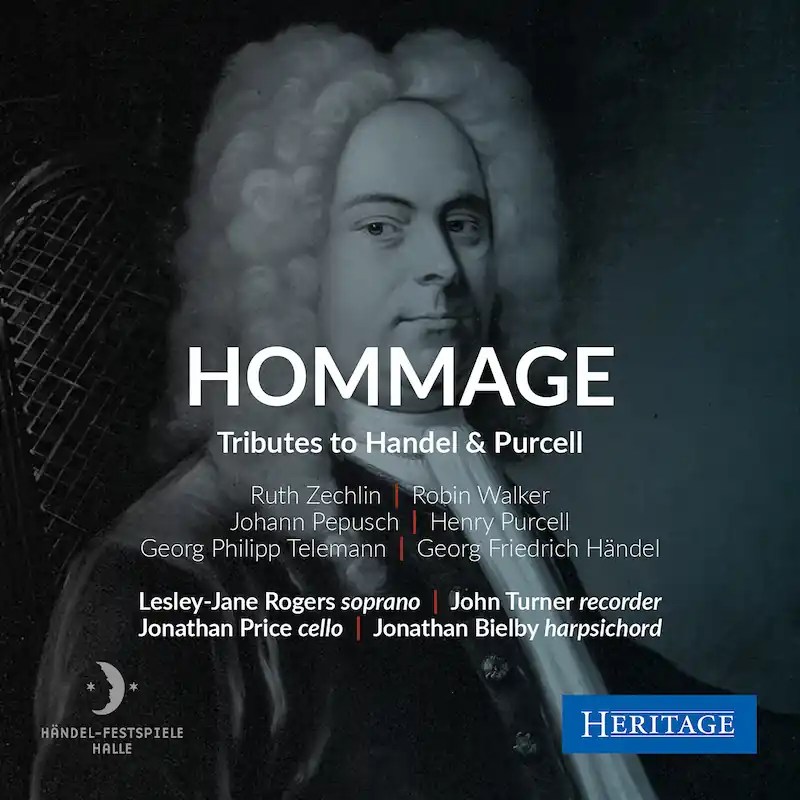
Lesley-Jane Rogers (soprano), John Turner (recorder), Jonathan Price (cello), Jonathan Bielby (harpsichord)
Ruth Zechlin Hommage á Henry Purcell (1997); Hommage á Handel (2004)
Robin Walker Handel to his Soul (2006)
Pepusch When Love’s Soft Passion (pub. 1720)
Purcell The Blessed Virgin’s Expostulation, Z196; Oedipus, Z583 (1678) – Music for a while; The Indian Queen, Z630 (1695) – I attempt from love’s sickness to fly
Telemann Cello Sonata in D major TWV41: D6 (pub. 1728-9)
Handel Nel Dolce del’Oblio, HWV134 (1709)
Heritage Records HTGCD118 [73’06”] Texts and translations included
Remastering Engineer Paul Arden-Taylor
Live performance on 14 June 2006 at Händel-Haus, Halle an der Saale
Reviewed by Richard Whitehouse
What’s the story?
Heritage releases what was actually a live performance, given at the original ‘Handel House’ in the composer’s hometown of Halle while featuring an imaginative miscellany of Baroque and Contemporary works, all expertly realized by soprano, recorder, cello and harpsichord.
What’s the music like?
The sub-title says it all – tributes to Handel and Purcell that range from pieces by both these composers to works which wear their ‘hommage’ credentials not a little obliquely. Purcell is heard in evergreen extracts from his incidental music to Oedipus and semi-opera The Indian Queen elegantly sung by Lesley-Jane Rogers, who renders the interplay of recitative and aria in The Blessed Virgin’s Expostulation with real eloquence. Handel rounds off this programme with Nel Dolce del’Oblio (In the Sweetness of Oblivion), one of several Italian cantatas that helped establish his reputation prior to his arrival in England. Again, a fine performance that respects this music’s expressive deftness and understatement though without making it seem trite or lightweight; failings which are not so uncommon in latter-day accounts of this music.
Also featured is a cello sonata drawn from Telemann’s collection Der Getreue Musikmeister (The Faithful Music-Master), its simple alternation of Largo and Allegro movements belying the piece’s overall motivic subtlety. Interest naturally attaches to the cantata When Love’s Soft Passion by Johann Pepusch, remembered for his musical contribution to The Beggar’s Opera by John Gay (and lesser-known sequel Polly) but who wrote extensively for various genres – among them the secular cantata, hence the poise and sensuous appeal of the present example.
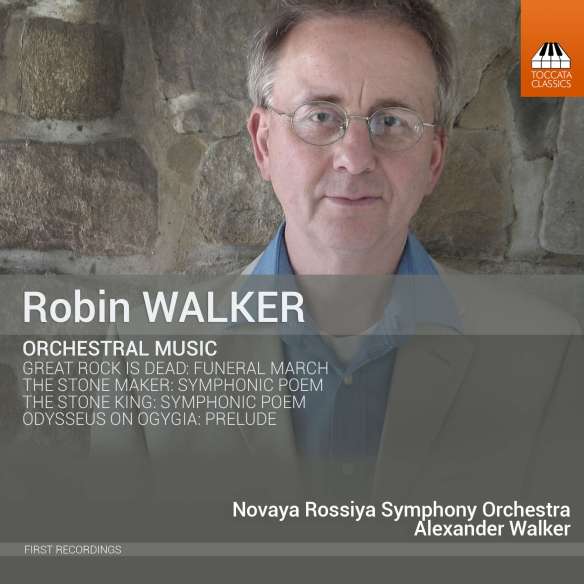
Two of the contemporary works are by Ruth Zechlin (1926-2007), among the most prominent composers in what was East Germany, whose expertise as harpsichordist or organist informed her own works. Hommage á Henry Purcell juxtaposes recorder and harpsichord with pointed humour redolent of Mauricio Kagel, whereas Hommage á Handel comprises settings of three Shakespeare sonnets (Nos. 36, 78 and 46) with their music derived from three Handel arias to verses by Barthold Brockes. Even more engrossing is Handel to his Soul, a cantata setting his own text by Robin Walker (b.1953) who, known primarily for some seismic orchestral works (Toccata Classics TOCC0283), brings comparable insight to this thought-provoking trialogue between the composer, his soul and the goddess Proserpina – its music being witty and ironic.
Does it all work?
Yes, not least as collated into a programme which elides nimbly if meaningfully between the musical past and present. All credit to the musicians that these performances are so idiomatic across the board, thereby bringing works separated by over three centuries into enlightening accord. Whether the present release is taken from a radio broadcast or an archive recording, its sound lacks nothing in spaciousness or focus; enabling Rogers’s excellent annunciation to come through unimpeded. An occasion which was decidedly making available commercially.
Is it recommended?
It is. The booklet has decent notes and full texts (if not all English translations) – making for a worthy tribute to Percy M. Young (1912-2004), renowned music scholar and soccer historian, in whose memory this concert was sponsored by the British Professional Football Association.
Listen / Buy
You can explore purchase options at the Heritage Records website. Click on the names for more information on Lesley-Jane Rogers, John Turner, Jonathan Price, Jonathan Bielby, Ruth Zechlin, Robin Walker and the Händel-Haus
Published post no.2,914 – Thursday 11 June 2026