
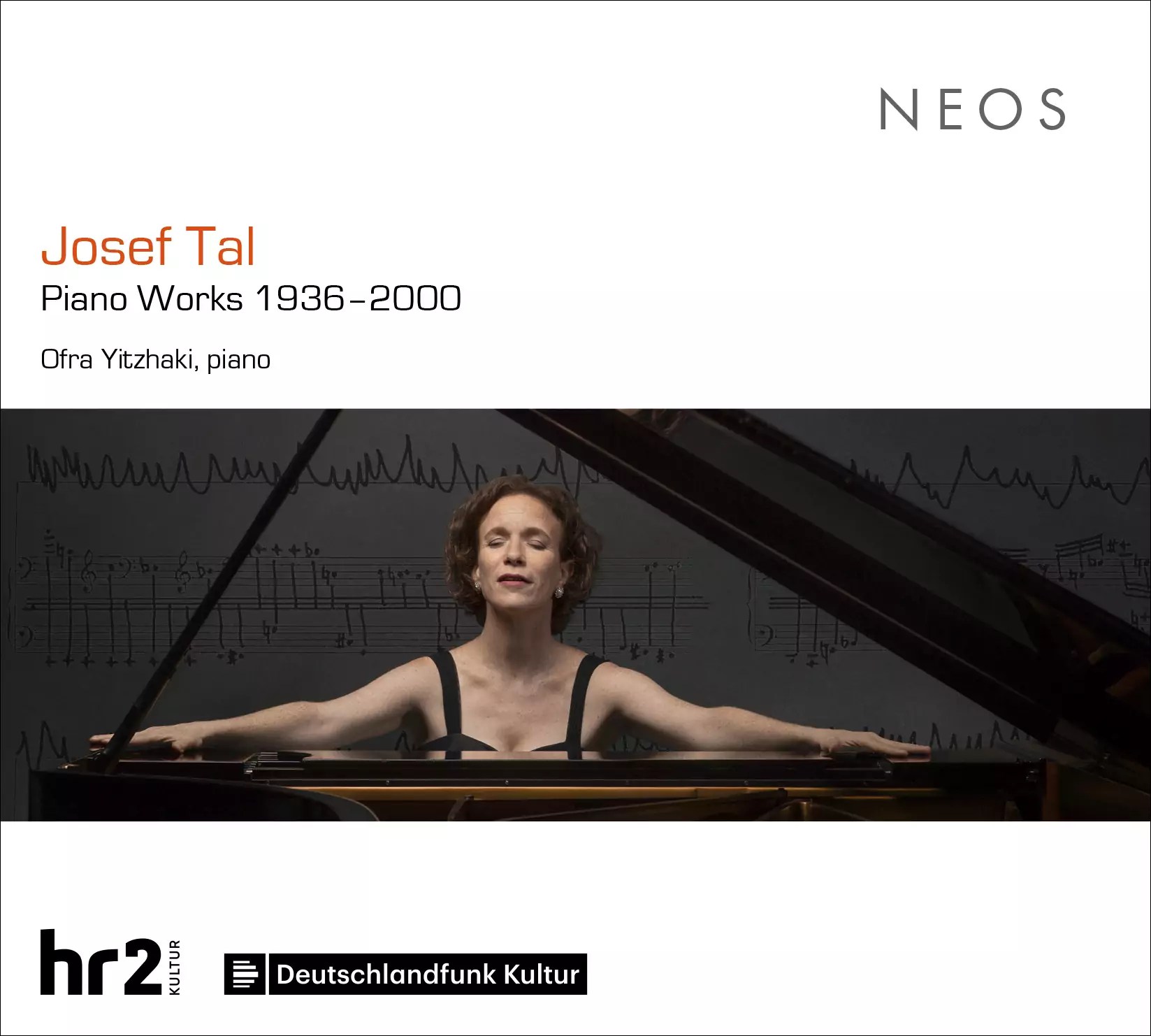
Ofra Yitzhaki (piano)
Josef Tal
Sonata for Piano (1949)
Five Densities (1975)
Three Pieces (1937)
Concerto no.5 for Piano and Magnetic Tape (1964)
By the Rivers of Babylon (1951)
Six Sonnets (1946)
Essay IV (1997)
Essay V (2000)
Chaconne (1936)
NEOS Music 12520 [82’04”]
Producers Alexander Hainz and Dominik Weinmann Engineer Robin Bös
Recorded 1-3 September 2022 at Hessian Radio Studio, Frankfurt am Main
Reviewed by Richard Whitehouse
What’s the story?
The enterprising NEOS Music label releases an anthology of piano music by Josef Tal (2010-2008), the German-born Israeli composer who did much to advance the cause of new music in Israel during the post-war era and whose varied output confirms him as a significant creative figure.
What’s the music like?
Little heard in the UK (his Third Symphony featured at the 1979 Proms and his chamber opera The Garden at South Bank Centre in 1998), Tal wrote in all the main genres. His piano music, moving from overt Expressionism to innate Atonalism, is accorded focus by its motivic rigour.
This is evident from the earliest piece here – Chaconne being a consummate study in ‘less is more’ such that its variations on an austerely rhetorical theme merge into an intensifying and cumulative whole, capped by an epiphanic calm prior to the inevitability of a final onslaught. Elements of this language are further explored by the Three Pieces which, in their respective volatility, impetuousness or introspection, denote the influence of Schoenberg’s piano pieces -albeit less those emotional extremes of his Op. 11 than that fastidious subtlety of his Op. 23.
A subtlety duly refined in the Six Sonnets, miniatures of a formal ingenuity and expressive poise out of all proportion to their brevity. From there to the Sonata is to emerge at a crucial stylistic juncture in Tal’s output: again, the modest dimensions (each of its three movements lasting around four minutes) only makes more acute that growing ominousness of its initial movement, the plangency of its central Basso Ostinato (a favoured device throughout Tal’s career) then the mounting impetus of its final Rondo toward a viscerally unequivocal close.
Arranged from a theatrical work, By the Rivers of Babylon conveys a measure of eloquence prior to what became the most radical phase of Tal’s composing. Hence the Concerto No. 5 as replaces orchestra with electronics in a substantial single movement which, whatever the timbral limitations of its magnetic tape, ensures a tense while often combative interplay of mutually opposing forces. This intensity is channelled into the Five Densities, such that its starkly contrasted first four pieces find unlikely yet convincing rapprochement in the fifth.
The remaining works form part of a sequence that extends across Tal’s final creative decades. Essay IV moves stealthily between sharply distinct ideas to an ending which does not resolve but simply cease, and Essay V is more demonstrative as it heads to its terse yet forceful close.
Does it all work?
Indeed it does. A figure nowadays admired more for what his music represents than for what it achieves, Tal left a legacy which is highly significant in or of itself (and one which, unlike almost all Israeli composers of his generation, audibly transcends the idiom of Ernest Bloch). His piano output exemplifies that technical precision, underpinning a creative spontaneity, as are hallmarks of his maturity and which help make this music as relevant to our day as to his own. It also makes for an engrossing and sometimes even entertaining listen in its own right.
Is it recommended?
Indeed it is. Only the Sonata has previously been recorded, and Ofra Yitzhaki’s empathy with this music cannot be denied. Superbly recorded and informatively annotated, this deserves an enthusiastic recommendation, with hopefully a follow-up of Tal’s other piano works to come.
Listen / Buy
You can hear excerpts from the album and explore purchase options at the NEOS Music website. Click on the names to read more about pianist Ofra Yitzhaki and composer Josef Tal
Published post no.2,918 – Monday 15 June 2026

